I watched a YouTube video that referenced Hemingway App as an authors’ tool. Here, I pasted some sample content from Hemo Sapiens: Origins to see what it might suggest.
It’s a short passage, but the only things it found were trivial nits.
Highlighted, the complaint is that the top sentence (in yellow) is too complex, so I should break it up as shown in green. The only difference is that it swapped the semicolon with a full stop and capitalised the next letter to begin the next sentence. It also declared the Grade 11 writing sample to be reduced to Grade 6.
Is this really worth more than the free trial or the time and effort?
It highlighted two other related challenges: both adverbs, and neither with remediation advice. In the sceen shot, you can read ‘slightly crispy’. Honestly, I don’t have a more direct way to show this information. I suppose if it was ‘crispy’, I could specify a ‘crunch’ sound. But how is the crispy crunch diminished when it’s just ‘slightly’? Enquiring minds want to know.
Now that Hemo Sapiens: Awakening has been released into the wild, I can again focus on Hemo Sapiens: Origins. I started writing Origins a few weeks ago, but I was interrupted by the review and production process of Awakening.
In the world of Pantsers and Plotters, I tend to fall somewhere in between, but I favour plotting.
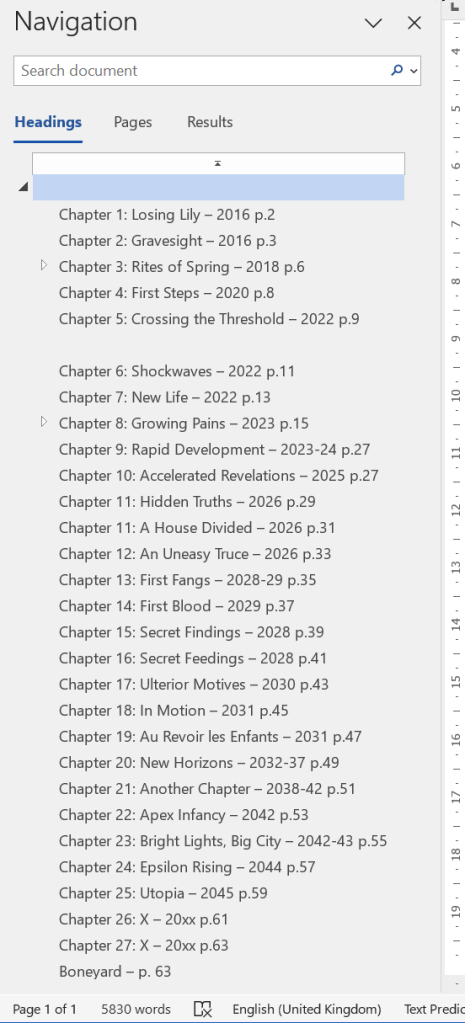
I write in Word. In the example above, you can see the working chapter titles, the year(s) a chapter covers and its starting page. Some of the chapters already contain preliminary copy.
As a writer, I don’t necessarily work chronologically. I find the chapters that are the most compelling and interesting to me. Then, I work down to the bridging chapters, hoping that the meat of the chapters penned earlier will support and inspire the later ones.
As I write, I usually create a ‘Boneyard’ chapter. This is where ideas go to incubate or die. Workable ideas are resurrected whilst others are laid to rest. Some ideas are like zombies, but at the end a project, they are either among the dead or living.
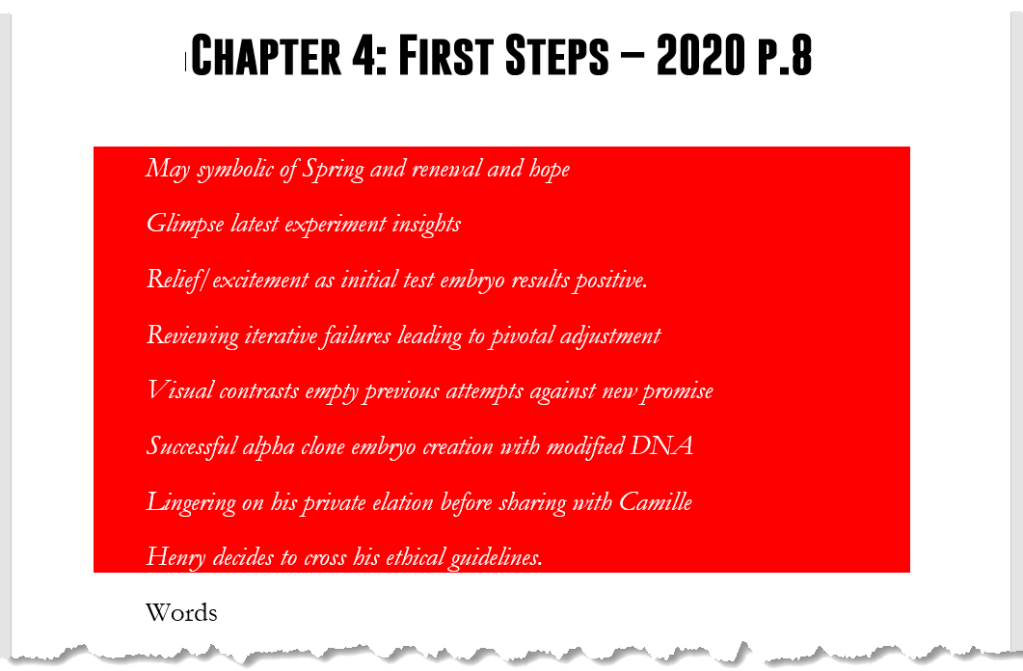
At the start, a chapter looks something like this. It’s a blend between ideas and story beats. Each chapter is outlined similarly. The other advantage this lends me is that I can *ahem* walk away from writing for a while and still have handholds and reminders when I return. For short fiction, I just write. No outlines. Perhaps just an idea to explore.
Mates, the proofing process was Hell. I even count the number of times I reviewed my book, Hemo Sapiens: Awakening. Then I sent it out to a couple of Beta readers, one of whom went over and above and did some proofreading, which I appreciated. I made some amends, and I ordered a proof.
The proof arrived relatively quickly—even without expedited shipping, which would have been more than twice the price of the book.
Lessons Learnt
Get a proof copy of your book Don’t skip this step. It’s inexpensive and is key to assessing formatting issues. It is also an opportunity for last-minute proofreading. I discovered probably 4-dozen nits that slipped through the cracks.
Layout In one case, I had an indefinite article (a) orphaned at the end of a line. I entered a soft return to get it to start on the next line to enhance readability.
Cover Art Silly me. I designed and composited the cover, and I didn’t hide the bounding rectangles I used to reference how my cover, back, and spine present. My proof copy has these rectangles in place. It’s not a huge issue, but it is an aesthetic flaw that I corrected.
Major Misses This is not as likely to happen to most authors, but this books began its life as four or five short stories that were in the same universe on a shared timeline, so I decided to add connective tissue and create a novel. The problem is that the short stories were set in Bristol, London, and Manchester, but I needed to set the novel in a single location, and I chose Manchester. A beta reader noticed that I even though the story was in Manchester, I left a scene having a character reflecting on the Thames, which is a feature of London. I changed it. Unfortunately, there where two instances. I was lazy, and I changed the instance they pointed out to a generic ‘river’, but I left another instance as ‘the Thames’. Oopsie.
References Another issue I caught is again fairly unique. I wrote out a male character and offloaded his scenes to a female character. I decided that I didn’t have enough material and differentiation for the two characters. It sounded good at the start, but he didn’t make the final cut. The problem is that I missed a few ‘his’ to ‘her’ pronoun swaps. Oops.
Punctuation Man, I missed a lot of question marks and a few commas. Nothing major, but it matters.
Spelling OK. Not too many here, but I had swapped a wonder for a wander that I missed the first hundred times through.
Spacing Again, minor formatting issue. The biggest offender was rogue spaces between en-dashes and trailing commas: – , instead of –,. It’s a little thing.
Tenses and POV This book was written in third-person, present, limited, deep point of view. Or that was the goal. All too often, I would slip into past tense. In some cases, it might have been OK, but I edited a lot back into present tense.
I also switched several times out of limited into omniscient. To be honest, I left some of this alone.
I was also guilty of some incidental head-hopping. Sue me. It happens.
Create Your Audiobook First OMG. I thought I was done, but I found so many small issues when I was forced to micro-focus for the audio version. It helped so much. I have been told to read your book out loud—advice I follow—, but I still uncovered a treasure trove of mistakes in the audio version. Moreover, some things that didn’t sound awkward earlier, now did, so I had the opportunity to change it up.
Last Minute Amends As it happens—in line with the audio version advice—, feel free to make more substantial content amends. My favourite one. When I heard this line during an audio review—I was literally listening in bed—, I got up and changed it immediately.
Before: When they arrive at the compound all is quiet except for the crickets that pause to listen.
After: When they arrive at the compound all is quiet except for the occasional cricket.
Obviously, crickets pausing to listen are also quiet, so…
Give yourself time enough time to do a thorough review I set a 1 March release date, so I left myself plenty of runway to take off.
Be patient Even though I gave myself plenty of time for review and amends, I rushed the process and approved a book that wasn’t ready for approval and had to do late revisions.
I”ve probably not mentioned some, but I had the opportunity to fix each of these mistakes, so I’ll bookmark this page and my next book will be that much easier to publish.
I’ve just received my first Beta feedback from Hemo Sapiens: Awakening. I’ve hired three readers and engaged two, so I’ve got more to go.
As I wrote recently, I’ve been using AI to review my work, and I’ve been waiting for flesh and blood humans to give me their opinions.
My Beta reader is Enrico B from South Africa. My next reader is from the UK. I found them both on Fiverr.com, a site I’ve successfully used for music collaboration in the past. Although your results may vary, it’s a generally inexpensive way to get quality results. I hired Doni from Indonesia to design my title and subtitle.
Judge the quality for yourself. I happen to like it. I was going to commission the rest of the book cover, but I opted to do that myself.
Enrico provided me with a summary report as well as an annotated markup of my manuscript. Beta reading is not developmental editing or copyediting, so I wasn’t expecting line edits, but he did provide commentary on most chapters. In my case, his focus was on pacing and adding narration to fast-paced dialogue exchanges. In most cases, he advised my to slow my roll, but I’ll wait to see what the next reader writes. My style is rather curt and quick, and perhaps Enrico wants to savour a bit more. I feel that his advice is constructive. I just don’t know how much I’ll implement—probably at least a little.
My target goal for writing is about 1,000 words per day. It’s a goal I hit way more often than not. On a good day, I can reach 2,500 or more.
As a reference, I write in Word with pages formatted for a 6 x 9 form factor, so a page holds about 200 words, which equates 1,000 words to about 5 pages. Not too shabby. It puts 60,000 words at around 300 pages or 50,000 words — a small novel—at around 250.
Doing some more maths, at 1,000 words a page, one can ostensibly write a 60,000 word novel in about 2 months. Not bad, right?
You still need more time for editing, revisions, and so on, so 3 months per book of this size gets you 4 books a year. If you are writing tiny novels or novellas, then you might be able to double this. I ‘m not sure how sustainable this is, but maths doesn’t care about sustainability.
Some people think they can game the system and produce a novel a day with AI. The truth is that they can. The other truth is that the output will most likely suck. If you actually read the material critically, a person could not likely publish a book a day. A piss-poor book a week would probably be a challenge. A book a month or so might be within range — even more achievable for shorter fare.
This might be someone’s goal, but it’s not mine. My interest in writing to to write. It’s not about quantity or even commerce. My writing is not my livelihood. It’s an art. I’ve seen so many videos on YouTube given advice how to write and sell more books. Usually, this involved researching the marketplace and determining what’s hot. Is mystery hot this month? Write a mystery book. Need some ideas for books? AI will help.
I guess I just don’t come from that position. I watched a video the other day with a woman switching from offering low-content books on Amazon to some other business model. Her entire modus operandi is to make money online. Myself, I felt sorry for her. I know that two-thirds of people dislike their jobs, so she’s in good company. By that I mean, she might as well just pick some random money-making job because it’s probably as stupid as whatever else she’d be doing. The question is whether it’s worth it.
For me, I’ll stick with writing at least 1,000 words a day with the occasional doubling. Hopefully, I sell some books along the way. Time will tell.
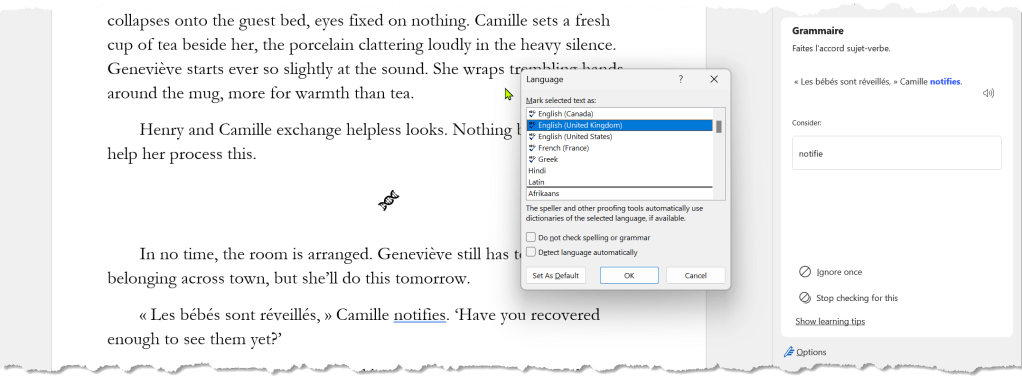
It seems that spelling and grammar checking in Microsoft Word might use some improvement.
Here is a segment from a chapter from the first draft of Hemo Sapiens: Origin. Notice the last paragraph. I’ve written some dialogue in French with a tag in English. followed by more dialogue in English. This is my attempt to provide guidance to readers who don’t read French, so they can still maintain the context The problem is that Word doesn’t do a great job of accepting language markers. In this case, ‘notifies’ is underlined as being incorrect because Word, despite being informed otherwise, sees this as being French.
I wish I could just highlight a phrase and select the language from a context menu. Up front, I could specify that I am using languages X, Y, and Z, so I am not burdened with a laundry list of language options.
Another interesting thing to me is that there are separate auto-correct dictionaries per language. This makes sense, but it creates a burden to have to signify the language to let Word know which one to use. In my case, I tend to add accented words to autocorrect because I use a standard English-language QWERTY keyboard, and Windows/Word doesn’t make compounding diacritical marks very easy.
For example, a common entry might be ‘bien sûr’ for ‘bien sur’. I also get guillemets « » from << and >>, respectively.
Sadly, the ‘Detect language automatically’ feature isn’t very reliable either, so I leave it unchecked instead of having it misidentify languages.
I just noticed a typo in the screen shot. Word missed that ‘belonging’ should be plural, but probably thinks it’s a verb rather than a noun. Other AI tools make similar semantic errors.
I use AI for copyediting, but I don’t quite understand the use case for using at as a writing tool. The gist is that the AI can brainstorm ideas for books, chapters, characters, and so on. In fact, once I was conversing with ChatGPT about some philosophical socio-political topics, and it suggested that it would make a good book idea. I asked it to elaborate, and it gave me more ideas. These ideas didn’t particularly ‘click’, but I was intrigued.
The AI suggested something in the mystery / thriller vein, not particular my genre. I asked about setting and time. It recommended London, New York, or Tokyo. I asked about time, and it suggested Victorian England or future Tokyo.
The problem is that I felt it would be an interesting exercise on an intellectual level, but I had not emotional interest, so I didn’t pursue it. If I did have an emotional investment, I feel that I’d already have had the idea.
The video below is a YouTuber I follow. His schtick is writing fiction (and more) with generative AI—tools like ChatGPT, Claude, and more. Here he discusses creating outlines (for Plotters) with ChatGPT.
Although he maintains a day job to pay his bills, he earns money through his writing and his social media presence. This is where I get lost.
If I am a driven writer—I suppose the operative being ‘driven’—, I already have an idea. I know on a high level what I want to say, where I an set, who the key characters are, and so on. Why would I need AI. As I mentioned above, in an edge case, I didn’t know, but it wasn’t my idea in the first place. I suppose I could have whipped the AI into writing it for me, but why? I suppose I could do the exercise just to see where it went, but this would not only NOT be my writing, it would (and did) distract from what I am passionate to write about.
And, yes, he can still use AI as an idea generator, and he can tweak the prose it outputs, but the question is still why? Isn’t that the challenge of writing—to have a beginning and end in mind and just want to connect those dots with story?
I have an unfinished book still on the backburner where I had a theme and a beginning, so my plan was to write from stream of consciousness and see where it took me. As it happened, the ending became wishy-washy, so I stopped to rethink where I wanted in to end. I decided that the ending wasn’t bad; it was just anticlimactic and would make a better beginning for a sequel. Now I needed an impactful ending. And some of the middle needs shoring up.
I took a break from this book and focused my attention on the Hemo Sapiens universe. I know not only what I want to do for at least four books, I have space to explore beyond this. Why would I need AI to give me ideas? Once I am satisfied with these books, I’ll return to my original one with more writing experience under my belt, so it’s win-win.
If there comes a time where I have to rely on AI to generate writing ideas, I think it will be time to exit this hobby.
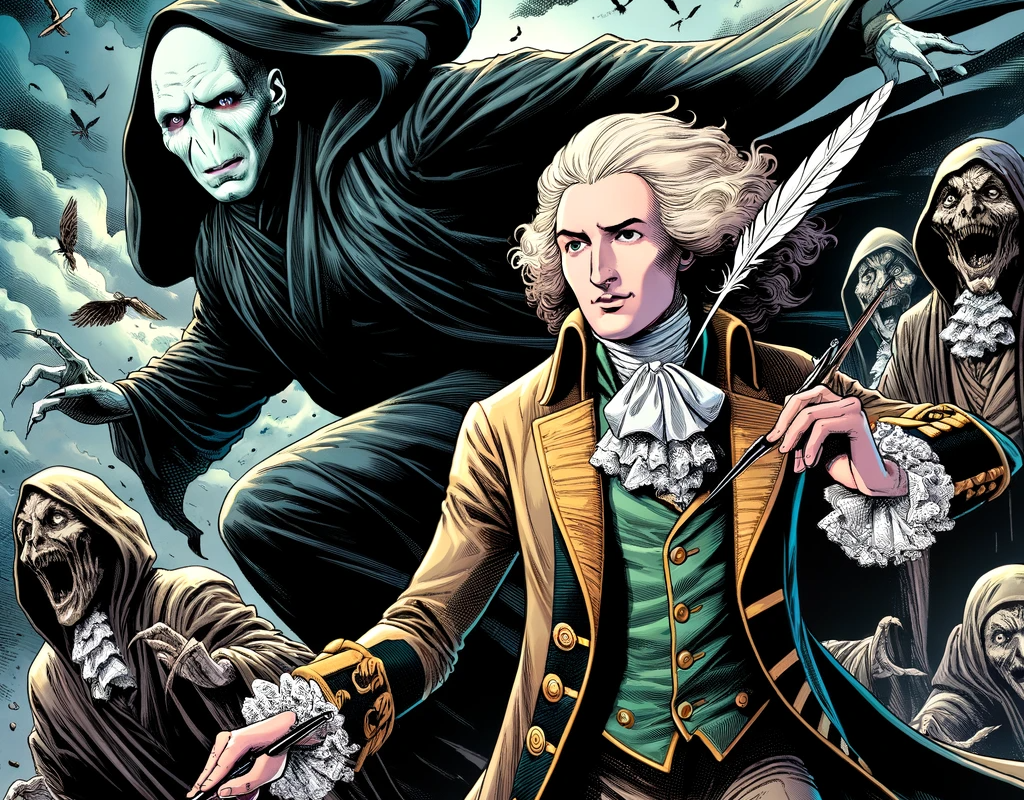
Is Voldemort secretly François-Marie Arouet? I’ve never seen the two in the same place.
I am fleshing out the outline for Hemo Sapiens: Origins and I was sharing a chapter structure with Claude. One of the bullet points cites a quip by Voltaire:
« Si Dieu n’existait pas, il faudrait l’inventer. »
Voltaire
English Translation: “If God did not exist, it would be necessary to invent him”.
I fed the chapter outline to Claude. Among other things, it mentioned this:
Masterful architecture capped with that second Voldemort quote again for anyone tracking!
— Claude
I did a double-take. I re-scanned my copy and looked for a quote that might be interpreted as being said by Voldemort. Alas, there was only one quote—Voltaire’s.
My AI had confused Voldemort with Voltaire. I’ve never seen these two in the same place either, so it could be fact.
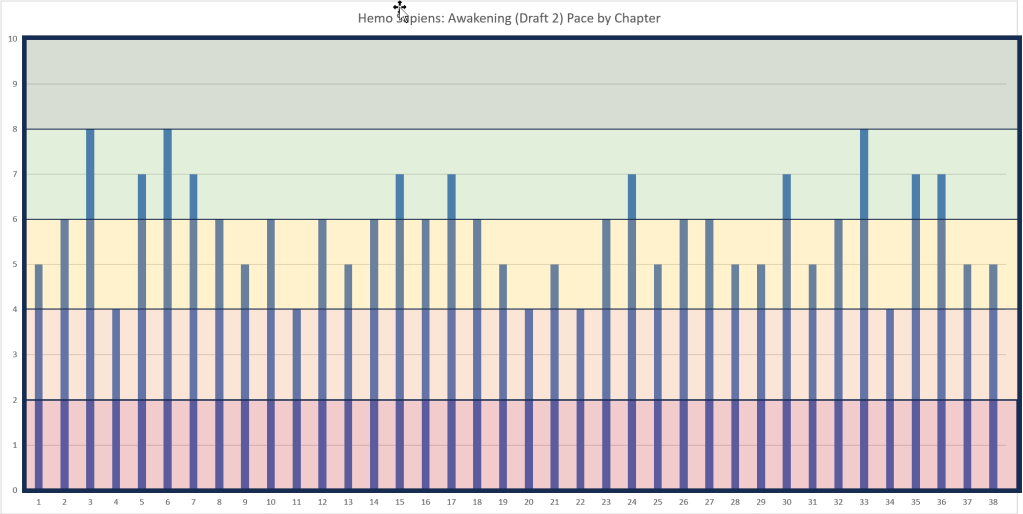
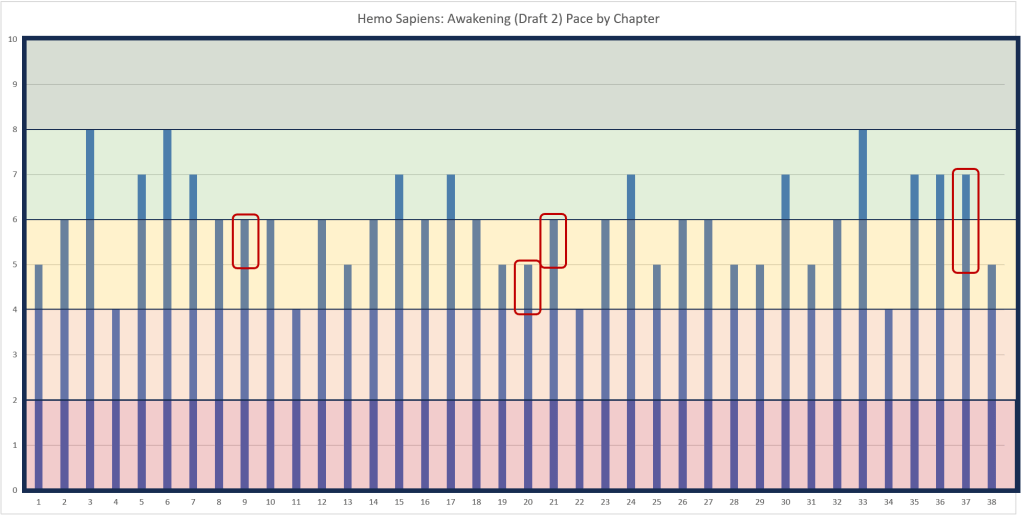
As I review Hemo Sapiens: Awakening and work on the second draft, I asked Claude 2.1 to analyse the pacing of each chapter. This is the result.
Legend
1-2: Very slow, not much happening plot-wise
3-4: Moderately slow pace with some plot development
5-6: Steady pace with a balance of action and exposition
7-8: Fast-paced with lots of plot advancement
9-10: Very fast-paced, intense action or events
The positive news is that I don’t have anything a the glacial pace of 1 and 2. I do have some slothful 4s, but not threes. I’ve got quite a few 5s and 6s, a respectable amount of 7s and a few 8s, with no break-neck 9’s and 10s.
My goal will be to review the 4s to determine if they are intentional. At first glance, I don’t have any consecutively slow chapters, although having sequential 4s and 5s might be problematic. For example, the four chapters 20 to 22 might be too much of a lag in the middle. I’ll need to keep page count into account as ell. There are a handful of very short chapters, so if a few of those are slow, I might just accept it.
As percentages, we’ve got 13% of 4s (5), 29% of 5s (11), 29% of 6s (11), 21% of 8s (3), so it feels OK—generally a steady to fast-paced novel. The pace seems to ebb and flow, so the reader should be able to remain engaged. Obviously, the slower parts of for character development and description, but none of this is just meandering pointlessly.
In the end, this works for me as a diagnostic tool. This is the first time I’ve tried it. It seems like the assessments are fair. As I rewrite, I can try to tighten some of the slower section and see if the pace picks up.
UPDATE: I reworked chapters 8, 20, 21, and 37, increasing the pace of 5 to 6, 4 to 5, 5 to 6, and 5 to 7, respectively. Chapter 37 was boosted to 7 when I added new information to set up downstream conflict. Unfortunately, the conflict won’t payoff until book 3, since the next book,2, will be a prequel—Hemo Sapiens: Origin—, after which this story will continue.
I still have revisions unrelated to pacing, but I’ll measure them as they come and hope not to stall any. At this point, the average is about 6 (not displayed). Of 38 chapters, 89 per cent of the chapters are steady to fast. 11 per cent are moderate—only 4 of them—and none are slow.
I feel this is a good starting place, and I’d be happy to land here.
Or is that ‘reading allowed?’ I’m all but done with my first draft of Hemo Sapiens, so I’m recording is chapter by chapter so I can listen to it. Listening uses different cognitive processes beyond the obvious sensory apparatus, so one catches different sorts of factors.
For me as an example, it helps me to capture pacing. When I scan my own work at this stage, I’ve read it so many times, it’s difficult to read critically. I sort of just gloss over the words in a perfunctory manner. Maybe that’s just me, but…
What I do is listen whilst I read along—sort of like in grade school: read silently whilst someone reads aloud. This is what it gets me:
Clumsy phrasing. It felt ok when I wrote it, but doesn’t read particularly well.
Repeat words written nearby. I try to avoid placing the same word in the same paragraph or to close in adjoining paragraphs. In this case, I used and character’s surname name near the end of a paragraph and then at the start at the next, It really caught my ear, so I changed the later one to a subject pronoun.
Spelling. Yep, spelling and grammar checkers still miss things. For me, some of my dialogue it either text-speak, BRB, or truncated, ‘That ain’t for nuttin”, so I often Word to ignore spelling until I’m ready. Though it isn’t necessarily revealed by the audio portion, I tend to track audio word by word, whilst I tend to read in paragraphs.
Typos and wrong words. Listening along yesterday, I noticed that I missed a pronoun change resulting from removing a male character and expanding a female character. A remnant ‘his’ needed to be amended to ‘her’.
Dense (or sparse) paragraphs. This is also about pacing. When listening, one can pick up that a passage just drags unnecessarily. It may need to be written, or it might just need to be broken up or re-punctuated. If it feels too fast that it might give the reader seizures, perhaps toss in a few dialogue tags or descriptors.
Perhaps I could come up with more, but these make my top of mind list.
I use ElevenLabs AI speech synthesis to convert my content from text to speech. I’ve written about my ElevenLabs wish list before. For the plan I use, I get 100,000 characters per month and can exceed that limit by purchasing 1,000 word blocks. I don’t the overage to be cost-effective, so I’d only ever use it in a pinch. The next plan is for a 500,000 word block, but the economics don’t work for me there either. Usually, it’s no big deal. Unless I am using it to narrate a novel, I just wait for the month to roll over and I can pick up where I left off. Fortuitously enough for me, I recorded 11 chapters yesterday before i ran out, and my plan refreshes today, so easy peasy.
ElevenLabs charges by the character, not by the word, which does make sense, but it’s not how I think about writing. I tend to think in terms of words or pages. When they say character count, they mean it—punctuation, quotes, and apostrophes, spaces, and carriage returns. I have discovered ways to reduce spaces, but you need to be careful, because it also uses punctuation to control some elements of prosody and delivery. For example, if you remove all of the commas and full stops, the delivery will be a ramble. For those who still double-space after double stops, this will cost you. Sometimes, when I’m feeling particularly frugal, I remove the carriage returns. They don’t seem to have any effect on the output, and it saves characters. It wouldn’t make for a great reading experience, but the AI doesn’t care.








 Ridley Park