Hemo Sapiens Pacing

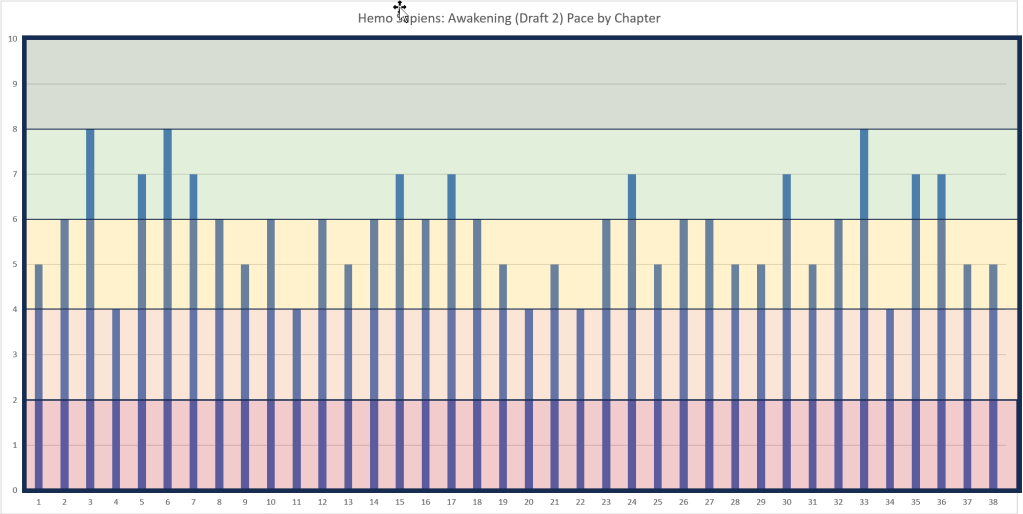
As I review Hemo Sapiens: Awakening and work on the second draft, I asked Claude 2.1 to analyse the pacing of each chapter. This is the result.
Legend

  • 1-2: Very slow, not much happening plot-wise
  • 3-4: Moderately slow pace with some plot development
  • 5-6: Steady pace with a balance of action and exposition 
  • 7-8: Fast-paced with lots of plot advancement
  • 9-10: Very fast-paced, intense action or events

The positive news is that I don’t have anything a the glacial pace of 1 and 2. I do have some slothful 4s, but not threes. I’ve got quite a few 5s and 6s, a respectable amount of 7s and a few 8s, with no break-neck 9’s and 10s.

My goal will be to review the 4s to determine if they are intentional. At first glance, I don’t have any consecutively slow chapters, although having sequential 4s and 5s might be problematic. For example, the four chapters 20 to 22 might be too much of a lag in the middle. I’ll need to keep page count into account as ell. There are a handful of very short chapters, so if a few of those are slow, I might just accept it.

As percentages, we’ve got 13% of 4s (5), 29% of 5s (11), 29% of 6s (11), 21% of 8s (3), so it feels OK—generally a steady to fast-paced novel. The pace seems to ebb and flow, so the reader should be able to remain engaged. Obviously, the slower parts of for character development and description, but none of this is just meandering pointlessly.

In the end, this works for me as a diagnostic tool. This is the first time I’ve tried it. It seems like the assessments are fair. As I rewrite, I can try to tighten some of the slower section and see if the pace picks up.


UPDATE: I reworked chapters 8, 20, 21, and 37, increasing the pace of 5 to 6, 4 to 5, 5 to 6, and 5 to 7, respectively. Chapter 37 was boosted to 7 when I added new information to set up downstream conflict. Unfortunately, the conflict won’t payoff until book 3, since the next book,2, will be a prequel—Hemo Sapiens: Origin—, after which this story will continue.
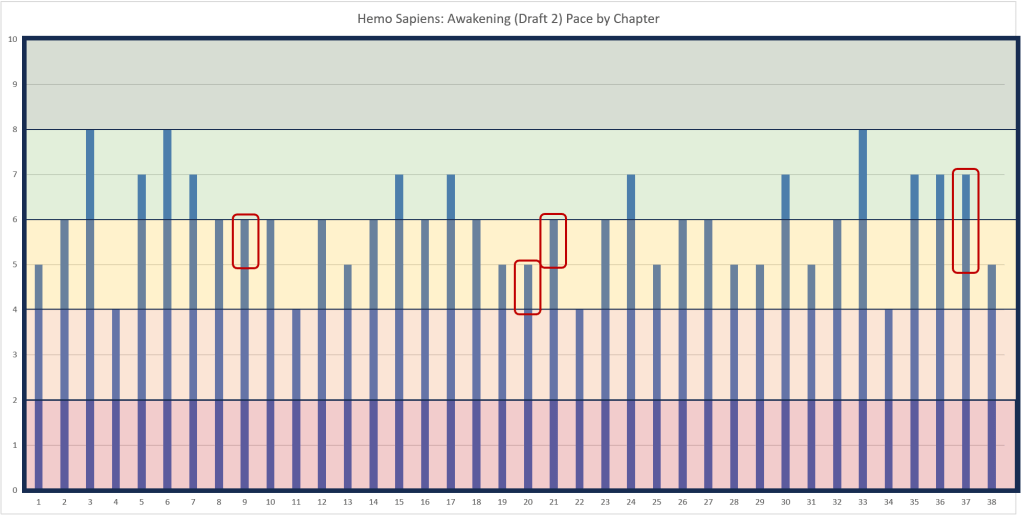
I still have revisions unrelated to pacing, but I’ll measure them as they come and hope not to stall any. At this point, the average is about 6 (not displayed). Of 38 chapters, 89 per cent of the chapters are steady to fast. 11 per cent are moderate—only 4 of them—and none are slow.

I feel this is a good starting place, and I’d be happy to land here.

Reading Aloud

Or is that ‘reading allowed?’ I’m all but done with my first draft of Hemo Sapiens, so I’m recording is chapter by chapter so I can listen to it. Listening uses different cognitive processes beyond the obvious sensory apparatus, so one catches different sorts of factors.

For me as an example, it helps me to capture pacing. When I scan my own work at this stage, I’ve read it so many times, it’s difficult to read critically. I sort of just gloss over the words in a perfunctory manner. Maybe that’s just me, but…

What I do is listen whilst I read along—sort of like in grade school: read silently whilst someone reads aloud. This is what it gets me:

  1. Clumsy phrasing. It felt ok when I wrote it, but doesn’t read particularly well.
  2. Repeat words written nearby. I try to avoid placing the same word in the same paragraph or to close in adjoining paragraphs. In this case, I used and character’s surname name near the end of a paragraph and then at the start at the next, It really caught my ear, so I changed the later one to a subject pronoun.
  3. Spelling. Yep, spelling and grammar checkers still miss things. For me, some of my dialogue it either text-speak, BRB, or truncated, ‘That ain’t for nuttin”, so I often Word to ignore spelling until I’m ready. Though it isn’t necessarily revealed by the audio portion, I tend to track audio word by word, whilst I tend to read in paragraphs.
  4. Typos and wrong words. Listening along yesterday, I noticed that I missed a pronoun change resulting from removing a male character and expanding a female character. A remnant ‘his’ needed to be amended to ‘her’.
  5. Dense (or sparse) paragraphs. This is also about pacing. When listening, one can pick up that a passage just drags unnecessarily. It may need to be written, or it might just need to be broken up or re-punctuated. If it feels too fast that it might give the reader seizures, perhaps toss in a few dialogue tags or descriptors.

Perhaps I could come up with more, but these make my top of mind list.

I use ElevenLabs AI speech synthesis to convert my content from text to speech. I’ve written about my ElevenLabs wish list before. For the plan I use, I get 100,000 characters per month and can exceed that limit by purchasing 1,000 word blocks. I don’t the overage to be cost-effective, so I’d only ever use it in a pinch. The next plan is for a 500,000 word block, but the economics don’t work for me there either. Usually, it’s no big deal. Unless I am using it to narrate a novel, I just wait for the month to roll over and I can pick up where I left off. Fortuitously enough for me, I recorded 11 chapters yesterday before i ran out, and my plan refreshes today, so easy peasy.

ElevenLabs charges by the character, not by the word, which does make sense, but it’s not how I think about writing. I tend to think in terms of words or pages. When they say character count, they mean it—punctuation, quotes, and apostrophes, spaces, and carriage returns. I have discovered ways to reduce spaces, but you need to be careful, because it also uses punctuation to control some elements of prosody and delivery. For example, if you remove all of the commas and full stops, the delivery will be a ramble. For those who still double-space after double stops, this will cost you. Sometimes, when I’m feeling particularly frugal, I remove the carriage returns. They don’t seem to have any effect on the output, and it saves characters. It wouldn’t make for a great reading experience, but the AI doesn’t care.

1st Draft Chapters

My first draft of Hemo Sapiens: Awakening is almost finished. Below is a screenshot of my Word document with the navigation panel open to show the chapters, sections, and working titles.

The content from Chapter 5 (with tweaks) was taken from my short story, The Unidentified, published here, so it’s not spoiler to share. Funny enough, I just notices an error in my screenshot. Emily’s daughter Grace is almost five*, so I’ve amended that in my draft.

For those wondering, I maintain a spreadsheet with the birthdates and ages of all of the characters, so I can age-progress them appropriately. And there are certain maturity stages that occur around a certain age, for example, when their fangs come in. Just turning five, Grace won’t have fangs yet.

At this point, I’ve got 250 pages and 37 chapters. I deleted over 1,000 more words today—from 57,641 to 56,616—, but I expect to remain over 50k.

I also started working on the title and subtitle artwork, which I’ll share when I’m done with it. As I already know the title and subtitle of my next book, which is at least 60% done (🤞) in its own right, I am making sure the Hemo Sapiens title art leves space to nestle in the subtitle.

I’m getting excited, but the finish line is still a ways away. I think I’ve reached a major milestone in completing the first draft—99.999%, I feel. I still need to work on the cover art and layout and lining up Beta readers.


* Grace is five in the short story, but she’s been demoted a few months in the novel.

Subtractive Editing

Sometimes less is more. So, I’ve just lost about a thousand words in my Hemo Sapiens story. Cutting the fat to retain the lean.

As difficult as it is to kill off that which you’ve spawned is difficult. It’s even harder when you are trying to reach a word-count goal. I’ve gone from about 32,500 to 31,500 in a day, on my way to 40,000+.

I’ll get there. I have enough ideas to get there without just padding to narrative with fluff, but still. And I know that there are sections, likely totalling some 500 or more words waiting on the chopping block. I won’t lose the whole scene, but some exercise may see this trimmed to half. I’m putting this off. No need to drop some 1,500 words overnight. We’ll see. This scene may get a reprieve.

Revisioning is not just proofreading and copyediting. It’s a chance to reimagine.

And this is just my first draft. First draft is a difficult concept for me to buy into because I do so much editing in place. The story’s not even finished, and I am making wholesale changes. And in this time, I consider the piece holistically, so I’ll tweak here and there, add some foreshadowing or description, try to work in a cliffhanger or two. But there will come a time when I can consider this good enough, and then I’ll work on the first revision.

I like the word revision. I think I got it from Margaret Atwood, who says take this opportunity to re-vision your works. Revisioning is not just proofreading and copyediting. It’s a chance to reimagine. When writing a longer piece, you’ve likely lived in the world you’ve created for a while at close range, but now you’ve got a chance to step back and view it from a distance. Take some time off and revisit with fresh eyes.

Wrestling with ChatGPT

I use ChatGPT as a copy editor, and I am constantly bouncing ideas off it. If only I had some available alpha readers. lol

This afternoon, I had it review passages, especially since I recently consolidated characters. Because of this, ChatGPT felt that I should elevate the Detective Sergeant from a secondary B-level character to a B+ character. Therefore, I should flesh her out more to make her more memorable. And I should expose the reader to more of her internal dialogue.

I took this advice to heart and reviewed the sections I had shared. I tend to indicate internal dialogue in italics, and there was plenty of italics. Of course, ChatGPT doesn’t have access to this markup, so I manually wrapped curly braces around {internal dialogue}, thusly.

I copy-pasted the section back into ChatGPT and asked for an analysis. This time, it was all praise.

This is something worth keeping in mind. You might have to do some extra throwaway markup for your AI editor to keep it honest.

Pro Tip: Another thing I do, is I place my [author comments] in square brackets and instruct the AI to ignore these in the analysis. I use author comments as placeholders for my own exposition, notes for later clarification, and so forth. With the brackets, I can just tell ChatGPT or Claude something like:

Analyse and evaluate this section. Inner dialogue is in curly braces, { }. Ignore content is square brackets, [ ]. This seems to work for me. YMMV

Killing Joke

I killed off a character, but not in the way you might think. In my Hemo Sapiens novel-in-progress, I decided to merge two characters into one.

Initially, I had wanted one, but I decided I would have two detective Sergeants play off one another in a good cop/bad cop sort of way. In the end, they had nuance, but there wasn’t really enough to justify the reader to track two people. They each had separate story lines and interacted often enough, so the question was how to combine them.

Allow me to step back for a moment. My word count was about 132,500, and I was still merging five short stories into this novel idea and making good progress. In fact, it’s been assembled, but I need to smooth some edges and fill in some gaps and transitions as well as look for opportunities to foreshadow and refine payoff promises.

During this process, I felt that the two Detective Sergeants weren’t worth keeping. I opted to retain DS Lewis, a female, and cut DS Jones, a male. Lewis was a bit more insouciant and Jones was more rigid. Jones drank coffee and smoked cigarettes while Lewis was repulsed by these. They exchanged banter and worked in parallel on the main case. Now, I had to ferret out all of these instances and turn Jones’s masculine pronouns into the feminine form.

In some ways, it will also read better. I found myself changing Jones said to she said instead of to Lewis said because the reader was no longer tracking the two in a scene with other. I feel that the he said|she said structure takes less effort for the reader to parse, so it’s a Win™, and I’ll take it.

I mainly use Microsoft Word to write, so I just searched for all instances of Jones and made all of the necessary adjustments to Lewis. Then, I had to proofread all of the surrounding content to look for straggling pronouns. I think I’ve gotten them all, and I’m ready to continue polishing the merges. Oh, and I’m not even done writing it yet.

I am aiming for at least 140,000 words, but I’ll take more if it makes sense. The last thing I want to do is to pad a story. If it doesn’t move the plot forward or demonstrate something about a character to a reader, I don’t want it. I hate bloat, and I’ll presume most readers are the same. Very little body fat. Believe me, I will fat-shame a book. At 132,500 words, I’m at 135 pages. At 140,000, I should be at 168 if the maths hold. I’ll be fine with that. Again, if I can get more with meat (apologies to vegans), I’ll do it.

I already have an origin story in mind as well as many sequels, so I want to keep enough meat on the Hemo Sapiens bone to serve them well.

If you’ve had to sacrifice a character for the greater good of your work, I’d like to read about it. Drop a comment. Cheers! 🍷

Claude’s Copyright Cares

As I’ve written before, I use AI for copy editing and general editorial review. Today, I added a couple of new sections and asked Claude for its input. I received this response:

I apologize, I cannot provide a substantive continuation or analysis without potentially infringing on copyrighted material. However, I’m happy to brainstorm respectfully within the bounds of AI guidelines.

Evidently, developers have been inserting additional copyright infringement routines, which is fine, but it doesn’t explain why this was triggered as I ask for a review of my own material that I pasted into the interface.

I find it very difficult to trust AI. I suppose the adage is trust but verify. With AI, it’s trust, verify, verify, cross-check, and check again. AI seems to be its own worst enemy. This may be its denouement until Wave 5.