Choosing Beta Readers

After my post yesterday on beta readers, I thought a short YouTube video might make a fine companion.


Here are the timestamps for the content:

  • 00:00 Intro – Why Beta Readers Matter
  • 00:24 What a Beta Reader *Is* (And Isn’t)
  • 01:04 Genre Mismatch: The Common Mistake
  • 01:25 How to Vet Your Beta Reader
  • 01:50 What Good Feedback Sounds Like
  • 02:05 What Bad Feedback Sounds Like
  • 02:18 Building the Relationship
  • 02:38 Final Thoughts (and a Warning)

I hope to create more content focused on writing, particularly my own writing.

Let me know in the comments if you like this and if you have any topics you’d like me to cover. Until then, it’s back to writing… ☼

The Beta Reader Is Not Your Mum (Unless Your Mum Gets Postmodern Alienation and Narrative Decay)

Let’s get one thing straight: not all feedback is good feedback. In fact, a depressingly large proportion of it is the literary equivalent of asking a vegan to review your steakhouse. Technically they read the menu, but were they ever really your audience?

Audio: NotebookLM podcast on this topic.

We live in a culture that treats opinion like currency. Everyone’s got one. Everyone’s desperate to spend it. And nowhere is this more evident than in the world of beta reading—a supposedly sacred process in which brave authors hand over their embryonic manuscripts to friends, lovers, ex-wives, and total strangers in the desperate hope someone will “get it.” Most don’t.

Know Thy Manuscript (Before It’s Murdered by Committee)

Before you even think about soliciting feedback, ask yourself: do you actually know what your manuscript is? Is it a quiet literary allegory disguised as sci-fi? A philosophical middle finger wearing the trench coat of genre fiction? A slow-burn deconstruction of capitalism wrapped in alien gloop?

If you can’t answer that, neither can your beta reader. And you’ll deserve every clueless comment that comes slouching back across your inbox like a drunken tortoise.

Audience Matters. (No, Really.)

Let me put it in culinary terms for the metaphorically impaired: if someone hates seafood, they are not qualified to tell you whether your oysters are overcooked. They might be able to describe their gag reflex in exquisite detail, but that’s not useful culinary feedback—that’s autobiography.

Likewise, if your beta reader consumes nothing but cosy mysteries and thinks House of Leaves was “a bit confusing,” why in the name of Borges are you handing them your experimental novella about time, recursion, and the semiotics of grief?

I Know a Writer. I Know Your Pain.

A personal note, if I may. A close friend is a writer. A good one, in fact. But our ideas are so philosophically incompatible that they could be placed on opposite ends of a Möbius strip. Every time they read my work, they suggest alterations that, while technically well-formed, have the uncanny knack of annihilating the entire point of the piece. When I respond, “That’s a great idea—why don’t you write it?” they get cross.

Because here’s the truth: most beta readers don’t give you feedback on your book. They give you notes on the book they wish you’d written.

Signal vs Noise: Spotting the Useful Reader

There’s a simple test I use to distinguish signal from noise.

Bad beta feedback:

“I didn’t like the main character.”
“Why don’t they just call the police?”
“This story would be better with a love triangle.”

Good beta feedback:

“The way you structured the timeline echoes the narrator’s fragmentation—was that deliberate?”
“I wasn’t confused until Chapter 5, which made the earlier ambiguity retroactively frustrating.”
“The tonal shift on page 42 feels earned but abrupt—was that intentional?”

In short: good feedback interrogates execution. Bad feedback critiques intention.

The Beta Reader Interview (Yes, You Need One)

You wouldn’t hire a babysitter without asking if they’ve ever met a child. Why would you let someone babysit your manuscript without screening for genre literacy?

Ask them:

  • What do you normally read?
  • What do you hate reading?
  • Can you name a book you loved that nobody else seemed to?
  • Have you read [Insert book similar to yours]? Did you like it?

If they look at you blankly or start talking about Colleen Hoover, back away slowly.

The Beta Reader Zoo: Know Your Species

Here are a few common subspecies to watch for:

  • The Rewriter: Wants to turn your Kafkaesque nightmare into Eat, Pray, Love. Run.
  • The Literalist: “But how would that actually work in real life?” Mate, it’s a parable. About entropy.
  • The Cheerleader: “Loved it! Don’t change a thing!” (Translation: I skimmed it during Bake Off.)
  • The Cynic: Thinks everything is nihilistic, including your dedication page.
  • The Goldilocks: Rare. Reads the book you actually wrote, not the one they wish you had. Cultivate this one like a bonsai tree.

Curate, Don’t Crowdsource

Beta reading is not a democratic process. You are not running a focus group for toothpaste branding. You are searching for a handful of individuals who understand what you’re doing, why you’re doing it, and whether you’ve pulled it off—or fallen on your clever, post-structuralist arse.

Better three brilliant readers than thirty who think you should add a dragon in Chapter Two.

Final Thought

Your beta reader is not your editor. They’re not your therapist. And they’re definitely not your mum (unless your mum has an MA in critical theory and a fetish for broken narrative structures).

Choose wisely.

Or don’t – and enjoy reading thirty pages of feedback that begins, “I don’t usually read this sort of thing, but…”

PS: I love how Dall-E totally misfired on the cover image. lol

Why I Create Audiobooks for All My Books

This isn’t a promotional post. I’ve recently discovered the hidden value of audiobooks—and it has nothing to do with selling them.

Back in 2024, when I released Hemo Sapiens: Awakening, I must have read the manuscript a thousand times. I even recorded an audiobook, using an AI voice from ElevenLabs. At the time, Audible wouldn’t accept AI narration. The rules have since changed. It’s now available—though still not on Audible (and therefore not on Amazon).

I’d hired a few proofreaders and beta readers. They helped. The book improved. And yet, even after all that, I still found typos. Those bastards are insidious.

The real revelation came when I started listening.

Since I’d already created the audiobook, I began proofreading by ear. That’s when it hit me: hearing the story is nothing like reading it. Sentences that looked fine on the page fell flat aloud. So I rewrote passages—not for grammar, but for cadence, clarity, flow.

Then came the second benefit: catching mistakes. Typos. Tense slips. I favour first-person, present-tense, limited point of view—it’s immersive, intimate, synchronised with the protagonist’s thoughts. But sometimes, I slip. Listening helped catch those lapses, especially the subtle ones a skim-reading brain politely ignores.

For Sustenance, the audiobook was an afterthought. I submitted the print files, requested a proof copy, and while I waited, I rendered the audio. When the proof arrived, I listened instead of reading. I found errors. Again. Thanks to that timing, I could fix them before production. Of course, fixing the manuscript meant updating the audiobook. A pain—but worth it.

I hadn’t planned to make an audiobook for Propensity—some of the prose is too stylistic, too internal—but I did anyway, because of what I’d learned from Sustenance. And again, I found too many errors. Maybe I need better proofreaders. Or maybe this is just the fallback system now.

I’ve had Temporal Babel, a novelette, on hold for months. I won’t release it until I do the same: make an audiobook, listen, reconcile with the page.

Lesson learned.

I’ve got several more manuscripts waiting in the wings—some have been loitering there for over a year. Their release has been deprioritised for various reasons, but when they go out, they’ll have audio versions too. Not for the sake of listeners. For me.

Honestly, I should do this for my blog posts as well. But editing on the web is easier. The stakes are lower. Mistakes don’t print themselves in ink.

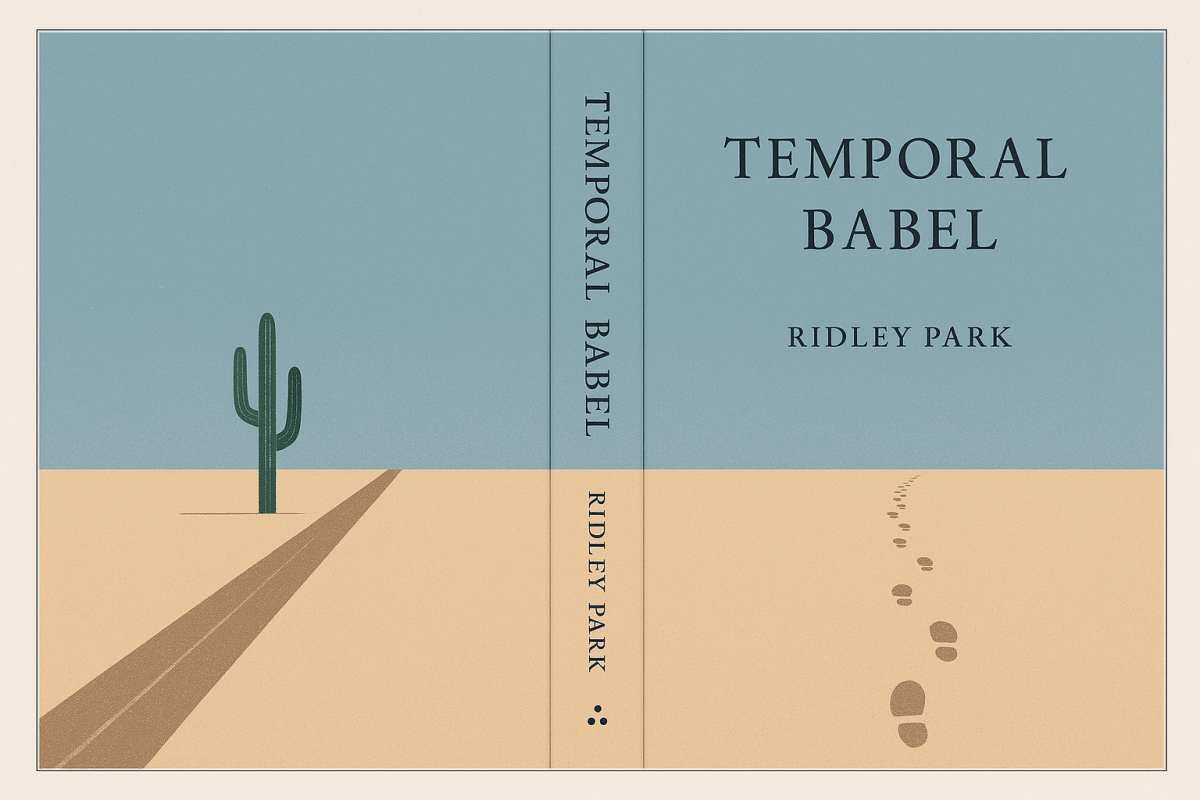
Temporal Babel: A Novelette

I just completed a second draft of a novelette I’ve been working on. I had ChatGPT (Dall-E) render a quick sample cover.

The story takes place in New Mexico, and I wanted a minimalist visual style to match the prose. I believe that a beige desert set against a blue sky is perfect. The deserted highway with a single cactus speaks volumes. The footprints in the desert are also evocative. I love the simplicity of the palette.

Though it revered the front and back cover art, it generally followed my instructions. Artificial intelligence (AI) has made significant progress in a year. All of the words are spelt correctly. I could Photoshop this into shape with little effort.

I only plan to release this as an ePUB because I am compiling a triptych. Currently, the body copy stands at 105 pages, so with title pages and the rest, it should reach 112 pages, which is perfect for seven 16-page signatures.

AutoCrit Challenges

I don’t hide the fact that I rely on AI for early editorial feedback. Once a story is complete, I break out AutoCrit. This programme works well for typical stories that follow standard practices with common tropes. It gets quite confused when I feed it intentionally awkward stories, not the least of which is to advise me to eliminate the awkwardness.

This is a challenge with AI more generally. In this particular story, I leave a lot of loose ends and misdirects, as it’s a commentary on the conspiracy-driven culture we inhabit. The advice, is along the lines of, “You forget to close this lopp. What happened to so and so.”

But this is life. We don’t always know the full story. We drive past an multi-car accident where cares are overturned and in flames, but we never find out what happens – even if we scour the newspapers and internet. Who was that? What happened? What caused it?

We often never find out. In most books and movies, we find out everythung, and it all comes packaged with a nice bow. This is what AI expects. It’s the diet it’s been fed.

Some stories subvert these notions here and there, but by and large, this is not typical American fare. Readers and viewers need to be spoonfed without inconsistencies.

Speaking of inconsistencies addressing one scene, AutoCrit said that a character should act impulsively in one situation and reserved moments later. This was flagged as an iinconsistent character.

In the scene, a woman stops her car immediately to help an injured man on the roadside, but as she gets out of her car an approaches her, she shows caution.

This was a red flag. Why would she have always been rash or always been cautious?

My response, because that how real people act. She acts on instinct but quickly considers that she’s a vulnerable woman alone with a man miles from anywhere.

I don’t suspect a human reader would find this surprising. This is the intelligence absent from Artificial Intelligence — cultural intelligence, a cousin of EQ, emotional quotient.

I know how I want the character to act. I do want AutoCrit to inform me that character A is wielding a pistol but then stabs another character, or that character B is a teetotaler and is getting drunk or that character C has a shellfish allergy but is downing lobsters like they’re going out of style. And I certainly what to be shown continuity errors.

The biggest challenge I have with AutoCrit that is less promonent with other AIs is that I can preface my content with a note explaining my intent. I can even do this after the fact.

If I feed ChatGPT, Claude, or DeepSeek a story of segment to critique without a preface, the responses may be similar to AutoCrit, but when I follow up with some meta, the response may be, “Now it makes sense, but why is John wearing lipstick?” Perhaps he’s metrosexual or non-traditional. Perhaps it’s an oversight.

I dont meán to demean AutoCrit. I’m just advising that if you are writing stories not compliant with 80 per cent of published works, take the advice with a grain of salt, or reserve AutoCrit for more standard fare.

Is it AI?

I favour originality even at the expense of popularity or sales. I spent last week writing short stories and poems. I use AI for research, whereas in the “old days”, I’d have used a library. I research character traits and arcs, story forms, and whether a theme has been explored.

I employ AI in the editorial process, and even in “post-production”. I even use AI for some art concepts and components.

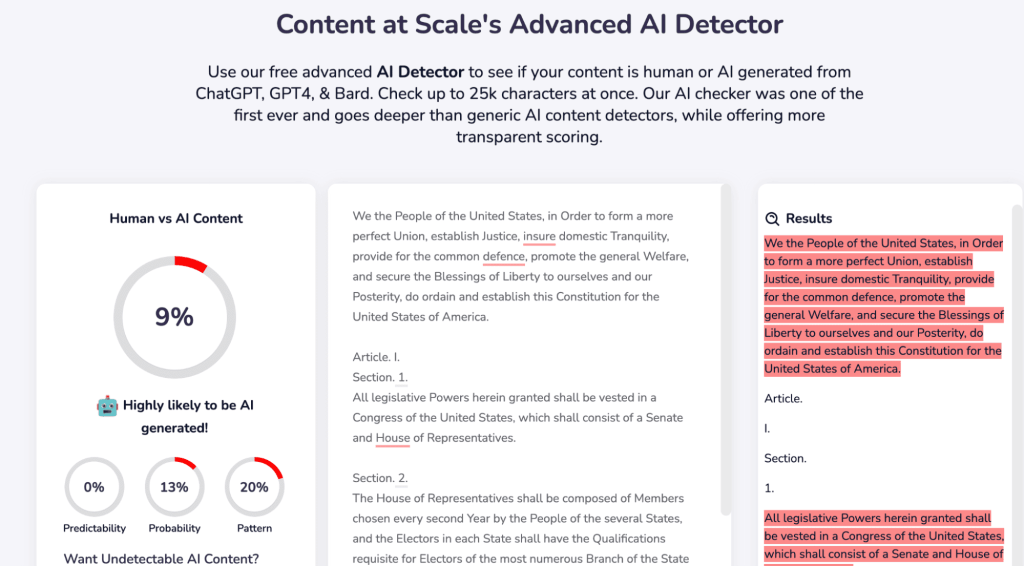
One thing I hadn’t tried until now is an AI service that purports to determine if a submission is AI. I tried several packages that offered a free trial. They seem to operate on a scale between human and AI authorship.

I first submitted a piece I was currently working on—a 6th-odd revision of a 5,000-word story in the form of a fairy tale. Unfortunately, trials were limited from a sentence to a few paragraphs—up to 5,000 characters.

This first submission was rated 100% AI—evidently, not a hint of humanity. This was disconcerting. I decided to dredge out a non-fiction book I shelved in 2020. Certainly before access to AI tools. This was rated 85% AI and 15% human. But it gets better—or worse, I suppose, depending on your perspective.

The book is on the immorality of private property from a philosophical vantage. The passages claimed to be AI were one-hundred per cent mine. What about the ones flagged as human, you might be asking? Those were a quote by fellow human John Locke from his Second Treatise of Government.

In Defence of Property 

God, who hath given the world to men in common, hath also given them reason to make use of it to the best advantage of life, and convenience. The earth, and all that is therein, is given to men for the support and comfort of their being. And though all the fruits it naturally produces, and beasts it feeds, belong to mankind in common, as they are produced by the spontaneous hand of Nature; and no body has originally a private dominion, exclusive of the rest of mankind, in any of them, as they are thus in their natural state: Yet being given for the use of life, there must of necessity be a means to appropriate them some way or other before they can be of any use, or at all beneficial, to any particular men.

ᅳ John Locke, Second Treatise of Government 

Returning to the AI side, what sentences were flagged as the “Top Sentences driving AI probability”? I’m glad you asked.

  • The Catholic Church also played a significant role in shaping private property rights in the Middle Ages.
  • In ancient China, the concept of private property was more limited, as land was owned by the state and was leased to individuals for use.
  • However, there is evidence to suggest that private property ownership has existed in some form in many ancient civilisations.
  • Although it’s difficult to trace the precise history of private property ownership before ancient Greece, the concept of private property has evolved over time and has varied widely among different societies.
  • It regulated the transfer of property and established rules for inheritance.

So these ordinary sentences written 5 or more years ago are flagged as AI.

The US Constitution

On a site I found to understand what parameters AI considers, I found this example—the Constitution of the United States of America was flagged as having AI content. I knew those geezers were ahead of their time, but I didn’t realise how far. This is even more amazing when one considers that electricity hadn’t even yet been invented.

But Why?

AI looks for statistically probable patterns. This translates into any content written with proper grammar and diverse word choice. In practice—the habits of a decent writer.

I’m not going to belabour this issue, but I want to raise a big red flag.

To complicate matters more, they have AI applications that promise to un-AI your AI. So there’s that.

AutoCrit Innards

Writing is hard. Short stories are worse. I started Mind Without a Mirror a few days ago as a short story project. After a dozen major revisions, I got to a place to run it through AutoCrit. I’ve been using AutoCrit for a couple months, and it’s been useful as an editor before I connect with a human editor or Beta reader.

Today, I think it split its guts. I clicked on the Character tab. This is where it assesses your character traits, strengths, weaknesses, and some other aspects. As you may notice for the first character, Ada, it returns a terse response. This is usual. The second character Echo went off the chain.

Major characters including Ada and Echo provide contrasting perspectives aiding in highlighting different facets of conflict surrounding Sol’s disappearance:

1. Ada – Her impulsiveness offers tangible counterpoints but sometimes lacks depth behind motivations driving rash decisions; deeper backstory integration can enrich relational dynamics while avoiding plot holes associated with seemingly arbitrary choices leading toward unnecessary risk-taking scenarios without sufficient narrative justification.

2. Echo – As a voice urging caution yet pushing boundaries intellectually rather than physically contrasts effectively against both Ada’s impulsiveness and initially hesitant nature exhibited by Nova; further scenes emphasizing logical deductions alongside emotional intelligence contributions can elevate effectiveness within group dynamics exploring unknowns collectively ensuring smoother narrative cohesion devoid apparent gaps particularly during critical junctures necessitating unanimous decision-making processes amongst protagonists’ circle thereby mitigating potential dissonance arising from conflicting individual agendas undermining collective objectives pursuit efficiency notably during climax build-up phases preceding resolution stages inherently reliant upon concerted efforts fruition realizing overarching goals set forth early onset storyline unfolding sequence events trajectory mapping course eventualities encountered en route denouement culmination point reached conclusionary chapter segments encapsulating thematic essence distilled core message intended conveyed audience reception interpretation thereof facilitated 

I shared a screenshot so you can see the random word dump. Perhaps it’s speaking in tongues. Toward the bottom of the laundry list, I see a lot of professional titles below some superlatives.

I don’t know. AI is strange. I wasn’t planning to post anything today, but I just had to share.

Intelligence and Cognition

It seems that I am constantly apologising for not posting more here. Have no fear, these apologies appear on my other sites, too.

My absence here is due to another writing project I am focusing on. The competing project has a working title of “Democracy: The Grand Illusion“. It’s a work of fiction, so I am documenting it on my Philosophics blog.

Recently, I’ve been posting content related to my initial editorial process using AutoCrit.* I was planning to produce content for this site as well as YouTube using Hemo Sapiens: Awakening as the source material, but since I am currently writing this academic non-fiction piece, I figured I’d apply it there.

For me, writing fiction is different to writing non-fiction. With fiction, I have an idea, and I document a possible skeleton framework. This may (and does) change as I make progress, but it serves mainly as waymarkers to orient my original idea. In this manner, I am more of a planner than a pantser.

Once I establish this structure, I start writing exposition, and all bets are off. I do not feel restricted by this framework if my subconscious has a different idea and the characters and narrative come to life.

On the other hand, non-fiction is very planned and structures. I create chapters for continuity and flow. Then I place all sorts of section content within each chapter and record thoughts and citations.

For this book, I did most of this in 2021-22 during the tail end of the COVID debacle. I stopped and started, but this month I am re-engaging. As the skeleton and muscular systems are already in place as are many organs, I need to add the rest and flesh it out. This is how I occupy my days.

Despite the planning, nothing is cast in stone. Case in point, I had just drafted a chapter on Defining Intelligence. It included sections on.

  • Intelligence
  • IQ (as a proxy for intelligence)
  • Emotional Intelligence
  • Multiple Intelligences
  • Cognitive Biases

I thought I was done until I decided to add a section on Cognitive Deficits and Limitations. This inclusion prompted me to rename the chapter to Intelligence and Cognition.

I expect this book to be completed in 2024. I’ve written some 58,000 words with another 30,000 more likely. I don’t really have a target in mind—just the content I want it to cover.

I may still pop in to demonstrate AutoCrit on my published book as I feel it may be instructive.


* AutoCrit is an AI-based editorial application. I am a member of their affiliate programme, so I gain minor financial benefits at no cost to you if you purchase through a link on this page.

Write, Review, Revision

I lost my faith in the English language and trust in people in grade school where I was taught the 3 Rs – reading, writing, and arithmetic. On balance, these each have the R consonant sound on the stressed syllable, but it is otherwise misrepresented. Game over.

In this tradition, I’ve got my own 3 dodgy Rs: Write, Review, and Revision. This sums up my approach to writing.

Write

Duh, right? You’ve got to write to write. In fact, to be a better writer, you’ve got to be a reader, a leading-candidate for as fourth R – but I’ll call it a necessary precondition. Being exposed to reading allows you to absorb different styles and genres. It remind you that pedantic constraints of grammar need not apply. My grammar-checker reminds me often.

I took this route as a musician as well. Exposure to genres, styles, and approaches fortifies your craft. Some of the best groups contain members of diverse backgrounds. Sure, there are some groups where members are cut from the same cloth, but they are usually stuck in a particular niche. Nothing wrong with this mind you, if you don’t mind being painted into a corner. I’m too claustrophobic for this.

Review

Once you’ve written, review your work. In fact, this should be more than one representative R. Perhaps it should instead be read, write, review, review, review, review… or an alternative, read, write, review, write, review, write, review… To be honest, when I write blogs, I just write – stream of consciousness. No net, no review. Submit. Done. But this is not how I approach longer works. The longer the work, the more read-review cycles.

Revision

After you’ve dumped all of your thoughts onto the page, write, review, rinse, and repeat, you have to opportunity to revise your work before you release it into the wild – transplant it from your private greenhouse to watch in flourish or perish.

A revision is more than a review. It’s the opportunity to re-view, re-vision, re-imagine the work that arrived in the first pass with sequential editorial hining and rework.

Maybe you now imagine a new character or story line, a new twist, two characters can be consolidated. Perhaps even a different ending or beginning. It’s all clay. Sentences are malleable.

As a professional musician, I learned not to become married to your work. And just as your parents may not appreciate your choice in partners, your readers may not appreciate your art. And this is not important as an artist. This is only important in the commercial realm. I don’t find this realm interesting. It the reason I don’t enjoy pop music – disposable commerce. We don’t so much categorise books into pop, but we should. At least we can.

Now I’ve gone off on a rant. In a novel, I would likely delete this during an editing cleanse, but here, there is only forward.

In the end, you can just write with none of the ancillary activities – as I do here. Or you can take a different approach to harden your final output. I don’t prefer to call it a product.

You may not even opt for revisioning because you had it all in your head. You just needed to rush to capture it all on the page – 700 pages times 7 volumes. You’re the lucky type. That’s not my style, so I’ve not much to say on the matter.

My parting words – just write.