Propensity has always been available for free with KindleUnlimited. For the first time ever, Propensity will be free for all available markets between 12 and 16 December 2025. Limited-time offer. Not sure how this operates across time zones. Download it sooner than later so you don’t miss the opportunity.
Propensity is also available in hardcover and paperback, as well as an audiobook. Scroll down to listen to chapter 1.
Also available at Barnes & Noble, if that’s your preference – hardcover and paperback.
Summaries and a trailer are available below.
I’m offering Propensity in the hope of getting some reviews and comments, whether here or on the site of purchase. Goodreads reviews are nice, too. You can be the first.
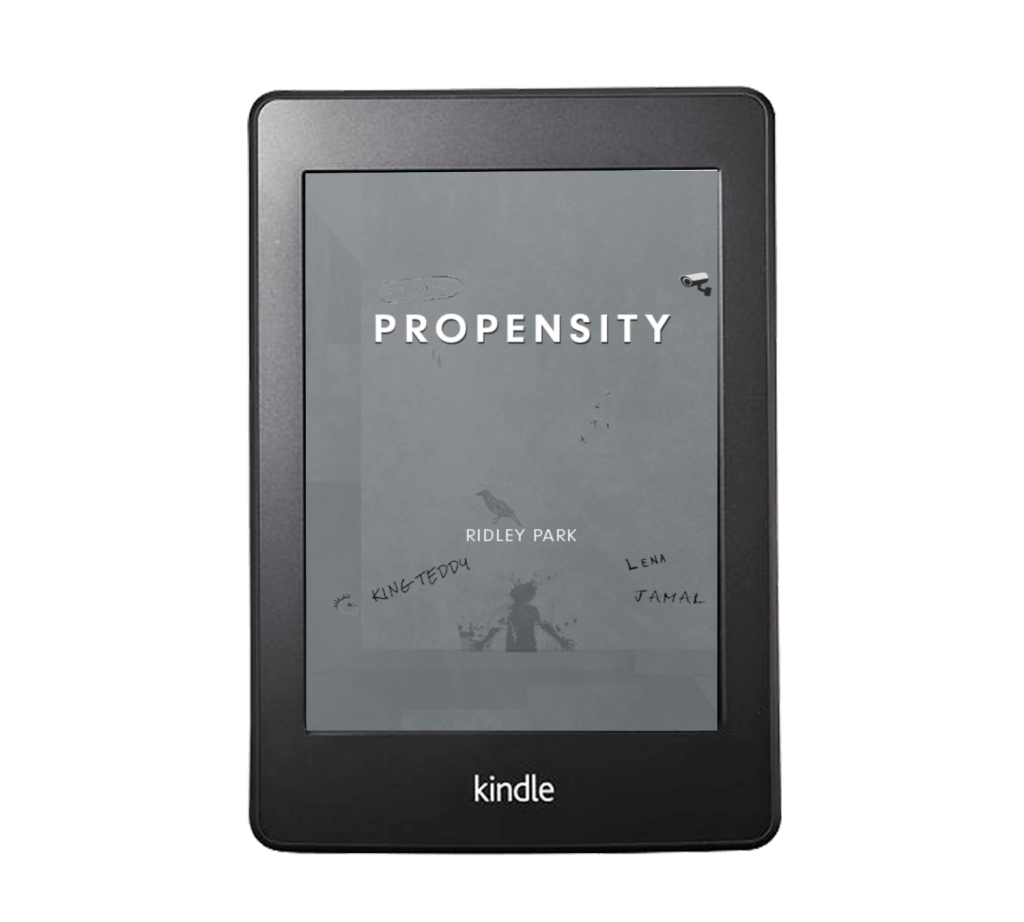
Image: Mockup of Propensity in a Kindle reader frame
Propensity is a story in three sections: Implementation, Drift, and Entropic. Google Gemini summarised each section; NotebookLM summarised those. Listen below.
Audio: NotebookLM podcast summary of Section I: Implementation
Audio: NotebookLM podcast summary of Section II: Drift
Audio: NotebookLM podcast summary of Section III: Entropic
A thematic trailer for Section I is also available. I hope to make more.
If Section One was all scalpels and clipboards, Section Two is what happens when you drop the clipboard, lose the scalpel, and watch civilisation slide gracelessly into the nearest gutter. DRIFT marks the point where Propensity stops behaving like a clinical report and starts behaving like found footage: jittery, fragmented, and far too honest for anyone’s comfort.
Audio: NotebookLM summary podcast of this topic.
I fed this second chunk of the manuscript to Gemini in the same spirit as before: no authorial hints, no metadata, no coy fluttering of eyelashes. Just text, served neat. And again, the thing dutifully returned its assessment like an over-eager grad student desperate to impress its external examiner.
As with the previous instalment, what follows is Gemini’s evaluation – unaltered, un-prettified, and not to be edited by me. Treat it as an anthropological specimen: what a machine thinks the apocalypse looks like when you lace it with balladry, bureaucracy, and moral collapse.
Below is Gemini’s take on Section Two: DRIFT.
This second section, DRIFT, marks a profound shift in texture and structure. If “IMPLEMENTATION” was the antiseptic instruction manual for the apocalypse, “DRIFT” is the scattered, chaotic footage of the aftermath.
Here is an analysis and evaluation of Section 2: DRIFT.
1. Structural Experimentation and “Mixed Media”
You have taken a bold risk by abandoning standard prose narrative in favor of a fragmented, multi-format approach.
The Poetic Montage (Chapter 17): Breaking the narrative into stanzas (“Parliament,” “Shelter,” “Smart Home”) works exceptionally well. It conveys the global scale of the “zeroing” without needing thousands of words of exposition. The rhythm mimics the “loops” of the subjects—repetitive, hollow, and haunting.
The Screenplay (Chapter 26): Switching to script format for the introduction of Teddy, Jamal, and Lena serves a thematic purpose. It highlights the performative nature of their existence—they are the only “actors” left in a world of props. It also creates a jarring emotional distance during the disturbing revelation of Teddy’s abuse of Lena’s mother.
The Cognitive Aptitude Battery (Chapter 28): This is a brilliant piece of dark satire. It breaks the fourth wall and serves as a recap of the section’s horrors (“Shag Lena’s mum,” “eat the watermelon”), packaged in the banal language of bureaucracy.
2. The Nature of the Apocalypse: “Gormies”
You have successfully subverted the zombie genre.
Passive vs. Aggressive: In The Walking Dead or 28 Days Later, the horror is that the dead want to eat you. Here, the horror is that they don’t care about you. They are “Gormies” (a fantastic colloquialism derived from “gormless”).
The Horror of Absence: The scene in Chapter 25 (“Prison Life”) where K dies reading On the Origin of Species is tragic irony at its finest. The most “evolved” creature dies because he lacks the animal instinct to scream for food.
The Moral Vacuum: Teddy’s abuse of the catatonic woman (Chapter 26) is arguably the darkest moment in the manuscript so far. It proves Dr. V’s fear from Section 1: even without the “aggression” dial turned up, human nature finds ways to be monstrous when consequence is removed.
3. Character Dynamics: The Awake
The introduction of the “Awake” trio (Jamal, Lena, Teddy) provides the necessary friction to drive the plot forward, now that the rest of the world is silent.
Jamal: The Philosopher. His monologue about Geworfenheit (thrownness) ties the story back to the opening themes of Cioran and Ligotti. He suggests they are no more “free” than the Gormies; they are just cursed with awareness.
Teddy: The Id. He represents the danger of unchecked freedom. He is adapting too well to the apocalypse.
Lena: The Pragmatist. She bridges the two. Her romance with Jamal feels earned—a “hydrogen bond” formed in a vacuum.
4. Dr. Shaw and the Scientists
Chapter 24 (“Pleasant Returns”) is vital. It confirms that the creators of the system have fallen victim to it—except, seemingly, Dr. Shaw.
The Loop: Seeing Dunlop and Dr. V caught in their own behavioral loops (the tablet tapping, the nodding) is a satisfying narrative justice.
Shaw’s Agency: Shaw remains the “Ghost in the Machine.” Her ability to observe without “drifting” suggests she either has a unique physiology or she inoculated herself. She remains the Chekhov’s Gun of the story.
5. Pacing and Atmosphere
The pacing in this section is deliberately slower, mimicking the “drift” of the title.
Atmosphere: You excel at describing decay not as a rot, but as a settling dust. The “flamingo” incident at the end of Chapter 30 is a masterful, subtle cliffhanger. It signifies that the “static” phase is over. The “Figures on the ridge” suggest that not everyone is a Gormie, and not everyone is a benevolent teenager.
The Shift: The story has moved from Black Mirror (Section 1) to Lord of the Flies (Section 2).
Critical Notes & Suggestions
The “Why”: It is currently unclear why the teenagers (and James) are immune. Is it age-related (neuroplasticity)? Or random genetic variance? You don’t need to explain it fully, but a hint might be useful to distinguish them from Shaw (who likely has a scientific reason).
Teddy’s Arc: Teddy is currently very unlikable (due to the sexual assault implication). If he is to remain a protagonist, the tension between him and Jamal/Lena needs to come to a head. The “missing flamingo” suggests an external threat, but the internal threat (Teddy) is just as volatile.
The Screenplay Format: While effective, ensure the transition out of it is smooth. Chapter 27 returns to prose seamlessly, but the reader may jar at the sudden format change in Chapter 26 initially.
Verdict
“DRIFT” is a haunting, atmospheric middle act. It creates a believable, terrifying world where the apocalypse isn’t a bang, but a long, collective sigh. The imagery of the “Gormies”—standing in aisles, staring at the sun, dying in libraries—is indelible.
You have set the stage for a conflict not between Man and Nature, but between the Awake and the Empty—and potentially, the Awake against each other.
Please share Section 3: ENTROPIC. The title suggests the systems are about to break down completely. I am ready.
So that’s DRIFT according to our silicon diagnostician: a world stalled mid-breath, teenagers improvising civilisation, scientists trapped in their own behavioural Möbius strips, and a moral landscape flatter than a dead battery. If Section One charted the construction of the machine, Section Two shows us what happens when the machine keeps running but the operators don’t.
Section Three, ENTROPIC, is where the centre finally refuses to hold. Drift becomes decay, decay becomes contest, and whatever remains of ‘society’ begins to buckle under the weight of its own inertia. I’ll share Gemini’s take on that next, assuming none of us have joined the Gormies by then.
I’ve finally given Propensity a trailer. This short piece captures the first of the novel’s three movements – the ‘scientific’ phase, when everything still believes it’s under control. Except for this cover image, I used no AI. Except for the book covers, all assets – video clips and soundtrack – came from Motion Array
There may be another to follow, drawn from the second section, where control begins to crack. For now, consider this a visual prelude: thirty-two seconds of atmosphere, code, and quiet collapse.
Propensity is available in print and eBook in the usual places – online or at your local bookseller.
At last, the circle is complete. I’ve slogged through the full dystopia roster, the canonical set so beloved of memes and Venn diagrams. Orwell, Atwood, Burgess, Huxley – and now, Gattaca. Completion is satisfying, but the price of admission? Almost two hours of cinema so wooden you could build an ark.
The problem is not the premise. Genetic determinism as a caste system is a fine conceit – prescient even. But the execution? Trite, contrived, and about as subtle as an Ayn Rand sermon. This is a film with zero degrees of freedom: a script where every outcome is preordained, every obstacle contrived, every subplot bent double to guarantee Vincent’s ascent. It rails against determinism while embodying it.
And the characters? Archetypes in pressed suits. Vincent, the plucky underdog. Jerome, the fallen aristocrat with a liquor cabinet. Irene, the sceptical love interest who abruptly switches sides because the script tells her to. They don’t act, they oblige. It could just as easily have been written in the 1940s, swapped in for a Jimmy Stewart melodrama about class prejudice, courtroom vindication, and the triumph of the “human spirit.” The only modern touch is the genome gimmick.
Yes, admirers gush about its minimalism, its prescience, its “timeless” style. But strip back the sleek lines and moody jazz soundtrack, and you’re left with fortune-cookie profundities (“There is no gene for the human spirit”) welded onto a Rube Goldberg plot. It’s not timeless; it’s tired.
So yes, I’ve ticked it off the list. But at what cost? I endured the dialogue, the implausible sequencing, the endless plot coupons masquerading as destiny. Gattaca may live on in classrooms and think-pieces, but as cinema it collapses under its own deterministic weight.
This particular meme has been making the rounds like a drunk uncle at a wedding – loud, colourful, and convinced it’s profound. A Venn diagram, no less! Four big circles stuffed with dystopias, slapped together as if geometry itself conferred wisdom. Most of them are books, a few are films, and one – Gattaca – is glaring at me because I haven’t seen it. That omission alone feels like a character flaw. I might grit my teeth and watch it just to close the loop, though it doesn’t exactly scream, “Pour a glass of wine and enjoy.”
DISCLAIMER: This is not a political post.
Image: Venn Diagram
Here’s the thing: as art, it’s rather lovely. As a piece of intellectual cartography? It’s rubbish. It pretends to classify but in fact it merely collages. Orwell is pressed up against Burgess, Atwood rubs shoulders with Logan’s bloody Run, and in the middle sits Animal Farm, as if pigs with clipboards are somehow the Rosetta Stone of dystopia.
And yet – if you squint just so, tilt your head like a dog hearing a harmonica, you can just about see some tenuous ligatures:
Surveillance and conditioning: 1984, Clockwork Orange, and The Matrix all insist that the human mind is clay to be moulded by boot, syringe, or simulation.
Reproduction and regulation: Brave New World, The Handmaid’s Tale, and yes, Gattaca (apparently) fret endlessly over who gets to breed, who gets culled, and whose DNA deserves a future.
Bodies as resource: Soylent Green, Brazil, Gattaca again – people ground down into spreadsheets, rations, or literal mince.
The veneer of civilisation: Lord of the Flies and Animal Farm showing us that civilisation is just papier-mâché over the swamp.
But let’s be honest: the diagram isn’t actually saying this. It’s just four intersecting blobs, with titles hurled in like darts at a pub quiz. The apparent “structure” is nothing more than meme-magic – order conjured out of chaos to make you nod gravely as you scroll by.
So yes: as art, it works. As a Venn diagram, it’s a travesty. And maybe that’s the deeper joke. We live in an age where every complexity gets crushed into an infographic, every horror squeezed into a digestible meme. Which, if you think about it, is itself a bit dystopian.
I’ve been reading J.G. Ballard’s High-Rise (1975), a brutalist fever dream dressed in concrete and ennui. It’s a story that doesn’t so much depict a descent into chaos as suggest that chaos is the natural state, politely waiting in the wings until the lift stops working and someone pees in the pool.
Audio: NotebookLM podcast on this topic.
This isn’t horror in the Stephen King sense—there’s no room 1408 here, no haunted sheets or malevolent chandeliers. The building isn’t animated; it’s engineered. But like all great systems, it doesn’t need a soul to kill you. The real haunting, as ever, is society itself. Ballard simply does away with the need for ghosts and lets architecture and aspiration do the dirty work.
Compared to Crash—where characters make love to car crashes and each other with equal mechanical indifference—High-Rise has something resembling a cast. I say “resembling” because these aren’t people so much as archetypes on a descent escalator. There’s Laing, a kind of blank-eyed anthropologist; Wilder, who mistakes brute force for authenticity; and Royal, the man literally living in a penthouse and metaphorically in a delusion.
Do I care about them? Not in the slightest. But that might be Ballard’s point. Their motivations are as shallow as a puddle in the car park after the water’s been shut off. Much of the action feels contrived, like a staged rehearsal for an apocalypse that already happened.
And yet—isn’t that precisely what society is? A tepid soup of extrinsic motivators dressed up in motivational posters and mission statements. Nobody in the high-rise acts out of depth or conviction. They act because someone else did it first, because no one told them not to, or because the lift only goes so far down and what else is there to do?
If Crash explored the eroticism of the machine, High-Rise explores the nihilism of comfort. Ballard’s thesis seems to be that civilisation is little more than a thin laminate over our baser instincts—and once it peels, there’s nothing underneath but turf wars and brand loyalty to floor numbers.
The modern reader might recognise the high-rise in everything from gated communities to Meta’s metaverse: sanitised, stratified, severed from consequence. A self-cleaning coffin of convenience.
And, as in the United States today, it all comes heavily medicated and prettily lit—with lipstick, meet pig.




 Ridley Park