Reaching the Finish Line with Zamyatin, Le Guin, and Foucault Still in My Head

The book ends, as these things always do, with a sigh and a stack of annotated pages. I’ve just closed the cover on Zamyatin’s We, and, like a cigarette slipped into the afterword, there sat Ursula K. Le Guin’s essay “The Stalin in the Soul“. She wrote it decades later in 1979, but it might as well have been stitched into the same binding. I may write about it in more detail elsewhere.

Zamyatin built the totalitarian city of glass; Le Guin peered into the reflective surfaces. Her “Stalin” isn’t a political leader but the minor tyrant most of us cultivate internally — the censor who edits desire into silence, who rewards obedience with the narcotic of safety. She understood what Foucault would later codify as biopower: that power’s finest trick is to outsource itself. You don’t need Rousseau’s chains when you can teach people to manage their own submission.

Reading it now feels almost indecently prescient. The State of We had surveillance towers; ours has dashboards. Zamyatin imagined a future where citizens surrendered privacy for perfection. We call it good UX. Le Guin warned that the artist’s real jailer was the fear of making art that doesn’t please the market. Foucault, if he were still here, would simply nod and mark it as another case study in voluntary servitude.

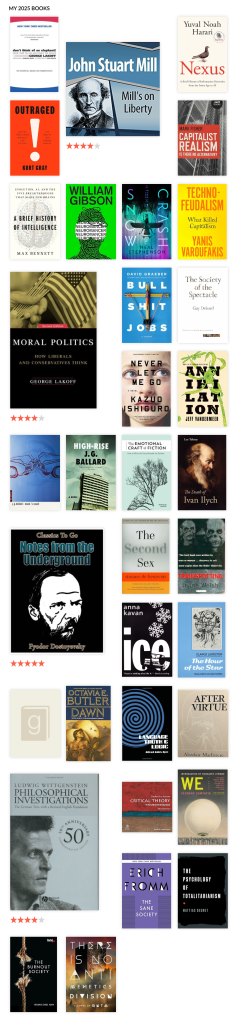
We‘s protagonist, D-503, had shades of Dostoyevsky’s in Notes from Underground – only a bit more reliable of a narrator.

As I close this run of readings — We and its prophetic essay appendage — I can’t shake the feeling that finishing the book is part of the ritual it describes: the quiet filing of experience, the discipline of comprehension. Yet finishing also matters. There’s a line between vigilance and paralysis, between watching the gears of power and daring to write anyway.

So yes, the project reaches its line — not a triumphant banner, more a hand-painted sign reading enough for now. Zamyatin showed me the machine. Le Guin showed me the human who keeps it running. Foucault, the analyst of our beautiful cages, taught me not to pretend there’s an outside.

All that remains is to write, while the internal commissar mutters and the cursor blinks like a surveillance light. That, apparently, is freedom.

On Goodreads, Social Media, and Not Giving a Toss About What You’re Reading

I watched this video this morning: Why I Quit Goodreads. Apparently, people are fleeing Goodreads like it’s a sinking ship. Frankly, I didn’t realise they’d ever boarded.

Video: Why I Quit Goodreads by Alison Reads Books

I’ve used Goodreads for years. Not out of love – habit. I was on another platform before Amazon bought both and quietly euthanised the lesser one. So, like any good digital serf, I migrated. Goodreads never really improved. But that’s not what this post is about.

Audio: NotebookLM podcast on this topic.

The woman in the video, Alison, recounts how she got sucked into the vortex of reading-as-performance. A treadmill of trending titles, five-star pressure, and dopamine farming. In short: social media with spines. She, like me, identifies as an introvert. Social media, she says, offered connection on her terms.

Fine. But here’s where we part ways: I don’t read what’s popular. I read like I write: deliberately, slowly, and mostly alone. I don’t care what the hive is reading. I don’t follow BookTok. I’m not hunting genre tropes like Pokémon. I’m not even watching telly.

That’s not snobbery. That’s filtration.

Yes, I read Tolstoy and Dostoevsky, not because they’re trending, but because they have staying power. I read Beauvoir and Foucault, not because they’re fashionable, but because they dismantle the very notion of fashion.

Ironically, AI has been more useful to me than Goodreads ever was. I ask it about tropes, continuity, and which authors my work resembles. Sometimes, it throws out a name I don’t know. So I investigate. If I see a resonance, great; I might lean in or veer away. Not because I want to copy, but because “originality” is a fairytale. Everything is recombinant DNA, literary or otherwise.

I’ve read friend recommendations. Mixed results. Often disastrous. I don’t care how many millions adore The Hunger Games, or William Gibson, or Taylor bloody Swift. That’s not an insult; it’s a mismatch. Their work just doesn’t speak to me. And that’s the point of art, it’s not for everyone.

Because of this, I’ve grown wary of recommendations. I no longer approach them with hope; I approach them like a suspicious mushroom in a stranger’s risotto.

So why do I still use Goodreads? To track what I’ve read and, occasionally, write reviews…for myself. If others find those reviews useful, great. If Goodreads’ recommendation engine serves up a gem, brilliant; but it rarely does. Algorithms don’t understand headspace. They see pattern, not mood.

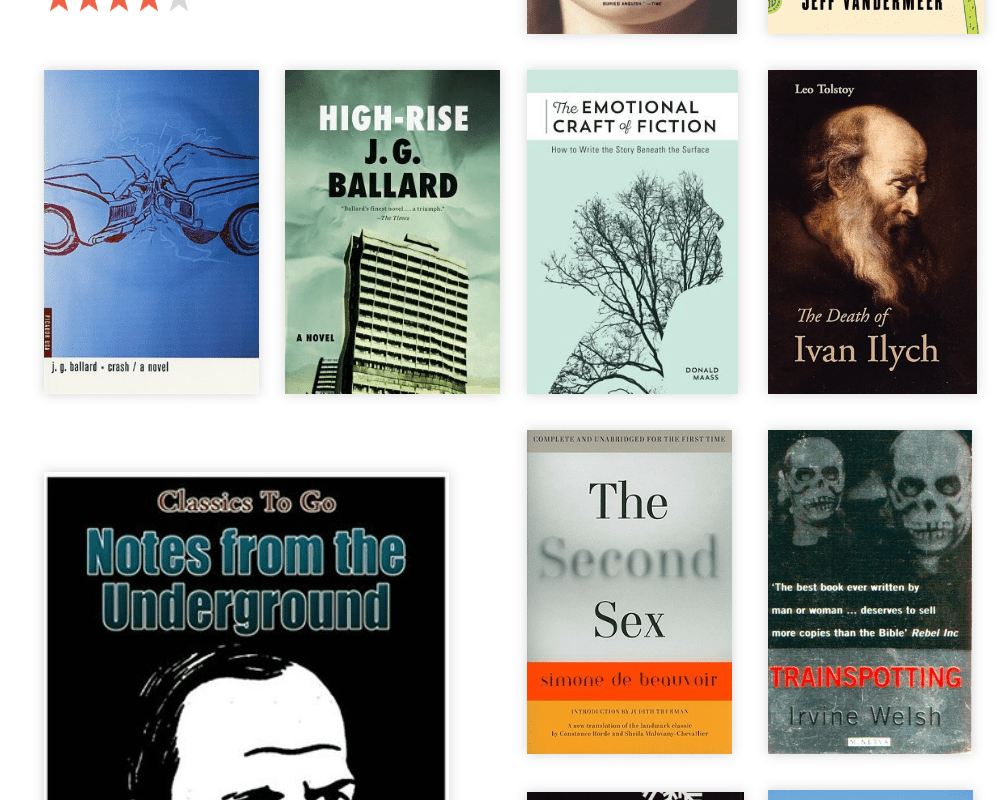
I might binge Dostoevsky and Tolstoy one week, but that doesn’t mean I want a Russian lit syllabus. After Notes from Underground and The Death of Ivan Ilych, I finally cracked open The Second Sex – a book that’s loomed on my TBR like a monument.

Sometimes reading fuels my writing. Sometimes it stalls it. But unlike Alison, I never needed Goodreads to tell me who I am as a reader. And I sure as hell don’t need social media to validate my literary tastes.

If you’re quitting Goodreads because it became too performative, maybe you were never using it for the right reasons. Or maybe, like most platforms, it just stopped being fun once everyone else showed up.


About the cover image: “photo of a stereotypical punk rocker anarchist reading a book in a crowd of people staring at their mobile phones”

I’m not sure this Midjourney render captures much of the essence of my prompt, but there it is.

Notes from the Underground

★★★★★ – “I Am a Sick Man. I Am a Spiteful Man. I Am, Apparently, Hilarious.”

Dostoevsky’s Notes from Underground is a masterclass in misanthropic soliloquy — part philosophical treatise, part psychological farce, and altogether one of the most darkly entertaining monologues I’ve ever had the guilty pleasure of eavesdropping upon. It’s a screaming match between Enlightenment rationality and the petty, pulsing irrationality of actual human life — and guess who wins? (Hint: not the utopians.)

Audio: NotebookLM podcast on this topic.

The first part, a searing, feverish diatribe, reads like the diary of a man who’s been locked in a room with too much Hegel and not enough human contact. It’s Dostoevsky’s pre-emptive strike against every social engineer who’s ever said, “Well, surely man will behave if we just fix the plumbing.” The Underground Man begs to differ — loudly, neurotically, and with an almost Shakespearean flourish of self-abuse.

But it’s the second part — Apropos of the Wet Snow — where things truly fall gloriously apart. Here the theoretical gives way to the tragically tangible. Our narrator, more unhinged by the page, lurches into society like a moth into a bonfire — vengeful, humiliated, self-aware to the point of paralysis. His disastrous encounter with Liza is almost unbearable in its sincerity and cruelty, a pas de deux of hope and destruction that left me squirming and spellbound.

What surprised me most was the humour. Not the cheap slapstick of caricature, but the agonising, close-to-the-bone absurdity that arises when a man is too clever to be functional and too self-aware to change. The Underground Man doesn’t just dig his hole — he drafts blueprints, writes footnotes, and criticises the soil quality.

As a companion read, Tolstoy’s The Death of Ivan Ilych provides a poignant counterpoint. Where Tolstoy charts the steady, ghastly march of bourgeois conformity towards a deathbed revelation, Dostoevsky gives us a man already buried in his psyche, clawing at the dirt and calling it philosophy. Ivan Ilych dies trying to make sense of his life; the Underground Man lives trying to make death of sense itself.

Together, they are a fine Russian reminder that being alive is no guarantee of being well — or even remotely rational.