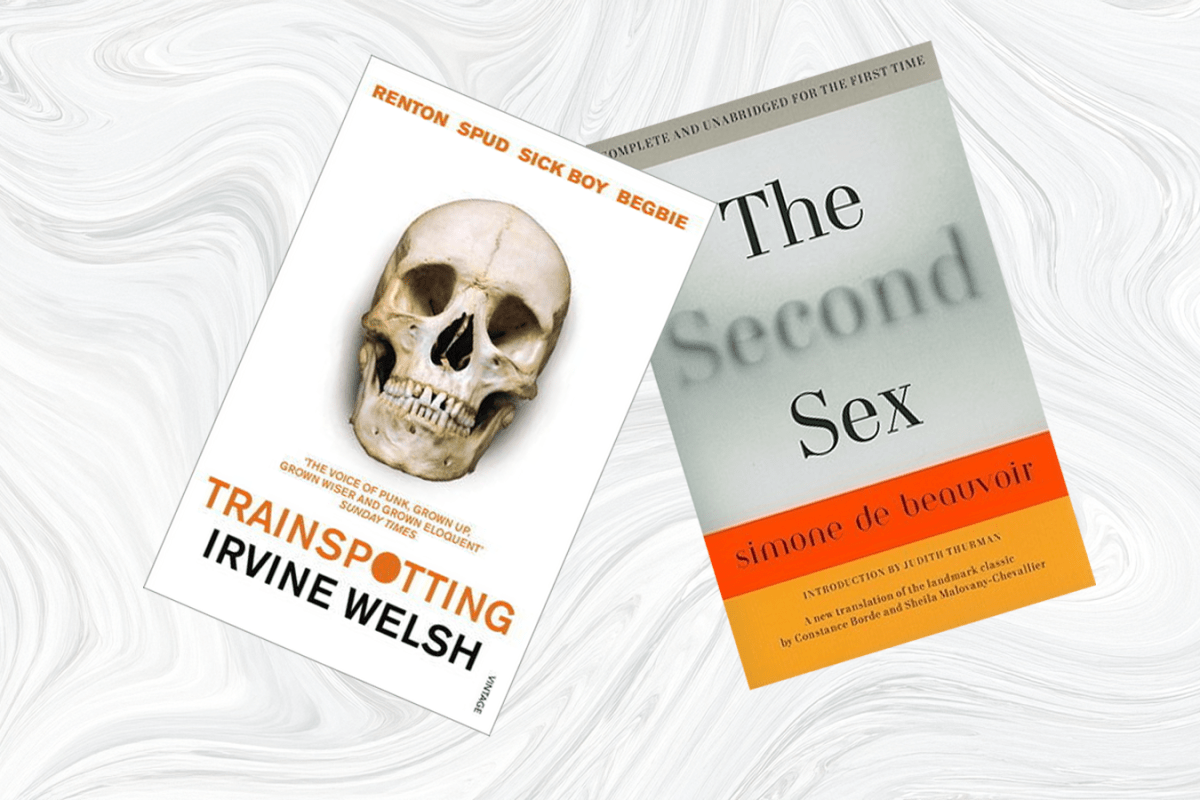
I’ve just finished Simone de Beauvoir’s The Second Sex – all 800 pages of it – and have now started Irvine Welsh’s Trainspotting. Both are classics in their own way. I’ll review Second Sex properly on my Philosophics Blog, but here I want to think about Trainspotting in relation to my current manuscript, Needle’s Edge.
Interestingly, Trainspotting was a ChatGPT recommendation. I fed in my draft of Needle’s Edge and this was one of the books it said my work resembled. Two chapters in, I see the connexion. First, the subject matter – drugs and addiction. Second, the rawness of the experience.
There are differences, of course. Trainspotting is rooted in Leith, Scotland; Needle’s Edge belongs to the East Coast of the United States – Delaware and Philadelphia. Welsh draws heavily on dialect and vernacular, with a narrative voice that’s linguistically dense and aurally charged. In Needle’s Edge, the style is pared down. Sentence fragments, middle dots instead of full stops, and an intentional “lower” register mirror the protagonist’s fractured perception and limited resources.
That gap in register creates a different authorial challenge. With every edit pass, I find myself policing intrusions of my vocabulary into her voice. Welsh, by contrast, can deploy a broader lexicon and trust the dialectal texture to keep it authentic. Listening to Trainspotting, I’m struck by how words and turns of phrase leap out – sometimes apt for Needle’s Edge, but often just a shade too polished for Stacey’s world.
Both texts orbit around environments that resist glamour. Welsh’s squat flats and pubs are grimy and feral; Needle’s Edge’s motel rooms and sidewalks are littered with fast-food wrappers, orange caps, and fading unicorn posters. Addiction erodes bodies in both stories, but the textures differ – Scotland’s industrial gray versus the East Coast’s cheap motels and suburban detritus.
As for the film version of Trainspotting, I saw it long ago and remember almost nothing. The novel isn’t refreshing my memory either; it feels like a separate creature altogether. Which is fitting: both Trainspotting and Needle’s Edge are less about plot than about capturing a lived texture, a rhythm of voices and environments that mainstream narratives usually discard.
Story ideas come from everywhere. Sometimes from books, sometimes from overheard conversations, sometimes from the dubious cesspool of internet memes. The meme I saw claimed that male flatworms duel with their penises to determine which one gets saddled with pregnancy. Naturally, I thought: That’s a story seed if ever I’ve seen one. Biomimicry is also a viable source.
Audio: NotebookLM podcast on this topic.
Of course, the meme was wrong. Flatworms aren’t male, or female. They’re simultaneous hermaphrodites – every worm is kitted out with sperm factories and egg sacs, with duelling penises to boot. When two meet, they fence. Whoever lands the stab injects sperm through the other’s skin (hypodermic insemination, to use the clinical term). The “winner” struts away as father, the “loser” absorbs the sperm, becomes mother, and carries the eggs. Sometimes both stab each other, and both walk away victorious fathers and reluctant mothers. Equality at last.
This is not genre fantasy, it’s zoology. No X or Y chromosomes, no fixed roles, just biology as a knife fight.
Writers, take note: this is why you don’t trust memes as science, but you do trust them as inspiration. The error – “male flatworms” – was pedestrian. The truth – all flatworms are both sexes all the time – is far more subversive. It blows up the binary and replaces it with a contest. Parenthood isn’t destiny, it’s a duel.
If I were to anthropomorphise this, I’d have the makings of a gladiator society: wounds as wombs, motherhood as punishment, fatherhood as prize. Not homoerotic vampire tropes, not vagina dentata horror – something stranger, sharper, harder to tame. A kind of Spartacus with gonads.
The point isn’t whether I’ll write it (probably not; worms don’t sell). The point is that even bad science can spark good fiction, provided you bother to check the details before running to press. Let the meme start the fire, let the facts shape the flame.
See Also (for the bookish wormhole explorer):
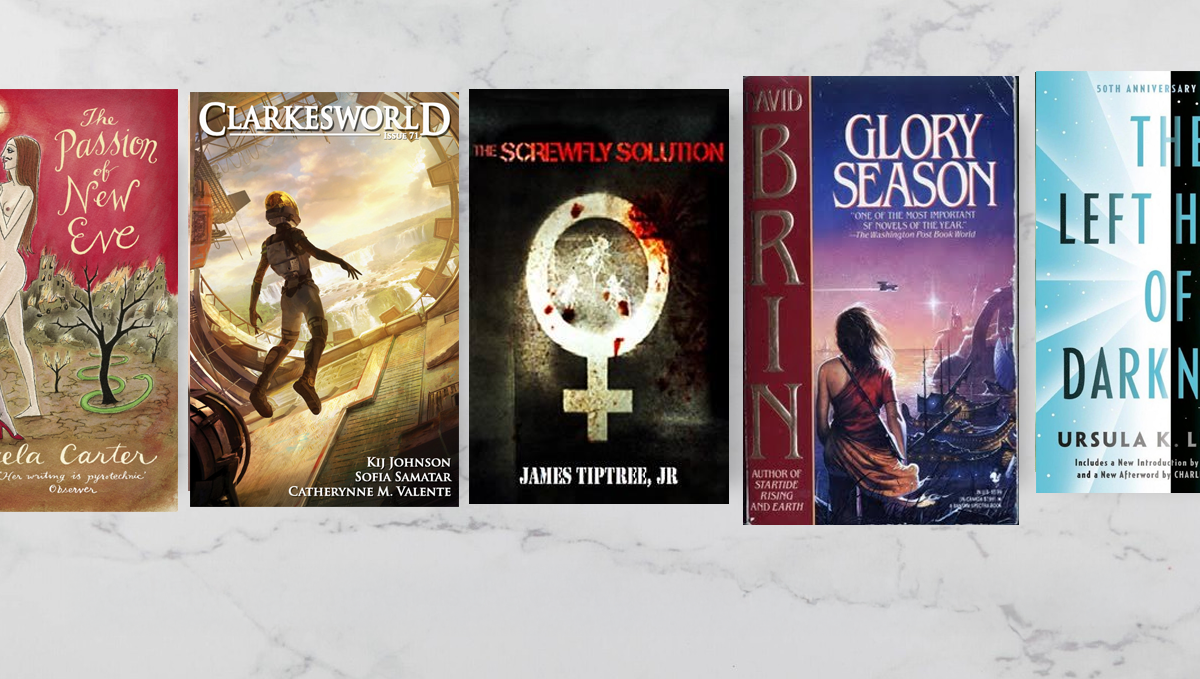
David Brin, Glory Season: speculative reproductive politics, society structured by cloning and sexual cycles.
Ursula K. Le Guin, The Left Hand of Darkness: androgynous Gethenians shifting between fatherhood and motherhood.
Kij Johnson, Mantis Wives (short story): erotic horror inspired by mantis cannibalism, equal parts Kama Sutra and war crime.
Angela Carter, The Passion of New Eve: grotesque gender-bending satire, bodies rewritten as battlegrounds.
Some bloke on social media posted to celebrate hitting his 10-book milestone for the year. It made me reflect on my own. I don’t keep a running tally, but I do use Goodreads, so I reviewed my list. I share it here. Evidently, I’ve read 22 so far. In all honesty, I cheated, because I won’t finish The Second Sex until later this evening or tomorrow morning. Sue me.
The Second Sex —Simone de Beauvoir In its day, I may be given this 4 stars. NONFICTION. Today, perhaps 3, but it’s a seminal work, so I’ll give it 3½.
Notes from Underground —Fyodor Dostoevsky 5 stars. FICTION. Perhaps 4½, rounded up. This came with Apropos of the Wet Snow, where it all falls apart (in a satisfying way).
Crash —J.G. Ballard 3 stars. FICTION. This was a ChatGPT suggestion*. Generous 3. Probably a 2½ if I’m being honest.
Acceptance —Jeff VanderMeer 3 stars. FICTION. This was not as good as Annihilation, but it got the bad taste of Authority out of my mouth. It closed the loop in the Southern Reach universe.
Authority —Jeff VanderMeer 1 star. FICTION. This was horrible. I wanted to read more about the Southern Reach universe. This prequel should have been an email.
Annihilation —Jeff VanderMeer 4 stars. NONFICTION. This was a ChatGPT suggestion*. I liked it. Much better than the movie with Natalie Portman.
Never Let Me Go —Kazuo Ishiguro 4 stars. NONFICTION. This was a ChatGPT suggestion*. It took a few chapters to see where this was going, but it was worth the wait.
The Left Hand of Darkness —Ursula K. Le Guin 3 stars. FICTION. This was a ChatGPT suggestion*. Read 8 or 9 chapters. Didn’t realise it was #7 in a series. Was OK. Not a Sci-Fi fan. Love her short stories.
English after RP —Geoff Lindsey 3 stars. NONFICTION. I liked this book and the author, but I can’t justify completing a linguistics reference book at this time. Maybe later.
* ChatGPT recommendations stem from my feeding draft manuscripts and prompting who it reads like.
Critics never tire of reminding us that AI has no emotions, as though this were some startling revelation. Next, perhaps, they’ll inform us that penguins can’t fly and that bankers are allergic to honesty. Yes, generative AI has no emotions. But must we wheel in the fainting couches? Writers don’t need it to sob into its silicon sleeve.
Full disclosure: I am a writer who writes fiction and non-fiction alike. I am also a language philosopher; I study language. And a technologist. I’ve been working with artificial intelligence since the early ’90s with Wave 3 – expert systems. I am still involved with our current incarnation, Wave 4 – generative AI. I know that artificial intelligence has no intelligence. I also know that intelligence is ill-defined and contains metaphysical claims, so there’s that…
Meantime, let’s stroll, briskly, through three ghosts of philosophy: Saussure, Wittgenstein, and Derrida.
Audio: NotebookLM podcast on this topic.
Saussure and the Tree That Isn’t There
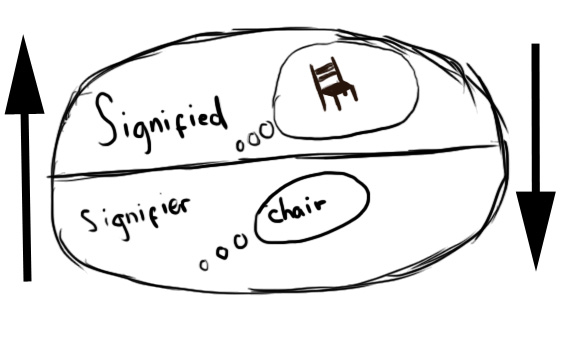
Ferdinand de Saussure gave us the tidy structuralist package: the signified (the thing itself, say, a tree) and the signifier (the sound, the squiggle, the utterance “tree,” “arbre,” “árbol”). Lovely when we’re talking about branches and bark. Less useful when we stray into abstractions—justice, freedom, love—the slippery things that dissolve under scrutiny.
Image: Saussure’s Signified and Signifiers
Still, Saussure’s model gets us so far. AI has consumed entire forests of texts and images. It “knows” trees in the sense that it can output something you and I would recognise as one. Does it see trees when it dreams? Do Androids Dream of Electric Sheep? Of course not. But neither do you when you define one.
René Magritte‘s famous painting reminds us that the reference is not the object.
Image: Magritte’s Ceci n’est pas une pipe (This is not a pipe)
Wittgenstein and the Dictionary Without a Key
Ludwig Wittgenstein, that glorious thorn, tore the Saussurean comfort blanket to shreds. Words, he said, are not tethered to the world with neat strings. They define themselves by what they are not. A tree is a tree because it is not a cow, a kettle, or an Aston Martin.
Image: Tree, isolated
Take a dictionary entry:
tree /trē/ noun a woody perennial plant, typically having a single stem or trunk growing to a considerable height and bearing lateral branches at some distance from the ground.
What’s woody? What’s perennial? If you already speak English, you nod along. If you’re an alien with no prior knowledge, you’ve learned nothing. Dictionaries are tautological loops; words point only to more words. If you want to play along in another language, here’s a Russian equivalent.
дерево /derevo/ существительное древесное многолетнее растение, обычно имеющее один стебель или ствол, растущий до значительной высоты и несущее боковые ветви на некотором расстоянии от земли.
AI, like Wittgenstein’s alien, sits inside the loop. It never “sees” a tree but recognises the patterns of description. And this is enough. Give it your prompt, and it dutifully produces something we humans identify as a tree. Not your tree, not my tree, but plausibly treelike. Which is, incidentally, all any of us ever manage with language.
Derrida, Difference, and Emotional Overtones
Enter Jacques Derrida with his deconstructive wrecking ball. Language, he reminds us, privileges pairs—male/female, black/white—where one term lords it over the other. These pairs carry emotional weight: power, hierarchy, exclusion. The charge isn’t in the bark of the word, but in the cultural forest around it.
AI doesn’t “feel” the weight of male over female, but it registers that Tolstoy, Austen, Baldwin, Beauvoir, or Butler did. And it can reproduce the linguistic trace of that imbalance. Which is precisely what writers do: not transmit private emotion, but arrange words that conjure emotion in readers.
On Reading Without Tears
I recently stumbled on the claim that AI cannot “read.” Merriam-Webster defines reading as “to receive or take in the sense of (letters, symbols, etc.), especially by sight or touch.” AI most certainly does this—just not with eyeballs. To deny it the label is to engage in etymological protectionism, a petty nationalism of words.
The Point Writers Keep Missing
Here is the uncomfortable truth: when you write, your own emotions are irrelevant. You may weep over the keyboard like a tragic Byronic hero, but the reader may shrug. Or worse, laugh. Writing is not a syringe injecting your feelings into another’s bloodstream. It is a conjuring act with language.
AI can conjure. It has read Tolstoy, Ishiguro, Morrison, Murakami. It knows how words relate, exclude, and resonate. If it reproduces emotional cadence, that is all that matters. The question is not whether it feels but whether you, the reader, do.
So yes, AI has no emotions. Neither does your dictionary. And yet both will continue to outlast your heartbreak.
It is all well and good that experienced people share their advice with neophytes, with those who are less practised, less confident, or simply eager to imitate. There is nothing inherently wrong with offering footholds. This particular video, for instance, sets out ten strategies for the opening paragraph, each supposedly designed to stop readers from bolting at the first hurdle. For the green and anxious, a checklist can feel like a lifeline.
But here is the rub. The first rule of writing, which is also the first rule of art, is that there are no rules. There are, admittedly, a near-infinite number of bad ideas – every creative writing workshop is proof of that – but this abundance of failure does not magically distil into a shortlist of approved techniques. “Best practice” is a managerial fiction dressed up as gospel.
Video: First Paragraph Strategies
NB: I am not disparaging John Fox, Bookfox, or this video. I am commenting on the notion of writing formulae. I found the tips informative and on-point, but in the end, you are the artist.
Yes, if you are working in a commercial genre, there are conventions and tropes that must be acknowledged. A murder mystery without a corpse is merely awkward, and a romance without union or rupture is simply wishful thinking. But let us be clear: these are expectations, not commandments. They are signposts, not shackles.
The danger of this kind of advice is not that it is wrong, but that it is received as dogma. If every first paragraph dutifully obeyed these ten tricks, the outcome would not be ten compelling openings but ten perfectly interchangeable ones. Predictability, not incompetence, is the real enemy of writing. To follow rules too tightly is to aim directly at cliché.
And yet the defence is equally obvious. A novice often requires boundaries, if only to resist paralysis. “Begin here, avoid this, try that.” Advice of this sort can be useful scaffolding, and scaffolding, while inelegant, keeps the building upright until the architect has a design. The problem arises when people mistake the scaffolding for the cathedral.
So the honest conclusion is double-edged. Watch the video if you like. Steal what steadies you, ignore what doesn’t. But do not imagine that art is born from lists. At best, such advice can prevent you from falling flat on your face; at worst, it convinces you that walking in circles is the same thing as running.
She’s Come Undone is a novel published in 1992, written by Wally Lamb, no relation to Shaun the Sheep.
I haven’t read She’s Come Undone, and it’s unlikely that I ever will. I read a social media post where the author supplanted The Crossing by Cormac McCarthy as his top book. These don’t appear to be the same genre, so don’t ask me how the list was structured. Perhaps books about bears. Does She’s Come Undone have any passages on bears – prequel to The Revenant? We may never find out.
The reason this blog post exists is that I was reading the reviews on Goodreads – 3.91 of 5 stars. So, I read some reviews. This woman offered only one star and swore she’d have given fewer if she could. Odd, how zeros don’t carry the same weight. They act more like NULLs than zeroes. Sad, that.
Evidently, some commenters were furious at her revealing the spoiler. I share her defence here. For those who have yet to watch Citizen Kane, I warn you of the spoiler in her response. Read on at your own risk.
Addendum: Every so often, someone comes along and flags this review as having spoilers. Complaining about spoilers in this review is, not to put too fine a point on it, really stupid. Most of the plot points I mention here are either in the actual cover copy of the book, in the Goodreads summary, or occur somewhere within the first ten pages or so. The rest are so vague (e.g., hooking up with a bad boyfriend — a plot point that probably occurs in some form in, oh, half of the books ever written) that if you consider them “spoilers,” I’m not really sure why you read book reviews at all.
Further addendum: If you’re about to complain about spoilers in this review, please see comment 55 below. If you’re that hysterical about spoilers, maybe stop reading online reviews before you read the book. Also, the book was published 25 years ago and I think the statute of limitations has really run on this one. Rosebud was his sled!!
Many people have misgivings about AI, especially the generative flavour. It’s not really intelligent, they say. It has no feelings. Fine. I’ll cede those points without so much as a flinch.
But here’s the thing: some use cases don’t require intelligence, and feelings would only get in the way.
Take one of mine. I feed my manuscripts into various AIs – is that the accepted plural? – and ask them, “What does this read like? Who does it read like?” I want to know about content, flavour, format, cadence, posture, and gait.
A human could answer that too – if that human had read my manuscript, had read a million others, and could make the connexions without confusing me with their personal taste, petty grievances, or wine intake. AI just spits out patterns. It doesn’t need a soul. It needs data and a difference engine.
Cue the ecologists, stage left, to witter on about climate change and saving the whales. Worthy topics, granted, but that’s a different issue. This is where the conversation slides from “AI is bad because…” to “Let’s move the goalposts so far they’re in another sport entirely.”
I’m not asking my AI to feel, or to virtue-signal, or to single-handedly fix the carbon cycle. I’m asking it to tell me whether my chapter reads like Woolf, Vonnegut, or the back of a cereal box. And for that, it’s already doing just fine.
Let’s get this out of the way: Sturgeon’s Law, ‘90% of everything is crap‘, isn’t pessimism, it’s statistics. That includes your favourite novel, the collected works of Joyce, and, yes, AI-generated text. The key point? If AI has the same bell curve as human output, some slice of that curve will still be better than what most people write. If Pareto’s Rule feels better at 80%, I’ll cede that ten points.
90% of everything is crap
— Sturgeon’s Law
And before anyone gets misty-eyed about “human genius,” let’s remember that the average American adult reads at a 7th or 8th grade level, and more than half read at or below a 6th grade level. Nearly 1 in 5 reads below a 3rd grade level. That’s not a moral failing, but it is a market reality. We can wail about AI not producing the next Nabokov, but let’s be honest, Nabokov isn’t exactly topping the Costco bestsellers table.
Audio: NotebookLM podcast on this topic
Here’s the bit nobody wants to say out loud
AI doesn’t have to dethrone the literary elite. It just has to outperform the mass of competent-but-unremarkable human writers serving an audience who, frankly, doesn’t care about “stylistic nuance” or “metafictional self-reflexivity.”
There’s a vast literary middle ground – corporate copywriting, trade journalism, formulaic romance, SEO blogs – where AI will not just compete, but dominate, because the audience is reading for function, not art.
The high-literary crowd will remain untouched, partly because their readership fetishises human intentionality, and partly because AI doesn’t yet want to write about the precise smell of sadness in a damp Parisian garret in 1934.
The fearmongering about AI “killing literature” is a bit like saying instant ramen will kill haute cuisine. Yes, more people will eat the ramen, but Alain Ducasse isn’t sweating over his stock reduction.
More than half of American adults read at or below a sixth-grade level.
The printing press was supposed to obliterate the artistry of the hand-copied manuscript. Instead, it made books accessible and created new genres entirely. Calligraphy still exists, it’s just no longer the only way to get words on a page.
Photography was going to end painting. In reality, it freed painters from the burden of strict representation, allowing impressionism, cubism, and abstract art to flourish.
Recorded music didn’t destroy live performance, it expanded its reach. Some audiences still pay obscene amounts to see an actual human sweat on stage.
Film didn’t kill theatre; it created a parallel art form.
Synthesizers didn’t erase orchestras; they just meant you didn’t have to mortgage your house to hear a string section in your pop song.
AI is simply the next entrant in this long tradition of “threats” that turn out to be expansions. It will colonise the big islands of the creative archipelago – commercial writing, functional prose, genre boilerplate – and leave the small monasteries of high art mostly untouched.
So, no, AI won’t be the next Mozart, Picasso, or Nabokov. But it doesn’t need to be. It just needs to be good enough to meet – and occasionally exceed – the expectations of the largest share of the market. And given that most readers are happy if the plot makes sense, the spelling’s passable, and the ending doesn’t require a graduate seminar in semiotics to decipher, I’d say AI’s prospects are rather good.
Here’s why that 10% still matters
The rarefied work of the serious literary writer isn’t competing for market share; it’s preserving and evolving the cultural and linguistic possibilities of human expression. That work thrives not because it’s the only thing available, but precisely because it stands apart from the sea of functional prose, human or machine-made. The AI tide will rise, but the lighthouse will still be human.
There’s a peculiar little ecosystem out there called the author’s forum. You’ve probably seen it – digital watering holes where writers congregate to swap tips, trade war stories, and, inevitably, flog their latest magnum opus like a Victorian street hawker with a sack of dubious oysters.
Don’t get me wrong: I don’t begrudge other writers their moment in the sun. We all want our roses sniffed. But here’s the problem: I’m not looking for fellow gardeners. I’m looking for bees. Readers. Pollinators of stories. The ones who carry your words away, let them germinate somewhere else, and maybe if you’re very lucky leave a little honey in return.
Instead, these forums are like a row of market stalls where every vendor is shouting, “Buy my book!” at every other vendor. It’s a deafening loop of mutual advertising in which no one is actually in the market to buy anything. Imagine a cocktail party where everyone is giving a TED Talk at the same time. You can’t even taste the hors d’oeuvres for the noise.
Yes, there’s theoretical overlap; writers are often readers, and some might genuinely enjoy a novel by an unknown author. But the ratio is wildly off. Authors’ forums are not where most readers live. And when you do find a forum of book lovers, they’re usually busy discussing the books they’re already reading, not soliciting a cold pitch from a stranger waving around their unrecognised genius.
Bookseller and library forums? Same issue, just with a corporate gloss. They’re less like communities and more like speed dating events where every participant turns up with a PowerPoint presentation and a sales target.
I suppose it’s a rite of passage for indie authors: you wander into these places thinking you’ve found the gates to literary Shangri-La, only to discover you’ve walked into a multi-level marketing convention where everyone’s selling the same product in slightly different packaging.
So, I’ll keep my profile there, post occasionally and drop in to wave, but I know the audience I’m after isn’t there. The real trick, as ever, is finding the places where the readers live, and learning how to be interesting enough that they might actually care.
The hand-wringing over AI-assisted writing has become the new parlour game for those with literary pretensions. You’ve heard the refrain: It’s not real art. It’s cheating. It’s not proper literature. The pearl-clutchers imagine themselves defending the sanctity of the novel against an onslaught of silicon scribblers, as though Wordsworth himself might be weeping in a Lake District grave at the indignity of a chatbot helping you outline Chapter Three.
Audio: NotebookLM podcast about this topic
Here’s the problem: most art isn’t high art, and most writing isn’t literature. Perhaps yours, possibly mine, but most books sold today don’t even aspire to qualify as literature except in the broadest of terms – having been read. The majority of books on the shelf, those stacked to the rafters in airport WHSmiths and sprawled across the Kindle top-sellers list, are to literature what chicken nuggets are to fine dining. Perfectly enjoyable, but you don’t see Heston Blumenthal demanding they be served in a Michelin-starred tasting menu.
And that’s fine. Truly. Because the vast majority of readers aren’t combing through your prose for transcendence or stylistic innovation. They’re not here to wrestle with postmodern irony or wrest meaning from a fragmented narrative. They’re here to escape the tedium of their commute, to zone out after a long day, to gobble up familiar tropes like comfort food. Sometimes they want plot, sometimes they want romance, sometimes they want dragons and space marines and improbably muscular men named Rafe. What they don’t want is a lecture on the ontological integrity of the creative process.
The AI panic brigade, however, would have you believe that unless your novel was forged through the arduous labour of pen and paper, or at least a keyboard, with the requisite quota of caffeine and self-loathing, it cannot possibly be authentic. To which I say: nonsense. We’ve been “cheating” for centuries. Typewriters. Word processors. Spellcheck. Thesauruses. Collaborative editing. Ghostwriting. For heaven’s sake, most of your favourite “high art” authors had assistants, editors, or outright amanuenses polishing their sentences into the very state of grace you now venerate.
There’s also the small matter of motive. Very few writers are chasing pure artistic expression, many are chasing rent money, Amazon rankings, or a book deal that might finally cover their overdraft. That’s not cynicism, that’s survival. And survival has never given a toss about whether the means of production are sufficiently Romantic for the sensibilities of the literati.
If anything, AI merely exposes the uncomfortable truth: most writing is a craft, not a sacrament. It’s a process of assembling words into a functional, sometimes moving, occasionally transcendent arrangement. And like all crafts, it has tools. Some tools are chisels, some are typewriters, and now some happen to be algorithms with more patience than your average beta reader.
So, if someone wants to use AI to crank out the next mass-market thriller, let them. It’s not threatening literature because it was never in literature to begin with. And if they want to use it to experiment, to push boundaries, to hybridise forms, that’s art too. High or low, it all ends up in the same place: on a page, waiting for someone to care enough to read it.






 Ridley Park