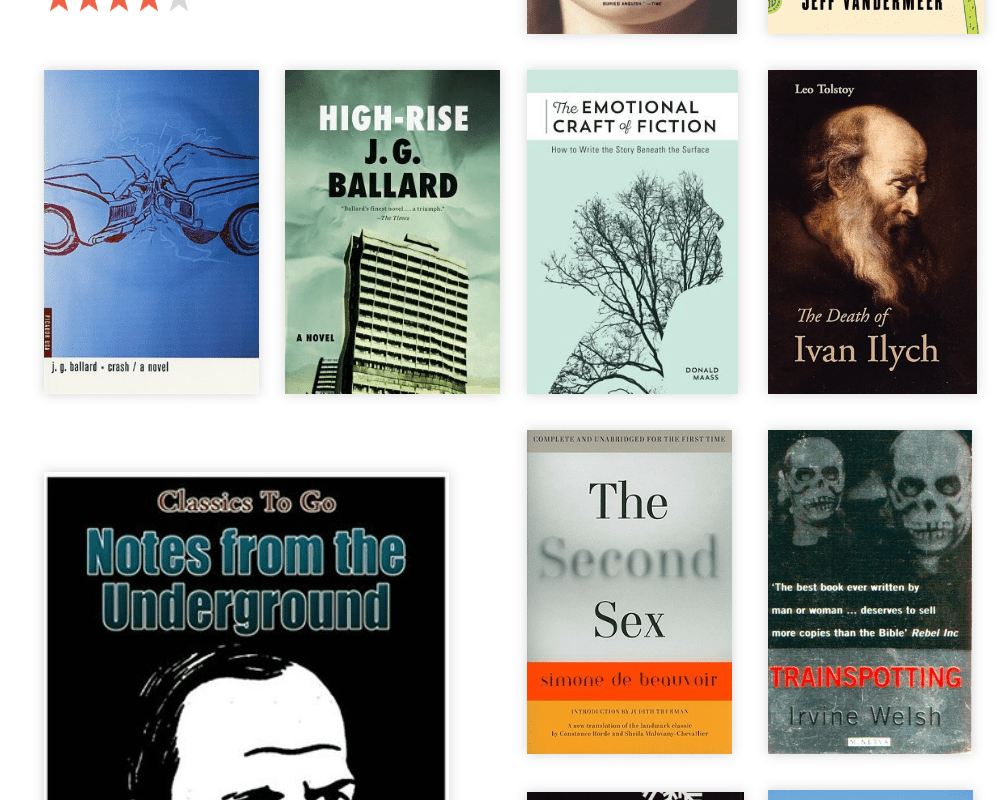
Top (and Bottom) Books Read in 2025

I genuinely loathe top X lists, so let us indulge in some self-loathing. I finished these books in 2026. As you can see, they cross genres, consist of fiction and non-fiction, and don’t even share temporal space. I admit that I’m a diverse reader and, ostensibly, writer. Instead of just the top 5. I’ll shoot for the top and bottom 5 to capture my anti-recommendations. Within categories are alphabetical.

Fiction

Never Let Me Go by Kazuo Ishiguro – A slow reveal about identity, but worth the wait.

Notes from Underground by Fyodor Dostoevsky – Classic unreliable narrator.

There Is No Antimemetics Division by QNTM (AKA Sam Hughes) – Points for daring to be different and hitting the landing.

Trainspotting by Irvine Welsh – Scottish drugs culture and bonding mates narrative.

We by Yevgeny Zamyatin – In the league of 1984 and Brave New World, but without the acclaim.

Nonfiction

Capitalist Realism by Mark Fisher – Explains why most problems are social, not personal or psychological. Follows Erich Fromm’s Sane Society, which I also read in 2025 and liked, but it fell into the ‘lost the trail’ territory at some point, so fell off the list.

Moral Politics by George Lakoff

Technofeudalism by Yanis Varoufakis – Explains why Capitalism is already dead on arrival.

NB: Some of the other books had great pieces of content, but failed as books. They may have been better as essays or blog posts. They didn’t have enough material for a full book. The Second Sex had enough for a book, but then poured in enough for two books. She should have quit whilst she was ahead.
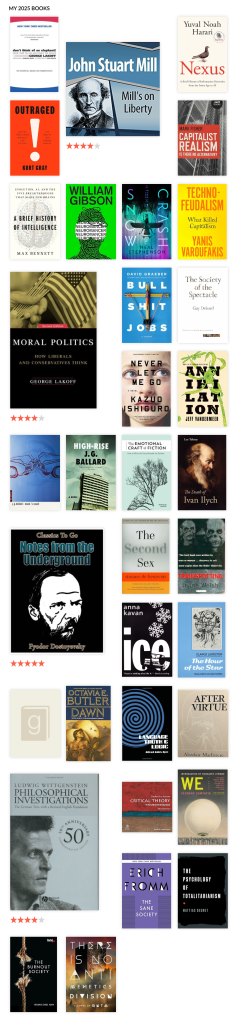
Image: Books I read in 2025 on Goodreads.
Full disclosure: I don’t always record my reading on Goodreads, but I try.

Bottom of the Barrel

Crash by J.G. Ballard – Hard no. I also didn’t like High-rise, but it was marginally better, and I didn’t want to count an author twice.

Neuromancer by William Gibson – I don’t tend to like SciFi. This is a classic. Maybe it read differently back in the day. Didn’t age well.

Nexus by Yuval Harari – Drivel. My mates goaded me into reading this. I liked Sapiens. He’s gone downhill since then. He’s a historian, not a futurist.

Outraged by Kurt Gray – Very reductionist view of moral harm, following the footsteps of George Lakoff and Jonathan Haidt

Society of the Spectacle by Guy Debord – A cautionary tale on why writing a book on LSD may not be a recipe for success.

Honourable Mention

Annihilation by Jeff VernderMeer was also good, but my cutoff was at 5. Sorry, Jeff.

Ballard’s High-Rise: When Brutalism Meets Behavioural Collapse


I’ve been reading J.G. Ballard’s High-Rise (1975), a brutalist fever dream dressed in concrete and ennui. It’s a story that doesn’t so much depict a descent into chaos as suggest that chaos is the natural state, politely waiting in the wings until the lift stops working and someone pees in the pool.

Audio: NotebookLM podcast on this topic.

This isn’t horror in the Stephen King sense—there’s no room 1408 here, no haunted sheets or malevolent chandeliers. The building isn’t animated; it’s engineered. But like all great systems, it doesn’t need a soul to kill you. The real haunting, as ever, is society itself. Ballard simply does away with the need for ghosts and lets architecture and aspiration do the dirty work.

Compared to Crash—where characters make love to car crashes and each other with equal mechanical indifference—High-Rise has something resembling a cast. I say “resembling” because these aren’t people so much as archetypes on a descent escalator. There’s Laing, a kind of blank-eyed anthropologist; Wilder, who mistakes brute force for authenticity; and Royal, the man literally living in a penthouse and metaphorically in a delusion.

Do I care about them? Not in the slightest. But that might be Ballard’s point. Their motivations are as shallow as a puddle in the car park after the water’s been shut off. Much of the action feels contrived, like a staged rehearsal for an apocalypse that already happened.

And yet—isn’t that precisely what society is? A tepid soup of extrinsic motivators dressed up in motivational posters and mission statements. Nobody in the high-rise acts out of depth or conviction. They act because someone else did it first, because no one told them not to, or because the lift only goes so far down and what else is there to do?

If Crash explored the eroticism of the machine, High-Rise explores the nihilism of comfort. Ballard’s thesis seems to be that civilisation is little more than a thin laminate over our baser instincts—and once it peels, there’s nothing underneath but turf wars and brand loyalty to floor numbers.

The modern reader might recognise the high-rise in everything from gated communities to Meta’s metaverse: sanitised, stratified, severed from consequence. A self-cleaning coffin of convenience.

And, as in the United States today, it all comes heavily medicated and prettily lit—with lipstick, meet pig.