Needle’s Edge: Narrative Origami

man typing in a room of spaghetti

Editing Needle’s Edge has taken longer than the time it took to draft the damned thing. Typical, I suppose, but demoralising all the same. Drafting is a rush; editing is a grind. In video game parlance, this is the endless dungeon crawl. Kill the same mob again and again, collect marginal XP, and hope that –eventually – you level up.

Recently, I wrestled with the narrative structure, which was starting to feel like Inception with a side order of Russian dolls. Flashbacks within flashbacks within flashbacks. I diagrammed it, mostly to convince myself I hadn’t lost the plot (see exhibit A, below).
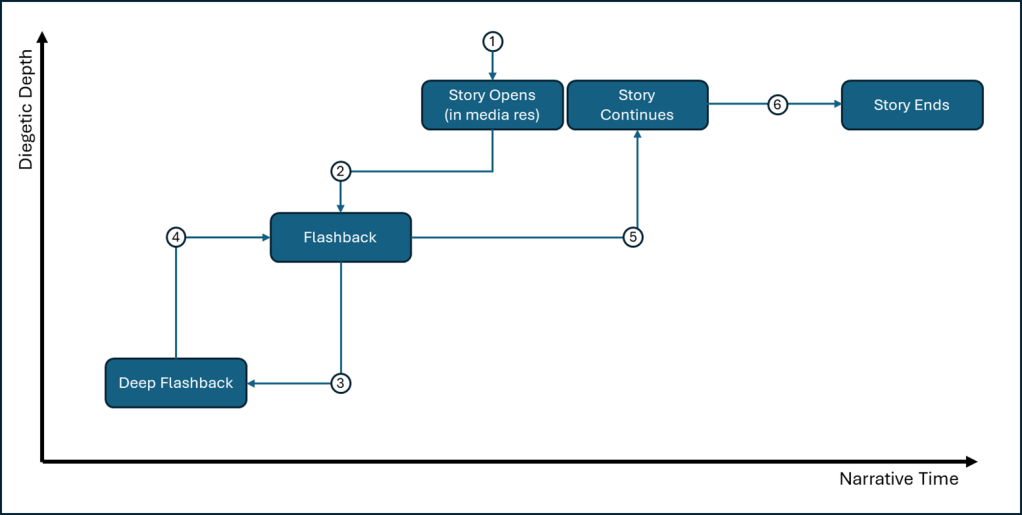
Image: Chronological and Sequential Timeline Abstraction

Here’s the lay of the land—without spoilers, of course. The story begins [1] in medias res, with Sarah-slash-Stacey already entrenched in her daily grind. Then comes [2] the flashback, showing how she arrived there. Midway through, we plunge into [3] a deep flashback of her childhood, before [4] snapping back to the mid-flashback, then finally [5] rejoining the present-day storyline until [6] the bitter – or possibly bittersweet – end.

Naturally, I subvert as many tropes as I can, though no one can write a tropeless story any more than they can write one without words. (I’m sure some post-structuralist is trying right now, but God help their readers.)

The hardest part wasn’t constructing the labyrinth but finding my way out again – reengaging with the present-day thread after chapters of detour without resorting to that televisual clanger: “We now return to our regularly scheduled programming.”

Editing a book like this is less polishing and more archeology: chiselling away sediment, brushing off centuries of dust, desperately hoping not to snap the artefact in half. With luck, the grind pays off. If not, at least I’ll have a lovely flowchart to show for it.

Editing is a Vicious Sport

Measuring progress is far simpler when you’re writing. You can count words. Or characters, if you’re a sadist. Sure, half of them might be drivel. Whole chapters may end up ceremonially executed by draft five, but at least you’ve done something. There’s a metric. A tally. A sense of movement.

Audio: NotebookLM podcast on this topic.

You can even see your progress, pages stack, paragraphs grow fat with promise. And if you still write on physical media (bless your nostalgic heart), you get the added catharsis of crumpling your failures and lobbing them at the bin like a disgruntled poet. It’s theatre. It’s progress. It’s delusional.

Editing, by contrast, offers no such cheap thrills. The word count doesn’t so much creep as collapse. One minute you’re a literary demi-god sitting on 80,000 words. The next, you’re scraping along at 74k and wondering whether your “tightening” has amputated a limb.

Yes, the prose might be cleaner. Punchier. Less like a whisky-soaked rant and more like a distilled insult. But does it feel like progress? Not in the way dopamine understands it.

As I’ve written before, editing takes me five – maybe ten – times longer than drafting. It’s a full hemispheric shift: from right-brain dreamscapes to left-brain bureaucracy. Creativity gives way to spreadsheet logic. Grammar. Timelines. Continuity. Did she sit before she spoke, or after? Is this line meant to be his? Why is this in past tense? Is this in any tense?

And so, the grind.

Yes, there are flashes of satisfaction – a retooled transition here, a twist landed just-so there. But mostly, it’s a long, slow crawl through self-loathing and misplaced modifiers.

I’ve spent most of my adult life toggling between left-right hemisphere roles. And frankly, the left side still gives me hives. The corporate world, bless its hollow soul, tried to stuff me in a logic-shaped box. A coffin of metrics, meetings, and “measurable outcomes.” I’m still recovering.

So why not outsource editing? Why not let someone else swing the machete through this jungle?

Two reasons:

  1. I secretly enjoy the act of refinement. It’s masochism, but it’s my masochism.
  2. I operate on a margin so thin it’s practically theoretical. A Schrödinger’s budget – simultaneously there and not.

Still, the margin’s probably winning.

Spreadsheet Says No

I was feeling smug. Fourth revision pass. Plot matrix built. Columns for chapter, scene, POV, date, time, location, word count, and emotional arc – because I’m that kind of monster. I even added colour-coding.

And it worked. Mostly.

After pruning and polishing, it finally felt ready to ship. Just a couple cosmetic tweaks. A trim here, a varnish there. Run a lint roller over the dialogue. Call it done.

Except.

The matrix – traitorous little bastard – exposed a structural fault so elegant I’d almost admired it. The problem? Pregnancy. Not mine, the protagonist’s. (Let’s not get ahead of ourselves.)

Turns out, I’d compressed over a decade of real-life events into two years of narrative space. Bold. Efficient. Reckless. I’d wrung out the filler, reshuffled a few puzzle pieces, and declared the thing plausible.

Only it wasn’t.

When I sorted the scenes chronologically, the matrix coughed. The story broke like a cheap lawn chair. There she was: visibly pregnant while also, somehow, gallivanting about in scenes that would’ve required a different physiology entirely. Not an Olympian, but the metaphor holds.

And that’s when it hit me: time may be a flat circle, but gestation is not. No amount of POV tricks or narrative backflips can make a third-trimester body do first-trimester things. Biology, the ultimate killjoy.

So now I’m doing surgery. Not delicate surgery, either. I’m sawing out whole sections, rebuilding connective tissue, and laying down scar tissue where the timeline used to be. I’ll need new plot scaffolding to support the pregnancy and its repercussions. It’s fine. It’s good. It’s hell.

This is revision. We go in thinking we’re buffing up the finish, only to discover we paved over a sinkhole.

Lesson of the week: spreadsheets don’t lie.

They just lie in wait.