Should You Make an Audiobook?

1–2 minutes

John Hartness, from Falstaff Books, recently noted that not all books translate well to audio. He’s right, and this isn’t a fan letter, just a nod to the truth of it. Every format has its own physics. Some stories bend beautifully. Others snap.

Video: John Hartness discusses the ins and outs of audiobooks.

Propensity is one of the snappers. It doesn’t behave on Kindle, either. That’s less a fault of the text than the medium. Its structure and typography do a lot of the storytelling, and when those are flattened to fit an algorithmic page template, something human is lost. I include the visual material as a PDF for the curious, but the audiobook can only gesture at what’s missing. No amount of verbal description replaces the architecture of the page.

Audio: NotebookLM podcast on this topic.

I listen to audiobooks constantly – commuting used to be my second job – but there’s a difference between hearing a story and parsing a spreadsheet by ear. Nonfiction especially suffers: tables, diagrams, anything spatially meaningful. Description isn’t substitution; it’s triage.

Musicians met this problem decades ago. When the Beatles stopped touring in 1966, it wasn’t vanity; it was liberation. They no longer had to replicate their studio work on stage. Garbage later flipped that logic: they engineered songs to survive live. The same divide holds for writers. Some build books that breathe on paper. Others craft ones that perform well through speakers. Neither camp is wrong.

When I produced records, my job was to capture the best possible experience – not the most ‘authentic’ performance. Now, with digital tools, some artists never play their own songs from start to finish until tour rehearsals. The copy-paste perfection of ProTools turns spontaneity into ornament. E-books and AI summaries do the same for text—efficient, portable, bloodless.

So, yes, formats matter. They always have. Paper isn’t just nostalgia; it’s part of the meaning. And while I’m happy to share Propensity however readers find it, I know where it breathes best: between real pages, under real light, in the one format that doesn’t pretend to be frictionless.

Why I Create Audiobooks for All My Books

This isn’t a promotional post. I’ve recently discovered the hidden value of audiobooks—and it has nothing to do with selling them.

Back in 2024, when I released Hemo Sapiens: Awakening, I must have read the manuscript a thousand times. I even recorded an audiobook, using an AI voice from ElevenLabs. At the time, Audible wouldn’t accept AI narration. The rules have since changed. It’s now available—though still not on Audible (and therefore not on Amazon).

I’d hired a few proofreaders and beta readers. They helped. The book improved. And yet, even after all that, I still found typos. Those bastards are insidious.

The real revelation came when I started listening.

Since I’d already created the audiobook, I began proofreading by ear. That’s when it hit me: hearing the story is nothing like reading it. Sentences that looked fine on the page fell flat aloud. So I rewrote passages—not for grammar, but for cadence, clarity, flow.

Then came the second benefit: catching mistakes. Typos. Tense slips. I favour first-person, present-tense, limited point of view—it’s immersive, intimate, synchronised with the protagonist’s thoughts. But sometimes, I slip. Listening helped catch those lapses, especially the subtle ones a skim-reading brain politely ignores.

For Sustenance, the audiobook was an afterthought. I submitted the print files, requested a proof copy, and while I waited, I rendered the audio. When the proof arrived, I listened instead of reading. I found errors. Again. Thanks to that timing, I could fix them before production. Of course, fixing the manuscript meant updating the audiobook. A pain—but worth it.

I hadn’t planned to make an audiobook for Propensity—some of the prose is too stylistic, too internal—but I did anyway, because of what I’d learned from Sustenance. And again, I found too many errors. Maybe I need better proofreaders. Or maybe this is just the fallback system now.

I’ve had Temporal Babel, a novelette, on hold for months. I won’t release it until I do the same: make an audiobook, listen, reconcile with the page.

Lesson learned.

I’ve got several more manuscripts waiting in the wings—some have been loitering there for over a year. Their release has been deprioritised for various reasons, but when they go out, they’ll have audio versions too. Not for the sake of listeners. For me.

Honestly, I should do this for my blog posts as well. But editing on the web is easier. The stakes are lower. Mistakes don’t print themselves in ink.

Propensity Excerpts

I’ve recently released a new book, Propensity. In preparation for the audiobook version, I’ve assembled some material for PDF that doesn’t convey well in an audible format – this image, for example, from Chapter 43.

This image depicts a frantic ink sketch of a woman’s face, wide-eyed and stricken, as if caught in the instant her world unravels. Her features are carved from chaos—lines scribbled in anguish, as though the act of drawing itself were a desperate grasp for meaning.

The PDF is available for free on the dedicated Propensity page.

I’ll be posting content on Propensity as well as some of my other recent and upcoming releases presently.

Barely Audible

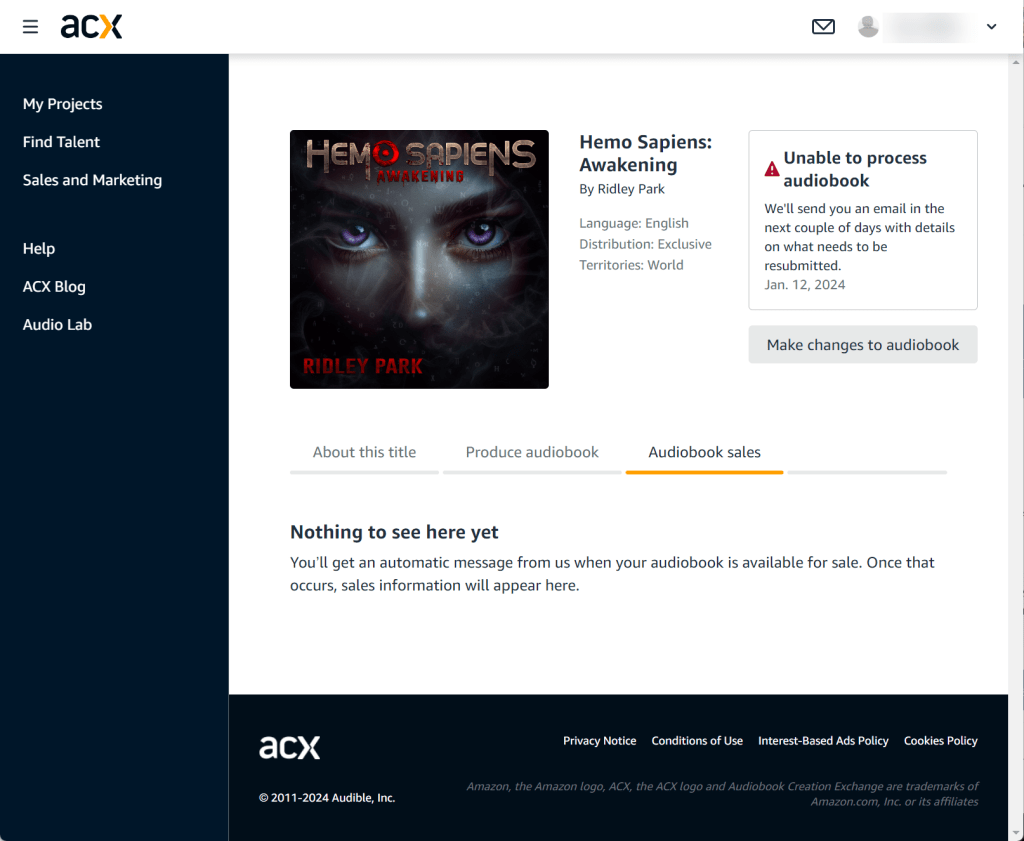
So this happened. I submitted Hemo Sapiens: Awakening as an audiobook, and it was rejected. The site says that they’ll let me know why in a couple days. My question is: if you rejected it, don’t you immediately know why?

I think I know why, but I can’t ‘fix’ the problem if I don’t know what it is. I don’t want to act on an assumption.

I believe they’ll inform me that I can’t use AI-generated narration. This would be odd because they have a programme in Beta where they provide the service of automatically converting the text of a book to audio. To be honest, it doesn’t sound amazing. It appears that they are using their own Amazon Polly, which I like, but you need to babysit it hard. It is very unlikely to sound good without heavy hand-holding. As it is, I hand-held my ElevenLabs AI to make the outcome sound like a professional human.

Audible offers some voiceover actors, but I didn’t like any of them, and they couldn’t compete with my ElevenLabs voice. I can understand that they don’t want to sell audiobooks that sound like Stephen Hawking, but theirs sound closer to him than mine.

On another note, I had to render and upload square cover art. There was a stated restriction disallowing padding a rectangular cover image with space or colour to make it square. I followed this rule, but this is exactly what they do. They take the cover of the book you’re selling through Amazon, and they pad the left and right margins with filler colour. I may append the rationale they provide once I’ve received it. Until them, my audiobook is on hold.