What’s With the Violet Aliens?

🛸 A Closer Look at the Cover of Sustenance

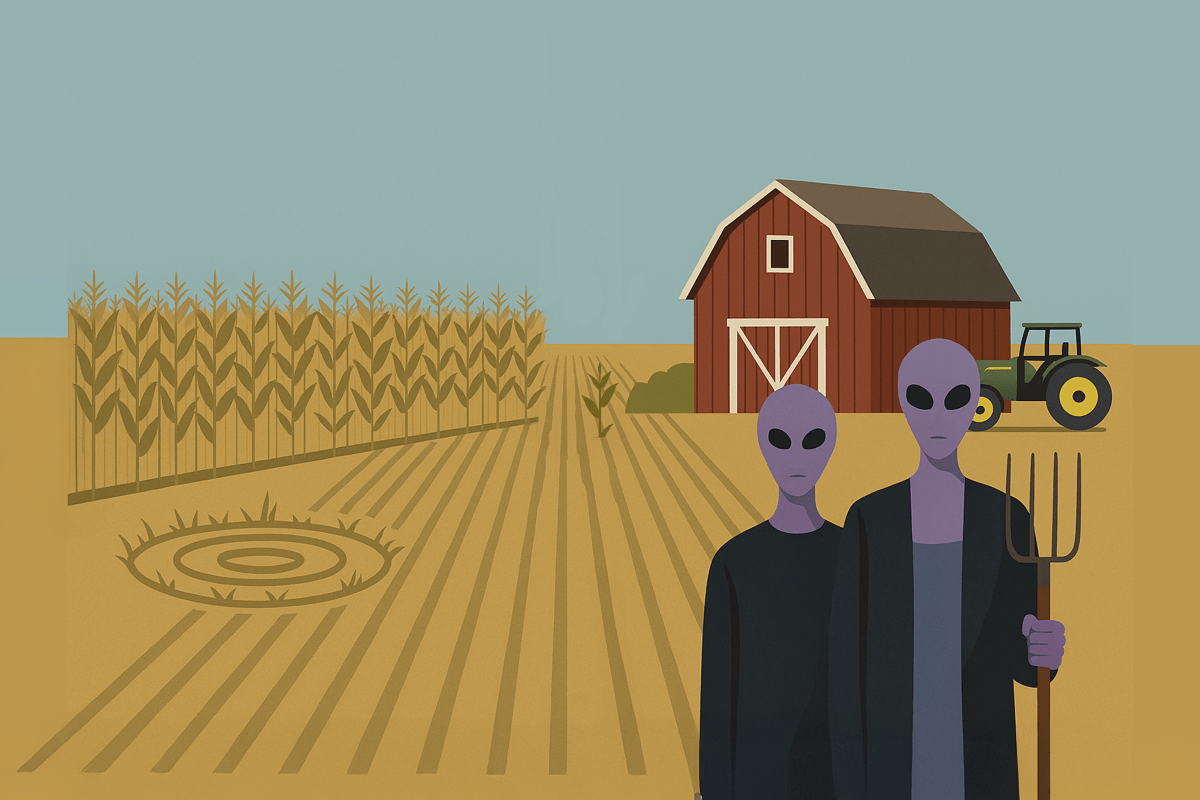
👽 People ask me: What’s with the aliens on the front cover of Sustenance?
Fair enough. Let’s talk about it.

Sustenance is set in Iowa – real, dusty, soybean-and-corn Iowa. I’ve spent months there. I’ve lived in the Midwest (including Chicago) for over a decade. The farms, the tractors, the gravel roads… they aren’t just set dressing. They’re part of the book’s DNA.

So, yes: we’ve got the requisite red barn, green tractor with yellow wheels (hi, John Deere 🚜), and a crop circle or two. The audiobook cover even features an alien peeking out of the barn – though logistics are holding that version back for now.

But those aliens…

If the composition feels familiar, it should.

The cover is a quiet parody of Grant Wood’s “American Gothic – a pitchfork-wielding farmer and his companion, stoic before their rural home. It’s one of the most recognisable paintings in American art, and I couldn’t resist twisting it just slightly. Grant was an Iowa boy.

I designed this cover using a flat vector art style, almost like cut paper or stylised children’s book illustrations. The sky is cyan, the land is beige, and everything is built in clean layers: barn, tractor, field, crop circle, and of course… two violet, large-eyed aliens striking a pose.

But no, this isn’t a literal scene from the book. You might encounter violet aliens in Sustenance, but you won’t find them standing around with pitchforks like interstellar Grant Wood impersonators. The image is meant to evoke the tone, not transcribe the events.

Why this style?

Because the story itself is quiet. Subtle. Set in the kind of place often overlooked or written off. The aliens aren’t invading with lasers. They’re… complicated. And the humans, well, aren’t always the best ambassadors of Earth.

The cover reflects that blend of satire, stillness, and unease.

Oh, and one last note:
🛑 No aliens were harmed in the writing of this book.

High Horses and Low Bars: AI, Literature, and the Pretence of Purity

The hand-wringing over AI-assisted writing has become the new parlour game for those with literary pretensions. You’ve heard the refrain: It’s not real art. It’s cheating. It’s not proper literature. The pearl-clutchers imagine themselves defending the sanctity of the novel against an onslaught of silicon scribblers, as though Wordsworth himself might be weeping in a Lake District grave at the indignity of a chatbot helping you outline Chapter Three.

Audio: NotebookLM podcast about this topic

Here’s the problem: most art isn’t high art, and most writing isn’t literature. Perhaps yours, possibly mine, but most books sold today don’t even aspire to qualify as literature except in the broadest of terms – having been read. The majority of books on the shelf, those stacked to the rafters in airport WHSmiths and sprawled across the Kindle top-sellers list, are to literature what chicken nuggets are to fine dining. Perfectly enjoyable, but you don’t see Heston Blumenthal demanding they be served in a Michelin-starred tasting menu.

And that’s fine. Truly. Because the vast majority of readers aren’t combing through your prose for transcendence or stylistic innovation. They’re not here to wrestle with postmodern irony or wrest meaning from a fragmented narrative. They’re here to escape the tedium of their commute, to zone out after a long day, to gobble up familiar tropes like comfort food. Sometimes they want plot, sometimes they want romance, sometimes they want dragons and space marines and improbably muscular men named Rafe. What they don’t want is a lecture on the ontological integrity of the creative process.

The AI panic brigade, however, would have you believe that unless your novel was forged through the arduous labour of pen and paper, or at least a keyboard, with the requisite quota of caffeine and self-loathing, it cannot possibly be authentic. To which I say: nonsense. We’ve been “cheating” for centuries. Typewriters. Word processors. Spellcheck. Thesauruses. Collaborative editing. Ghostwriting. For heaven’s sake, most of your favourite “high art” authors had assistants, editors, or outright amanuenses polishing their sentences into the very state of grace you now venerate.

There’s also the small matter of motive. Very few writers are chasing pure artistic expression, many are chasing rent money, Amazon rankings, or a book deal that might finally cover their overdraft. That’s not cynicism, that’s survival. And survival has never given a toss about whether the means of production are sufficiently Romantic for the sensibilities of the literati.

If anything, AI merely exposes the uncomfortable truth: most writing is a craft, not a sacrament. It’s a process of assembling words into a functional, sometimes moving, occasionally transcendent arrangement. And like all crafts, it has tools. Some tools are chisels, some are typewriters, and now some happen to be algorithms with more patience than your average beta reader.

So, if someone wants to use AI to crank out the next mass-market thriller, let them. It’s not threatening literature because it was never in literature to begin with. And if they want to use it to experiment, to push boundaries, to hybridise forms, that’s art too. High or low, it all ends up in the same place: on a page, waiting for someone to care enough to read it.

Ballard’s High-Rise: When Brutalism Meets Behavioural Collapse


I’ve been reading J.G. Ballard’s High-Rise (1975), a brutalist fever dream dressed in concrete and ennui. It’s a story that doesn’t so much depict a descent into chaos as suggest that chaos is the natural state, politely waiting in the wings until the lift stops working and someone pees in the pool.

Audio: NotebookLM podcast on this topic.

This isn’t horror in the Stephen King sense—there’s no room 1408 here, no haunted sheets or malevolent chandeliers. The building isn’t animated; it’s engineered. But like all great systems, it doesn’t need a soul to kill you. The real haunting, as ever, is society itself. Ballard simply does away with the need for ghosts and lets architecture and aspiration do the dirty work.

Compared to Crash—where characters make love to car crashes and each other with equal mechanical indifference—High-Rise has something resembling a cast. I say “resembling” because these aren’t people so much as archetypes on a descent escalator. There’s Laing, a kind of blank-eyed anthropologist; Wilder, who mistakes brute force for authenticity; and Royal, the man literally living in a penthouse and metaphorically in a delusion.

Do I care about them? Not in the slightest. But that might be Ballard’s point. Their motivations are as shallow as a puddle in the car park after the water’s been shut off. Much of the action feels contrived, like a staged rehearsal for an apocalypse that already happened.

And yet—isn’t that precisely what society is? A tepid soup of extrinsic motivators dressed up in motivational posters and mission statements. Nobody in the high-rise acts out of depth or conviction. They act because someone else did it first, because no one told them not to, or because the lift only goes so far down and what else is there to do?

If Crash explored the eroticism of the machine, High-Rise explores the nihilism of comfort. Ballard’s thesis seems to be that civilisation is little more than a thin laminate over our baser instincts—and once it peels, there’s nothing underneath but turf wars and brand loyalty to floor numbers.

The modern reader might recognise the high-rise in everything from gated communities to Meta’s metaverse: sanitised, stratified, severed from consequence. A self-cleaning coffin of convenience.

And, as in the United States today, it all comes heavily medicated and prettily lit—with lipstick, meet pig.

Against the Grain

As a writer, I fully embrace the digital age – word processors, AI, eBooks, print-on-demand, and so on. Still, I like to proof my drafts on paper. I also render audio with ElevenLabs, so I can hear the flow. You might be surprised how often that picks up awkward phrases and typos. I’ll save this for another post.

I find that printing double-sided on A5 creates just the right form factor for a paperback. A problem is that the grain is running the wrong way. This means that the pages curl horizontally, left to right. You want the page to curl to to bottom, especially if you want to bind it in book or booklet.

A solution to this is to print to A4 in a booklet form, and then fold the pages into a booklet. The result is a book having an A5 page size. And, the grain is now vertical, top to bottom, eliminating that pesky curl.

I take two approaches to this A4 technique.

First: Print a sheet containing four pages at a time, e.g., 1, 2, 3, and 4. This creates pages, 4 and 1 on the obverse and and 3 and two on the reverse. When folded, the pages are ordered as expected for a book.

TIP: Ensure you’ve set your printer to landscape and use a booklet template. I tend to print to PDF first, and use its format settings.

Rinse and repeate for pages 5 to 8, in counts of four. Stacked and ordered, you’ve got a booklet. The beenfit of this approach is that you can stack as many of these as you like until you’ve got all your entire book printed. Use a long stapler or pinch binders to fasten.

TIP: Be sure to account for a gutter, especially for books with more pages, so your text doesn’t get lost in the fold and is presents as expected.

Second: Print two of four sheets at a time. I recommend four but no more. Printing four A4 pages in a booklet format creates a 16-page booklet. And you thought, you’d never need to use maths out of school. The reason I recommend no more than four sheets is that the page ends don’t align well with more. The page ends start getting a curvature. Again, more maths. This is not an issue printing the previous style, but you need to keep it in mind here.

With four sheets at a time, the book is incremented (obviously) in groups of sixteen, so your finished booklet should be a multiple of sixteen. Blank pages at the start and end are fine. Consider a faux cover of sorts.

Also, of you only need a pamphlet – say, sixteen pages – you’re in luck.

In a Bind

If you want to be a real fancy pants, you might considering binding the pages. Say you want to create a bound novella for freinds and family. Punch holes through the folds, and stitch them together. This is fancier than staples.

Stack a series of 16, 32, 48, 64, and so on to create your book. If you have access to a binding machine, create a cover with heavier card stock and wrap it around, fixing it with adhesive.

The cover will need to be larger than A4 because of the aforementioned size problem. Plus, you’ll need to account for the thickness of all of the pages. B5 or even Legal-sized paper may be a solution. I haven’t done it or the maths, so this will be your assignment.

Parting Shots

You may be able to create a booklet with Letter and Landscape paper as long as you are OK with the final dimensions.

You may also be able to find A5 paper with a top-to-bottom grain, in which case, use it. You can settle with standard A5 sheets, but just know that you may be quickly frustrated when your pages start turing in.

Note: A4 and A5 are standard in the world except in the United States, where is is difficult to find and priced significantly higher there. If you know a source of decent quality A4 or A5 paper in the US, let me know in the comments.

Exowombs

A challenge with beginning a story in media res and then writing a prequel, is that one is able to kick the creative can down the kerb and cross the bridge when you come to it. I’ve painted myself into a few corners, but exowombs, or artificial wombs, are one of them.

Being speculative fiction, I have some leeway, but I need to make some plausible connexions. Exowombs have existed for a few years now, but they are for premature infants and animals, so my literary licence needs to stretch that. To be honest, when I was contemplating things at a fifty-thousand-foot level, I was going from test tube to petri dish to incubator, but I overlooked the gestation bit. Oopsie. My bad.

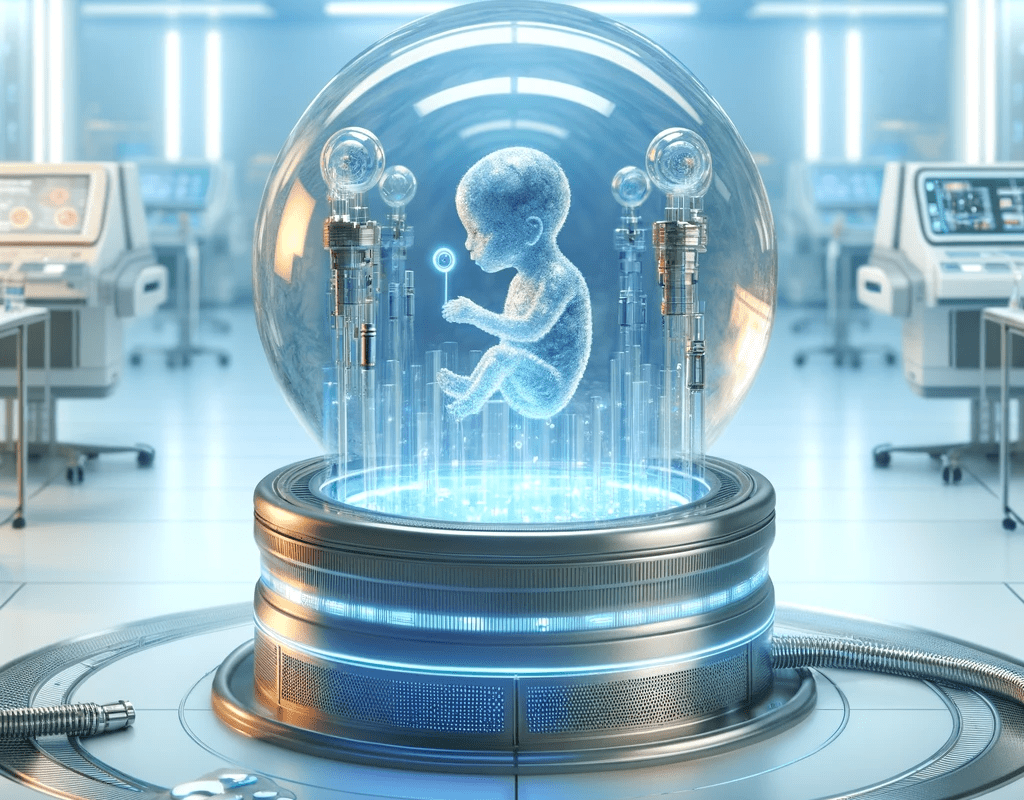
This is not a work of hard science fiction, so I can take liberties there as well. I just hadn’t researched the current state of science until now. I’ve got a plot device in place, and it seems I’ve got some ideas for early concept and cover art that I can share here.

I rendered these with Dall-E 3. By default, it chose a green hue. I modified it to blue, and I wanted to see how it looked in violet to match their irises—this being an artistic rather than scientific choice. Bubbles in cylinders suspended with wires and tubes.

Violet Gestation Cylinders

Rendering these early can also help me to write descriptive prose with visual references. Dall-E seems to have a thing for spheroids, so I asked it for cylinders instead. I do like this one.

Blue Exowomb

My first correction got me to here. I like the metaphor of the egg membrane encasing the foetus in the tube.

Cylindrical Exowomb

Next, I wanted to envisage multiple cylinders with perspective, so I got these two.

Exowombs in Perspective

The problem I have is that it seems to be too large of a scale, but it’s still cool. We seem to have lost the egg-shaped membrane by now.

Industrial Production of Foetuses in Exowombs

Before settling on violet, I wanted to see what six across looked like. Dall-E’s maths skills are pretty dodgy, so this is what six looks like to it. You’ll notice that the violet render at the top does contain six.

Seven Exowombs in a Row

I don’t have much to say beyond sharing these images. I don’t want to give too much away, but I am excited to be writing Chapter 5 where these are relevant to the narrative in play.

What do you think of the images? Let me know in the comments.