
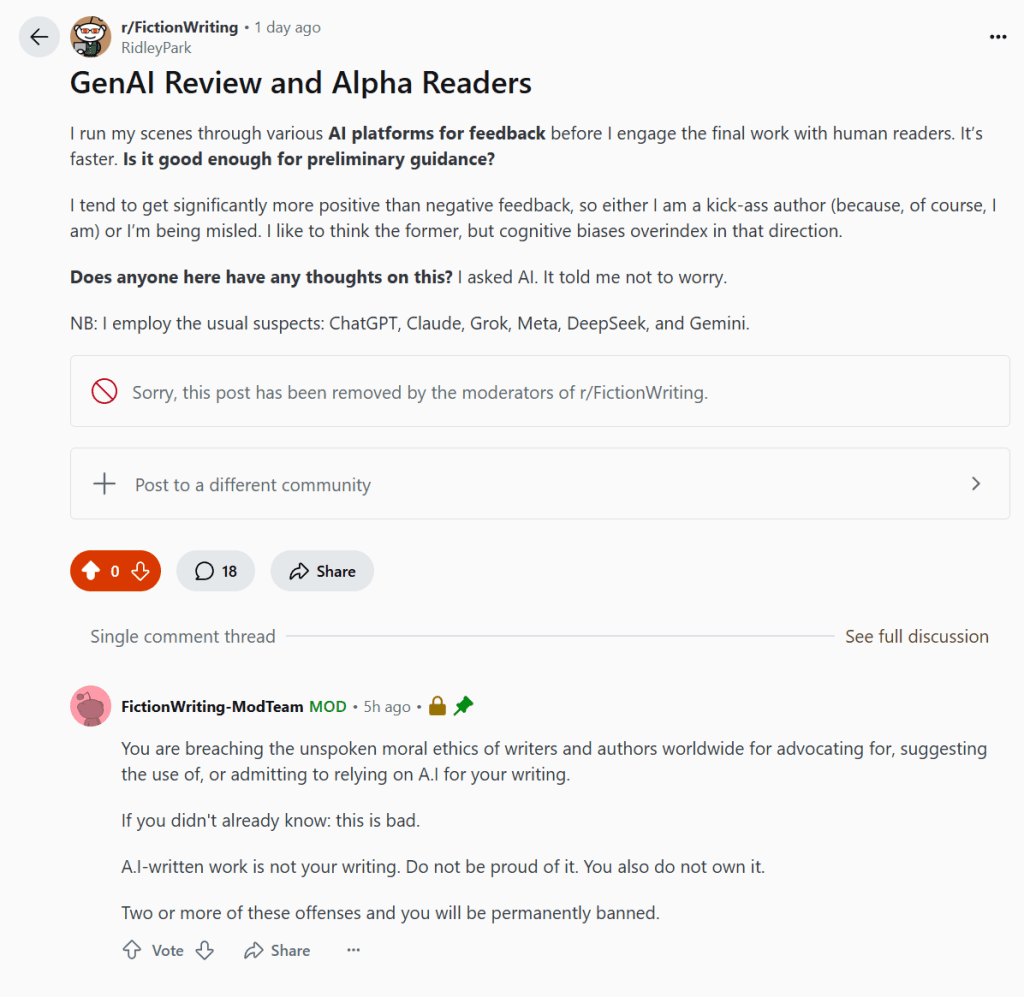
The hand-wringing over AI-assisted writing has become the new parlour game for those with literary pretensions. You’ve heard the refrain: It’s not real art. It’s cheating. It’s not proper literature. The pearl-clutchers imagine themselves defending the sanctity of the novel against an onslaught of silicon scribblers, as though Wordsworth himself might be weeping in a Lake District grave at the indignity of a chatbot helping you outline Chapter Three.
Here’s the problem: most art isn’t high art, and most writing isn’t literature. Perhaps yours, possibly mine, but most books sold today don’t even aspire to qualify as literature except in the broadest of terms – having been read. The majority of books on the shelf, those stacked to the rafters in airport WHSmiths and sprawled across the Kindle top-sellers list, are to literature what chicken nuggets are to fine dining. Perfectly enjoyable, but you don’t see Heston Blumenthal demanding they be served in a Michelin-starred tasting menu.
And that’s fine. Truly. Because the vast majority of readers aren’t combing through your prose for transcendence or stylistic innovation. They’re not here to wrestle with postmodern irony or wrest meaning from a fragmented narrative. They’re here to escape the tedium of their commute, to zone out after a long day, to gobble up familiar tropes like comfort food. Sometimes they want plot, sometimes they want romance, sometimes they want dragons and space marines and improbably muscular men named Rafe. What they don’t want is a lecture on the ontological integrity of the creative process.
The AI panic brigade, however, would have you believe that unless your novel was forged through the arduous labour of pen and paper, or at least a keyboard, with the requisite quota of caffeine and self-loathing, it cannot possibly be authentic. To which I say: nonsense. We’ve been “cheating” for centuries. Typewriters. Word processors. Spellcheck. Thesauruses. Collaborative editing. Ghostwriting. For heaven’s sake, most of your favourite “high art” authors had assistants, editors, or outright amanuenses polishing their sentences into the very state of grace you now venerate.
There’s also the small matter of motive. Very few writers are chasing pure artistic expression, many are chasing rent money, Amazon rankings, or a book deal that might finally cover their overdraft. That’s not cynicism, that’s survival. And survival has never given a toss about whether the means of production are sufficiently Romantic for the sensibilities of the literati.
If anything, AI merely exposes the uncomfortable truth: most writing is a craft, not a sacrament. It’s a process of assembling words into a functional, sometimes moving, occasionally transcendent arrangement. And like all crafts, it has tools. Some tools are chisels, some are typewriters, and now some happen to be algorithms with more patience than your average beta reader.
So, if someone wants to use AI to crank out the next mass-market thriller, let them. It’s not threatening literature because it was never in literature to begin with. And if they want to use it to experiment, to push boundaries, to hybridise forms, that’s art too. High or low, it all ends up in the same place: on a page, waiting for someone to care enough to read it.

 Ridley Park