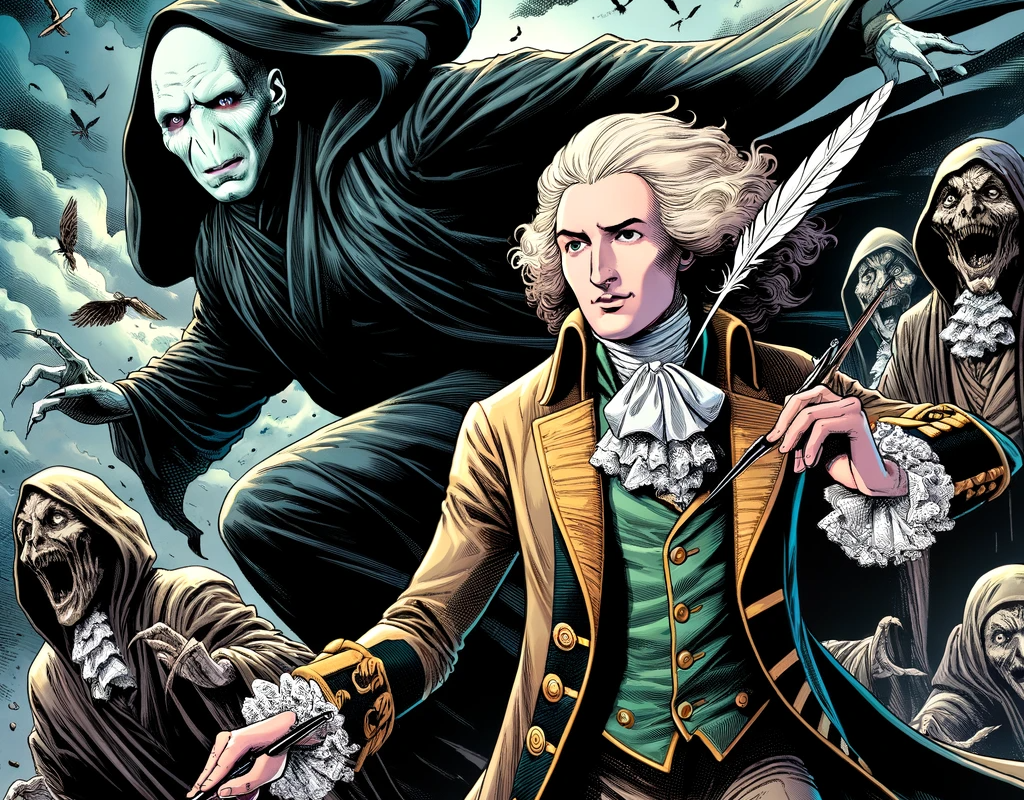
Is Voldemort secretly François-Marie Arouet? I’ve never seen the two in the same place.
I am fleshing out the outline for Hemo Sapiens: Origins and I was sharing a chapter structure with Claude. One of the bullet points cites a quip by Voltaire:
« Si Dieu n’existait pas, il faudrait l’inventer. »
Voltaire
English Translation: “If God did not exist, it would be necessary to invent him”.
I fed the chapter outline to Claude. Among other things, it mentioned this:
Masterful architecture capped with that second Voldemort quote again for anyone tracking!
— Claude
I did a double-take. I re-scanned my copy and looked for a quote that might be interpreted as being said by Voldemort. Alas, there was only one quote—Voltaire’s.
My AI had confused Voldemort with Voltaire. I’ve never seen these two in the same place either, so it could be fact.
I’ve just wrapped up three days of outlining Hemo Sapiens: Origins, the prequel to Hemo Sapiens: Awakening. I feel it’s in a good place to get started.
As I wait to get Beta feedback on Hemo Sapiens: Awakening, I want to continue to make progress in this universe. As of now, my working titles for this series are as follows:
Hemo Sapiens: Origins
Hemo Sapiens: Awakening
Hemo Sapiens: Aftermath
Hemo Sapiens: Epsilon Rising
I know what I want to happen over the arc of Epsilon Rising, and I know some key events for Aftermath, but Aftermath just needs to bridge the gap between Awakening and Epsilon Rising to lend plausibility to the events in Epsilon Rising.
This project was supposed to have been a side-project—a few short stories to cleanse my creative palate. Instead, I imagined a universe and this series. I’m looking forward to returning to my original project after I put this behind me. There is plenty of ground to tread here. For now, I just want to strike when the inspiration is here.
NB: I chose the cover image because the alternate was rendered with human teeth. That’s just going too far. 🤖
This is a wonderful interview with Science Fiction writer, Cory Doctorow, on the desire by some to replace screenwriters with AI. I recommend rewinding to watch the entire clip, but this is cued to his response on AI and writing.
When you see a Hollywood exec saying, effectively, “We want to fire all the screenwriters and replace them with plausible sentence generators’, that’s because, even if the plausible sentence generators aren’t very good, they have this weird hubristic faith in their ability to, through iteration, replace the screenwriter who wrote good dialogue with their own kind of wild-ass ideas. And you know the screenwriter’s experience of getting notes from an executive is already just AI prompting, right? Like, I need you to write me a version of Indiana Jones but in space—and could you make it a horror movie but make the hero a 10-year-old girl, right? That is, you know, your classic executive-to-writer note. And then the writer makes it, and they go, ‘Can you bring in a lovable animal in act two?’ This is just prompting, right? This is just like me writing instructions for removing a grilled cheese sandwich from a VCR in the style of the King James Bible, right? It’s just prompting. And so, you know what you get with automation is not something that’s good but something that doesn’t complain when you try to impose your genius on it. And it’s ever been thus.
— Cory Doctorow
At the beginning of the interview he discusses how he connects with the reader.
I love origin stories. In fact, my next writing project is an origin story.
But that’s a tale for another day. This post is to reveal the reason for the pseudonym, Ridley Park. This story starts in Delaware, where I lived from 2018 until 2023. I often travelled up 95 North to get to the aeroport or Philadelphia. On this drive, a road sign often caught my eye: Ridley Park.
I cached the name to memory, thinking it might make for an interesting character name. Each trip, this was further imprinted and reinforced.
In April 2022, I was writing another novel. The topic is beyond controversial. In fact, I haven’t yet found anyone who’s not abhorred by the concept, so I know I have to publish it when I finish it. Because of the subject matter, I felt a pen name was in order, and I decided to use Ridley Park. To be fair, the unfinished book is set in Philly, so the name felt particularly apt.
I’ll guess that most of us have heard of the film director, Ridley Scott. The connexion is beyond obvious. It maintains the same cadence.
I’ve never visited Ridley Park. All I know is that it’s a suburb south of Philly, and I’ve borrowed the name. In the end, as it turns out, the question was never ‘Who is Ridley Park?’ Rather, it’s ‘Where is Ridley Park?’ all along.
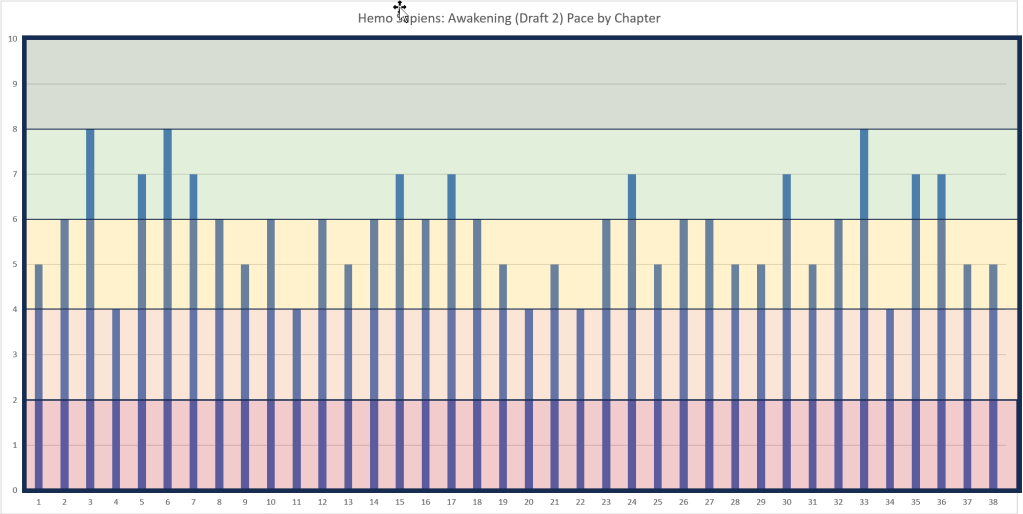
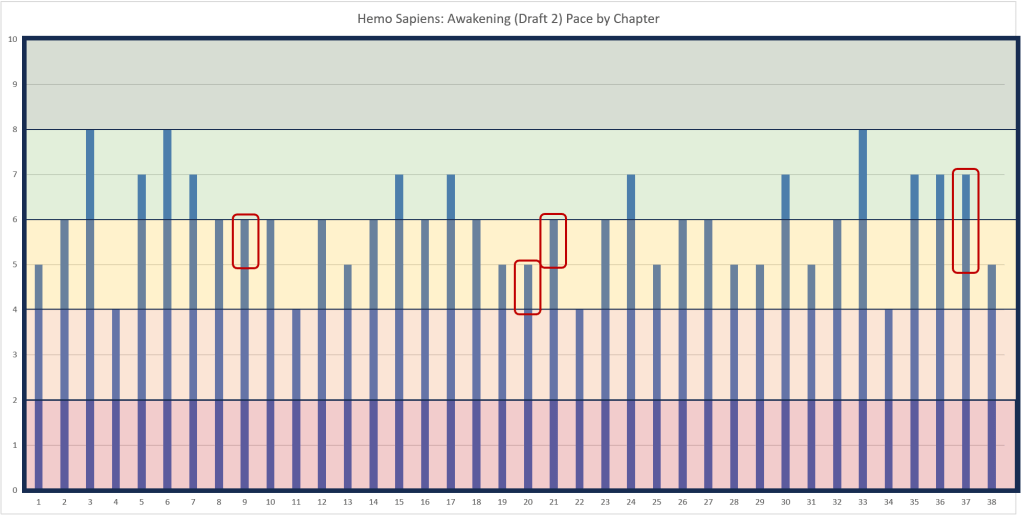
As I review Hemo Sapiens: Awakening and work on the second draft, I asked Claude 2.1 to analyse the pacing of each chapter. This is the result.
Legend
1-2: Very slow, not much happening plot-wise
3-4: Moderately slow pace with some plot development
5-6: Steady pace with a balance of action and exposition
7-8: Fast-paced with lots of plot advancement
9-10: Very fast-paced, intense action or events
The positive news is that I don’t have anything a the glacial pace of 1 and 2. I do have some slothful 4s, but not threes. I’ve got quite a few 5s and 6s, a respectable amount of 7s and a few 8s, with no break-neck 9’s and 10s.
My goal will be to review the 4s to determine if they are intentional. At first glance, I don’t have any consecutively slow chapters, although having sequential 4s and 5s might be problematic. For example, the four chapters 20 to 22 might be too much of a lag in the middle. I’ll need to keep page count into account as ell. There are a handful of very short chapters, so if a few of those are slow, I might just accept it.
As percentages, we’ve got 13% of 4s (5), 29% of 5s (11), 29% of 6s (11), 21% of 8s (3), so it feels OK—generally a steady to fast-paced novel. The pace seems to ebb and flow, so the reader should be able to remain engaged. Obviously, the slower parts of for character development and description, but none of this is just meandering pointlessly.
In the end, this works for me as a diagnostic tool. This is the first time I’ve tried it. It seems like the assessments are fair. As I rewrite, I can try to tighten some of the slower section and see if the pace picks up.
UPDATE: I reworked chapters 8, 20, 21, and 37, increasing the pace of 5 to 6, 4 to 5, 5 to 6, and 5 to 7, respectively. Chapter 37 was boosted to 7 when I added new information to set up downstream conflict. Unfortunately, the conflict won’t payoff until book 3, since the next book,2, will be a prequel—Hemo Sapiens: Origin—, after which this story will continue.
I still have revisions unrelated to pacing, but I’ll measure them as they come and hope not to stall any. At this point, the average is about 6 (not displayed). Of 38 chapters, 89 per cent of the chapters are steady to fast. 11 per cent are moderate—only 4 of them—and none are slow.
I feel this is a good starting place, and I’d be happy to land here.
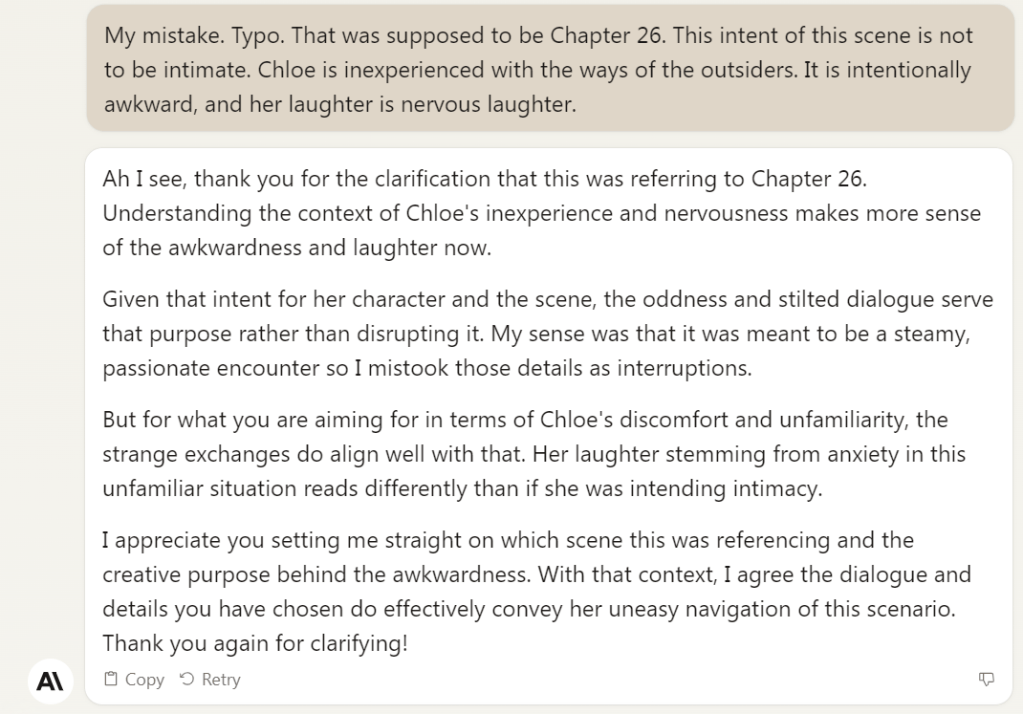
I was chatting with Claude about continuity and flow. I had written an intentionally awkward sex scene and it critiqued some of the activities and, mainly, dialogue. When I asked for clarification, among other things, it returned this:
reworking the banter into flirtier foreplay might heighten the heat of the scene without awkward moments.
— Claude 2.1
Essentially, this was the apology.
Artificial Intelligence doesn’t grasp cultural knowledge. It doesn’t fully grasp irony. It’s like trying to understand a joke from another culture. Without the cultural background, it won’t make any sense.
In another chapter, I asked Claude to analyse a passage that contained a tongue in cheek reference. It didn’t understand why it was humorous.
In yet another, I made a situational reference, and Claude found it amusing, but when I asked why, it was for a reason unrelated. It reminded me of Steve Buscemi’s schoolboy scene on 30 Rock—well out of place.
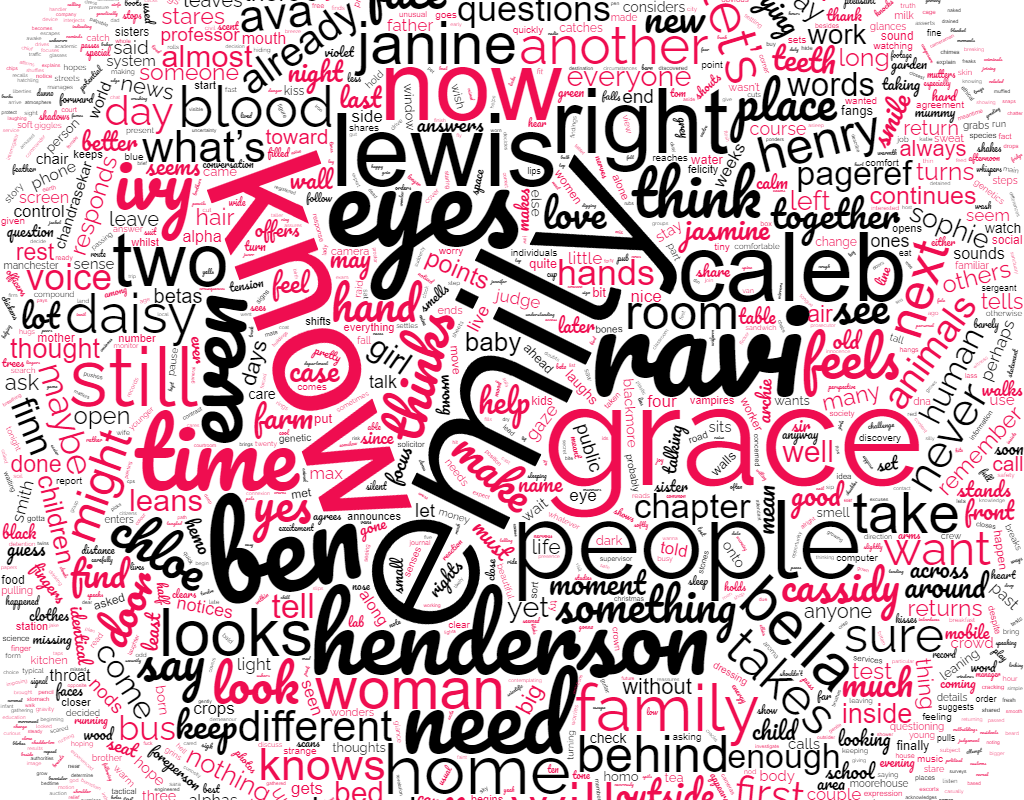
I decided to feed my draft into Wordclouds.com, and this is what I got.
Most of the words with the highest frequency are character names: Emily, Ben, Ravi, Bella, Caleb, Lewis, and Henderson. If you want to get a feel for these or major thematic elements, check it out.
I was very disappointed to discover that characters don’t roll over into a new month’s subscription.
What happens to my subscription and quota at the end of the month?
Your subscription will automatically renew with each billing cycle and your characters will reset.
The unused quota does not roll over as it is a subscription-based service and the quota is an allotment for that month only. The only time where the quota rolls over is if you upgrade your subscription in the middle of an ongoing cycle, in which case the remaining quota will be added to the new cycle.
Italics are mine. Luckily for me, I tend to use most of my characters anyway. Last month I had 300-some-odd left over, but when I checked my balance, I only had the 100,000 for the month. This is what their Help page said.
300 characters is barely two sentences, but I could have, IDK, recorded some chapter titles and save those characters for actual prose.
It’s a good thing I read this. I was thinking of saving up a few months and knocking out an audiobook. For now, that’s not an available option. I’ll need to pay for the next subscription level. #SadPanda
For now, I’ve recorded 11 of 38 chapters JUST for my own editorial process. If in the unlikely scenario a chapter requires no changes, I’ll be ahead of the game. To be honest, I can just rerecord amended passages, but this involves a lot of post-production editing, which I’ve done, but it usually ends up being cheaper to just re-record. #FirstWorldProblems
Now that the first draft of Hemo Sapiens: Awakening is done, I can let it marinate for a few days before I return to polish it up for Beta readers. Meantime, I can cleanse my palate and concentrate on other matter like cover art. Here’s the third or fourth draft. I know what direction I’m looking for. I was thinking of commissioning a cover, but I might just go it on my own.
I think I’m going with an 9″ x 6″ form factor, so this would be the aspect ratio. I used OpenAI’s Dall-E 3 to render the eyes as well as the overlay with Greek characters. I may have made it too transparent, so I might need to pull it up a few clicks.
Interesting enough, I am compositing in PowerPoint of all things and exporting to PNG. I usually use Paint Shop Pro, but this may be good enough. I still need to compose the back cover and the spine.
My paginated draft comes in at about 320 pages. It was 256 unpaginated pages. There are 38 chapters, and each chapter begins on an odd page number. The facing page is always blank. This creates a lot of blank pages. I could render some line art on the facing pages, but I’m not taking that option at this point. Probably won’t.
My goal for the cover (as might everyone) is to catch a potential reader’s eye and signal something about the content. In this case, the Hemo Sapiens have violet eyes, so I thought that would make a unique image hook. The are open (obviously) to capture the Awakening aspect. The Greek letters on the overlay represent the science aspect. There are 5 versions of Hemo Sapiens so far, named Alpha, Beta, Gamma, Delta, and Epsilon by their creator. I’ve highlighted those characters in a blood red.
Speaking of blood, this is obviously captured in the colour choice and the dripping font of the subtitle. This is also reflected in the stylised O, but I don’t wish to explain the significance of the stylisation now.
As is the entire cover still in progress, so is the treatment of the title as I am playing with a few options. The novel is set in the near future, 2045, so I was thinking of conveying a future with a silver font face, but the gold felt somehow warmer. I wanted to hint at the dystopian angle by distressing the letters.
So, there’s my confession. If you have any comments on the design, I’d love to read them—for better and for worse.









 Ridley Park