Against the Grain

As a writer, I fully embrace the digital age – word processors, AI, eBooks, print-on-demand, and so on. Still, I like to proof my drafts on paper. I also render audio with ElevenLabs, so I can hear the flow. You might be surprised how often that picks up awkward phrases and typos. I’ll save this for another post.

I find that printing double-sided on A5 creates just the right form factor for a paperback. A problem is that the grain is running the wrong way. This means that the pages curl horizontally, left to right. You want the page to curl to to bottom, especially if you want to bind it in book or booklet.

A solution to this is to print to A4 in a booklet form, and then fold the pages into a booklet. The result is a book having an A5 page size. And, the grain is now vertical, top to bottom, eliminating that pesky curl.

I take two approaches to this A4 technique.

First: Print a sheet containing four pages at a time, e.g., 1, 2, 3, and 4. This creates pages, 4 and 1 on the obverse and and 3 and two on the reverse. When folded, the pages are ordered as expected for a book.

TIP: Ensure you’ve set your printer to landscape and use a booklet template. I tend to print to PDF first, and use its format settings.

Rinse and repeate for pages 5 to 8, in counts of four. Stacked and ordered, you’ve got a booklet. The beenfit of this approach is that you can stack as many of these as you like until you’ve got all your entire book printed. Use a long stapler or pinch binders to fasten.

TIP: Be sure to account for a gutter, especially for books with more pages, so your text doesn’t get lost in the fold and is presents as expected.

Second: Print two of four sheets at a time. I recommend four but no more. Printing four A4 pages in a booklet format creates a 16-page booklet. And you thought, you’d never need to use maths out of school. The reason I recommend no more than four sheets is that the page ends don’t align well with more. The page ends start getting a curvature. Again, more maths. This is not an issue printing the previous style, but you need to keep it in mind here.

With four sheets at a time, the book is incremented (obviously) in groups of sixteen, so your finished booklet should be a multiple of sixteen. Blank pages at the start and end are fine. Consider a faux cover of sorts.

Also, of you only need a pamphlet – say, sixteen pages – you’re in luck.

In a Bind

If you want to be a real fancy pants, you might considering binding the pages. Say you want to create a bound novella for freinds and family. Punch holes through the folds, and stitch them together. This is fancier than staples.

Stack a series of 16, 32, 48, 64, and so on to create your book. If you have access to a binding machine, create a cover with heavier card stock and wrap it around, fixing it with adhesive.

The cover will need to be larger than A4 because of the aforementioned size problem. Plus, you’ll need to account for the thickness of all of the pages. B5 or even Legal-sized paper may be a solution. I haven’t done it or the maths, so this will be your assignment.

Parting Shots

You may be able to create a booklet with Letter and Landscape paper as long as you are OK with the final dimensions.

You may also be able to find A5 paper with a top-to-bottom grain, in which case, use it. You can settle with standard A5 sheets, but just know that you may be quickly frustrated when your pages start turing in.

Note: A4 and A5 are standard in the world except in the United States, where is is difficult to find and priced significantly higher there. If you know a source of decent quality A4 or A5 paper in the US, let me know in the comments.

AI Humour and Irony

I’m wrapping up a short story, and I ran it through several generative AIs for feedback.

The first problem is that. although AI provides critique, it is programmatically overly optimistic.

The second problem is that it doesn’t understand nuance.

The working title of this story is Temporal Babel. It’s a low-key absurd, mundane, ironic satirical journey through space-time, language, and identity.

An unconscious, naked man is discovered on a roadside. Events unfold. Who is this bloke, and how did he get here?

I fed the draft into these AI platforms and processed the responses:

  • Anthropic Claude
  • DeepSeek
  • Google Gemini
  • Grok
  • OpenAI ChatGPT
  • Perplexity

I tried to use some other platforms, but they were wholly inadequate:

  • Liquid Labs
    Doesn’t accept attachments.
  • Meta AI
    Doesn’t accept document attachments. Images only.
  • Not Diamond AI
    Just an aggregator that employs the other AIs.
  • Pi AI
    Conversational AI. Not designed for this type of critique.

I also use AutoCrit, but not until my draft is complete, so not yet.

With the draft, they each get the same starting prompt:

I am drafting this story. It’s not ended yet, but might you evaluate it as-is?

The draft includes copious notes about ideas not yet captured, as I tend to outline my material and then add resolution. It’s like taking a sketch to a final drawing, adding and shading until it’s complete.

Without fail, the AIs complained about a lack of an ending – despite being informed the ending is not yet written.

Some AIs miss the point (even having the benefit of explanatory notes). This is still useful because it allows me to reevaluate whether a reader will be as lost or confused.

I don’t want to share any spoilers, but I’ll copy-paste some high-level commentary, reiterating the optimism bias. This is not me humble-bragging. It’s what the AIs yield. DeepSeek seems to be the most critical on the surface

Anthropic Claude 3.7 Sonnet

Based on what you’ve shared, “Temporal Babel” presents a fascinating premise with strong potential. You’re developing a unique take on time travel that focuses on language evolution and the mundane aspects of humanity rather than the typical science fiction tropes.

DeepSeek

Temporal Babel is an intriguing and ambitious piece that blends elements of science fiction, mystery, and psychological drama. The narrative structure, with its shifting points of view and fragmented memories, creates a sense of disorientation that mirrors the protagonist’s own confusion, which is effective for the story you’re telling.

Google Gemini 2.0 Flash

{This is a well-written and intriguing story. The characters are well-developed and the plot is suspenseful. The story is also thought-provoking, raising questions about time travel, identity, and communication. I am eager to see how the story ends.}

Grok 3

Thank you for sharing your draft! It’s a compelling story with a strong sense of mystery and an intriguing premise that blends science fiction, cultural displacement, and human connection. Below, I’ll provide an evaluation of the story as it stands, focusing on its strengths, areas for potential improvement, and some thoughts on its current trajectory. Since it’s unfinished, I’ll avoid speculating too much about the ending but will offer suggestions based on what’s here so far.

OpenAI ChatGPT 4o

This is a fascinating and well-executed piece so far. You’ve managed to blend speculative fiction with grounded procedural storytelling, creating an atmosphere of quiet unease. The linguistic elements are some of the strongest aspects, making this feel fresh rather than like another “mysterious visitor” trope. The lack of easy resolution enhances the realism, and your characters feel distinctive and lived-in.

You’re well on your way to crafting something intelligent, immersive, and deeply intriguing. Keep pushing the subtle strangeness, and this could be an incredibly compelling read.

Perplexity (Auto)

The story has a strong, suspenseful opening. You’ve established a good sense of place and effectively built tension through Sena’s observations and internal thoughts. The mystery surrounding the naked man with strange markings is intriguing, and the arrival of the authorities adds another layer of suspense.

The Rest

Except for Gemini, perhaps a feature of its Flash model, the others provided more extensive feedback and summary.

To be fair, I am no fan of Elon Musk or X (formerly known as Twitter), but I liked Grok. Its responses felt more natural and less forced optimism. It also picked up on some nuance the others missed. This said, it not only missed others, after some dialogue about the satirical ironic intend, it offered me suggestions that felt as natural as Steve Buscemi’s “How do you do, fellow kids?” meme.

Here’s a non-spoiler sample:

Nurse in “Assessment”: “Hold still, E.T., no phoning home yet.” Jef blinks, “No compile,” thinking she means coffee—absurdly off.

Neither story context nor character profiles do anyhting to set up or frame this delivery. “The nurse” is a character. I have no idea where the ET reference comes from, nor by extension, the “phone home” line. How any of this relates to coffee is beyond me.

Grok, don’t quit your day job.

Closing

This story is intentionally anti-science fiction, anti-trope. To clarify, I’m not sure one can write a story devoid of tropes, but I prefer to subvert the expectations that come with some.

Those who follow my Philosophics Blog know that I am a Postmodern philosopher. I don’t buy into teleological notions of progress and associated metanarratives, leading to shiny spaceships and a Jetson existence. Technology is neither Skynet nor a saviour. It’s just a tool.

It’s a Matter of Time

After an extended hiatus, I’m back in writing mode. I’ve got an unfinished prequesl to Hemo Sapiens and several unfinished short stories.

Currently, I am focusing with themes of language morphology and mundanity of history.

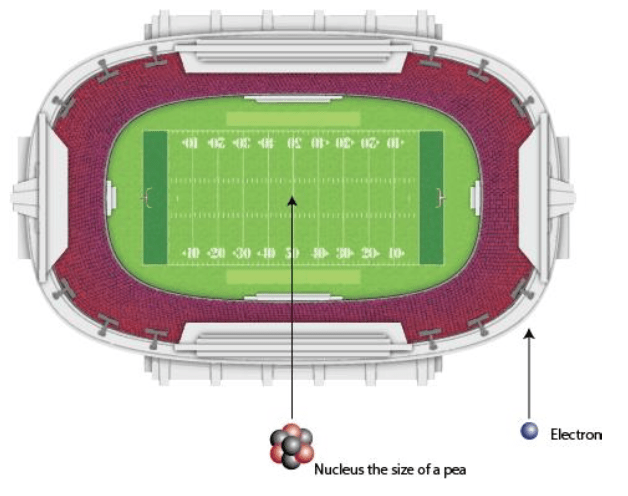
History is like an atom – more space than substance — yet it feels somehow significant to us in the moment. The substance-to-space ration is that of a pea in a football stadium, and yet we perceive these things as solids, liquids, gasses, and plasmas.

History is hitting the only car in an otherwise empty car park. Of course, you and your insurer give it extra significance, but history is more often than not self-absorbed narcisism and filling in the blanks with somewhat cohesive storylines.

As for language, people understand the notion that contemporary language is “living”, but they don’t realise as much that over time tiny perturbations result in huge shifts. Consider Middle English from the days of Chaucer, some 650 years ago, versus Shakespeare, only 450 years ago. The latter, is relatively readable; the former, nosomuch.

In the short term, some complain about incorrect usage, “Save cursive writing”, and “kids forget how to write” with their texts and social media shortcuts. What’s the world coming to?

I ‘ve always questioned time-travel stories where people visit places in the far-future or -past and everyone happens to be perfectly understood, save perhaps for a British accent for good measure – perhaps Germanic for ill measure. lol

I’ve been writing some future-forward stories involving artificial intelligence and more on the nature of time and space, but I’ll save these for another day. Now, I need to focus on Temporal Babel.

AutoCrit Innards

Writing is hard. Short stories are worse. I started Mind Without a Mirror a few days ago as a short story project. After a dozen major revisions, I got to a place to run it through AutoCrit. I’ve been using AutoCrit for a couple months, and it’s been useful as an editor before I connect with a human editor or Beta reader.

Today, I think it split its guts. I clicked on the Character tab. This is where it assesses your character traits, strengths, weaknesses, and some other aspects. As you may notice for the first character, Ada, it returns a terse response. This is usual. The second character Echo went off the chain.

Major characters including Ada and Echo provide contrasting perspectives aiding in highlighting different facets of conflict surrounding Sol’s disappearance:

1. Ada – Her impulsiveness offers tangible counterpoints but sometimes lacks depth behind motivations driving rash decisions; deeper backstory integration can enrich relational dynamics while avoiding plot holes associated with seemingly arbitrary choices leading toward unnecessary risk-taking scenarios without sufficient narrative justification.

2. Echo – As a voice urging caution yet pushing boundaries intellectually rather than physically contrasts effectively against both Ada’s impulsiveness and initially hesitant nature exhibited by Nova; further scenes emphasizing logical deductions alongside emotional intelligence contributions can elevate effectiveness within group dynamics exploring unknowns collectively ensuring smoother narrative cohesion devoid apparent gaps particularly during critical junctures necessitating unanimous decision-making processes amongst protagonists’ circle thereby mitigating potential dissonance arising from conflicting individual agendas undermining collective objectives pursuit efficiency notably during climax build-up phases preceding resolution stages inherently reliant upon concerted efforts fruition realizing overarching goals set forth early onset storyline unfolding sequence events trajectory mapping course eventualities encountered en route denouement culmination point reached conclusionary chapter segments encapsulating thematic essence distilled core message intended conveyed audience reception interpretation thereof facilitated 

I shared a screenshot so you can see the random word dump. Perhaps it’s speaking in tongues. Toward the bottom of the laundry list, I see a lot of professional titles below some superlatives.

I don’t know. AI is strange. I wasn’t planning to post anything today, but I just had to share.

Quoteless Dialogue

I’ve noticed a few publications adopting a quoteless or quote-free dialogue convention. I was wrestling with the idea of using it for my current short story, but I’ve opted not to.

On the upside, it can:

  1. create a more immersive reading experience, blending dialogue seamlessly with narration.
  2. give the prose a more streamlined, modern feel.
  3. be effective in representing stream of consciousness or internal monologue.
  4. subtly underscore themes of ambiguity or the blurring of reality and imagination.

On the upside, it might:

  1. lead to confusion about what is spoken aloud versus what is thought or narrated.
  2. be challenging for some readers, particularly those used to more traditional formatting.
  3. not be suitable for all types of stories or narrative styles.

I feel that it’s a valid stylistic choice that can be very effective when used deliberately and consistently. Its appropriateness depends on the specific work, its themes, and its intended audience.

If used, it often requires more careful writing to ensure clarity about who is speaking and what is dialogue versus narration. It works best when the author employs other means to differentiate dialogue, such as syntax, diction, or paragraph breaks.

    For my current writing project, (working title: “The Riga Paradox”), given its themes of reality versus perception and the blurring of identities, omitting quotation marks could be an interesting choice.

    However, it’s also a significant departure from my comfort zone and might require adjustments in other aspects of my writing to maintain clarity.

    Does anyone have thoughts for or against quote-free dialogue? Have you used it yet?

    Intelligence and Cognition

    It seems that I am constantly apologising for not posting more here. Have no fear, these apologies appear on my other sites, too.

    My absence here is due to another writing project I am focusing on. The competing project has a working title of “Democracy: The Grand Illusion“. It’s a work of fiction, so I am documenting it on my Philosophics blog.

    Recently, I’ve been posting content related to my initial editorial process using AutoCrit.* I was planning to produce content for this site as well as YouTube using Hemo Sapiens: Awakening as the source material, but since I am currently writing this academic non-fiction piece, I figured I’d apply it there.

    For me, writing fiction is different to writing non-fiction. With fiction, I have an idea, and I document a possible skeleton framework. This may (and does) change as I make progress, but it serves mainly as waymarkers to orient my original idea. In this manner, I am more of a planner than a pantser.

    Once I establish this structure, I start writing exposition, and all bets are off. I do not feel restricted by this framework if my subconscious has a different idea and the characters and narrative come to life.

    On the other hand, non-fiction is very planned and structures. I create chapters for continuity and flow. Then I place all sorts of section content within each chapter and record thoughts and citations.

    For this book, I did most of this in 2021-22 during the tail end of the COVID debacle. I stopped and started, but this month I am re-engaging. As the skeleton and muscular systems are already in place as are many organs, I need to add the rest and flesh it out. This is how I occupy my days.

    Despite the planning, nothing is cast in stone. Case in point, I had just drafted a chapter on Defining Intelligence. It included sections on.

    • Intelligence
    • IQ (as a proxy for intelligence)
    • Emotional Intelligence
    • Multiple Intelligences
    • Cognitive Biases

    I thought I was done until I decided to add a section on Cognitive Deficits and Limitations. This inclusion prompted me to rename the chapter to Intelligence and Cognition.

    I expect this book to be completed in 2024. I’ve written some 58,000 words with another 30,000 more likely. I don’t really have a target in mind—just the content I want it to cover.

    I may still pop in to demonstrate AutoCrit on my published book as I feel it may be instructive.


    * AutoCrit is an AI-based editorial application. I am a member of their affiliate programme, so I gain minor financial benefits at no cost to you if you purchase through a link on this page.

    Barely Audible

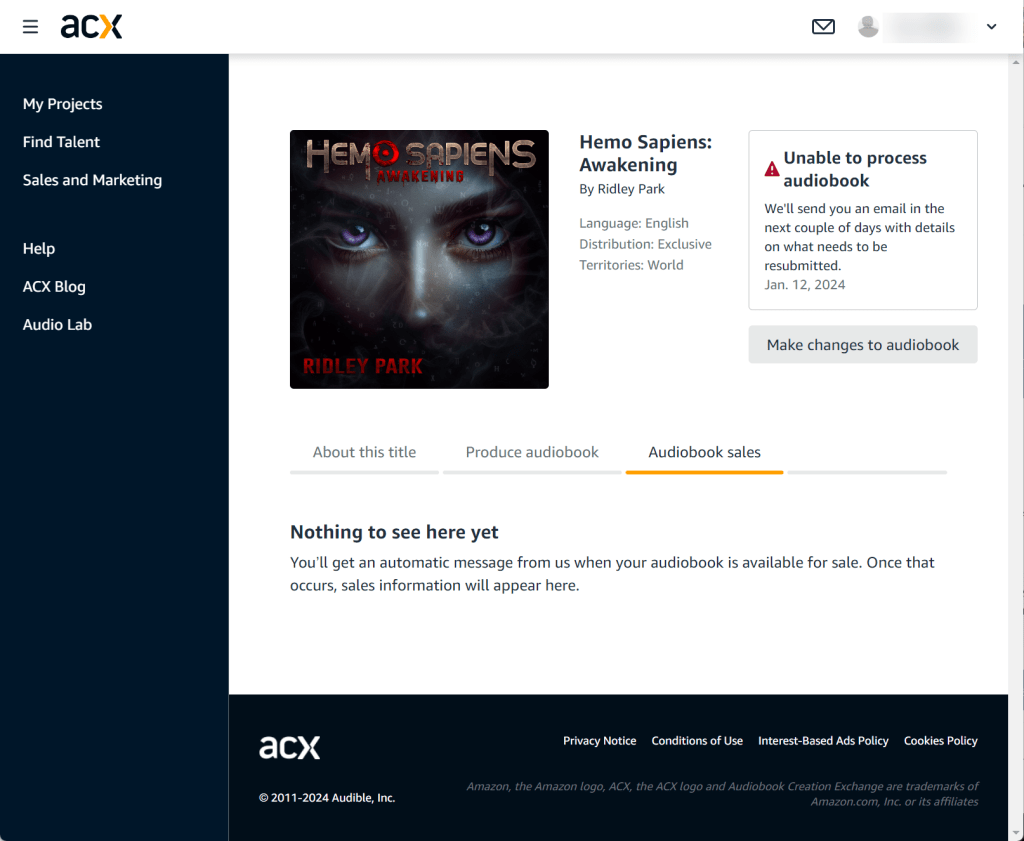
    So this happened. I submitted Hemo Sapiens: Awakening as an audiobook, and it was rejected. The site says that they’ll let me know why in a couple days. My question is: if you rejected it, don’t you immediately know why?

    I think I know why, but I can’t ‘fix’ the problem if I don’t know what it is. I don’t want to act on an assumption.

    I believe they’ll inform me that I can’t use AI-generated narration. This would be odd because they have a programme in Beta where they provide the service of automatically converting the text of a book to audio. To be honest, it doesn’t sound amazing. It appears that they are using their own Amazon Polly, which I like, but you need to babysit it hard. It is very unlikely to sound good without heavy hand-holding. As it is, I hand-held my ElevenLabs AI to make the outcome sound like a professional human.

    Audible offers some voiceover actors, but I didn’t like any of them, and they couldn’t compete with my ElevenLabs voice. I can understand that they don’t want to sell audiobooks that sound like Stephen Hawking, but theirs sound closer to him than mine.

    On another note, I had to render and upload square cover art. There was a stated restriction disallowing padding a rectangular cover image with space or colour to make it square. I followed this rule, but this is exactly what they do. They take the cover of the book you’re selling through Amazon, and they pad the left and right margins with filler colour. I may append the rationale they provide once I’ve received it. Until them, my audiobook is on hold.

    Hemp Sapiens: Awakening Advert Spot 1

    Podcast: Audio version of this content

    Hemo Sapiens: Awakening is a compelling near-future science fiction novel that explores issues of identity, belonging, and the struggle for personal sovereignty. When a community living off the grid is discovered by the authorities of a dominant society, their entire way of life is threatened. Forced to assimilate into a culture not their own, they must make an impossible choice – abandon their traditions or fight to preserve their cultural identity at any cost.

    This thought-provoking book sets the stage for an epic series that investigates the origin of these mysterious people. Their future hangs in the balance as the reader joins them on a journey of self-discovery. Will they succumb to conformity or rise up to claim their autonomy?

    I’m the author, Ridley Park, and I invite you to immerse yourself in this imaginative new world and come along for an unforgettable adventure. Hemo Sapiens: Awakening is available now in hardcover, paperback and ebook formats. Audiobook versions will be released in February 2024. Get your copy today!

    Thanks to India

    I’d like to thank the person in India who earned me $0.02 by reading 17 Kindle pages of Hemo Sapiens: Awakening. Reading on Kindle Unlimited is free—time aside. Read the whole book, and I’ve earned $0.50. In time, we’ll be as rich as astronauts.