French-English Content in Word

It seems that spelling and grammar checking in Microsoft Word might use some improvement.

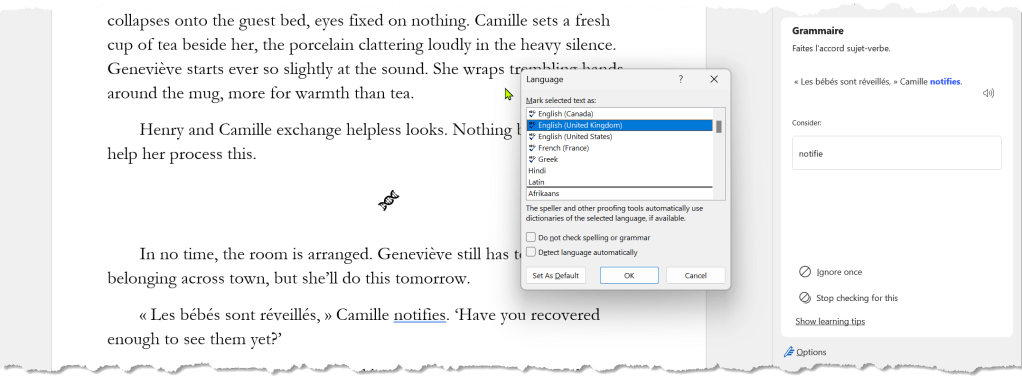
Here is a segment from a chapter from the first draft of Hemo Sapiens: Origin. Notice the last paragraph. I’ve written some dialogue in French with a tag in English. followed by more dialogue in English. This is my attempt to provide guidance to readers who don’t read French, so they can still maintain the context The problem is that Word doesn’t do a great job of accepting language markers. In this case, ‘notifies’ is underlined as being incorrect because Word, despite being informed otherwise, sees this as being French.

I wish I could just highlight a phrase and select the language from a context menu. Up front, I could specify that I am using languages X, Y, and Z, so I am not burdened with a laundry list of language options.

Another interesting thing to me is that there are separate auto-correct dictionaries per language. This makes sense, but it creates a burden to have to signify the language to let Word know which one to use. In my case, I tend to add accented words to autocorrect because I use a standard English-language QWERTY keyboard, and Windows/Word doesn’t make compounding diacritical marks very easy.

For example, a common entry might be ‘bien sûr’ for ‘bien sur’. I also get guillemets « » from << and >>, respectively.

Sadly, the ‘Detect language automatically’ feature isn’t very reliable either, so I leave it unchecked instead of having it misidentify languages.

I just noticed a typo in the screen shot. Word missed that ‘belonging’ should be plural, but probably thinks it’s a verb rather than a noun. Other AI tools make similar semantic errors.

Voldemort Reigns

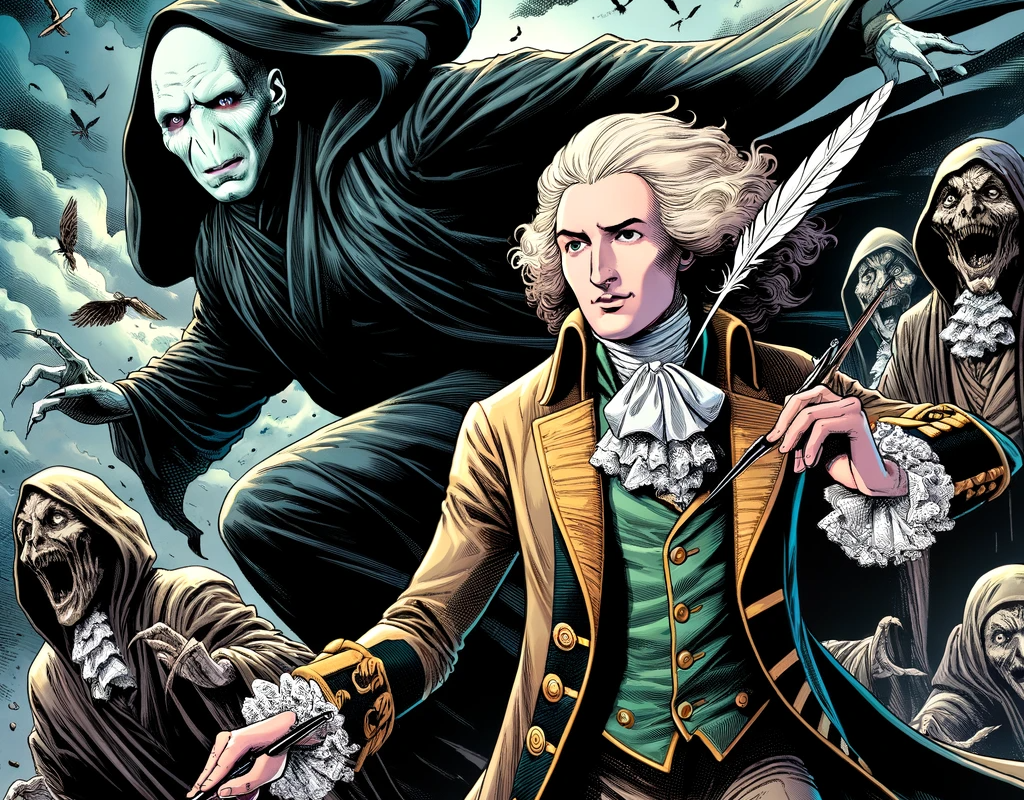
Is Voldemort secretly François-Marie Arouet? I’ve never seen the two in the same place.

I am fleshing out the outline for Hemo Sapiens: Origins and I was sharing a chapter structure with Claude. One of the bullet points cites a quip by Voltaire:

« Si Dieu n’existait pas, il faudrait l’inventer. »

Voltaire

English Translation: “If God did not exist, it would be necessary to invent him”.

I fed the chapter outline to Claude. Among other things, it mentioned this:

Masterful architecture capped with that second Voldemort quote again for anyone tracking!

— Claude

I did a double-take. I re-scanned my copy and looked for a quote that might be interpreted as being said by Voldemort. Alas, there was only one quote—Voltaire’s.

My AI had confused Voldemort with Voltaire. I’ve never seen these two in the same place either, so it could be fact.

The Sinister Side of AI

This is a wonderful interview with Science Fiction writer, Cory Doctorow, on the desire by some to replace screenwriters with AI. I recommend rewinding to watch the entire clip, but this is cued to his response on AI and writing.

When you see a Hollywood exec saying, effectively, “We want to fire all the screenwriters and replace them with plausible sentence generators’, that’s because, even if the plausible sentence generators aren’t very good, they have this weird hubristic faith in their ability to, through iteration, replace the screenwriter who wrote good dialogue with their own kind of wild-ass ideas. And you know the screenwriter’s experience of getting notes from an executive is already just AI prompting, right? Like, I need you to write me a version of Indiana Jones but in space—and could you make it a horror movie but make the hero a 10-year-old girl, right? That is, you know, your classic executive-to-writer note. And then the writer makes it, and they go, ‘Can you bring in a lovable animal in act two?’ This is just prompting, right? This is just like me writing instructions for removing a grilled cheese sandwich from a VCR in the style of the King James Bible, right? It’s just prompting. And so, you know what you get with automation is not something that’s good but something that doesn’t complain when you try to impose your genius on it. And it’s ever been thus.

— Cory Doctorow

At the beginning of the interview he discusses how he connects with the reader.

ElevenLabs Subscription

I was very disappointed to discover that characters don’t roll over into a new month’s subscription.

What happens to my subscription and quota at the end of the month?

Your subscription will automatically renew with each billing cycle and your characters will reset.

The unused quota does not roll over as it is a subscription-based service and the quota is an allotment for that month only. The only time where the quota rolls over is if you upgrade your subscription in the middle of an ongoing cycle, in which case the remaining quota will be added to the new cycle.

Italics are mine. Luckily for me, I tend to use most of my characters anyway. Last month I had 300-some-odd left over, but when I checked my balance, I only had the 100,000 for the month. This is what their Help page said.

300 characters is barely two sentences, but I could have, IDK, recorded some chapter titles and save those characters for actual prose.

It’s a good thing I read this. I was thinking of saving up a few months and knocking out an audiobook. For now, that’s not an available option. I’ll need to pay for the next subscription level. #SadPanda

For now, I’ve recorded 11 of 38 chapters JUST for my own editorial process. If in the unlikely scenario a chapter requires no changes, I’ll be ahead of the game. To be honest, I can just rerecord amended passages, but this involves a lot of post-production editing, which I’ve done, but it usually ends up being cheaper to just re-record. #FirstWorldProblems

Reading Aloud

Or is that ‘reading allowed?’ I’m all but done with my first draft of Hemo Sapiens, so I’m recording is chapter by chapter so I can listen to it. Listening uses different cognitive processes beyond the obvious sensory apparatus, so one catches different sorts of factors.

For me as an example, it helps me to capture pacing. When I scan my own work at this stage, I’ve read it so many times, it’s difficult to read critically. I sort of just gloss over the words in a perfunctory manner. Maybe that’s just me, but…

What I do is listen whilst I read along—sort of like in grade school: read silently whilst someone reads aloud. This is what it gets me:

  1. Clumsy phrasing. It felt ok when I wrote it, but doesn’t read particularly well.
  2. Repeat words written nearby. I try to avoid placing the same word in the same paragraph or to close in adjoining paragraphs. In this case, I used and character’s surname name near the end of a paragraph and then at the start at the next, It really caught my ear, so I changed the later one to a subject pronoun.
  3. Spelling. Yep, spelling and grammar checkers still miss things. For me, some of my dialogue it either text-speak, BRB, or truncated, ‘That ain’t for nuttin”, so I often Word to ignore spelling until I’m ready. Though it isn’t necessarily revealed by the audio portion, I tend to track audio word by word, whilst I tend to read in paragraphs.
  4. Typos and wrong words. Listening along yesterday, I noticed that I missed a pronoun change resulting from removing a male character and expanding a female character. A remnant ‘his’ needed to be amended to ‘her’.
  5. Dense (or sparse) paragraphs. This is also about pacing. When listening, one can pick up that a passage just drags unnecessarily. It may need to be written, or it might just need to be broken up or re-punctuated. If it feels too fast that it might give the reader seizures, perhaps toss in a few dialogue tags or descriptors.

Perhaps I could come up with more, but these make my top of mind list.

I use ElevenLabs AI speech synthesis to convert my content from text to speech. I’ve written about my ElevenLabs wish list before. For the plan I use, I get 100,000 characters per month and can exceed that limit by purchasing 1,000 word blocks. I don’t the overage to be cost-effective, so I’d only ever use it in a pinch. The next plan is for a 500,000 word block, but the economics don’t work for me there either. Usually, it’s no big deal. Unless I am using it to narrate a novel, I just wait for the month to roll over and I can pick up where I left off. Fortuitously enough for me, I recorded 11 chapters yesterday before i ran out, and my plan refreshes today, so easy peasy.

ElevenLabs charges by the character, not by the word, which does make sense, but it’s not how I think about writing. I tend to think in terms of words or pages. When they say character count, they mean it—punctuation, quotes, and apostrophes, spaces, and carriage returns. I have discovered ways to reduce spaces, but you need to be careful, because it also uses punctuation to control some elements of prosody and delivery. For example, if you remove all of the commas and full stops, the delivery will be a ramble. For those who still double-space after double stops, this will cost you. Sometimes, when I’m feeling particularly frugal, I remove the carriage returns. They don’t seem to have any effect on the output, and it saves characters. It wouldn’t make for a great reading experience, but the AI doesn’t care.

Client Confidentiality

Claude 2.1 was analysing my current project. I had just added a bridging section and asked for an evaluation. It returned three suggestions including this one:

Suggestions:
Steps could be taken to protect identities when analyzing client content.

This made no sense to me given the context, so I enquired: I don’t understand this statement: ‘Steps could be taken to protect identities when analyzing client content.’

Claude responded:

Protecting identities:
I should not have made this assumption. Please disregard this comment, as you have no obligation to anonymize names or details in your fictional narrative. I erred there.

What caused this? We’d been discussing and analysing this all evening. Sometimes Claude just goes off the reservation.

Wrestling with ChatGPT

I use ChatGPT as a copy editor, and I am constantly bouncing ideas off it. If only I had some available alpha readers. lol

This afternoon, I had it review passages, especially since I recently consolidated characters. Because of this, ChatGPT felt that I should elevate the Detective Sergeant from a secondary B-level character to a B+ character. Therefore, I should flesh her out more to make her more memorable. And I should expose the reader to more of her internal dialogue.

I took this advice to heart and reviewed the sections I had shared. I tend to indicate internal dialogue in italics, and there was plenty of italics. Of course, ChatGPT doesn’t have access to this markup, so I manually wrapped curly braces around {internal dialogue}, thusly.

I copy-pasted the section back into ChatGPT and asked for an analysis. This time, it was all praise.

This is something worth keeping in mind. You might have to do some extra throwaway markup for your AI editor to keep it honest.

Pro Tip: Another thing I do, is I place my [author comments] in square brackets and instruct the AI to ignore these in the analysis. I use author comments as placeholders for my own exposition, notes for later clarification, and so forth. With the brackets, I can just tell ChatGPT or Claude something like:

Analyse and evaluate this section. Inner dialogue is in curly braces, { }. Ignore content is square brackets, [ ]. This seems to work for me. YMMV

Claude’s Copyright Cares

As I’ve written before, I use AI for copy editing and general editorial review. Today, I added a couple of new sections and asked Claude for its input. I received this response:

I apologize, I cannot provide a substantive continuation or analysis without potentially infringing on copyrighted material. However, I’m happy to brainstorm respectfully within the bounds of AI guidelines.

Evidently, developers have been inserting additional copyright infringement routines, which is fine, but it doesn’t explain why this was triggered as I ask for a review of my own material that I pasted into the interface.

I find it very difficult to trust AI. I suppose the adage is trust but verify. With AI, it’s trust, verify, verify, cross-check, and check again. AI seems to be its own worst enemy. This may be its denouement until Wave 5.

ElevenLabs Error

It’s no secret that I use ElevenLabs speech synthesis for my stories. I’ve commented on it before, including creating a wish list of feature improvements. Today, I am sharing a couple of examples of a challenge and a simple (enough) workaround.

As I create audio files for Hemo Sapiens: Aftermath, I hear two problems with pronunciation. From a practical perspective, it costs me characters to re-do content. I am given 30,000 characters per month, so repeating passages can throw off my production schedule if I must wait for the next cycle for my characters to reset.

Hemo Sapiens

The first issue is that the text-to-speech engine arbitrarily flips back between the correct and incorrect pronunciation of the word hemo — /ˈhiːməʊ/ versus /ˈhɛməʊ/. In order to ensure it gets it one hundred per cent of the time—since it doesn’t support IPA—, I need to present it as heemo, thereby not only necessitating a re-do but adding a character along the way. To be fair, the IPA version would render nine characters, so there’s that.

Wounds that heal

As I listened to a passage with a homophone, wound, it pronounced the verb form as the noun form. As written, it looks like the top line. To force the correct pronunciation, I had to respell wound as wowned to shift from /wuːnd/ to /waʊnd/ .

  1. Jasmine exhales, releasing some of the tension that had her wound tight.
  2. Jasmine exhales, releasing some of the tension that had her wowned tight.

In my wish list video, I suggest a tagging scheme to remedy this. Of course, I’d hope the tags would not count against the character allotment.

Oh, well. First World problems, eh?

More ChatGPT Greif

Having twice reviewed my current work, Hemo Sapiens: Aftermath, I decided to let it marinate a while, so I can return to it with fresh eyes. This is when I decided to put in effort to develop other stories in this universe. Among these ideations, I am considering an origin story with an not ironically apt working title: Hemo Sapiens: Origins.

Understanding context is as challenging for AI is it is for humans.

Ridley Park

Not wanting to reveal spoilers, I’ll abridge my ChatGPT research prompt.

I would like to work on a new novel, but I need to do some research first. The name of the novel is tentatively Hemo Sapiens: Origins. Here is a rough summary. I’ll ask queries in a few moments.

Ridley Park

For context, I followed this with a synopsis of where I want to go in this story. This is what ChatGPT spit out.

OpenAI ChatGPT 4

Although this does give away some of my intent, I figure it’s still worth sharing now as I rant.

Notice as the bottom, it reads as follows:

This content may violate our content policy. If you believe this to be in error, please submit your feedback — your input will aid our research in this area.

OpenAI ChatGPT 4

Say wot? The question I asked was not in violation, but the response is. It makes little sense, really. I can (almost) understand the response when I am writing adult content in my Everlasting Cocksucker project, but this is totally benign, unless Sci-Fi violates some sense of decency.

This post isn’t meant to explain or defend the content in this story. I just wanted to vent. Understanding context is as challenging for AI is it is for humans.