Dispatches from the Publishing Trenches: A Field Report

I, Ridley Park, am an independent author and publisher. Before this literary turn, I did time as an economist, business analyst, and management consultant – none of which prepared me for the peculiar economics of modern publishing.

Much like traditional music in the Digital Age, traditional publishing has lost a bit of its lustre. Its gatekeeping function remains, but the gates are now rusted, and half the guards have been made redundant.

Audio: NotebookLM podcast on this topic.

From a business standpoint, the Independent™ must ask: Is the distribution reach of a traditional publisher or third-party distributor worth the revenue share they demand? It’s tempting to cast them as parasites feeding off your creative lifeblood—but statistically, the average indie author sells only 60 copies of their book. Yes, that includes the five you bought yourself and the ten your mum distributed among reluctant neighbours.

Could you sell more than average? Possibly. Less? Almost certainly. Better to sell 100 copies and earn a pittance than to earn 100% of nothing. But if the publisher can’t move your book either, and if they’re not investing in you as an author, you may well find yourself in the red. Especially if you’re the one paying them for the privilege of being published. That’s not publishing – that’s vanity cosplay.

Publishers also offer (read: upsell) services like editing, formatting, and cover design. As an Independent™, you either pay for these à la carte or do them yourself. Or, if you’re like me, you cobble together a mixed strategy of DIY, AI, and professional outsourcing – whatever the project demands.

For Hemo Sapiens, I did everything except the typography for the title and byline on the cover. That part I outsourced; I know my limits. The rest – cover composition, layout, typesetting – I handled. I also brought in beta readers, who offered some valuable copyedits and corrections.

With Sustenance, I went end-to-end solo, with AI in the wings for flow and proofing support.

Propensity followed a similar path – except I made the rare (some might say perverse) choice of hiring a beta reader after release. Heretical, I know. But the feedback was so incisive I’m now considering a mid-edition revision, particularly in the middle third, where things get a bit heady.

As for Temporal Babel – still unreleased – I’ve done everything myself thus far, but I’m leaning toward bringing that same beta reader back for another round of bruising clarity.

Beta readers, it turns out, are worth their weight in snark and red ink. I’ll save my ruminations on them for another post, which I promise will be full of revelations and at least one semi-poetic lament.

I could say more here, but there are other things demanding my time – and no publisher breathing down my neck.


Bless MidJourney for the cover art based on this prompt:

beautiful woman wearing glasses and a sheer top, holding a red pen, reading a book, office setting

Why I Create Audiobooks for All My Books

This isn’t a promotional post. I’ve recently discovered the hidden value of audiobooks—and it has nothing to do with selling them.

Back in 2024, when I released Hemo Sapiens: Awakening, I must have read the manuscript a thousand times. I even recorded an audiobook, using an AI voice from ElevenLabs. At the time, Audible wouldn’t accept AI narration. The rules have since changed. It’s now available—though still not on Audible (and therefore not on Amazon).

I’d hired a few proofreaders and beta readers. They helped. The book improved. And yet, even after all that, I still found typos. Those bastards are insidious.

The real revelation came when I started listening.

Since I’d already created the audiobook, I began proofreading by ear. That’s when it hit me: hearing the story is nothing like reading it. Sentences that looked fine on the page fell flat aloud. So I rewrote passages—not for grammar, but for cadence, clarity, flow.

Then came the second benefit: catching mistakes. Typos. Tense slips. I favour first-person, present-tense, limited point of view—it’s immersive, intimate, synchronised with the protagonist’s thoughts. But sometimes, I slip. Listening helped catch those lapses, especially the subtle ones a skim-reading brain politely ignores.

For Sustenance, the audiobook was an afterthought. I submitted the print files, requested a proof copy, and while I waited, I rendered the audio. When the proof arrived, I listened instead of reading. I found errors. Again. Thanks to that timing, I could fix them before production. Of course, fixing the manuscript meant updating the audiobook. A pain—but worth it.

I hadn’t planned to make an audiobook for Propensity—some of the prose is too stylistic, too internal—but I did anyway, because of what I’d learned from Sustenance. And again, I found too many errors. Maybe I need better proofreaders. Or maybe this is just the fallback system now.

I’ve had Temporal Babel, a novelette, on hold for months. I won’t release it until I do the same: make an audiobook, listen, reconcile with the page.

Lesson learned.

I’ve got several more manuscripts waiting in the wings—some have been loitering there for over a year. Their release has been deprioritised for various reasons, but when they go out, they’ll have audio versions too. Not for the sake of listeners. For me.

Honestly, I should do this for my blog posts as well. But editing on the web is easier. The stakes are lower. Mistakes don’t print themselves in ink.

Behind the Binding: Sustenance in Print, Pixels, and Purgatory

Not quite a launch. Not quite a rant. Just one author trying to get a novella into the world without sacrificing too many hours or brain cells.

Paperback Problems

I’ve been writing quite a bit lately—several novellas/novelettes, to be precise.

They all began life as short stories, but brevity doesn’t come naturally. Apparently, I can’t shut up even on the page. I toyed with the idea of releasing a thematic collection, and I still might. But for now, Sustenance is getting its own debut—likely this month.

The book clocks in at around 14,000 words, printed across 144 pages. I’ve read that readers prefer novels to novellas, but I’ve also read that readers don’t really read anymore. Time’s short. Attention spans are shorter. Maybe shorter fiction has a fighting chance. We’ll see.

I formatted it in 6×9 inches, which may have been overly generous. It’s leaner than your average indie fantasy tome but still thicker than my last Žižek collection. So there’s that.

The manuscript began in Word, like every poor decision. I laid it out in InDesign and exported the PDF through Acrobat. No budget, so I designed the cover too—started in Illustrator for the vector charm, but ended up in Photoshop, where I’m more at home. I designed the full wrap—front, back, spine—as a single canvas.

This was a mistake. More on that later.

Still, I’m pleased with the final look. Might reuse the style across future novellas for a bit of visual branding. There’s barely enough of a spine to print on, but we suffer for aesthetics.

Proofs arrive Thursday. Fingers crossed.

Hardback Headaches

Then came the hardback edition. Same 6×9 size, same interior. Should’ve been simple.

It wasn’t.

I forgot (again) that hardbacks require extra bleed and margin space. Couldn’t just resize the existing cover without risking pixelation. If I’d stuck with vectors, this would’ve been a breeze. Instead, I got to rebuild the entire layout from scratch—layers, guides, grids, the lot.

Hours of joyous rework. Lesson learned. Until next time.

eBook Escapism (and Other Fantasies)

Converting the layout to eBook format was a slow-motion trainwreck. I’d inserted custom font glyphs above chapter titles in InDesign. They rendered fine—until they didn’t. Halfway through, chaos reigned.

I cracked open Sigil and manually edited the XHTML. So far, so fiddly.

Then I uploaded the .epub to Amazon. Except Amazon wanted a .kpf file. Of course it did.

Enter Kindle Previewer. Except it doesn’t support embedded font glyphs. So I converted them to SVGs.

Still no dice. Kindle’s rendering engine is older than most of its readers. SVGs failed too. So I converted every glyph to PNG, rewrote the CSS, rebuilt the XHTML again, and gave it another go.

Looks fine. Not perfect. I gave up.

They’re just decorative anyway. No plot-critical glyphs here.

The Kindle version should go live shortly. I enrolled it in KDP Select, which means 90 days of exclusivity in exchange for a modicum of convenience. After that, I’ll look at wider distribution.

For the eBook cover, I simply cropped the original layout in Photoshop. That part was, mercifully, straightforward.


What’s Next?

This post is more documentation than declaration. A sort of production diary. I’ll follow up with an actual announcement when the book launches, plus a few reflections on themes, characters, and that moment when you realise your protagonist may have accidentally sexed up a chicken.

Long story.

Anyway, this is just the start. Stay tuned.

Or don’t. Up to you.

Temporal Babel: A Novelette

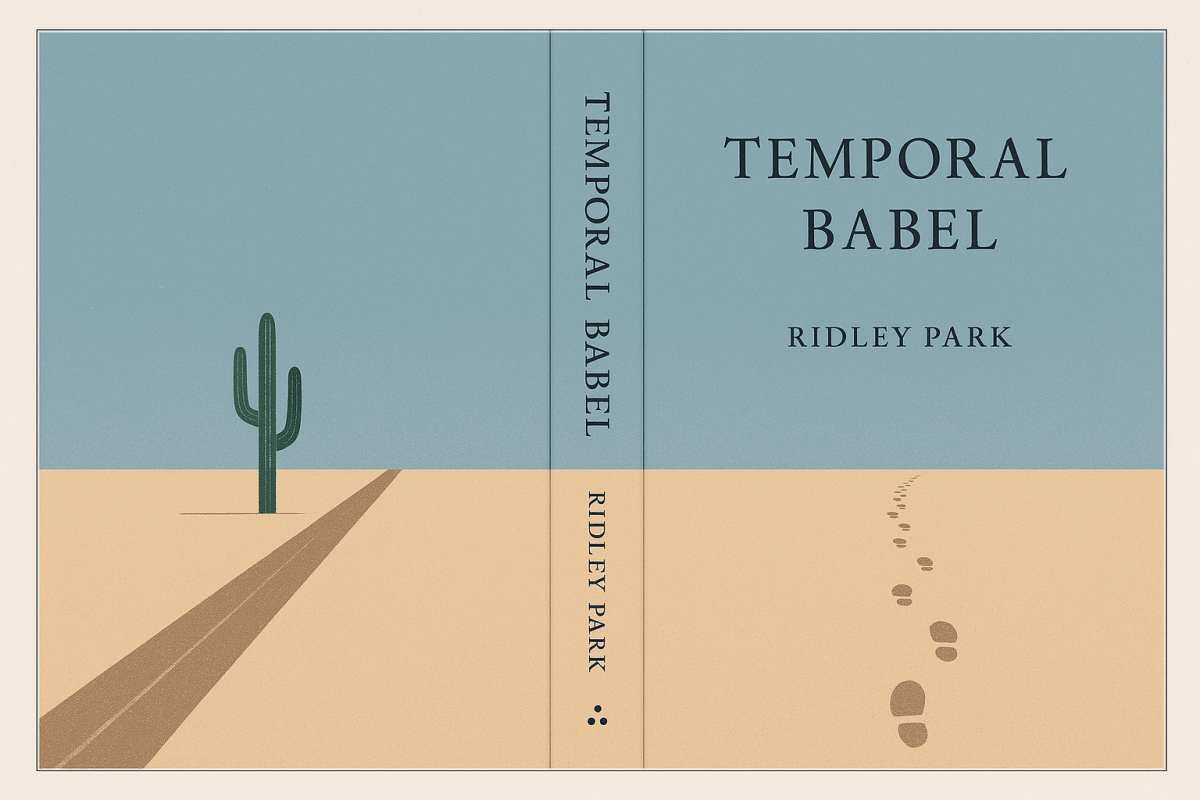
I just completed a second draft of a novelette I’ve been working on. I had ChatGPT (Dall-E) render a quick sample cover.

The story takes place in New Mexico, and I wanted a minimalist visual style to match the prose. I believe that a beige desert set against a blue sky is perfect. The deserted highway with a single cactus speaks volumes. The footprints in the desert are also evocative. I love the simplicity of the palette.

Though it revered the front and back cover art, it generally followed my instructions. Artificial intelligence (AI) has made significant progress in a year. All of the words are spelt correctly. I could Photoshop this into shape with little effort.

I only plan to release this as an ePUB because I am compiling a triptych. Currently, the body copy stands at 105 pages, so with title pages and the rest, it should reach 112 pages, which is perfect for seven 16-page signatures.

AI Editor Issues

I employ AI editors for copyediting and alpha-reading. They are useful but have limitations.

Some of my writing is ordinary – Acts I, II, and III; Beginning, Middle, and End. This is AI’s sweet spot: assess a piece and compare it to a million similar pieces, sharing plot structures, story and character arcs, heroes’ journeys, and saving cats.

Other stories are experimental. They don’t follow the Western tradition of tidy storylines and neat little bows, evey aspect strongly telegraphed, so as not to lose any readers along the journey.

Mary approaches a doorway. Mary opens the door. She walks through the doorway — the doorway she had approached.

Obviously, this is silly and exaggerated, but the point remains. AI presumes that readers need to be spoonfed, especially American audiences. (No offence.)

But life doesn’t work like this. We often witness events where we have no idea what happens after we experience them. We pass strangers on the street, not knowing anything about their past or future. We overhear something interesting, never to get a resolution. We get passed by for a promotion but never know the reason why.

In science, there are lots of dead ends. Do we want to know the answers? Yes. Is one likely? Maybe; maybe not. Will we make up answers just to satisfy our need for closure? It happens all the time.

In writing, we seem to not accept these loose ends. How many times have you read a review or critique where the complaint is, “What happened to this character?” or “Why didn’t Harry Potter use his invisibility cloak more than once despite it being an obvious solution to many prior and future challenges he faced?”

Sure. I agree that it feels like a plot hole, but the author doesn’t have to tell you that Harry lost it in a poker match, it got lost in the wash, or Ron snatched it.

I’m finishing a story, and various AIs provide similar commentary. Even more humorous are the times it can’t follow a thread, but when a human reviewer reads it, they have no difficulty. In the end, there may be unanswered questions. Some of these leave the universe open for further exploration, but not all questions have answers. AI has difficulty grasping this perspective.

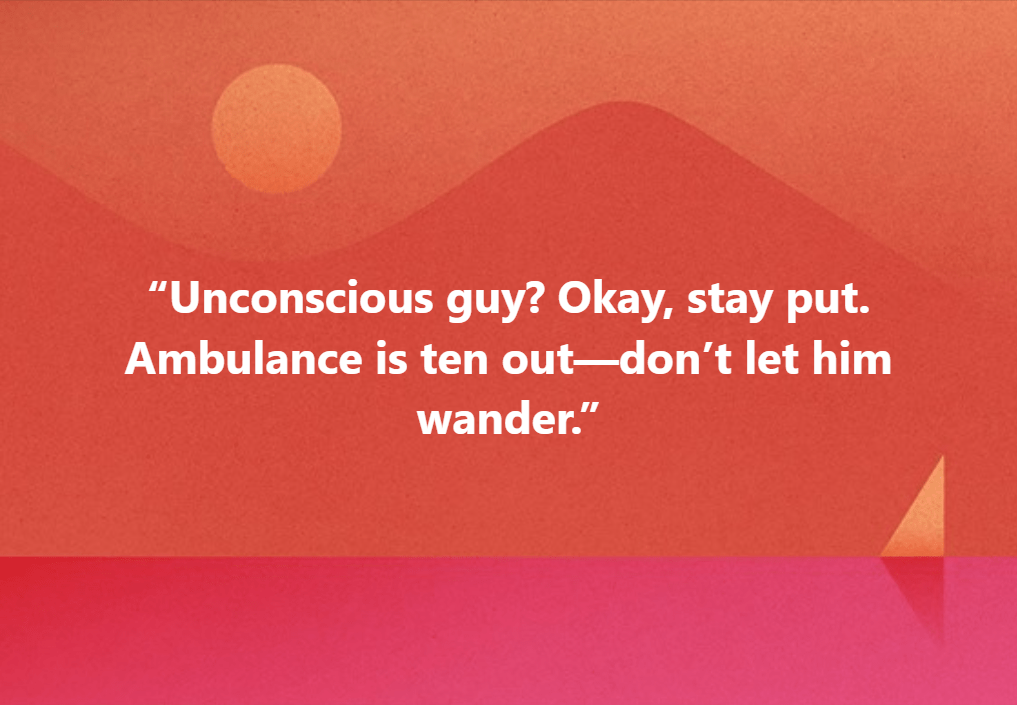
—don’t let him wander.

My biggest problem with generative AI is its lack of subtlety and misunderstanding of satire and irony. I am writing a short story, and a character is calling an emergency number. I shared the first scene with Grok, and it suggests that I turn the absurdity up to 11 and replace this segment with the one above:

“Okay, ma’am. Can you stay with him? I’ll dispatch an ambulance to your location.”

It is funny in its way, but I’m only pretty sure that an operator would not be injecting humour into a situation where a woman is reporting an unconscious person. Absurd doesn’t need to be Monty Python funny.

Am I being too critical?

Audio: NotebookLM Podcast discusses this issue.

More to the point, I find that many humans miss subtlety. Many people need every storyline highlighted and retraced with a bold Sharpie. Every detail needs to be explained because they can’t connect the dots. This is reflected in the cinema, television, and books of the past half-century or more, so is it fair to criticise AI for being dull when it’s at least on par with more than half the human population.

Are we asking AI to be held to a higher standard?

AutoCrit Challenges

I don’t hide the fact that I rely on AI for early editorial feedback. Once a story is complete, I break out AutoCrit. This programme works well for typical stories that follow standard practices with common tropes. It gets quite confused when I feed it intentionally awkward stories, not the least of which is to advise me to eliminate the awkwardness.

This is a challenge with AI more generally. In this particular story, I leave a lot of loose ends and misdirects, as it’s a commentary on the conspiracy-driven culture we inhabit. The advice, is along the lines of, “You forget to close this lopp. What happened to so and so.”

But this is life. We don’t always know the full story. We drive past an multi-car accident where cares are overturned and in flames, but we never find out what happens – even if we scour the newspapers and internet. Who was that? What happened? What caused it?

We often never find out. In most books and movies, we find out everythung, and it all comes packaged with a nice bow. This is what AI expects. It’s the diet it’s been fed.

Some stories subvert these notions here and there, but by and large, this is not typical American fare. Readers and viewers need to be spoonfed without inconsistencies.

Speaking of inconsistencies addressing one scene, AutoCrit said that a character should act impulsively in one situation and reserved moments later. This was flagged as an iinconsistent character.

In the scene, a woman stops her car immediately to help an injured man on the roadside, but as she gets out of her car an approaches her, she shows caution.

This was a red flag. Why would she have always been rash or always been cautious?

My response, because that how real people act. She acts on instinct but quickly considers that she’s a vulnerable woman alone with a man miles from anywhere.

I don’t suspect a human reader would find this surprising. This is the intelligence absent from Artificial Intelligence — cultural intelligence, a cousin of EQ, emotional quotient.

I know how I want the character to act. I do want AutoCrit to inform me that character A is wielding a pistol but then stabs another character, or that character B is a teetotaler and is getting drunk or that character C has a shellfish allergy but is downing lobsters like they’re going out of style. And I certainly what to be shown continuity errors.

The biggest challenge I have with AutoCrit that is less promonent with other AIs is that I can preface my content with a note explaining my intent. I can even do this after the fact.

If I feed ChatGPT, Claude, or DeepSeek a story of segment to critique without a preface, the responses may be similar to AutoCrit, but when I follow up with some meta, the response may be, “Now it makes sense, but why is John wearing lipstick?” Perhaps he’s metrosexual or non-traditional. Perhaps it’s an oversight.

I dont meán to demean AutoCrit. I’m just advising that if you are writing stories not compliant with 80 per cent of published works, take the advice with a grain of salt, or reserve AutoCrit for more standard fare.

Is it AI?

I favour originality even at the expense of popularity or sales. I spent last week writing short stories and poems. I use AI for research, whereas in the “old days”, I’d have used a library. I research character traits and arcs, story forms, and whether a theme has been explored.

I employ AI in the editorial process, and even in “post-production”. I even use AI for some art concepts and components.

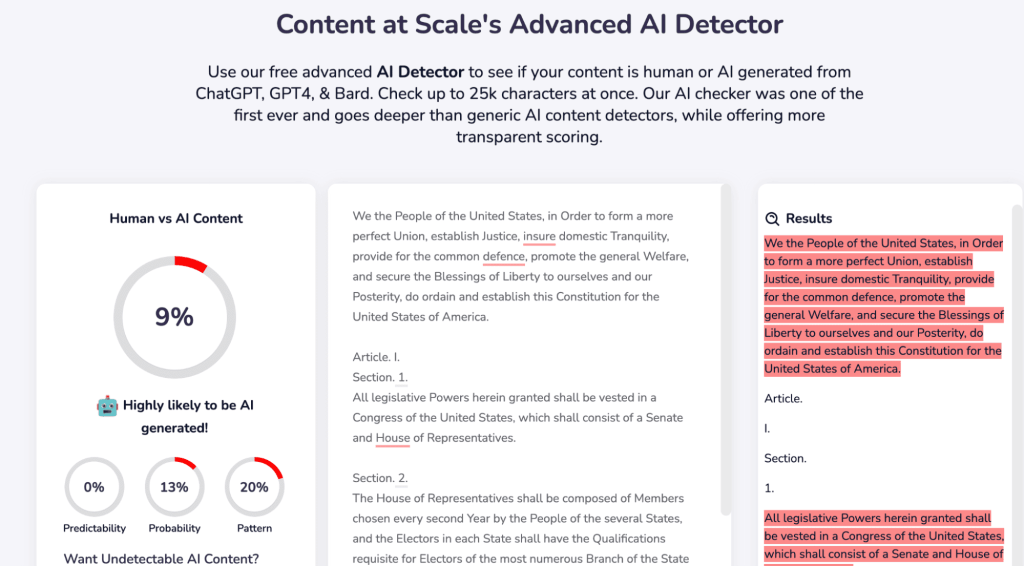
One thing I hadn’t tried until now is an AI service that purports to determine if a submission is AI. I tried several packages that offered a free trial. They seem to operate on a scale between human and AI authorship.

I first submitted a piece I was currently working on—a 6th-odd revision of a 5,000-word story in the form of a fairy tale. Unfortunately, trials were limited from a sentence to a few paragraphs—up to 5,000 characters.

This first submission was rated 100% AI—evidently, not a hint of humanity. This was disconcerting. I decided to dredge out a non-fiction book I shelved in 2020. Certainly before access to AI tools. This was rated 85% AI and 15% human. But it gets better—or worse, I suppose, depending on your perspective.

The book is on the immorality of private property from a philosophical vantage. The passages claimed to be AI were one-hundred per cent mine. What about the ones flagged as human, you might be asking? Those were a quote by fellow human John Locke from his Second Treatise of Government.

In Defence of Property 

God, who hath given the world to men in common, hath also given them reason to make use of it to the best advantage of life, and convenience. The earth, and all that is therein, is given to men for the support and comfort of their being. And though all the fruits it naturally produces, and beasts it feeds, belong to mankind in common, as they are produced by the spontaneous hand of Nature; and no body has originally a private dominion, exclusive of the rest of mankind, in any of them, as they are thus in their natural state: Yet being given for the use of life, there must of necessity be a means to appropriate them some way or other before they can be of any use, or at all beneficial, to any particular men.

ᅳ John Locke, Second Treatise of Government 

Returning to the AI side, what sentences were flagged as the “Top Sentences driving AI probability”? I’m glad you asked.

  • The Catholic Church also played a significant role in shaping private property rights in the Middle Ages.
  • In ancient China, the concept of private property was more limited, as land was owned by the state and was leased to individuals for use.
  • However, there is evidence to suggest that private property ownership has existed in some form in many ancient civilisations.
  • Although it’s difficult to trace the precise history of private property ownership before ancient Greece, the concept of private property has evolved over time and has varied widely among different societies.
  • It regulated the transfer of property and established rules for inheritance.

So these ordinary sentences written 5 or more years ago are flagged as AI.

The US Constitution

On a site I found to understand what parameters AI considers, I found this example—the Constitution of the United States of America was flagged as having AI content. I knew those geezers were ahead of their time, but I didn’t realise how far. This is even more amazing when one considers that electricity hadn’t even yet been invented.

But Why?

AI looks for statistically probable patterns. This translates into any content written with proper grammar and diverse word choice. In practice—the habits of a decent writer.

I’m not going to belabour this issue, but I want to raise a big red flag.

To complicate matters more, they have AI applications that promise to un-AI your AI. So there’s that.

AutoCrit Innards

Writing is hard. Short stories are worse. I started Mind Without a Mirror a few days ago as a short story project. After a dozen major revisions, I got to a place to run it through AutoCrit. I’ve been using AutoCrit for a couple months, and it’s been useful as an editor before I connect with a human editor or Beta reader.

Today, I think it split its guts. I clicked on the Character tab. This is where it assesses your character traits, strengths, weaknesses, and some other aspects. As you may notice for the first character, Ada, it returns a terse response. This is usual. The second character Echo went off the chain.

Major characters including Ada and Echo provide contrasting perspectives aiding in highlighting different facets of conflict surrounding Sol’s disappearance:

1. Ada – Her impulsiveness offers tangible counterpoints but sometimes lacks depth behind motivations driving rash decisions; deeper backstory integration can enrich relational dynamics while avoiding plot holes associated with seemingly arbitrary choices leading toward unnecessary risk-taking scenarios without sufficient narrative justification.

2. Echo – As a voice urging caution yet pushing boundaries intellectually rather than physically contrasts effectively against both Ada’s impulsiveness and initially hesitant nature exhibited by Nova; further scenes emphasizing logical deductions alongside emotional intelligence contributions can elevate effectiveness within group dynamics exploring unknowns collectively ensuring smoother narrative cohesion devoid apparent gaps particularly during critical junctures necessitating unanimous decision-making processes amongst protagonists’ circle thereby mitigating potential dissonance arising from conflicting individual agendas undermining collective objectives pursuit efficiency notably during climax build-up phases preceding resolution stages inherently reliant upon concerted efforts fruition realizing overarching goals set forth early onset storyline unfolding sequence events trajectory mapping course eventualities encountered en route denouement culmination point reached conclusionary chapter segments encapsulating thematic essence distilled core message intended conveyed audience reception interpretation thereof facilitated 

I shared a screenshot so you can see the random word dump. Perhaps it’s speaking in tongues. Toward the bottom of the laundry list, I see a lot of professional titles below some superlatives.

I don’t know. AI is strange. I wasn’t planning to post anything today, but I just had to share.