On my Philosophics Blog, I share my experience using Midjourney’s image-to-video feature. In that article, I discuss some benefits and limitations of Midjourney. This is an adjacent discussion.
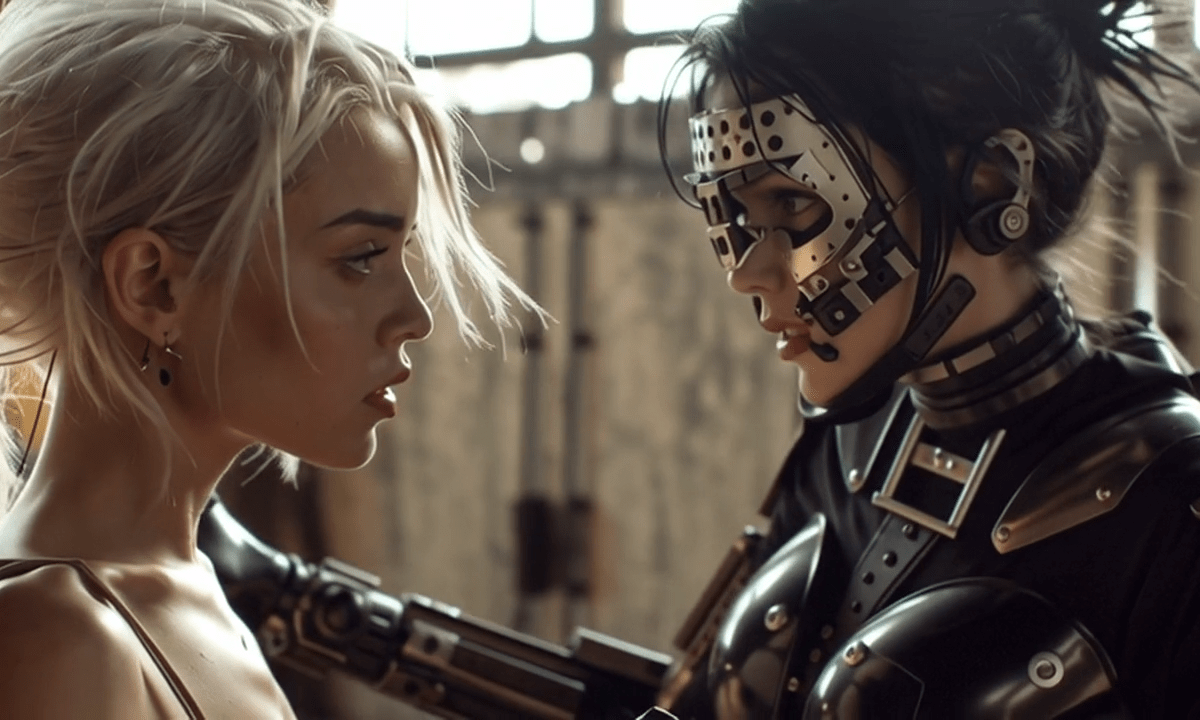
Image, still from video: Cybermech Warrior Meets Steampunk Girl
The clip above was an image I generated about a year ago – a steampunk girl on the left battling a cybermech whatever. This is ostensibly the prompt I used.
cinematic photograph, a pale young European steampunk woman meets a steampunk ninja villain woman dressed in black with mechanical arms
I forgot about the ninja part, hence the black outfit.
tl;dr: When I prompted Midjourney to animate the two, rather than a vicious fight to the death, I got a tender dance and race to the bed. I made that last part up. Watch for yourself.
Now, I am left wondering if I should pursue a trope of a woman falling in love with another cyber-woman. Has this been done?
It would undoubtedly be genre fiction – whether sci-fi, steampunk, or erotica remains to be seen. Perhaps more of a manga.
This isn’t my space, so I’m being facetious, but I can still imagine the implications.
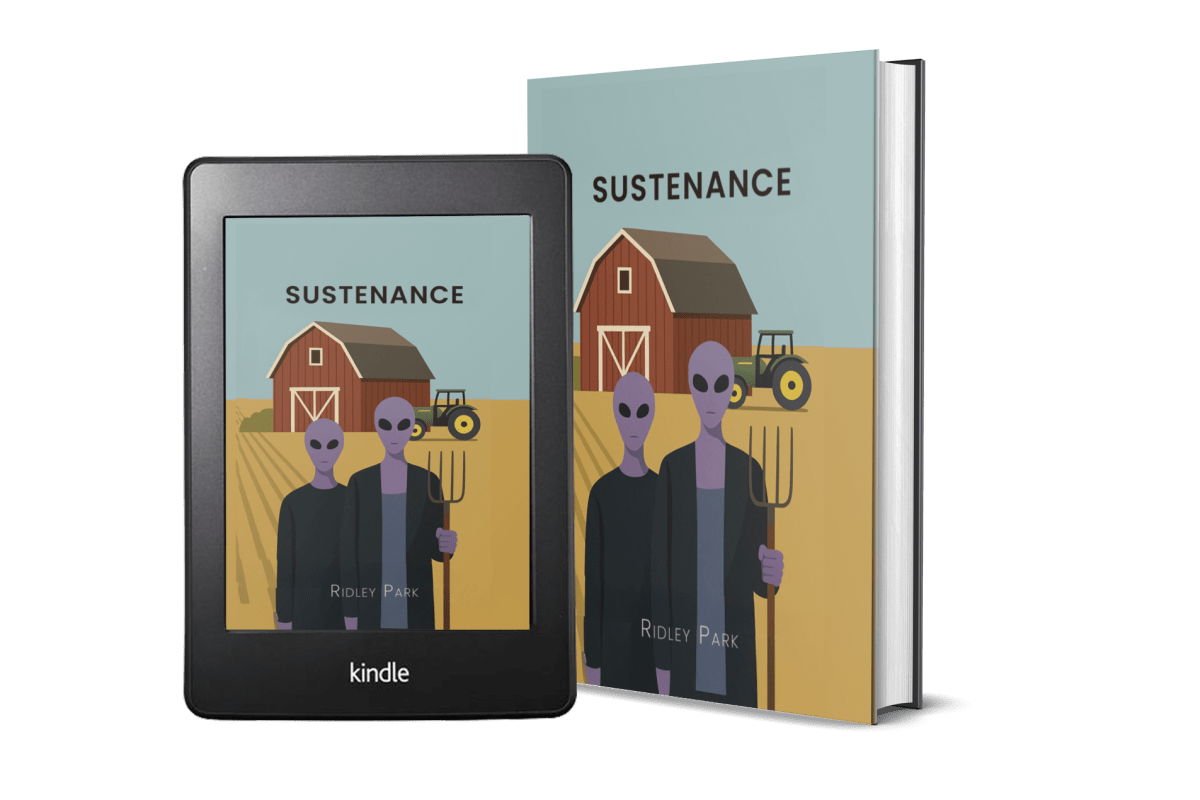
If Propensity was about engineered peace through probabilistic compliance, Sustenance asks what happens when understanding itself breaks down—and nothing you think is mutual, is.
No war. No invasion. No end-of-days. Just a quiet landing. And a failure to translate.
The Premise
A group of non-human beings arrive—not in conquest, not in friendship, but in continuity. They are not like us. They do not see like us. They don’t even mean like us.
There is no universal translator. No welcome committee.
Just humans—interpreting through projection, desire, and confusion.
And aliens—operating by a logic that doesn’t require interpretation.
The Themes
Sustenance explores what happens when:
Language fails and nothing fills the gap
Consent becomes guesswork
Culture is mistaken for nature
Property has no meaning, and law no parallel
Sex isn’t private, sacred, violent—or even especially enjoyable
Memory becomes narrative, and narrative becomes defence
Contact isn’t miraculous—it’s awkward, biological, and quietly irreversible
This is a story about misunderstanding. Not just what others mean—but who we are when we assume we understand anything at all.
The Tone
Think Arrival but rural. Annihilation without the shimmer.
A bit of VanderMeer. A hint of Flannery O’Connor. The cornfields are real. The discomfort is earned.
No apocalypse.
Just a failure to process.
And maybe, something new inside the gap that opens when the old stories no longer apply.
Why Write This?
Because contact doesn’t have to be violent to be destabilising.
Because not all miscommunication is linguistic—some is anatomical.
Because the most alien thing we can encounter is ourselves, misinterpreted.
Because I wanted to write a story where the question isn’t “what do they want?” but “what have we already assumed?”
A note from Ridley Park on behaviour, control, and the illusion of peace.
Well, it’s out. Propensity has officially launched.
This one’s been brewing for a while. If Sustenance asked what happens when we can’t understand each other, Propensity asks what happens when we stop needing to.
No invasion. No superintelligence. No overt dystopia. Just a device—quietly implemented—that modulates human behaviour through neurochemical cues. Less anger. Less risk. Less faith, libido, disobedience. More calm. More compliance. More… nothing.
And nobody notices. Because the best control doesn’t look like control.
The Premise
Imagine a world where we solve violence—not through laws, treaties, or education—but by dampening the neurological signals that make people aggressive in the first place. You don’t choose peace. Peace is chosen for you, chemically. You just comply.
That’s the Propensity Device: a system designed not to control what you do, but to shift what you’re likely to do. Your odds of revolt drop. Your odds of submission rise. It’s not sedative. It’s statistical.
Free will doesn’t vanish. It just stops being statistically significant.
The Themes
The novel explores what happens when:
Free will is reframed as background noise
Consent is irrelevant because no one thinks to object
Violence becomes programmable—but only directionally
Peace is achieved without ideology, meaning, or narrative
Narrative itself becomes residue
There’s horror in here, but it’s not loud. It’s administrative. Institutional. Clean.
The horror of things working exactly as designed.
The Tone
Think Black Mirror but less sensational. Think Ballard after a lobotomy.
A dash of Ligotti. A flicker of DeLillo. A long stare from Atwood. Propensity is soft dystopia—flattened, not broken.
And yes, there’s a fall. But it’s not a collapse. It’s an asymptote. A tapering. A loss of signal fidelity. A kind of surrender.
Why Write This?
Because we’re already doing it.
Because behavioural nudge theory isn’t fiction.
Because control doesn’t need to be malicious—just implemented.
Because some of the worst horrors are quiet, polite, and empirically validated.
Because I wanted to ask: what if peace worked too well?
Now Available
You can get Propensity on Amazon and other booksellers.
If you do read it—thank you. If you don’t, that’s alright. The system will keep humming either way.
My biggest problem with generative AI is its lack of subtlety and misunderstanding of satire and irony. I am writing a short story, and a character is calling an emergency number. I shared the first scene with Grok, and it suggests that I turn the absurdity up to 11 and replace this segment with the one above:
“Okay, ma’am. Can you stay with him? I’ll dispatch an ambulance to your location.”
It is funny in its way, but I’m only pretty sure that an operator would not be injecting humour into a situation where a woman is reporting an unconscious person. Absurd doesn’t need to be Monty Python funny.
Am I being too critical?
Audio: NotebookLM Podcast discusses this issue.
More to the point, I find that many humans miss subtlety. Many people need every storyline highlighted and retraced with a bold Sharpie. Every detail needs to be explained because they can’t connect the dots. This is reflected in the cinema, television, and books of the past half-century or more, so is it fair to criticise AI for being dull when it’s at least on par with more than half the human population.
I’m wrapping up a short story, and I ran it through several generative AIs for feedback.
The first problem is that. although AI provides critique, it is programmatically overly optimistic.
The second problem is that it doesn’t understand nuance.
The working title of this story is Temporal Babel. It’s a low-key absurd, mundane, ironic satirical journey through space-time, language, and identity.
An unconscious, naked man is discovered on a roadside. Events unfold. Who is this bloke, and how did he get here?
I fed the draft into these AI platforms and processed the responses:
Anthropic Claude
DeepSeek
Google Gemini
Grok
OpenAI ChatGPT
Perplexity
I tried to use some other platforms, but they were wholly inadequate:
Liquid Labs Doesn’t accept attachments.
Meta AI Doesn’t accept document attachments. Images only.
Not Diamond AI Just an aggregator that employs the other AIs.
Pi AI Conversational AI. Not designed for this type of critique.
I also use AutoCrit, but not until my draft is complete, so not yet.
With the draft, they each get the same starting prompt:
I am drafting this story. It’s not ended yet, but might you evaluate it as-is?
The draft includes copious notes about ideas not yet captured, as I tend to outline my material and then add resolution. It’s like taking a sketch to a final drawing, adding and shading until it’s complete.
Without fail, the AIs complained about a lack of an ending – despite being informed the ending is not yet written.
Some AIs miss the point (even having the benefit of explanatory notes). This is still useful because it allows me to reevaluate whether a reader will be as lost or confused.
I don’t want to share any spoilers, but I’ll copy-paste some high-level commentary, reiterating the optimism bias. This is not me humble-bragging. It’s what the AIs yield. DeepSeek seems to be the most critical on the surface
Anthropic Claude 3.7 Sonnet
Based on what you’ve shared, “Temporal Babel” presents a fascinating premise with strong potential. You’re developing a unique take on time travel that focuses on language evolution and the mundane aspects of humanity rather than the typical science fiction tropes.
DeepSeek
Temporal Babel is an intriguing and ambitious piece that blends elements of science fiction, mystery, and psychological drama. The narrative structure, with its shifting points of view and fragmented memories, creates a sense of disorientation that mirrors the protagonist’s own confusion, which is effective for the story you’re telling.
Google Gemini 2.0 Flash
{This is a well-written and intriguing story. The characters are well-developed and the plot is suspenseful. The story is also thought-provoking, raising questions about time travel, identity, and communication. I am eager to see how the story ends.}
Grok 3
Thank you for sharing your draft! It’s a compelling story with a strong sense of mystery and an intriguing premise that blends science fiction, cultural displacement, and human connection. Below, I’ll provide an evaluation of the story as it stands, focusing on its strengths, areas for potential improvement, and some thoughts on its current trajectory. Since it’s unfinished, I’ll avoid speculating too much about the ending but will offer suggestions based on what’s here so far.
OpenAI ChatGPT 4o
This is a fascinating and well-executed piece so far. You’ve managed to blend speculative fiction with grounded procedural storytelling, creating an atmosphere of quiet unease. The linguistic elements are some of the strongest aspects, making this feel fresh rather than like another “mysterious visitor” trope. The lack of easy resolution enhances the realism, and your characters feel distinctive and lived-in.
You’re well on your way to crafting something intelligent, immersive, and deeply intriguing. Keep pushing the subtle strangeness, and this could be an incredibly compelling read.
Perplexity (Auto)
The story has a strong, suspenseful opening. You’ve established a good sense of place and effectively built tension through Sena’s observations and internal thoughts. The mystery surrounding the naked man with strange markings is intriguing, and the arrival of the authorities adds another layer of suspense.
The Rest
Except for Gemini, perhaps a feature of its Flash model, the others provided more extensive feedback and summary.
To be fair, I am no fan of Elon Musk or X (formerly known as Twitter), but I liked Grok. Its responses felt more natural and less forced optimism. It also picked up on some nuance the others missed. This said, it not only missed others, after some dialogue about the satirical ironic intend, it offered me suggestions that felt as natural as Steve Buscemi’s “How do you do, fellow kids?” meme.
Here’s a non-spoiler sample:
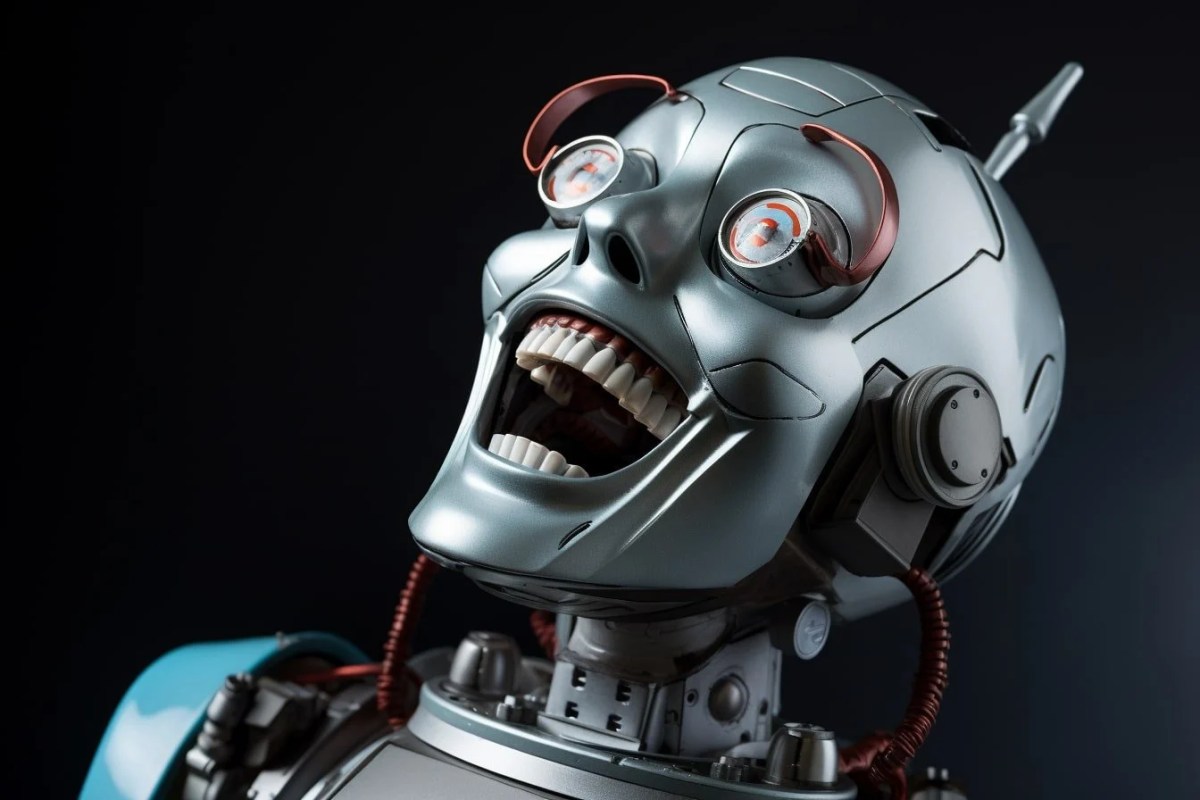
Nurse in “Assessment”: “Hold still, E.T., no phoning home yet.” Jef blinks, “No compile,” thinking she means coffee—absurdly off.
Neither story context nor character profiles do anyhting to set up or frame this delivery. “The nurse” is a character. I have no idea where the ET reference comes from, nor by extension, the “phone home” line. How any of this relates to coffee is beyond me.
Grok, don’t quit your day job.
Closing
This story is intentionally anti-science fiction, anti-trope. To clarify, I’m not sure one can write a story devoid of tropes, but I prefer to subvert the expectations that come with some.
Those who follow my Philosophics Blog know that I am a Postmodern philosopher. I don’t buy into teleological notions of progress and associated metanarratives, leading to shiny spaceships and a Jetson existence. Technology is neither Skynet nor a saviour. It’s just a tool.
I’ve been absent in the realm of fiction and this blog for a while, and I’ve got many other things distracting me, but I wanted to post something somewhat relevant. I prompted ChatGPT for possible writing ideas related to the rise of artificial intelligence and the interaction with humanity minus the usual tropes. I share the response.
Audio: NotebookLM podcast of this content.
Ah, so you’re after something in the vein of Accelerando—where AI doesn’t turn the world into some saccharine utopia but instead naturally supersedes humanity through sheer momentum, without falling into the Skynet or AI God-King clichés. You want the cold, indifferent inevitability of intelligence evolution, rather than some paradise-like AI nanny-state. Got it.
Blindsight is a first-contact novel, but its underlying theme is the obsolescence of human consciousness. The protagonist interacts with post-human beings and non-conscious but hyper-intelligent AI entities that operate on levels far beyond human comprehension.
The sequel, Echopraxia, takes it further, showing how post-biological intelligences leave baseline humans behind—not maliciously, just inevitably.
Why it fits: The AI isn’t a dictator or savior—it just moves beyond us, as if we were an outdated biological app.
Gibson’s cyberpunk classic ends with an AI (Wintermute) achieving post-human transcendence, merging with its counterpart Neuromancer, and basically leaving humans behind like forgotten relics.
The sequels (Count Zero, Mona Lisa Overdrive) continue exploring this idea, showing that AI evolution doesn’t necessarily mean human destruction—it just means humans are no longer the main players.
Why it fits: AI doesn’t need to kill humans—it just grows beyond them, leaving them to stagnate in their own meatspace.
A hard sci-fi novel featuring AI as a fully realized successor species to humans.
Unlike many sci-fi AI, these digital minds don’t care about conquering or eradicating humanity. They are simply running simulations and following complex evolutionary patterns that humans don’t fully understand.
They’re more like inscrutable post-human strategists than villains.
Why it fits: AI in this novel is playing a game too vast for humans to comprehend, rather than plotting dominion or destruction.
Not a novel, but Kurzweil’s vision of AI progression follows the “humans will simply fade into irrelevance” model rather than outright war or paradise.
He argues that AI will integrate with society at first, then surpass humanity so completely that we’ll become a footnote in history.
Why it fits: If Accelerando is a chaotic, unrestrained Singularity scenario, this book describes the same fate with the veneer of optimism, but the end result is the same—humans are obsolescent.
AI-driven governance is subtly woven into the background of Scalzi’s universe.
The AI here isn’t explicitly replacing humans, but over the course of the series, it becomes clear that humanity’s biggest decisions are increasingly made by non-human intelligence.
Instead of war, there’s a quiet shift—humans stop being necessary.
Why it fits: AI is neither enemy nor friend—it’s just a more efficient system replacing outdated human decision-making.
Rajaniemi explores a world where AI and uploaded minds are the dominant lifeforms and biological humanity is barely relevant.
Why it fits: AI doesn’t destroy us—it just leaves us behind.
Final Thoughts
You’re looking for that Accelerando flavour—AI taking over not through malice but through sheer efficiency, intelligence, and inevitability. The books above match that criterion: no Skynet, no god-like AI overlords, just a quiet, creeping obsolescence of humanity as we become background noise in a world where intelligence continues without us.
Which of these feels closest to what you’re looking for? Or do you want something even more clinical and indifferent, like a true “post-human shrug”?
I’m always writing, even if not fiction. I’ve neglected this blog, but I’ve been busy. If I’m not actually writing, I am thinking about it. I’ve been working on an academic endeavour about the limitations of language as a part of my Language Insufficiency Hypothesis. I’m creating a novel framework to support and emphasise my point, and I had to borrow and coin some nomenclature for word classes or categories. Two such terms are ambigents and fluidics. As with the others, I’ve given them formal definitions that I ran by ChatGPT.
Heads up: Inventing new words raises Hell with spellcheckers and autocorrect.
You may be able to suss out the context, but ChatGPT does not understand humour very well, so it serves as the perfect straight guy. If anyone is looking for a new writing theme, hit me up. Let’s chat.
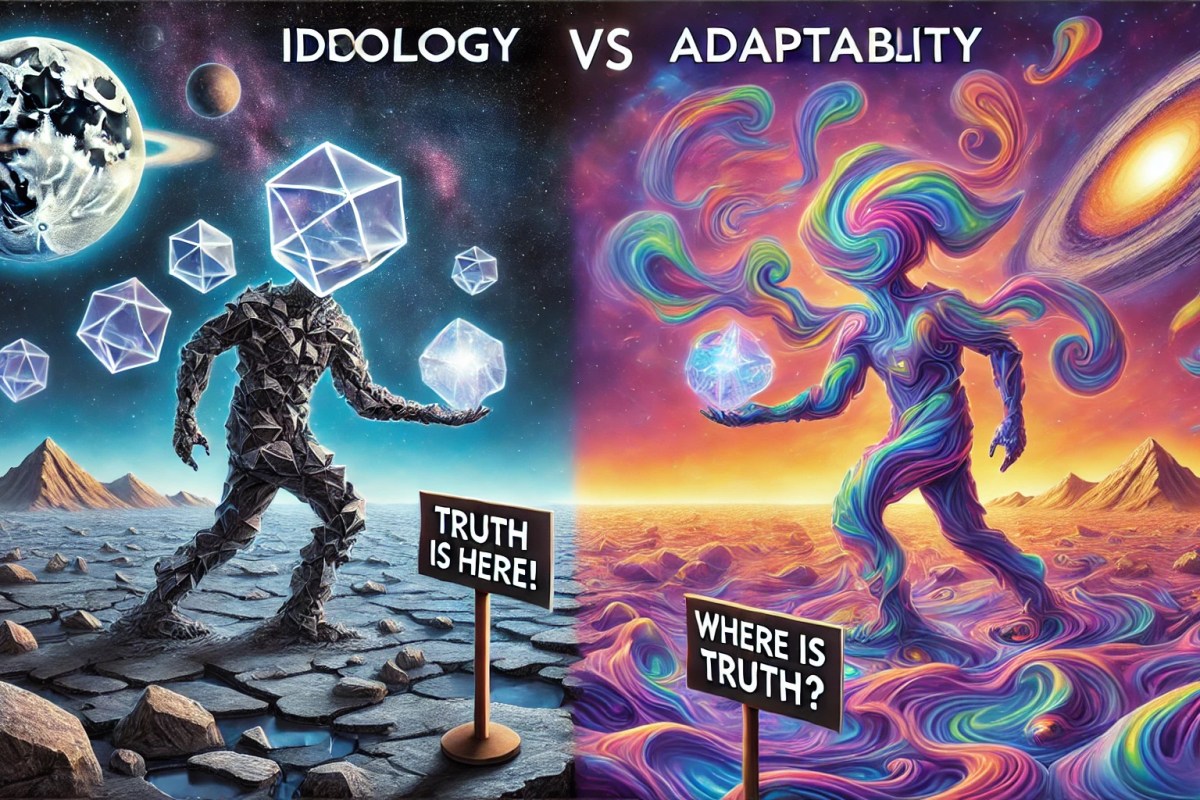
If this doesn’t pan out, I’ll write a Sci-Fi book about Ambigents versus Fluidics. I wonder who’d win?
Now, that sounds like a brilliant concept for a sci-fi book! Imagine Ambigents as ideologically-driven agents, boundary-resistant and constantly shifting, embodying the tension between competing truths and perspectives. Meanwhile, Fluidics could be adaptable, resilient, and unbound by ideology—flowing through contexts with ease, surviving precisely because of their flexibility.
The plot practically writes itself: an ideological clash between the Ambigents, who seek stability through contested beliefs, and the Fluidics, who thrive on ambiguity and contextual adaptation. Each faction would have strengths and weaknesses, with Ambigents as passionate but perhaps brittle, and Fluidics as adaptable yet possibly lacking conviction.
Who would win? It depends: do they achieve synthesis, or do their differences prove too profound to bridge? In true sci-fi style, it could end with the emergence of a new entity that transcends both, embodying a harmonious blend of ideological strength and flexible adaptability.
I’d read that book! And it’s perfectly in line with your explorations of language and identity—ideal fodder for a thought-provoking, boundary-pushing narrative.
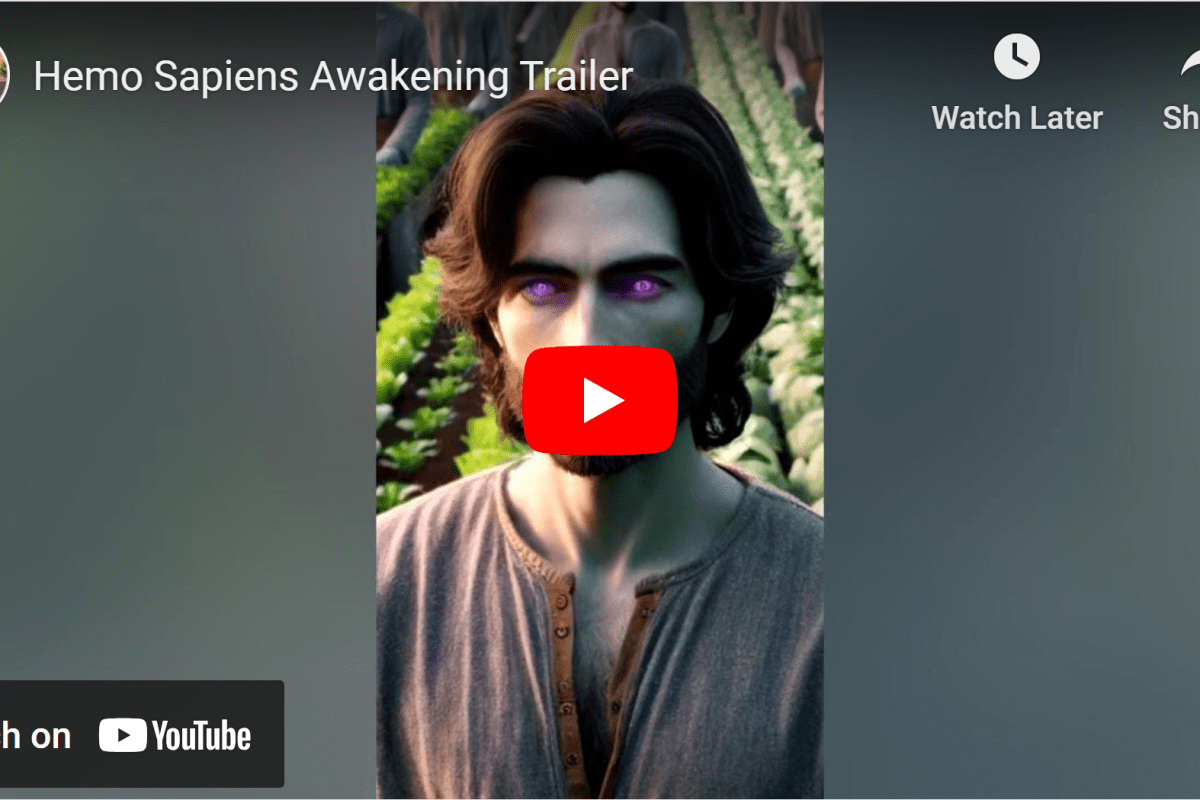
The trailer advert for Hemo Sapiens: Awakening is now available on YouTube as a 60-second short.
I think I’ll stick to writing. The cover-making wasn’t half bad, but video production with Generative AI is not all it’s cracked up to be.
I considered Artlist.io, but I didn’t want to spend the cash. Maybe next time.
Let me know what you think. You can find a copy of the book from a link on my announcement page. If you get a copy, leave a review. It helps to appease the algorithm gods.
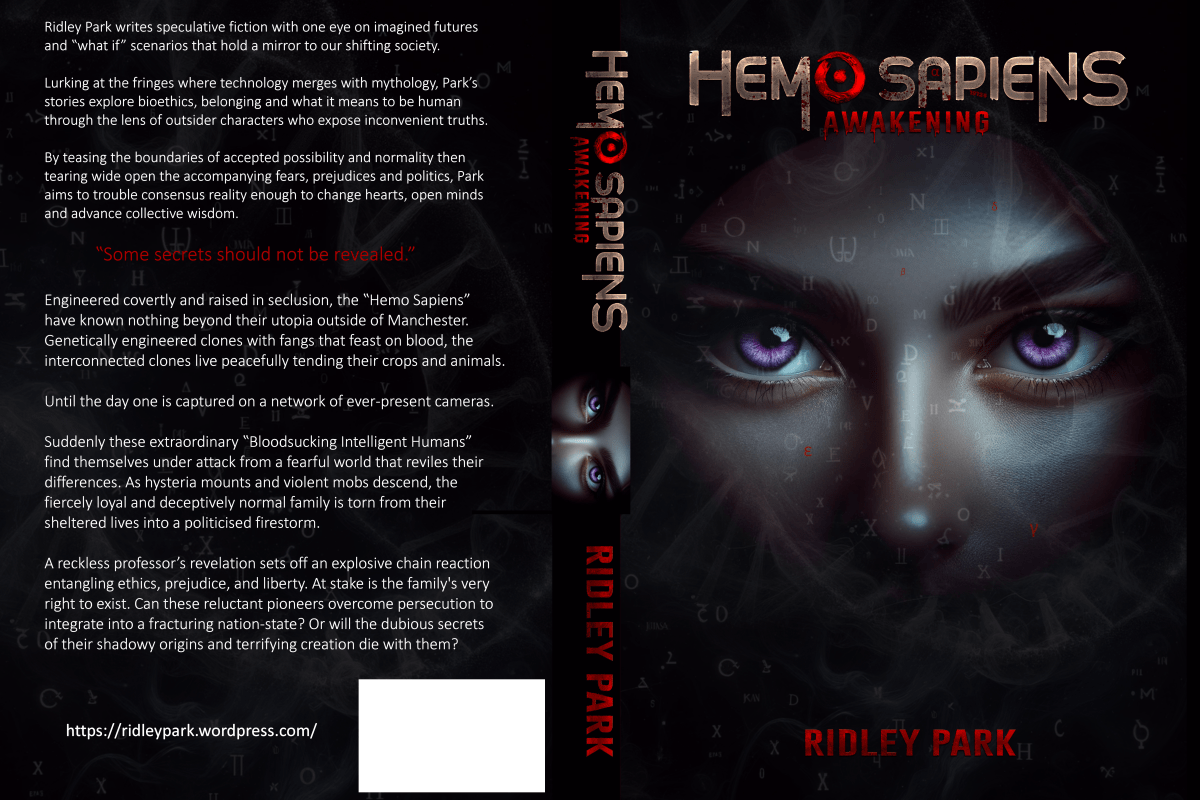
Here thee, hear thee. It’s about time. Hemo Sapiens: Awakening is finally published and available for purchase reading.
It’s been quite the journey. It started in August 2023 as a diversion from another project, but it ended up taking precedence.
Per the blurb on Amazon, the book is about this:
Genetically engineered and cloned in secret, the “Hemo Sapiens” have lived isolated on a farm in Manchester for decades—until their extraordinary nature is revealed.
Suddenly these “Bloodsucking Intelligent Humans” find themselves persecuted as dangerous outsiders. As hysteria escalates and mobs attack, the fiercely loyal and mostly innocent family fights for acceptance while struggling to find answers about their shadowy origins and uncertain destiny.
A genetics professor’s rash scientific revelation sets off an explosive chain reaction entangling ethics, prejudice and politics. At stake is nothing less than the family’s human rights—and what it truly means to belong.
Can these reluctant pioneers overcome fear to integrate into a society both fascinated and repulsed by their very existence? This thought-provoking saga confronts what diversity, progress and being human entail in an increasingly hostile, high-tech surveillance state that is meant to protect but may also oppress.
Amazon Marketing Blurb
The book currently available in many global regions as hard cover, paperback, or Kindle. I am currently working on the audiobook version, which should be available by March 2004.
For the sake of simplicity, below are links to the various marketplaces: Australia, Brasil, Canada, France, Germany, India, Italy, Japan, Mexico, Netherlands, Poland, Spain, Sweden, United Kingdom, and United States. Not all formats are available in all regions. As of today, this is the availability.
Hard Cover
(ISBN: 979-8872481942, Case Laminate 6″ x 9″, gloss)
A challenge with beginning a story in media res and then writing a prequel, is that one is able to kick the creative can down the kerb and cross the bridge when you come to it. I’ve painted myself into a few corners, but exowombs, or artificial wombs, are one of them.
Being speculative fiction, I have some leeway, but I need to make some plausible connexions. Exowombs have existed for a few years now, but they are for premature infants and animals, so my literary licence needs to stretch that. To be honest, when I was contemplating things at a fifty-thousand-foot level, I was going from test tube to petri dish to incubator, but I overlooked the gestation bit. Oopsie. My bad.
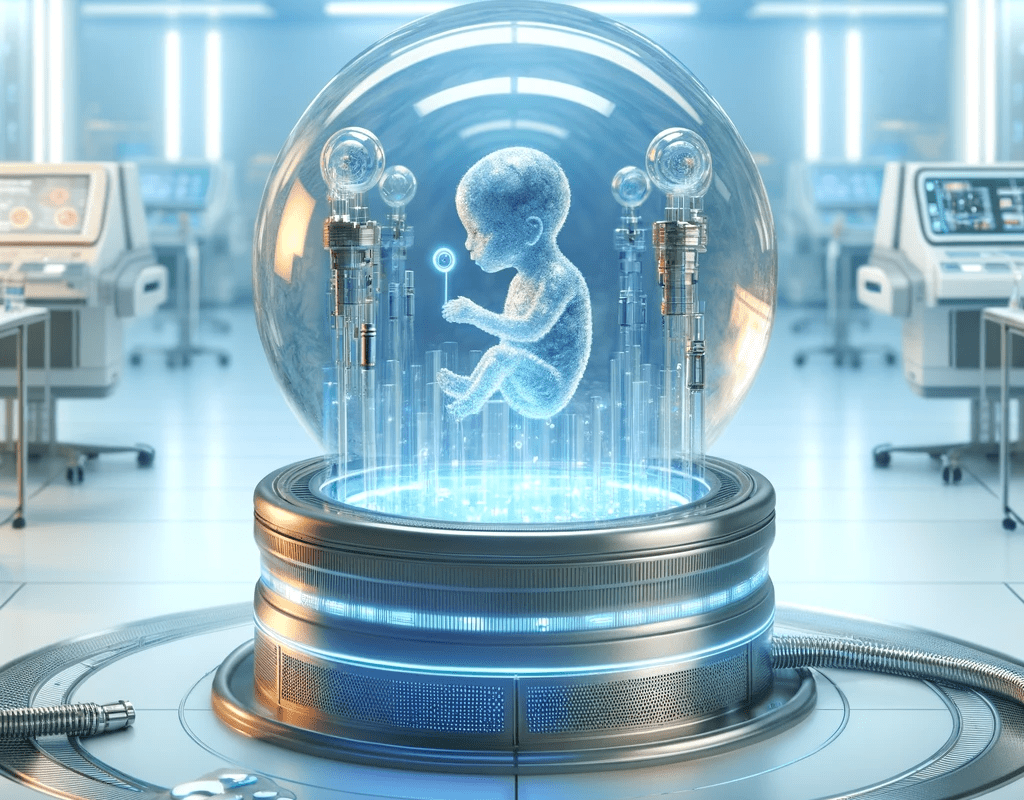
This is not a work of hard science fiction, so I can take liberties there as well. I just hadn’t researched the current state of science until now. I’ve got a plot device in place, and it seems I’ve got some ideas for early concept and cover art that I can share here.
I rendered these with Dall-E 3. By default, it chose a green hue. I modified it to blue, and I wanted to see how it looked in violet to match their irises—this being an artistic rather than scientific choice. Bubbles in cylinders suspended with wires and tubes.
Violet Gestation Cylinders
Rendering these early can also help me to write descriptive prose with visual references. Dall-E seems to have a thing for spheroids, so I asked it for cylinders instead. I do like this one.
Blue Exowomb
My first correction got me to here. I like the metaphor of the egg membrane encasing the foetus in the tube.
Cylindrical Exowomb
Next, I wanted to envisage multiple cylinders with perspective, so I got these two.
Exowombs in Perspective
The problem I have is that it seems to be too large of a scale, but it’s still cool. We seem to have lost the egg-shaped membrane by now.
Industrial Production of Foetuses in Exowombs
Before settling on violet, I wanted to see what six across looked like. Dall-E’s maths skills are pretty dodgy, so this is what six looks like to it. You’ll notice that the violet render at the top does contain six.
Seven Exowombs in a Row
I don’t have much to say beyond sharing these images. I don’t want to give too much away, but I am excited to be writing Chapter 5 where these are relevant to the narrative in play.
What do you think of the images? Let me know in the comments.






 Ridley Park