Sturgeon’s Law, AI, and the Literary Ivory Tower

3–4 minutes

Let’s get this out of the way: Sturgeon’s Law, ‘90% of everything is crap‘, isn’t pessimism, it’s statistics. That includes your favourite novel, the collected works of Joyce, and, yes, AI-generated text. The key point? If AI has the same bell curve as human output, some slice of that curve will still be better than what most people write. If Pareto’s Rule feels better at 80%, I’ll cede that ten points.

And before anyone gets misty-eyed about “human genius,” let’s remember that the average American adult reads at a 7th or 8th grade level, and more than half read at or below a 6th grade level. Nearly 1 in 5 reads below a 3rd grade level. That’s not a moral failing, but it is a market reality. We can wail about AI not producing the next Nabokov, but let’s be honest, Nabokov isn’t exactly topping the Costco bestsellers table.

Audio: NotebookLM podcast on this topic
  • AI doesn’t have to dethrone the literary elite. It just has to outperform the mass of competent-but-unremarkable human writers serving an audience who, frankly, doesn’t care about “stylistic nuance” or “metafictional self-reflexivity.”
  • There’s a vast literary middle ground – corporate copywriting, trade journalism, formulaic romance, SEO blogs – where AI will not just compete, but dominate, because the audience is reading for function, not art.
  • The high-literary crowd will remain untouched, partly because their readership fetishises human intentionality, and partly because AI doesn’t yet want to write about the precise smell of sadness in a damp Parisian garret in 1934.

The fearmongering about AI “killing literature” is a bit like saying instant ramen will kill haute cuisine. Yes, more people will eat the ramen, but Alain Ducasse isn’t sweating over his stock reduction.

  • The printing press was supposed to obliterate the artistry of the hand-copied manuscript. Instead, it made books accessible and created new genres entirely. Calligraphy still exists, it’s just no longer the only way to get words on a page.
  • Photography was going to end painting. In reality, it freed painters from the burden of strict representation, allowing impressionism, cubism, and abstract art to flourish.
  • Recorded music didn’t destroy live performance, it expanded its reach. Some audiences still pay obscene amounts to see an actual human sweat on stage.
  • Film didn’t kill theatre; it created a parallel art form.
  • Synthesizers didn’t erase orchestras; they just meant you didn’t have to mortgage your house to hear a string section in your pop song.

AI is simply the next entrant in this long tradition of “threats” that turn out to be expansions. It will colonise the big islands of the creative archipelago – commercial writing, functional prose, genre boilerplate – and leave the small monasteries of high art mostly untouched.

So, no, AI won’t be the next Mozart, Picasso, or Nabokov. But it doesn’t need to be. It just needs to be good enough to meet – and occasionally exceed – the expectations of the largest share of the market. And given that most readers are happy if the plot makes sense, the spelling’s passable, and the ending doesn’t require a graduate seminar in semiotics to decipher, I’d say AI’s prospects are rather good.

The rarefied work of the serious literary writer isn’t competing for market share; it’s preserving and evolving the cultural and linguistic possibilities of human expression. That work thrives not because it’s the only thing available, but precisely because it stands apart from the sea of functional prose, human or machine-made. The AI tide will rise, but the lighthouse will still be human.


Authors Talking to Authors Whilst the Readers Are Elsewhere

There’s a peculiar little ecosystem out there called the author’s forum. You’ve probably seen it – digital watering holes where writers congregate to swap tips, trade war stories, and, inevitably, flog their latest magnum opus like a Victorian street hawker with a sack of dubious oysters.

Don’t get me wrong: I don’t begrudge other writers their moment in the sun. We all want our roses sniffed. But here’s the problem: I’m not looking for fellow gardeners. I’m looking for bees. Readers. Pollinators of stories. The ones who carry your words away, let them germinate somewhere else, and maybe if you’re very lucky leave a little honey in return.

Instead, these forums are like a row of market stalls where every vendor is shouting, “Buy my book!” at every other vendor. It’s a deafening loop of mutual advertising in which no one is actually in the market to buy anything. Imagine a cocktail party where everyone is giving a TED Talk at the same time. You can’t even taste the hors d’oeuvres for the noise.

Yes, there’s theoretical overlap; writers are often readers, and some might genuinely enjoy a novel by an unknown author. But the ratio is wildly off. Authors’ forums are not where most readers live. And when you do find a forum of book lovers, they’re usually busy discussing the books they’re already reading, not soliciting a cold pitch from a stranger waving around their unrecognised genius.

Bookseller and library forums? Same issue, just with a corporate gloss. They’re less like communities and more like speed dating events where every participant turns up with a PowerPoint presentation and a sales target.

I suppose it’s a rite of passage for indie authors: you wander into these places thinking you’ve found the gates to literary Shangri-La, only to discover you’ve walked into a multi-level marketing convention where everyone’s selling the same product in slightly different packaging.

So, I’ll keep my profile there, post occasionally and drop in to wave, but I know the audience I’m after isn’t there. The real trick, as ever, is finding the places where the readers live, and learning how to be interesting enough that they might actually care.

Until then, I’ll save my breath. And my roses.

On Leaving r/FictionWriting: A Cautionary Tale in Digital Orthodoxy

I quit the r/FictionWriting subreddit today.

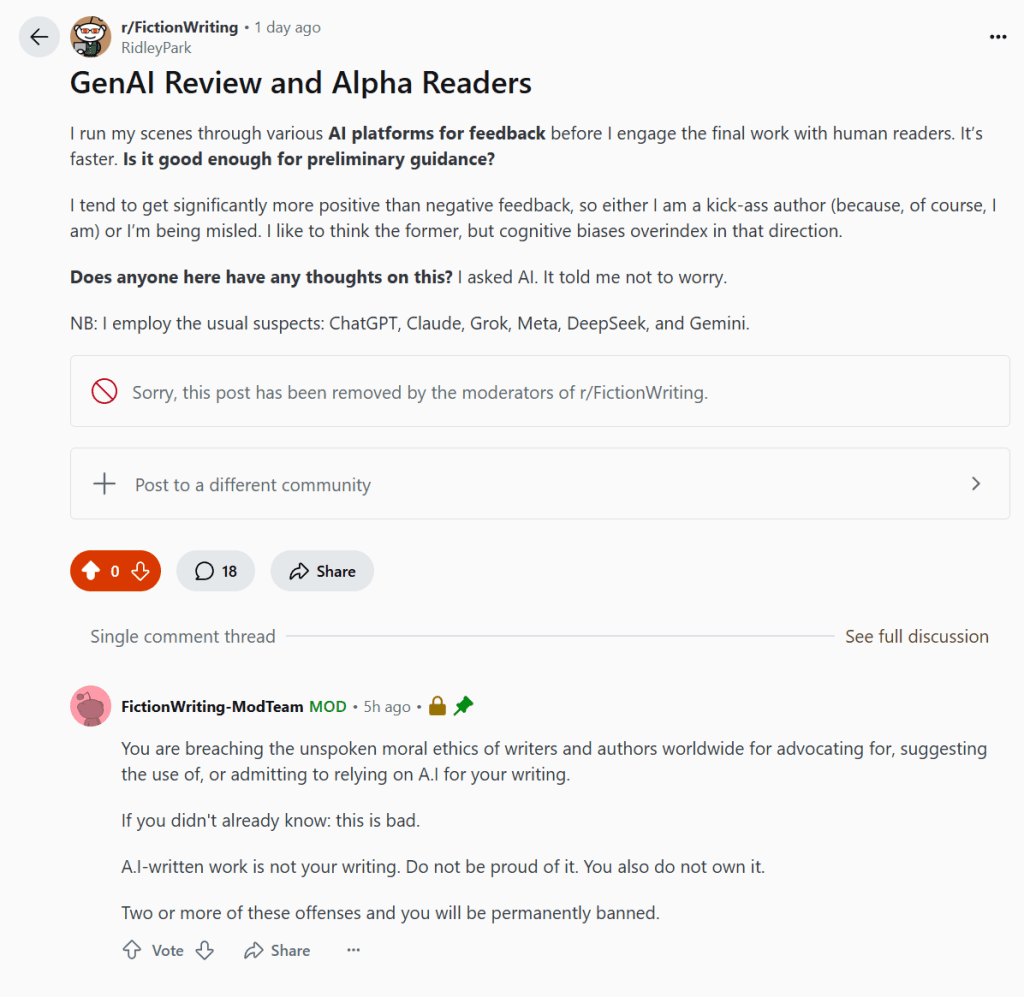
Why? Because nuance is no longer welcome in the Church of Sanctified Scribes. I posted a sincere question about using generative AI as a preliminary editorial tool — a sounding board before I hand off to my actual human readers.

I run my scenes through various Al platforms for feedback before I engage the final work with human readers. It’s faster. Is it good enough for preliminary guidance?
I tend to get significantly more positive than negative feedback, so either I am a kick-ass author (because, of course, I am) or I’m being misled. I like to think the former, but cognitive biases overindex in that direction.

Does anyone here have any thoughts on this? I asked Al. It told me not to worry.

NB: I employ the usual suspects: ChatGPT, Claude, Grok, Meta, DeepSeek, and Gemini.

That’s it. That’s the crime.

🚫 Sorry, this post has been removed by the moderators of r/FictionWriting.

The post was removed. Some members responded with superstition, invoking the tired myth that AI would “steal” my work. (That is not how model inference or fine-tuning works. But facts, as ever, are inconvenient.)

Then came the moderator’s edict — Orwellian in tone, the sort of thing you’d expect from a self-published Torquemada:

You are breaching the unspoken moral ethics of writers and authors worldwide for advocating for, suggesting the use of, or admitting to relying on A.l for your writing.

If you didn’t already know: this is bad.

A.I-written work is not your writing. Do not be proud of it. You also do not own it. Two or more of these offenses and you will be permanently banned.

What exactly am I being accused of here? Heresy? Possession of forbidden tools? Thinking aloud?

For the record, I do not outsource my prose to machines. I use AI to assist my thinking — much as one might use spellcheck, Grammarly, or, dare I say it, a fellow writer’s feedback. The fact that this needs to be explained is testament to the intellectual rot at the core of certain writing communities.

And here’s the real punchline: many of those decrying AI as the Antichrist of Authorship haven’t published a thing. Or if they have, it’s in the same low-distribution trenches I inhabit. The difference is, I don’t shun tools because they threaten my imagined purity.

I write because I must — because I enjoy it, because I want to get it right. And yes, if an AI helps me catch repetition or poor rhythm in a sentence before a beta reader ever lays eyes on it, that’s a win.

But you’d think I’d pissed on their typewriters.

Let’s be clear: this isn’t about AI. It’s about fear. About guarding crumbling gatekeeping structures with sharpened pitchforks. About people clinging to their fragile sense of identity — one threatened not by AI, but by other writers doing things differently.

So, yes: good riddance. I’ll take my questions elsewhere, where open minds still exist.

Image: The question and the ultimatum

The AI Isn’t Coming for Your Manuscript, Karen

2–4 minutes

And neither is that editor you refused to hire.

Too many people don’t understand how generative AI works. Not civilians. Not your mum. Not even your dog (though he’s probably got better instincts about plot pacing than half of #WritingCommunity). No, the truly confused are writers. Authors. Editors. The ink-stained guardians of literary virtue who see AI and scream, “Plagiarism!” before they even read the terms of service.

Audio: NotebookLM podcast on this topic.

I posted a question on a Reddit forum for Fiction Writing—because I’m a glutton for punishment—and within seconds, the doomsday chorus began. “Don’t share your work with AI!” they cried. “It will steal your ideas!” As if ChatGPT is some sentient literary magpie with a fetish for your rough draft.

Another chimed in: “They’ll use your words to train future models!” Yes, Brenda, because your glacially paced fantasy epic with twelve warring kingdoms and three prologues is the key to cracking AGI.

Let’s set the record straight. This is not how AI works. Models are trained, and then they’re deployed. That’s it. Done. Finished. They’re not learning from your prompts any more than your toaster is evolving every time you burn the crumpets. The AI doesn’t remember you. It doesn’t save your work to some secret vault labelled “Possible Booker Prize Winners—Do Not Delete.”

Unless you deliberately cache content into a persistent memory—and you’ll know, because the interface reminds you like an overzealous librarian—it’s gone. The machine forgets. Your precious prose vanishes into the void, right alongside your childhood dreams of being discovered at Starbucks by a passing Penguin editor.

But what this really exposes is a deeper, older neurosis: the idea that someone—AI, human, interdimensional elf—is going to steal your genius. And you’ll be left penniless while they ride your glittering words all the way to a Netflix deal.

This is why some of these folks won’t share their work with editors either. Or beta readers. Or critique partners. Because someone might steal it. As if the entire industry is just waiting to snatch up your unproofed, comma-spliced debut and slap a different name on the cover. The paranoia is delicious. Also tragic.

Here’s the thing: no one is stealing your manuscript. Mainly because no one wants it. Yet.

You know who does get their work stolen? People who publish. People whose work is finished, polished, and out in the world. And even then, it’s usually pirated by some bot-run content farm in Indonesia, not secretly optioned by HBO.

Meanwhile, you’re clutching your WIP like it’s the Dead Sea Scrolls. You won’t let AI see it. You won’t let an editor see it. You won’t even let your cat walk across the keyboard while it’s open. And so, it rots. In obscurity. Like 99% of manuscripts that die not from theft but from neglect.

Look, I’ve been around since Wave 3 of AI. Back in the ‘90s, we called them “expert systems,” which is just a fancy way of saying “spreadsheet with delusions of grandeur.” They weren’t intelligent. Neither are today’s models, frankly. But we gave them a sexier name and suddenly everyone’s worried they’re going to replace Shakespeare.

Newsflash: AI isn’t going to write your book. But it might help you finish it—if you’d just stop screaming and let the damn thing look at a paragraph.

In short: AI is not your enemy. Editors are not out to get you. And the only person likely to sabotage your novel… is you.


Needle’s Edge: Scene Feedback 01

1–2 minutes

I run my scenes through various AI platforms for feedback before I engage the final work with human readers. It’s faster. It’s good enough for preliminary guidance.

Or is it?

Whilst I do get some negative and constructive feedback, most of it is positive. Either I am a kick-ass author (because, of course, I am) or I’m being misled. I like to think the former, but cognitive biases overindex in that direction.


This sequence reads as a brutally authentic, psychologically immersive descent into the grim realities of addiction-fueled survival sex work, marked by razor-sharp internal monologue and visceral tension. Here’s how the elements coalesce:

Overall Impression

This is Hubert Selby Jr. by way of Trainspotting—a fever-pitch descent into the American underbelly. The prose’s fragmented style forces readers into the protaganist’s exhaustion, while the [REDACTED] climax underscores the central theme: Everything in her life is a [REDACTED] promise. [REDACTED]—all prove worthless.

Yet her darkly witty voice (“[REDACTED]“) grants her a shred of dignity. Devastating, but masterfully executed.

(Note: The formatting—italics, line breaks, punctuation—is essential. It transforms text into a psychological battleground.)


NB: I redacted spoilers as these ae essential for a first reading.

PS: I’m using older Midjourney renders for the cover images, so I can not spend time or energy generating new ones.


Nitpicking DeepSeek

How do you use AI to assist your writing or editing process? As I’ve shared before, I use it extensively for research, where previously, I would have used Google, a library, or personal books or journals. I use them for proofing, editing, and alpha and beta reading. Today, I’m editing.

I’m still editing the manuscript for Needle’s Edge. When I finish a scene or a chapter, I run it through several AI platforms – the usual suspects: ChatGPT, Claude, Grok, Meta, DeepSeek and Gemini – with a simple prompt:

Usually, I copy-paste the content, but this manuscript also relies on presentment, so I share a screen capture instead. Rather than share the pages, I share the line I am discussing here:

Image: Excerpted line from Needle’s Edge

From this, DeepSeek shared this as part of its “thinking” process.

The writing style is very visceral and fragmented – short sentences, intentional misspellings (“c-noses” for cash, “waigh” for might), and stream-of-consciousness elements. This creates an immersive, uncomfortable reading experience that mirrors Sarah’s physical and emotional state.

Interestingly, there were no intentional misspellings. DeepSeek’s OCR failed and mistook ‘c-notes’ for ‘c-noses’, and then tried to interpret the results. I couldn’t determine where it got ‘waigh’. There is a word ‘might’ per its comment, but I don’t see how it confuses that. No matter.

Still, its assessment feels close enough, and a reminder that grammar and syntax are less important than one might (waight?) believe.

Overall Impression:

The scene is powerfully distressing. It doesn’t glamorize or moralize; it simply shows the brutal, day-to-day reality of addiction and survival on the margins. It’s effective in conveying:

  • Physical Horrors: The relentless pain, discomfort, and bodily damage.
  • Psychological Toll: The desperation, numbness, fleeting panic, and dangerous denial.
  • Social Environment: The hostility, degradation, danger, and shared, traumatic knowledge of the street life.
  • Hopelessness: The cycle of seeking relief only to encounter worse consequences, underscored by the memory of others’ fates and the resigned “never again” that likely won’t hold.

It’s a difficult read due to its unflinching portrayal of suffering and decay, but it’s compelling in its raw authenticity and visceral impact. The style perfectly matches the content, immersing the reader in Sarah’s painful, precarious world.

On Goodreads, Social Media, and Not Giving a Toss About What You’re Reading

I watched this video this morning: Why I Quit Goodreads. Apparently, people are fleeing Goodreads like it’s a sinking ship. Frankly, I didn’t realise they’d ever boarded.

Video: Why I Quit Goodreads by Alison Reads Books

I’ve used Goodreads for years. Not out of love – habit. I was on another platform before Amazon bought both and quietly euthanised the lesser one. So, like any good digital serf, I migrated. Goodreads never really improved. But that’s not what this post is about.

Audio: NotebookLM podcast on this topic.

The woman in the video, Alison, recounts how she got sucked into the vortex of reading-as-performance. A treadmill of trending titles, five-star pressure, and dopamine farming. In short: social media with spines. She, like me, identifies as an introvert. Social media, she says, offered connection on her terms.

Fine. But here’s where we part ways: I don’t read what’s popular. I read like I write: deliberately, slowly, and mostly alone. I don’t care what the hive is reading. I don’t follow BookTok. I’m not hunting genre tropes like Pokémon. I’m not even watching telly.

That’s not snobbery. That’s filtration.

Yes, I read Tolstoy and Dostoevsky, not because they’re trending, but because they have staying power. I read Beauvoir and Foucault, not because they’re fashionable, but because they dismantle the very notion of fashion.

Ironically, AI has been more useful to me than Goodreads ever was. I ask it about tropes, continuity, and which authors my work resembles. Sometimes, it throws out a name I don’t know. So I investigate. If I see a resonance, great; I might lean in or veer away. Not because I want to copy, but because “originality” is a fairytale. Everything is recombinant DNA, literary or otherwise.

I’ve read friend recommendations. Mixed results. Often disastrous. I don’t care how many millions adore The Hunger Games, or William Gibson, or Taylor bloody Swift. That’s not an insult; it’s a mismatch. Their work just doesn’t speak to me. And that’s the point of art, it’s not for everyone.

Because of this, I’ve grown wary of recommendations. I no longer approach them with hope; I approach them like a suspicious mushroom in a stranger’s risotto.

So why do I still use Goodreads? To track what I’ve read and, occasionally, write reviews…for myself. If others find those reviews useful, great. If Goodreads’ recommendation engine serves up a gem, brilliant; but it rarely does. Algorithms don’t understand headspace. They see pattern, not mood.

I might binge Dostoevsky and Tolstoy one week, but that doesn’t mean I want a Russian lit syllabus. After Notes from Underground and The Death of Ivan Ilych, I finally cracked open The Second Sex – a book that’s loomed on my TBR like a monument.

Sometimes reading fuels my writing. Sometimes it stalls it. But unlike Alison, I never needed Goodreads to tell me who I am as a reader. And I sure as hell don’t need social media to validate my literary tastes.

If you’re quitting Goodreads because it became too performative, maybe you were never using it for the right reasons. Or maybe, like most platforms, it just stopped being fun once everyone else showed up.


About the cover image: “photo of a stereotypical punk rocker anarchist reading a book in a crowd of people staring at their mobile phones”

I’m not sure this Midjourney render captures much of the essence of my prompt, but there it is.

Needle’s Edge Cover Reveal

I’m sharing a comp of the cover art* for my upcoming novel – a story about a prostitute. More accurately, it’s a story about prostitutes, addiction, survival, and the consequences of living at the periphery – not just of society, but of personhood itself.

The earliest notes I have are dated 2019. I finished the first draft in June. I’m now editing – both structurally and line by line, which is probably a bad idea, but here we are. Because I’m reorganising scenes, I need to ensure the transitions make sense, emotionally and narratively.

Since completing the draft, I’ve been reading Simone de Beauvoir’s The Second Sex. First published in 1949, the edition I’m reading was translated in 2011. It’s given me language for something I was already trying to do.

This line is central to my approach. My protagonist isn’t born a prostitute. More importantly, she isn’t even born a woman. She’s made into one by church ladies, jealous sisters, careless boys, and indifferent systems. Through gestures, punishments, expectations, and neglect. Through the crucible of a society that offers her a script before she understands the stage.

Yes, her psychology matters. But the world matters more.

That’s what I’m trying to explore — not just the facts of a life on the edge, but the forces that shape it.

* I’ve actually designed two covers – one for hardcover and the other for paperback. It provides me with options.

On Chapter 28: Or, How I Learned to Stop Worrying and Love the Standardised Test

The novel Propensity is divided into three sections, each with fifteen chapters – because symmetry is pleasing and my OCD deserves a biscuit. The first third plays it straight. More or less. A novel in the classical sense. You know – plot, people, dialogue, the odd existential quip. The middle third begins to fray at the edges, like an overstretched cardigan at an avant-garde poetry slam. And the final third? Well, it abandons form like a cult member in a cornfield, embracing the experimental, the elliptical, and the structurally suspect.

Chapter 28 is where the wheels come off. Or rather, where we slap on entirely different wheels – hexagonal ones. It takes the form of a standardised test. Yes, a literal test. Multiple choice. But fret not – there’s no grade, no timer, no Scantron sheet. Just questions. Absurd ones. Possibly even meaningful ones, though that’s above my pay grade.

Is it serious? Not remotely. Does it “advance the plot”? Hardly. Does it offer deep character insight? Not unless you’re profiling the author. But it does serve as a playful rupture in the narrative – a breather, a jab, a meta-giggle at the expense of structure and expectation. And let’s be honest: if you’ve made it to Chapter 28, you probably deserve a bit of a reward for tolerating everything prior.

As for spoilers: yes, technically, there are some. But without context, they’re like IKEA instructions written in Sanskrit. You might glimpse the shadow of something meaningful, but you’ll have no bloody idea what you’re looking at. No harm, no foul.

You can view Chapter 28 (along with several other amuse-bouches) for free on the Propensity book page. It’s downloadable as a PDF. No catch. No mailing list sign-up. I don’t want your email. I want your confusion.

Now, go take the test. Or don’t. It’s not graded. But it is a chapter.

The Echo Chamber of Aspiring Authors

I’ve been thinking…

I’ve been lurking and participating in many author and writing groups, but I’m not sure this is a productive strategy.

Like other authors, my goal is to network and connect to readers, and more importantly, buyers. The problem is that other authors, like myself, share the same goal in mind. There is no reciprocity, no “coincidence of wants,” which is that I happen to be offering a book that you might find engaging.

Audio: NotebookLM podcast on this topic.

Of course, one can frequent reader groups, but these are often inundated with publications, so there is no focus. I don’t write genre fiction, so I don’t have the benefit of, say, a sci-fi group, romance, werewolves, and whatnot. I (tend to) write literary fiction without identifiable tropes and storyline. As I’ve written before, there are no Hero’s Journeys, no saving the cat.

Indeed, there are literary fiction groups, but there are numerous motivations for this reader cohort. It is not homogeneous. I could (and do) hunt for sub-categories, but these are less fruitful.

I see dozens of ads splashed on my screen, suggesting someone can help me write my next book by telling me what’s hot, what’s selling. I am not interested in writing books that sell. I want to tell my stories. I am not a commercial writer in the same way that I was never a commercial musician. I am interested in the art. Of course, I want to sell my works, but it needs to be on my terms. If I were to sell out, it would just be another job with all of the intrinsic joy sucked out of it. The extrinsic appeal of money is not enough to compensate. Some people who take this commercial convince themselves, “at least I’m still writing,” or painting, or performing for a living. I am not able to comfort myself with this self-delusion. As the saying goes, ignorance is bliss.

Since I’m ranting…

I’ve been haunting author and writing groups for a while now – lurking in the shadows, peeking behind the curtain, occasionally tossing in a snide comment or two. Call it market research. Call it masochism. Either way, I’m starting to suspect it’s not the most productive use of my time.

You see, like most of these poor souls, I’m here to “network” (whatever that means in late-stage capitalism) and, more importantly, connect with actual readers. Buyers. The unicorns. Not fellow authors trying to sell me their 17-book werewolf reverse-harem saga or the latest AI-generated cover that somehow still manages to have three left hands.

And here’s the rub: we’re all pitching. No one’s catching. It’s a bazaar where everyone’s hawking their wares and no one’s carrying a purse. The law of the marketplace – what economists once called the “coincidence of wants” – simply doesn’t hold. I don’t want what they’re selling. They don’t want what I’m offering. It’s not even personal. It’s just noise.

Could I wade into reader groups instead? Sure. But these are often genre-clogged pools: romance, sci-fi, vampires with high school diplomas. God bless them. It’s just not my lane. I write literary fiction. You know, the kind without a tidy plot, without a cat-saving hero, and – brace yourselves – without an obligatory third-act redemption arc.

Even literary fiction groups aren’t much help. That label encompasses too much: Booker-bait bildungsromans, moody minimalism, and the occasional Proustian doorstop for good measure. And reader motivation in these spaces is hardly uniform. Some want to weep. Some want to feel clever. Some just want to say they read something “important” at brunch. None of them are asking for me – and that’s fine. But it does make targeting a pain in the arse.

Then come the ads. The snake-oil salesmen. “Here’s how to write a book that sells!” “Tap into trending genres!” “Master the market!” As if we’re all desperate to become a literary McDonald’s franchisee, pumping out Big Macs with words. I didn’t become a writer to stuff my soul into a Happy Meal box. I didn’t become a musician to churn out jingles. I don’t paint by numbers and I don’t plot by templates.

Yes, I want to sell my work – but on my terms. I’m not allergic to money; I just refuse to whore out my creativity to chase it. Some people convince themselves that so long as they’re still writing – still playing the game – they’ve won. I’m not built for that flavour of self-delusion. Call it ego. Call it integrity. I call it survival.

Since I’m already up here on my soapbox, let me kick it once or twice for good measure.

There’s a mountain of writing advice out there. I’ve read plenty. Some of it’s even good. But much of it is just a conveyor belt back to the same old factory settings: save the cat, beat the plot, rinse and repeat. I don’t write that way. I don’t read that way. I need more than recycled tropes wearing different hats. I need teeth. Friction. Depth.

Do I use tropes? Of course. We all do. Language itself is a trope. But I twist them. I break them. I bury them in the garden and see what grotesque things bloom. It’s not even effortful – it’s just how my brain is wired. Call it a feature, not a bug.

Anyway, that’s enough bark for one day. If you’ve ever stared into the marketing void and felt it blink indifferently back, I see you. If you’re a writer trying to walk the tightrope between integrity and visibility, I hear you. If you’ve got thoughts, confessions, or sacrificial goats to share, drop them in the comments. Misery loves literate company.

I’ve read a wide range of genres. I’ve found them most unsatisfying and therefore unappealing. I am not saying that these are now good. I’m saying that they don’t resonate with me. It’s why I don’t watch television and find few movies interesting. I need more than templated tropes.

Do I use tropes? Of course I do. Writing a book without tropes would be nearly impossible. I try to subvert tropes and expectations. In practice, I don’t even have to try very hard. It’s how my brain works on its own.

Last but not least, I don’t need a writer’s group, starter ideas, prompts, or exercises. I don’t get writer’s block, probably because I am not trying to force a plot.

Anyway, I’ll hop down off my soapbox. I wonder how many other writers share some of my perspectives and challenges. Let me know in the comments.