Sustenance (available here) was free for everyone on Kindle on 8 and 9 September. My goal was to provide access to the book for exposure with the hope of getting ratings and reviews. It’s still early, but I’d like to report that over 100 people downloaded the Kindle version. Now, I’ll share some details.
The Kindle version was downloaded 106 times in the past two days.
Some read it from their KindleUnlimited accounts
Some bought physical copies
Some people rated the book; some even left reviews on Amazon or Goodreads
The ratings and reviews are mixed, but all are welcome. Few people rate books; even fewer review them, so I appreciate the effort.
I got 3 ratings and 2 reviews on Amazon: ⭐⭐⭐⭐⭐, ⭐⭐⭐⭐, and ⭐. A one-star review. Thanks for that, too.
The ⭐rating didn’t leave a review, so I don’t know why they didn’t like it. I don’t know what types of books they read or this is exatcly what they prefer – they just didn’t like this. Still, at least they took the time to do it.
As a former statistician who has worked with survey data, I find this to be similar – most people don’t respond to surveys. Most people don’t engage in call-in shows. Most often, the people who respond either love or hate the topic so much that they feel compelled to broadcast their opinions. The people who say “meh” won’t even bother.
KindleUnlimited notwithstanding, I have no idea how people engage with a book. I have purchased and downloaded more books than I can read in a lifetime – probably multiple lifetimes. Sometimes, I just want to have access to a classic in case the mood strikes me; sometimes a book comes into view, and I convince myself that when I have the time, I might read it. I have no way of knowing.
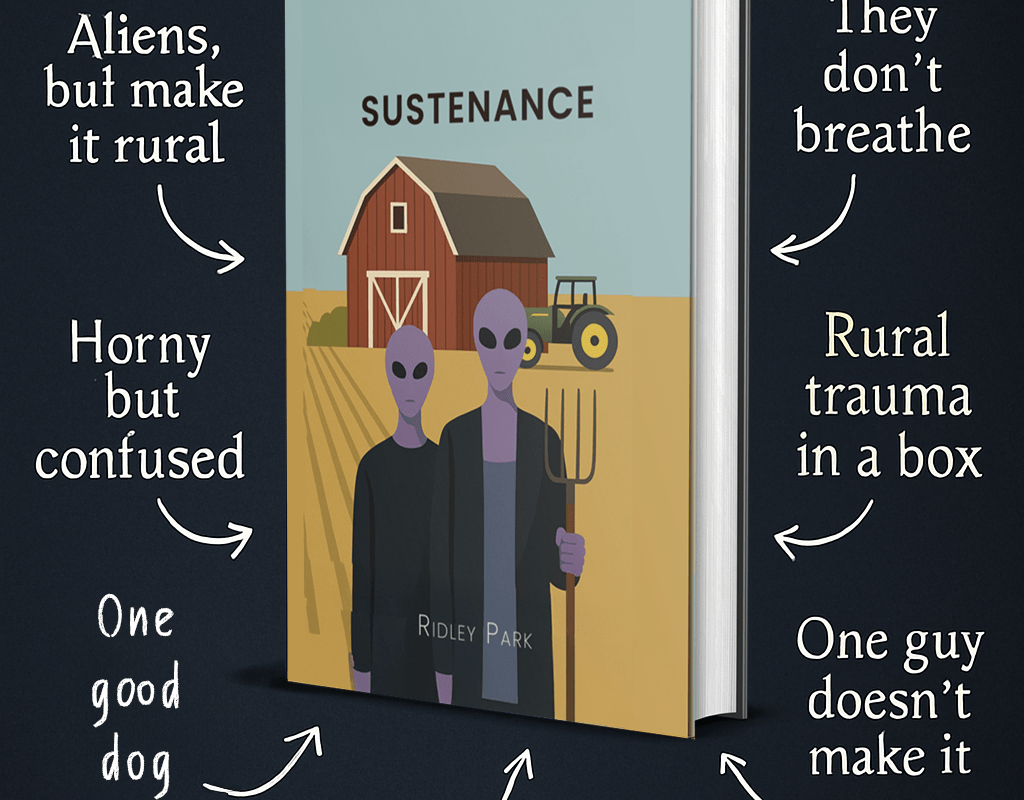
Image: Sustenance Trope Board
I’m guilty of some single-star ratings without leaving a review, so I am in no position to point fingers. Sometimes a book seems bad that you want to warn the world, but you don’t want to expend more time on the endeavour that you already have.
I took this screengrab of 1-star ratings from Goodreads – some have reviewers, others don’t.
Image: 1-Star Reviews
Only one of these books is non-fiction, though I might argue that point, hence the single star.
One Ayn Rand was a class assignment. The other was someone telling me that I hadn’t judged her best work. In this case, her best work is one star, so I can skip anything else. Ditto for the Bible – complete dreck.
Authority, I only recently read. it was part of a trilogy. The other two books got 4 and 3 stars, so I’ll consider this one a dud. I’m not in good company, as it rated worse than the other two on average, yet still managed a 3.55. Some people liked it.
The last one was a class assignment for my son that I read with him. His rating matched mine. How it became an assignment is just testimony that there is no accounting for taste.
Also, as a public service, I’d be willing to bet that if you liked these books, you won’t like mine.
Octavia Butler’s Dawn
On the topic of rating— I am midway through Dawn. It’s mid. I was asked why I hadn’t read it as part of the dystopian Venn, so I picked it up. To be fair, I thought several of the stories on the Venn were mid themselves, classics or otherwise. Perhaps I’ll write a separate post on that someday.
Honestly, I’d give Dawn 2 stars. However, I also know that Sci-Fi is not a genre that resonates with me, so I’ll be generous and give it a star because it may just be my personal bias of not relating to Sci-Fi that’s the problem, and the book might be better received by fans of that genre. Offhand, the only fiction genres I dislike worse than Sci-Fi are Fantasy and Romance.
Aside from being Sci-Fi, it reads like YA fiction. There’s nothing inherently wrong with YA, but I am clearly not its target demographic. Other than that, it’s serviceable, but I prefer to read content that’s more complex and layered, not spoonfed to me.
Conclusion
Anyway, I’ve derailed this thread, but I wanted to clarify how I approach rating books and want to thank those of you who have taken the time on Sustenance. If you haven’t yet, I’d appreciate any rating from 1 to 5. Reviews earn extra karma points.
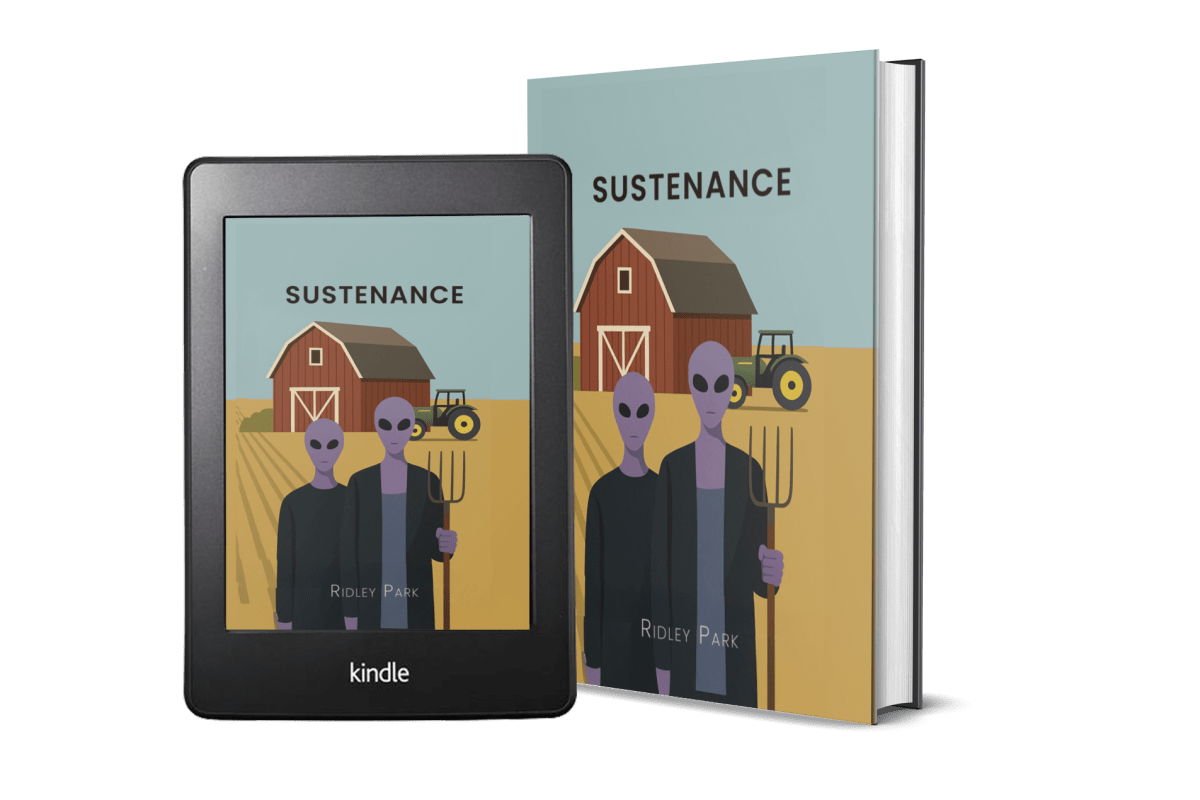
👽 People ask me: What’s with the aliens on the front cover of Sustenance? Fair enough. Let’s talk about it.
Sustenance is set in Iowa – real, dusty, soybean-and-corn Iowa. I’ve spent months there. I’ve lived in the Midwest (including Chicago) for over a decade. The farms, the tractors, the gravel roads… they aren’t just set dressing. They’re part of the book’s DNA.
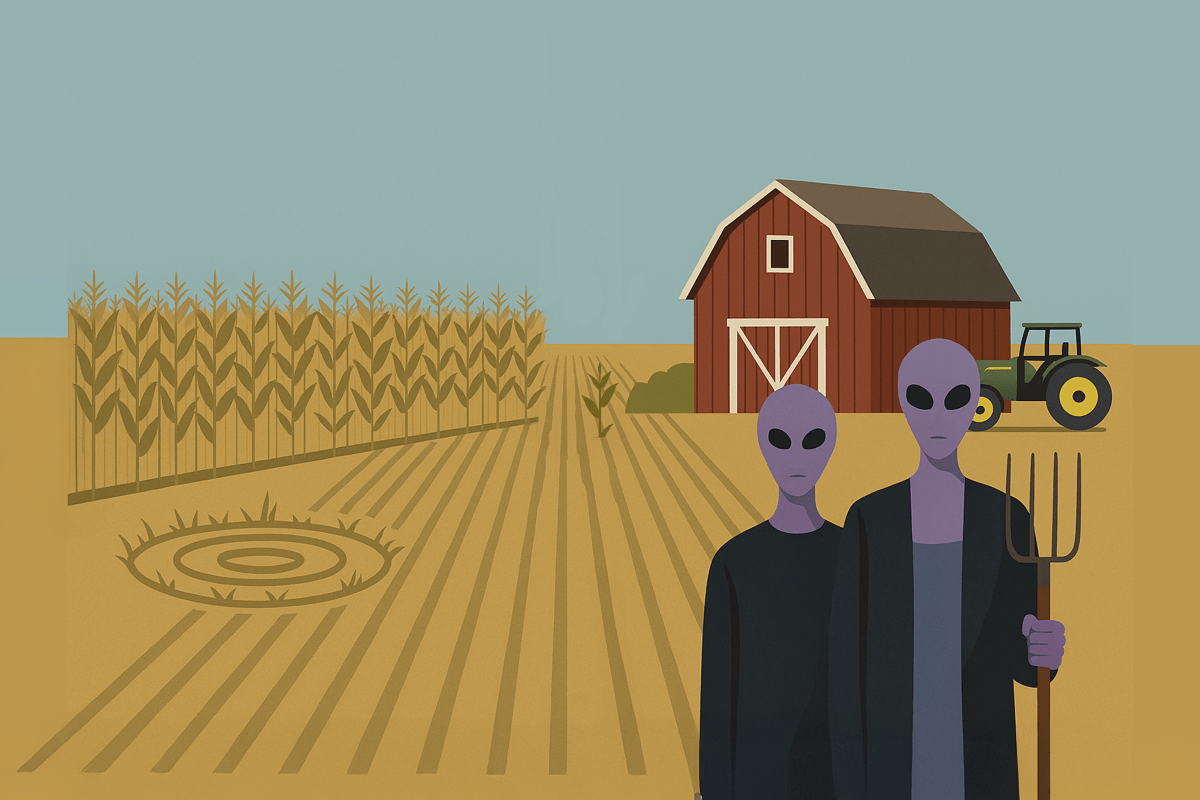
So, yes: we’ve got the requisite red barn, green tractor with yellow wheels (hi, John Deere 🚜), and a crop circle or two. The audiobook cover even features an alien peeking out of the barn – though logistics are holding that version back for now.
Please note that the Kindle version is available for free for the rest of today (8 Sep 25). Download your copy while you still can without paying through the nose. Leave a review for👍 better or for👎 worse.
But those aliens…
If the composition feels familiar, it should.
The cover is a quiet parody of Grant Wood’s “American Gothic” – a pitchfork-wielding farmer and his companion, stoic before their rural home. It’s one of the most recognisable paintings in American art, and I couldn’t resist twisting it just slightly. Grant was an Iowa boy.
I designed this cover using a flat vector art style, almost like cut paper or stylised children’s book illustrations. The sky is cyan, the land is beige, and everything is built in clean layers: barn, tractor, field, crop circle, and of course… two violet, large-eyed aliens striking a pose.
But no, this isn’t a literal scene from the book. You might encounter violet aliens in Sustenance, but you won’t find them standing around with pitchforks like interstellar Grant Wood impersonators. The image is meant to evoke the tone, not transcribe the events.
Why this style?
Because the story itself is quiet. Subtle. Set in the kind of place often overlooked or written off. The aliens aren’t invading with lasers. They’re… complicated. And the humans, well, aren’t always the best ambassadors of Earth.
The cover reflects that blend of satire, stillness, and unease.
Oh, and one last note: 🛑 No aliens were harmed in the writing of this book.
On 7–8 September 2025, the Kindle version of my novella Sustenance will be available free to everyone on Amazon. (It’s always free if you’re a KindleUnlimited member, but these two days open it up to all readers.)
So what is Sustenance?
It’s a novella that begins with the dust and grit of rural Iowa – soybean fields, rusted trucks, a small town where everyone knows your name (and your secrets). At first glance, it reads like plainspoken realism, narrated by a local mechanic who insists he’s just a “regular guy.” But then the ground literally shifts. A crash. Figures glimpsed by firelight in the woods. Naked, violet-skinned beings who don’t laugh, don’t sleep, don’t even breathe.
What follows is not your usual alien-invasion story. It’s quieter, stranger, and more unsettling. The encounters with the visitors aren’t about lasers or spaceships – they’re about language, culture, and the limits of human understanding. What happens when concepts like property, law, or even woman and man don’t translate? What does it mean when intimacy itself becomes a site of misunderstanding?
Sustenance is for readers who:
Gravitate toward literary fiction with a speculative edge rather than straight genre beats.
Appreciate the mix of the banal and the uncanny – the smell of corn dust giving way to the shock of alien otherness.
Are interested in themes of language, power, misunderstanding, and human self-deception.
Enjoy writers like Jeff VanderMeer, Margaret Atwood, Octavia Butler, or Denis Johnson – voices that blur realism, philosophy, and estrangement.
This isn’t a story that offers tidy answers. It lingers, provokes, and resists easy moral closure. Think of it less as a sci-fi romp and more as a philosophical fable wrapped in small-town dust and cicada-song.
This version of the book is available in these Kindle storefronts: United States, United Kingdom, Germany, France, Spain, Italy, Netherlands, Japan, Brazil, Canada, Mexico, Australia, and India
Does anyone else use writing props to help immerse yourself in adjascent fiction?
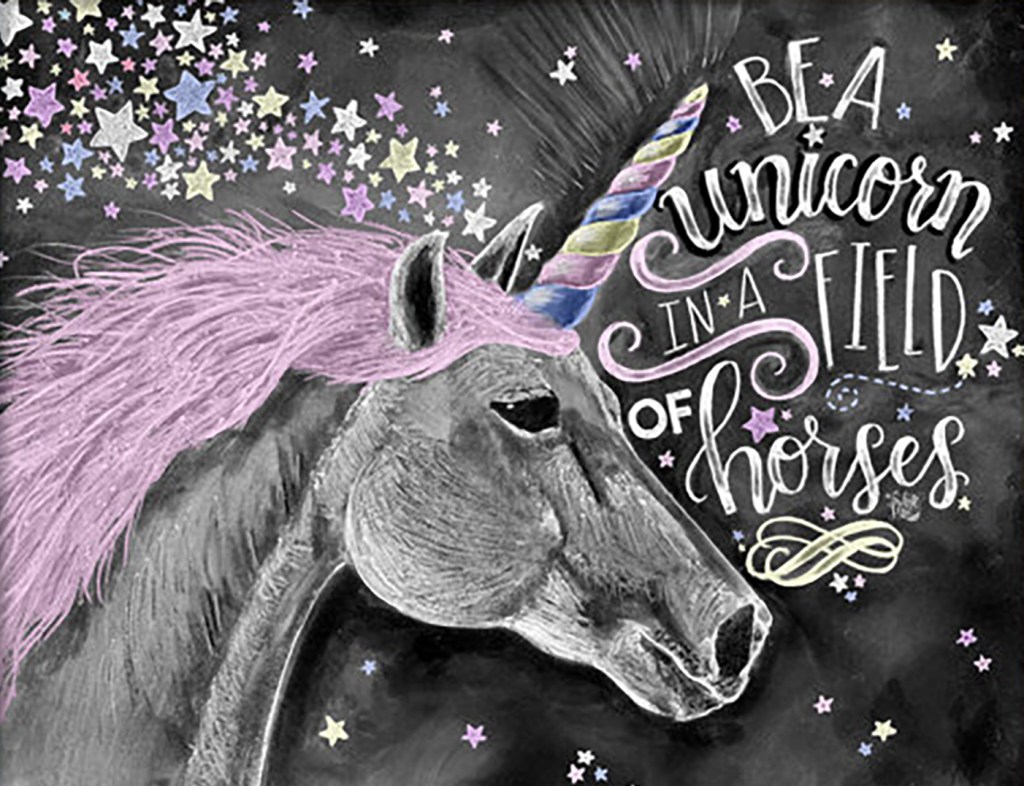
This unicorn image is from a poster. I am using it as a reference for a current project. It’s already seared into my brain, but it renders it somehow more real.
This unicorn poster hung on the wall of the inspiration for the protagonist of an upcoming novel, Needle’s Edge. It featuers prominently – almost has a speaking part.
Maps
Hemo Sapiens: Awakening is set in near-future Manchester, UK, so I had maps of Manchester at the ready. It helped me to add some realism. Because a trip from a nearby town into the city only took 15 to 20 minutes, I had to edit down a scene I was hoping would fill an hour. I could have used a location further away, but it wouldn’t have made sense to the plot, and I hate those sorts of plot gimmicks.
Sustenance is set in Iowa. I not only had a map of Iowa, I had resources on flora and fauna, so I could name-drop. I’ve visited parts of Iowa, but I couldn’t have drawn these details from memory—and I mightn’t have known the names or the onomonapoeia fascimiles.
Temporal Babel is set in New Mexico, so besides a map for highway references and distances from landmarks—towns, cities, and reservations—, I saved image resources of local photographs, landscapes, plants, buildings, attire, and so on. It really helps we with the description, something that is not otherwise my forte.
Propensity is set in no place in particular, so I used no maps, but I studied interiors of institutions, prisons, laboratories, and the like.
This is another unicorn sticker that was in the house of the protagonist, but it doesn’t make the cut. It still makes me chuckle.
Another unfinished novel, Everlasting Cocksucker, is set in Philly. I spent severl years in and around there, so I know the lay of the land. Still, I find maps useful.
I put this project ont he backburner because I received so much hate over the subject matter. I decided to concentrate on other projects. But, I created a physical shadowbox as a reminder of the protagonist.
Image: Reconstruction of a shadowbox.
In this story, this represents her life habits: Newport Menthol 100s in a box, Red Bull, Maruchan Ramen, and tarot readings. The Hanged Man is relevant to the plot. When I return to the manuscript, I’ll have this as, let’s call it, inspiraration.
If I wrote genre fiction, this wouldn’t work as well – Sci-Fi or Fantasy and whatnot. It might work for historical fiction though.
I’ve got a bone to pick with Claire Fraise, dammit. I’ve lost 2 days I’ll never get back — including the time it’s taking me to create this post.
Claire shared a YouTube video on using plot grids for your writing process. Being me and heeding her advice, I decided to create a plot grid – I call it a plot matrix; same thing – for a project I am editing.
Video: What is a plot grid?
I should probably create a video response, but I didn’t have even more time to lose.
Full Disclosure: By lose time, I don’t want to imply by any means that this is wasted time.
Since the plot matrix I created is for an unpublished manuscript, I decided to create one for the first chapter of my published book, Sustenance. It contains two sections or scenes.
Audio: NotebookLM podcast on this topic.
I’ll share the process I used and reference the Excel document I created. Download it if you’d like to follow along.
After the explanations, I’ll discuss how I use ChatGPT to help me with this, as well as some challenges you may wish to be aware of.
Below is a screenshot of a portion of the plot matrix.
Image: Portion of plot matrix
I’ll start by sharing the column headers and a brief explanation of what each means. Some should be obvious, but I’ll describe them as well.
Narrative Order: The order a scene appears in the manuscript.
Chronological Order: The sequence in which events occur in story-time, enabling tracking of flashbacks or non-linear jumps.
Sentiment: A numerical indicator of the scene’s emotional tone, from deeply negative (–5) to strongly positive (+5).
Chapter: The chapter or section title in which the scene appears.
Plot Points: A summary of key events, revelations, or decisions that occur in the scene.
Time: When the scene takes place, whether exact or relative (e.g., “early morning,” “flashback,” “six months later”).
Primary Characters in Scene: The characters actively driving or anchoring the scene.
Secondary Characters in Scene: Important but less central characters who influence or are present in the scene.
Minor Characters in Scene: Tertiary figures mentioned or briefly appearing without narrative weight.
Word Count: The number of words in the scene, useful for pacing and balance.
Emotional Beat/Theme: The scene’s dominant emotional tone or thematic current (e.g., betrayal, longing, discovery).
Emotional State: The internal condition or affective register of the POV character(s) during the scene.
Scene Function: What the scene accomplishes narratively (e.g., exposition, climax, setup, reversal).
Character Arc: How a character is developing, stagnating, or regressing within the scene.
External Stakes: The tangible, real-world risks or consequences present in the scene.
Internal Stakes: The emotional, psychological, or relational consequences at play.
Needs Clarification?: A flag to indicate whether a scene contains confusing elements or ambiguous logic.
Revision Priority: A ranking of how urgently the scene needs refinement.
Conflict Type: The dominant form of conflict (e.g., internal, interpersonal, systemic, environmental).
Turning Point?: Whether the scene marks a key reversal or decision point in the narrative.
Turning Point Direction: Indicates the shift’s trajectory (positive, negative, neutral, ambiguous).
Direction Commentary: A brief rationale for how and why the narrative tone or direction changes.
Reinforces: Themes, motifs, or ideas the scene strengthens.
Undermines: Themes or ideas the scene weakens, contradicts, or questions.
Reveals: New information, secrets, or understandings brought to light.
Conceals: Key details or truths the scene deliberately withholds.
Distorts: Misunderstandings, biases, or unreliable elements introduced.
Inverts: Role, expectation, or thematic reversals subverted in the scene.
Echoes: Recurrent phrases, images, or patterns from earlier scenes or motifs.
Revision Commentary: Notes on potential rewrites, improvements, or cautions.
Punch List: Specific edits or action items needed in revision.
Resolved?: Whether the scene’s tension, question, or arc has been closed.
Location: Where the scene is physically set—important for continuity, blocking, and worldbuilding.
Iowa: Opening Scene
Narrative Order: The order a scene appears in the manuscript.
I am tracking scenes/sections rather than chapters because that’s the way I’ve organised the manuscript. I want to capture the smalled logical element of the story.
Being a spreadsheet, I need to keep track of the sections, so I give each scene a number. In this case, we are looking at section 1 of the narrative order, the first section a reader encounters.
Chronological Order: The sequence in which events occur in story-time, enabling tracking of flashbacks or non-linear jumps.
This manuscript has no flashbacks at this point, so the sequencing tracks 1-to-1. In the manuscript I am editing, it starts in media res, and there are two large jumps back and forth in time.
Being in a spreadsheet table, I can sort the story by narrative or chronology, which helps me track logical progressions that I might miss otherwise.
Sentiment: A numerical indicator of the scene’s emotional tone, from deeply negative (–5) to strongly positive (+5).
I like to track sentiment, so I can provide emotional dynamics to the reader. I don’t want to come across as bleak or euphoric for extended periods.
By this scale, 0 is neutral, -5 is gawdawful, and +5 is over the moon.
In these first two scenes, the protagonist, Kenny, is tracking just under baseline to neutral. Nothing much is happening emotionally, as we are just establishing the place.
Chapter: The chapter or section title in which the scene appears.
The name of this chapter is Iowa.
Plot Points: A summary of key events, revelations, or decisions that occur in the scene.
In scene 1, we have this:
Narrator establishes his identity, location, and tone.
Mentions girl, Bruce’s death, and being misunderstood.
Foreshadows larger story.
Time: When the scene takes place, whether exact or relative (e.g., “early morning,” “flashback,” “six months later”).
We are in the now.
Retrospective/Near-Present
Primary Characters in Scene: The characters actively driving or anchoring the scene.
This is a first-person, present, limited, deep POV story, so Kenny is one with the narrator.
Secondary Characters in Scene: Important but less central characters who influence or are present in the scene.
Kenny is just setting up the scene, and he mentions two secondary characters:
Bruce (mentioned)
‘Her’ (mentioned)
My preference is to scope the characters globally. This means that if some character interacts with a significant character but doesn’t appear elsewhere, I’ll consider them to be a tertiary or minor character. Some writers prefer to track these characters at a scene level. This is a personal preference.
Minor Characters in Scene: Tertiary figures mentioned or briefly appearing without narrative weight.
These are incidental characters that you might want to track in case you want to expand or adjust them.
Jake (mentioned)
narrator’s dad (mentioned)
Word Count: The number of words in the scene, useful for pacing and balance.
These are two short scenes: 247 and 502 words.
Emotional Beat/Theme: The scene’s dominant emotional tone or thematic current (e.g., betrayal, longing, discovery).
What’s going on here? Am I conveying what I aim to?
Isolation, defensiveness, curiosity
Belonging vs alienation; repetition vs rupture
Emotional State: The internal condition or affective register of the POV character(s) during the scene.
What’s the POV character feeling?
Guarded, nostalgic, lonely
Resigned, mildly boastful, reflective
Scene Function: What the scene accomplishes narratively (e.g., exposition, climax, setup, reversal).
Why does this scene exist? If it doesn’t serve a purpose, get rid of it, or give it one. Make sure every scene builds on characters or advances the plot.
Narrator introduction; frame story establishment; tonally primes the reader
Establishes rural setting, background on narrator’s world and connections, foreshadows disruption
Character Arc: How a character is developing, stagnating, or regressing within the scene.
Again, ensure your characters(s) have movement. In this story, there are several characters with an arc, but Kenny is the only one being tracked thus far. Being the start of the story, the question is, where does he go from here?
Establishes base-level insecurity masked by bravado
Solidifies narrator’s self-image and history within town hierarchy
External Stakes: The tangible, real-world risks or consequences present in the scene.
What external considerations might the character be making in this scene, whether they do or don’t do something?
Implied social stigma or alienation
Community perception and social standing
Internal Stakes: The emotional, psychological, or relational consequences at play.
What internal considerations might the character be making in this scene, whether they do or don’t do something?
Fear of being misunderstood or blamed
Fear of irrelevance, unresolved identity
Needs Clarification?: A flag to indicate whether a scene contains confusing elements or ambiguous logic.
When sketching a scene idea, you may have unresolved loose ends that you either need to tie up in the scene or somewhere else. Usually, this is more interested in making sure a reader doesn’t leave the scene confused — unless, of course, this is your intent.
Revision Priority: A ranking of how urgently the scene needs refinement.
This is important in a reviewing/editing phase. As you are cleaning up your manuscript, are there massive holes that need to be plugged, or might this just need some minor refinements?
Conflict Type: The dominant form of conflict (e.g., internal, interpersonal, systemic, environmental).
This could be a post of its own, so I won’t belabour the issue here. Readers like conflict. It gives something to resolve. Is this conflict related to the person, their past, another person, their environment, society, and so on? Document it here. Several conflicts make for more complex characters and stories.
Internal (identity, credibility)
Internal (identity vs environment)
Turning Point?: Whether the scene marks a key reversal or decision point in the narrative.
In this case, the first scene has now; the second does.
No
Yes
Turning Point Direction: Indicates the shift’s trajectory (positive, negative, neutral, ambiguous).
If there is a turning point, what’s the direction? A stable or lateral vector is fine.
None
Foreshadows disruption
Direction Commentary: A brief rationale for how and why the narrative tone or direction changes.
If there is a shift in direction, what is it? This might help to orient you when scanning, so you can know in the scene where to edit.
None
Last line (“Until that day”) subtly transitions from ordinary routine into impending change
This next section captures how the scene functions from several perspectives.
Reinforces: Themes, motifs, or ideas the scene strengthens.
Undermines: Themes or ideas the scene weakens, contradicts, or questions.
I like to subvert tropes and expectations as well as make social commentary, so this can be informative for me. In this case, I want to depict these things in a different light.
Traditional heroic framing
Romanticisation of small-town life
Reveals: New information, secrets, or understandings brought to light.
What does this scene reveal?
Setting, tone, perspective
Social fabric of the town, Kenny’s values and limitations
Conceals: Key details or truths the scene deliberately withholds.
In the first scene, I mention matter-of-factly,
Real details of Bruce’s death and who ‘she’ is
The event that disrupted the routine
So the reader knows there’s a “Bruce” and a “she,” but who they are remains to be seen. And Bruce died. How?
Distorts: Misunderstandings, biases, or unreliable elements introduced.
This is getting more nitpicky, but sometimes I like to obscur some things?
Narrator’s reliability and possible biases
Self-perception vs actual social role
Is this a reliable narrator? Even if he wants to be, is his perception accurate?
Inverts: Role, expectation, or thematic reversals subverted in the scene.
I like to subvert tropes and expectations here, too. This can also be used to intentionally have a character act out of character.
Traditional ‘boy meets girl’ trope
The classic “tight-knit community” mythos
Echoes: Recurrent phrases, images, or patterns from earlier scenes or motifs.
Early on, this most captures echoes of the external world, as this does. Later on, a scene might echo (and perhaps amplify) a prior scene.
Small-town fatalism
American nostalgia, masculine banality
Revision Commentary: Notes on potential rewrites, improvements, or cautions.
Here, the AI gods advise me to streamline these scenes, but I answer to no gods. 😉
Could trim repetition or streamline internal monologue for pacing
Minor streamlining of “rural inventory” might improve pacing without losing tone
Punch List: Specific edits or action items needed in revision.
If there are revisions to be made, capture them here, so you’ll remember what you were thinking about when you suggested a revision. In this case, the reminder is the same. Too late, it’s already published.
None
Possibly trim town description repetition
Resolved?: Whether the scene’s tension, question, or arc has been closed.
In both case, the answer here is no. Being an opening scene, hopefully, this open issues and questions – unless you prefer to resolve everything immediately.
Location: Where the scene is physically set—important for continuity, blocking, and worldbuilding.
This is setting information. This will be more helpful in a complex environment. In this case, there’s not a lot to say. He’s on his front porch step, rambling away about his town and his story.
Iowa, unspecified small town
Iowa, narrator’s town and neighbouring town
ChatGPT and Plot Matrices
After completing my manuscript, say a first draft, I feed it into a ChatGPT project. Then I run this prompt.
Let's use this format. I'll provide the value of (X). From where we are, Narrative and Chronological orders have converged and will remain so. They are equal to Row ID - 1. I'll use Row ID (X) as a reference marker.

Row ID (2), Narrative Order (), Chronological Order (), Sentiment, (Integer: Range between -5 and +5), Chapter (Iowa), Plot Points, Time, Primary Characters in Scene, Secondary Characters in Scene, Minor Characters in Scene, Word Count (247), Emotional Beat/Theme, Emotional State, Scene Function, Character Arc, External Stakes, Internal Stakes, Needs Clarification?, Revision Priority, Conflict Type, Turning Point?, Turning Point Direction, Direction Commentary, Reinforces, Undermines, Reveals, Conceals, Distorts, Inverts, Echoes, Revison Commentary, Punch List, Resolved?, Location

I know you’ve heard this before.

Boy meets girl. Different places. Different cultures.

Not quite Romeo and Juliet. Not yet, anyway.

It could’ve been Nebraska. Montana. Oklahoma.

But it wasn’t. We’re in Iowa.

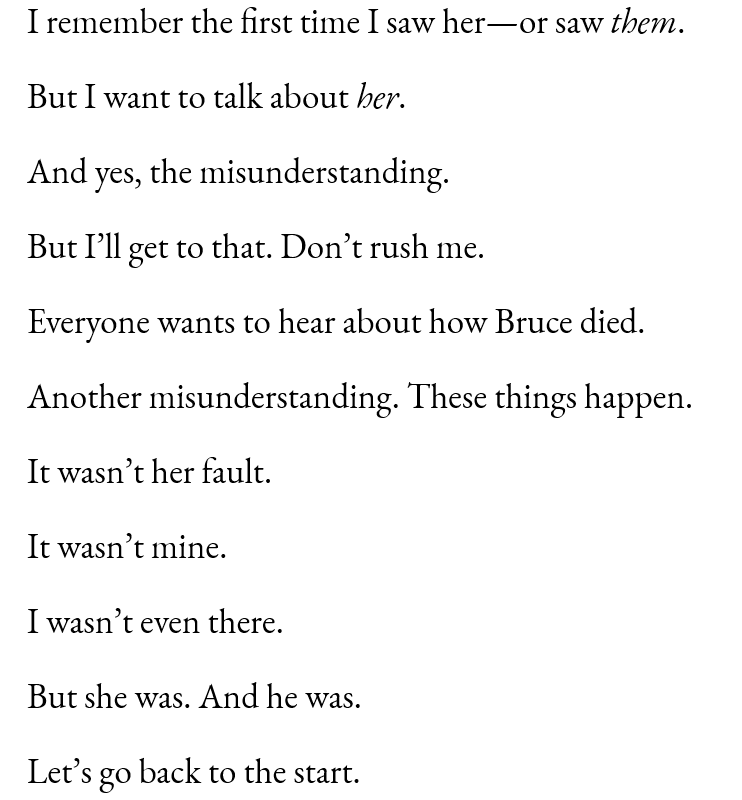
I remember the first time I saw her—or saw them.

But I want to talk about her.

And yes, the misunderstanding.

But I’ll get to that. Don’t rush me.

Everyone wants to hear about how Bruce died.

Another misunderstanding. These things happen.

It wasn’t her fault.

It wasn’t mine.

I wasn’t even there.

But she was. And he was.

Let’s go back to the start.

It was over a year ago.

A bit before that.

But first, let’s set the facts straight. I’m a
regular guy. Graduated high school. Not some conspiracy theorist, if that’s what you’re thinking.

Never left Iowa. Not even for college. The furthest
I’ve been’s Jake’s and the flea market a couple towns West. I know this place the way some folks know scripture—by scent, not verse. The way the soybean dust hits your throat during harvest. The way old barn wood smells after rain.

I believe in Jesus, but I’m not one of those Jesus freaks. Don’t paint me with that broad brush.

And I’m not one of them incels either. I’ve had girls. I’ll tell you about Jake’s. I even had a girlfriend for a few weeks, but it didn’t work out. A guy needs some space. That’s all. I’m sure you know what I mean.
I find that ChatGPT isn’t great tracking within larger documents, so I’ll pass in a section at a time, as shown above. This is the first scene of the first chapter of Substance.
Noticing that this scene sets up a flashback to a year in the past, the narrative and chronological order values should differ. Since this is just an example, I hope you learn from my mistakes. Also, I’d reorder the columns next time, but I created this prompt in steps as I progressed.
You need to be careful about what AI outputs. Don’t take it all at face value. If you incorporate a lot of nuance or subtext, the AI will likely miss the point. AI is a low-context system. Most communication in the West (notably excepting the South in the United States) is high-context.
High-context cultures rely heavily on shared understanding, nonverbal cues, and implied meaning—much is left unsaid because context fills in the gaps. Low-context cultures prioritise explicit, direct communication where meaning is made clear through words, not assumptions.
The AI picks out the plot points from your passage. This is usually uncontroversial.
The way ChatGPT uses Time could be better. This is almost an extension of the setting. What I was initially hoping for in my more complex story is a method to ensure my timeline wasn’t convoluted. I didn’t want to have a pregnancy delivery flashback to a conception two weeks earlier – unless that is an intentional plot point… or we’re talking about flies or something.
I find that some of the scene descriptions are a bit suss, but you can tweak them if they are too far off target. To be fair, you can share your manuscript with a dozen readers and get a dozen renditions – none of them in line with your own. It happens.
I commented on the Revision Commentary earlier. Just like a human editor, you can take or leave the advice. In the end, the writing is that of the author.
In many cases, you can ask the AI to elaborate: What do you mean it’s too long? or some such.
Or you can explain your intent. For example, I wrote another book and intentionally left it open-ended. The AI came back with, What happened?
I explained that the reader could draw their own conclusions, and the AI came into line.
One parting thought: You may pass the same passage through the same AI several times and get several outputs. They aren’t usually diametric, but be aware of this. Also, if you run this on Claude, Perplexity, or another platform, your results might vary there, too.
Anyway, if you got this far, what did you think? Do you use pilot grids? Do you use AI to assist in your editing? I use AI for research. Do you? Some people use AI for writing. I’m not as keen on this, but I’m not judging.
This isn’t a promotional post. I’ve recently discovered the hidden value of audiobooks—and it has nothing to do with selling them.
Back in 2024, when I released Hemo Sapiens: Awakening, I must have read the manuscript a thousand times. I even recorded an audiobook, using an AI voice from ElevenLabs. At the time, Audible wouldn’t accept AI narration. The rules have since changed. It’s now available—though still not on Audible (and therefore not on Amazon).
I’d hired a few proofreaders and beta readers. They helped. The book improved. And yet, even after all that, I still found typos. Those bastards are insidious.
The real revelation came when I started listening.
Since I’d already created the audiobook, I began proofreading by ear. That’s when it hit me: hearing the story is nothing like reading it. Sentences that looked fine on the page fell flat aloud. So I rewrote passages—not for grammar, but for cadence, clarity, flow.
Then came the second benefit: catching mistakes. Typos. Tense slips. I favour first-person, present-tense, limited point of view—it’s immersive, intimate, synchronised with the protagonist’s thoughts. But sometimes, I slip. Listening helped catch those lapses, especially the subtle ones a skim-reading brain politely ignores.
For Sustenance, the audiobook was an afterthought. I submitted the print files, requested a proof copy, and while I waited, I rendered the audio. When the proof arrived, I listened instead of reading. I found errors. Again. Thanks to that timing, I could fix them before production. Of course, fixing the manuscript meant updating the audiobook. A pain—but worth it.
I hadn’t planned to make an audiobook for Propensity—some of the prose is too stylistic, too internal—but I did anyway, because of what I’d learned from Sustenance. And again, I found too many errors. Maybe I need better proofreaders. Or maybe this is just the fallback system now.
I’ve had Temporal Babel, a novelette, on hold for months. I won’t release it until I do the same: make an audiobook, listen, reconcile with the page.
Lesson learned.
I’ve got several more manuscripts waiting in the wings—some have been loitering there for over a year. Their release has been deprioritised for various reasons, but when they go out, they’ll have audio versions too. Not for the sake of listeners. For me.
Honestly, I should do this for my blog posts as well. But editing on the web is easier. The stakes are lower. Mistakes don’t print themselves in ink.
If Propensity was about engineered peace through probabilistic compliance, Sustenance asks what happens when understanding itself breaks down—and nothing you think is mutual, is.
No war. No invasion. No end-of-days. Just a quiet landing. And a failure to translate.
The Premise
A group of non-human beings arrive—not in conquest, not in friendship, but in continuity. They are not like us. They do not see like us. They don’t even mean like us.
There is no universal translator. No welcome committee.
Just humans—interpreting through projection, desire, and confusion.
And aliens—operating by a logic that doesn’t require interpretation.
The Themes
Sustenance explores what happens when:
Language fails and nothing fills the gap
Consent becomes guesswork
Culture is mistaken for nature
Property has no meaning, and law no parallel
Sex isn’t private, sacred, violent—or even especially enjoyable
Memory becomes narrative, and narrative becomes defence
Contact isn’t miraculous—it’s awkward, biological, and quietly irreversible
This is a story about misunderstanding. Not just what others mean—but who we are when we assume we understand anything at all.
The Tone
Think Arrival but rural. Annihilation without the shimmer.
A bit of VanderMeer. A hint of Flannery O’Connor. The cornfields are real. The discomfort is earned.
No apocalypse.
Just a failure to process.
And maybe, something new inside the gap that opens when the old stories no longer apply.
Why Write This?
Because contact doesn’t have to be violent to be destabilising.
Because not all miscommunication is linguistic—some is anatomical.
Because the most alien thing we can encounter is ourselves, misinterpreted.
Because I wanted to write a story where the question isn’t “what do they want?” but “what have we already assumed?”
A common question I get about my writing—my fiction, anyway—is: what motivates you?
It sounds like a harmless question. Like asking a plumber what motivates them to fix pipes. But fiction is not plumbing. And motivation, for a writer, is often post-rationalised. Still, I have answers. Or at least fragments of them.
Audio: NotebookLM podcast on this topic.
A primary driver is to convey philosophical concepts that I feel apply to life in general, but don’t tend to get the airtime they deserve. A good example is Heidegger’s Geworfenheit.
In English, that’s usually translated as “thrownness.” It refers to the feeling—no, the condition—of having been thrown into existence without consent, without context, without recourse. It’s the anti-heroic beginning. You wake up on a raft. No map, no memory. Just current.
Now, Heidegger gets a bad rap. And some of it is earned. He joined the Nazi party. There’s no excusing that. But if we’re going to disqualify thinkers based on political affiliation, we’ll need to scrap about half of the Enlightenment and most of the 20th century. The point is: Geworfenheit is useful. It names something modern life often glosses over: the fact that you didn’t choose to be here, and now you have to swim.
This theme shows up across my work. In Temporal Babel, Jef is stranded in a temporally dislocated world. In Sustenance, the visitors are alien in both senses of the word. And in Hemo Sapiens, the title species are cloned into personhood with no legal or cultural footing.
None of us choose how, where, or when we are born. But I like to amplify that truth until it becomes impossible to ignore. Take the Hemo Sapiens case: they aren’t born; they’re instantiated. But what is birth if not a legally sanctioned instantiation? Once you remove the ritual scaffolding of parentage, nationhood, and paperwork, what remains is the raw fact of being.
Another key motivator for me is philosophical provocation—questions I don’t intend to answer, only pose. Like this one: imagine you’re shipwrecked and wash up on a tiny island. A single inhabitant lives there and claims ownership. He tells you to leave or die. You have no weapon. He has a spear. The sea is vast and lethal.
Do you have the right to stay?
Do you take the spear?
Does ownership matter when survival is at stake?
Sustenance explores that tension. Property, sovereignty, mercy, survival—these are themes we pretend to understand until the scaffolding is removed. My aim isn’t to preach about what’s fair. My aim is to show what happens when fairness loses its footing.
Related to this is the theme of otherness. Us versus them. But I’m less interested in dramatising hostility and more interested in the quiet bewilderment that comes when categories fail. What do you call someone who isn’t man or woman, isn’t alive or dead in the way we recognise, doesn’t speak our language or obey our metaphysics? What happens when you meet something you can’t assimilate?
Another layer is cultural construction—the way our societies retrofit meaning onto reality. We build scaffolds. Gender, law, ownership, grief. Then we forget we built them. My fiction likes to peel back the drywall. Not to show the truth, but to reveal the studs. The story behind the story.
And finally, I write because I suspect something important is always missing. That language is never quite enough. So I keep trying. Not to solve the insufficiency, but to dwell inside it.
That’s what motivates me.
Or maybe I’m just trying to answer questions I never knew how to ask.










 Ridley Park