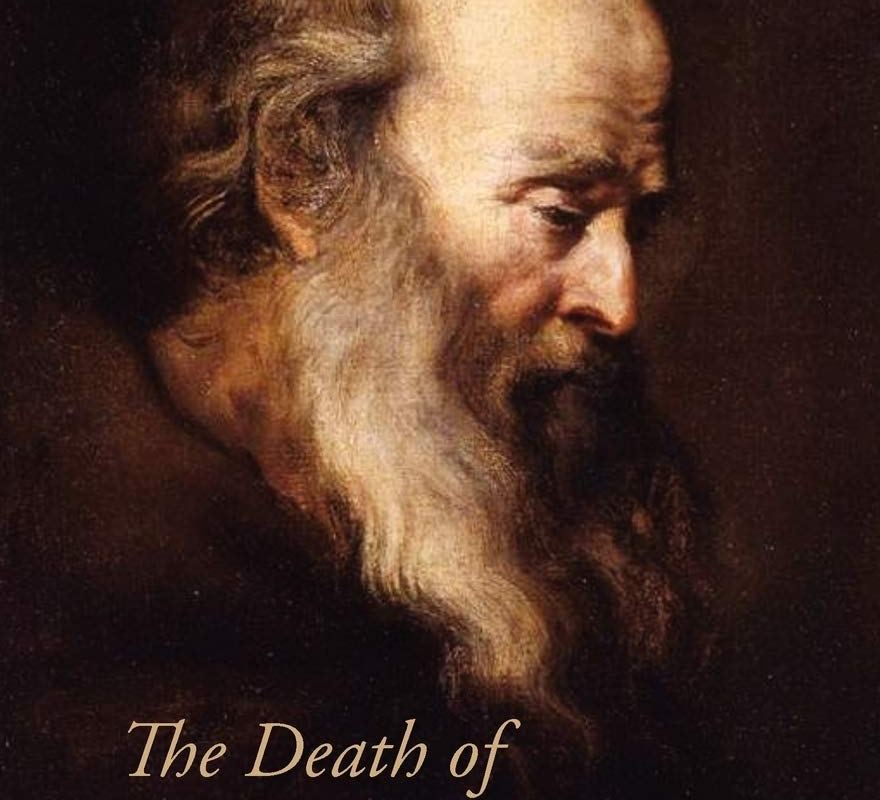
Halfway through The Death of Ivan Ilych. Not to be confused with One Day in the Life of Ivan Denisovich, though honestly, Russian literature does love an Ivan in crisis. I used to binge on it – more Dostoyevsky than Tolstoy, if we’re keeping score – but there’s something about the philosophical dread that still hits like a cold slap.
Ivan’s recently been promoted and is busy feathering his little bourgeois nest:
“In reality it was just what is usually seen in the houses of people of moderate means who want to appear rich, and therefore succeed only in resembling others like themselves…”
Damask. Polished bronze. Pretentious plants. It’s all there in Chapter 3—a catalogue of aspirational mediocrity. And here’s the kicker: he thinks it’s exceptional. That’s the tragicomic punchline of late capitalism, isn’t it? Everyone desperate to be unique by copying the same IKEA showroom.
The wallpaper may change, but the existential wallpaper paste remains the same. Conformity with delusions of grandeur.
I don’t write character-based fiction. I’m not a “people person” – not in the lived world, and certainly not on the page. I prefer people at arm’s length, ideally shrink-wrapped and on mute, where I can manage the terms of engagement.
Yes, my work features characters. I flesh them out just enough to spare readers the Ayn Rand experience, those one-dimensional ideological mannequins masquerading as protagonists. But character isn’t the centrepiece. I write to explore worldviews, metanarratives, and environmental interactions. I’m less interested in what a person feels and more in what their presence means within a broader system.
Audio: NotebookLM podcast of this topic.
Audible Irony
At the fitness centre (the irony isn’t lost on me), I listen to audiobooks. Today’s pick: The Emotional Craft of Fiction by Donald Maass. I’ve just cracked Chapter Four, and already I’ve panned a few glittering nuggets for future consideration.
That said, I found myself wondering: why am I even listening to a book so obsessed with the deep inner life of characters?
Simple. Because it’s still useful – even if I only dose it homeopathically. Just because I don’t write bleeding-heart confessions doesn’t mean I can’t exploit emotional undercurrents when it serves a structural or rhetorical purpose.
Character, Morality, and My Problem with Haidt
One section rubbed me the wrong way: the bit about character morality. Maass references Jonathan Haidt’s work on moral psychology—yes, that Jonathan Haidt, patron saint of middlebrow centrism and moral-sentiment handwaving.
I’m familiar with Haidt. Not a fan. His notion of “moral elevation”—the idea that stories with virtuous themes inspire moral behaviour—strikes me as both quaint and quaintly manipulative. In a sense, I agree with him: morality is curated. But that’s where our Venn diagram becomes a shrug.
I’m a moral non-cognitivist. I won’t bore you here (though feel free to tumble down that rabbit hole over on my philosophical blog). In short, I don’t believe morals are objective truths handed down from Olympus or Enlightenment think-tanks. They’re socio-emotional artefacts – human constructs born from gut feelings, tempered by culture, and ossified into norms. Different contexts yield different values. That’s why I delight in yanking characters out of time and place, disorienting them – and you – to expose just how contingent it all is.
So yes, I understand moral tropes. I even deploy them. But I do so to subvert them – not to reinforce a collective bedtime story about “goodness” or “redemption.” Those are the myths we tell ourselves to stay sane. I’m here to loosen your grip.
I, Ridley Park, am an independent author and publisher. Before this literary turn, I did time as an economist, business analyst, and management consultant – none of which prepared me for the peculiar economics of modern publishing.
Much like traditional music in the Digital Age, traditional publishing has lost a bit of its lustre. Its gatekeeping function remains, but the gates are now rusted, and half the guards have been made redundant.
Audio: NotebookLM podcast on this topic.
From a business standpoint, the Independent™ must ask: Is the distribution reach of a traditional publisher or third-party distributor worth the revenue share they demand? It’s tempting to cast them as parasites feeding off your creative lifeblood—but statistically, the average indie author sells only 60 copies of their book. Yes, that includes the five you bought yourself and the ten your mum distributed among reluctant neighbours.
Could you sell more than average? Possibly. Less? Almost certainly. Better to sell 100 copies and earn a pittance than to earn 100% of nothing. But if the publisher can’t move your book either, and if they’re not investing in you as an author, you may well find yourself in the red. Especially if you’re the one paying them for the privilege of being published. That’s not publishing – that’s vanity cosplay.
Publishers also offer (read: upsell) services like editing, formatting, and cover design. As an Independent™, you either pay for these à la carte or do them yourself. Or, if you’re like me, you cobble together a mixed strategy of DIY, AI, and professional outsourcing – whatever the project demands.
For Hemo Sapiens, I did everything except the typography for the title and byline on the cover. That part I outsourced; I know my limits. The rest – cover composition, layout, typesetting – I handled. I also brought in beta readers, who offered some valuable copyedits and corrections.
With Sustenance, I went end-to-end solo, with AI in the wings for flow and proofing support.
Propensity followed a similar path – except I made the rare (some might say perverse) choice of hiring a beta reader after release. Heretical, I know. But the feedback was so incisive I’m now considering a mid-edition revision, particularly in the middle third, where things get a bit heady.
As for Temporal Babel – still unreleased – I’ve done everything myself thus far, but I’m leaning toward bringing that same beta reader back for another round of bruising clarity.
Beta readers, it turns out, are worth their weight in snark and red ink. I’ll save my ruminations on them for another post, which I promise will be full of revelations and at least one semi-poetic lament.
I could say more here, but there are other things demanding my time – and no publisher breathing down my neck.
Bless MidJourney for the cover art based on this prompt:
beautiful woman wearing glasses and a sheer top, holding a red pen, reading a book, office setting
Much like Chapter 10 (Memorandum), it functions less as narrative propulsion and more as an aperture, fleshing out character psychology and relational tension. But unlike the bureaucratic memo of Chapter 10, this one adopts the cinematic grammar of a screenplay.
Three teens. One post-collapse flat. No script but survival.
Teddy, Lena, and Jamal, three of the few who’ve retained volition after the global cognitive outage, attempt to negotiate the boundaries of self, sex, and something like ethics. The world has gone silent. Behavioural modulations have zeroed out the rest of humanity. What’s left is not exactly freedom, but the residue of agency.
Teddy wants to dominate; he flirts with tyranny and the post-moral indulgence of the moment.
Jamal wants to refuse the cycle; he recognises the scaffoldings that led to collapse and hopes not to rebuild them. Lena wants… something else entirely. Survival, perhaps. Or at least integrity.
Their conversation, unfolding through stage direction and dialogu, wrestles with autonomy, desire, and disgust. What counts as a violation in a world where the victims cannot resist? What norms persist when no one is left to enforce them?
This chapter doesn’t tell the reader what to think. It lets the contradictions breathe. And for a few pages, the novel becomes a film that cannot be watched, only read.
I’ve been reading J.G. Ballard’s High-Rise (1975), a brutalist fever dream dressed in concrete and ennui. It’s a story that doesn’t so much depict a descent into chaos as suggest that chaos is the natural state, politely waiting in the wings until the lift stops working and someone pees in the pool.
Audio: NotebookLM podcast on this topic.
This isn’t horror in the Stephen King sense—there’s no room 1408 here, no haunted sheets or malevolent chandeliers. The building isn’t animated; it’s engineered. But like all great systems, it doesn’t need a soul to kill you. The real haunting, as ever, is society itself. Ballard simply does away with the need for ghosts and lets architecture and aspiration do the dirty work.
Compared to Crash—where characters make love to car crashes and each other with equal mechanical indifference—High-Rise has something resembling a cast. I say “resembling” because these aren’t people so much as archetypes on a descent escalator. There’s Laing, a kind of blank-eyed anthropologist; Wilder, who mistakes brute force for authenticity; and Royal, the man literally living in a penthouse and metaphorically in a delusion.
Do I care about them? Not in the slightest. But that might be Ballard’s point. Their motivations are as shallow as a puddle in the car park after the water’s been shut off. Much of the action feels contrived, like a staged rehearsal for an apocalypse that already happened.
And yet—isn’t that precisely what society is? A tepid soup of extrinsic motivators dressed up in motivational posters and mission statements. Nobody in the high-rise acts out of depth or conviction. They act because someone else did it first, because no one told them not to, or because the lift only goes so far down and what else is there to do?
If Crash explored the eroticism of the machine, High-Rise explores the nihilism of comfort. Ballard’s thesis seems to be that civilisation is little more than a thin laminate over our baser instincts—and once it peels, there’s nothing underneath but turf wars and brand loyalty to floor numbers.
The modern reader might recognise the high-rise in everything from gated communities to Meta’s metaverse: sanitised, stratified, severed from consequence. A self-cleaning coffin of convenience.
And, as in the United States today, it all comes heavily medicated and prettily lit—with lipstick, meet pig.
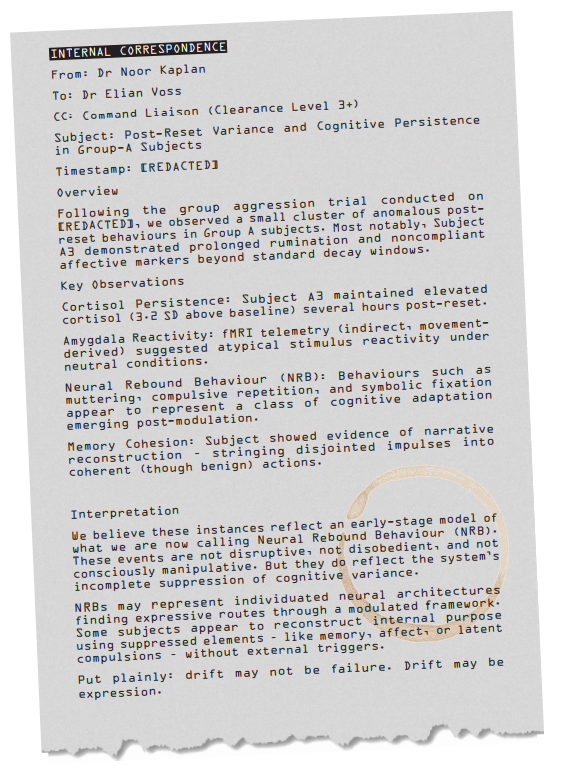
Chapter 10 of Propensity is a memorandum—fashioned in the style of a… wait for it… memorandum.
It doesn’t advance the plot much. That’s not its job. Like a dead-end corridor in a brutalist government building, it exists for atmosphere. Aesthetic artefact. Light foreshadowing. Bureaucratic texture. You know the type.
The memo comes from a psychologist involved in the Propensity experiment—writing to the study’s director about unexpected side effects. What they describe isn’t quite failure. It’s something stranger: drift, persistence, compulsive symbolism, the return of narrative despite modulation.
A precursor. A warning. And a throwback to a time when language still tried to make sense of things.
This chapter is one of several experimental inserts throughout the novel. I’ll be showcasing each of them here—in principle, if not in full.
Neither did I like nor dislike Crash. It just was. It is different, though I can help feeling that it’s gratuitous and contrived. Perhaps it seemed edgy and read differently in the 1970s.
It appears to operate on repeated vignettes – a lot of repetition. I want to see a word cloud. As an author myself, ChatGPT suggested some of my work reads like Ballard. I started with The Atrocity Exhibition, but quickly set it aside due to a lack of continuity. I settled for Crash.
Perhaps I should try something else by Ballard before writing him off, but for now, he doesn’t make my recommended author list.
Let’s get one thing straight: not all feedback is good feedback. In fact, a depressingly large proportion of it is the literary equivalent of asking a vegan to review your steakhouse. Technically they read the menu, but were they ever really your audience?
Audio: NotebookLM podcast on this topic.
We live in a culture that treats opinion like currency. Everyone’s got one. Everyone’s desperate to spend it. And nowhere is this more evident than in the world of beta reading—a supposedly sacred process in which brave authors hand over their embryonic manuscripts to friends, lovers, ex-wives, and total strangers in the desperate hope someone will “get it.” Most don’t.
Know Thy Manuscript (Before It’s Murdered by Committee)
Before you even think about soliciting feedback, ask yourself: do you actually know what your manuscript is? Is it a quiet literary allegory disguised as sci-fi? A philosophical middle finger wearing the trench coat of genre fiction? A slow-burn deconstruction of capitalism wrapped in alien gloop?
If you can’t answer that, neither can your beta reader. And you’ll deserve every clueless comment that comes slouching back across your inbox like a drunken tortoise.
Audience Matters. (No, Really.)
Let me put it in culinary terms for the metaphorically impaired: if someone hates seafood, they are not qualified to tell you whether your oysters are overcooked. They might be able to describe their gag reflex in exquisite detail, but that’s not useful culinary feedback—that’s autobiography.
Likewise, if your beta reader consumes nothing but cosy mysteries and thinks House of Leaves was “a bit confusing,” why in the name of Borges are you handing them your experimental novella about time, recursion, and the semiotics of grief?
I Know a Writer. I Know Your Pain.
A personal note, if I may. A close friend is a writer. A good one, in fact. But our ideas are so philosophically incompatible that they could be placed on opposite ends of a Möbius strip. Every time they read my work, they suggest alterations that, while technically well-formed, have the uncanny knack of annihilating the entire point of the piece. When I respond, “That’s a great idea—why don’t you write it?” they get cross.
Because here’s the truth: most beta readers don’t give you feedback on your book. They give you notes on the book they wish you’d written.
Signal vs Noise: Spotting the Useful Reader
There’s a simple test I use to distinguish signal from noise.
Bad beta feedback:
“I didn’t like the main character.” “Why don’t they just call the police?” “This story would be better with a love triangle.”
Good beta feedback:
“The way you structured the timeline echoes the narrator’s fragmentation—was that deliberate?” “I wasn’t confused until Chapter 5, which made the earlier ambiguity retroactively frustrating.” “The tonal shift on page 42 feels earned but abrupt—was that intentional?”
In short: good feedback interrogates execution. Bad feedback critiques intention.
The Beta Reader Interview (Yes, You Need One)
You wouldn’t hire a babysitter without asking if they’ve ever met a child. Why would you let someone babysit your manuscript without screening for genre literacy?
Ask them:
What do you normally read?
What do you hate reading?
Can you name a book you loved that nobody else seemed to?
Have you read [Insert book similar to yours]? Did you like it?
If they look at you blankly or start talking about Colleen Hoover, back away slowly.
The Beta Reader Zoo: Know Your Species
Here are a few common subspecies to watch for:
The Rewriter: Wants to turn your Kafkaesque nightmare into Eat, Pray, Love. Run.
The Literalist: “But how would that actually work in real life?” Mate, it’s a parable. About entropy.
The Cheerleader: “Loved it! Don’t change a thing!” (Translation: I skimmed it during Bake Off.)
The Cynic: Thinks everything is nihilistic, including your dedication page.
The Goldilocks: Rare. Reads the book you actually wrote, not the one they wish you had. Cultivate this one like a bonsai tree.
Curate, Don’t Crowdsource
Beta reading is not a democratic process. You are not running a focus group for toothpaste branding. You are searching for a handful of individuals who understand what you’re doing, why you’re doing it, and whether you’ve pulled it off—or fallen on your clever, post-structuralist arse.
Better three brilliant readers than thirty who think you should add a dragon in Chapter Two.
Final Thought
Your beta reader is not your editor. They’re not your therapist. And they’re definitely not your mum (unless your mum has an MA in critical theory and a fetish for broken narrative structures).
Choose wisely.
Or don’t – and enjoy reading thirty pages of feedback that begins, “I don’t usually read this sort of thing, but…”
PS: I love how Dall-E totally misfired on the cover image. lol
This isn’t a promotional post. I’ve recently discovered the hidden value of audiobooks—and it has nothing to do with selling them.
Back in 2024, when I released Hemo Sapiens: Awakening, I must have read the manuscript a thousand times. I even recorded an audiobook, using an AI voice from ElevenLabs. At the time, Audible wouldn’t accept AI narration. The rules have since changed. It’s now available—though still not on Audible (and therefore not on Amazon).
I’d hired a few proofreaders and beta readers. They helped. The book improved. And yet, even after all that, I still found typos. Those bastards are insidious.
The real revelation came when I started listening.
Since I’d already created the audiobook, I began proofreading by ear. That’s when it hit me: hearing the story is nothing like reading it. Sentences that looked fine on the page fell flat aloud. So I rewrote passages—not for grammar, but for cadence, clarity, flow.
Then came the second benefit: catching mistakes. Typos. Tense slips. I favour first-person, present-tense, limited point of view—it’s immersive, intimate, synchronised with the protagonist’s thoughts. But sometimes, I slip. Listening helped catch those lapses, especially the subtle ones a skim-reading brain politely ignores.
For Sustenance, the audiobook was an afterthought. I submitted the print files, requested a proof copy, and while I waited, I rendered the audio. When the proof arrived, I listened instead of reading. I found errors. Again. Thanks to that timing, I could fix them before production. Of course, fixing the manuscript meant updating the audiobook. A pain—but worth it.
I hadn’t planned to make an audiobook for Propensity—some of the prose is too stylistic, too internal—but I did anyway, because of what I’d learned from Sustenance. And again, I found too many errors. Maybe I need better proofreaders. Or maybe this is just the fallback system now.
I’ve had Temporal Babel, a novelette, on hold for months. I won’t release it until I do the same: make an audiobook, listen, reconcile with the page.
Lesson learned.
I’ve got several more manuscripts waiting in the wings—some have been loitering there for over a year. Their release has been deprioritised for various reasons, but when they go out, they’ll have audio versions too. Not for the sake of listeners. For me.
Honestly, I should do this for my blog posts as well. But editing on the web is easier. The stakes are lower. Mistakes don’t print themselves in ink.
I’ve recently released a new book, Propensity. In preparation for the audiobook version, I’ve assembled some material for PDF that doesn’t convey well in an audible format – this image, for example, from Chapter 43.
This image depicts a frantic ink sketch of a woman’s face, wide-eyed and stricken, as if caught in the instant her world unravels. Her features are carved from chaos—lines scribbled in anguish, as though the act of drawing itself were a desperate grasp for meaning.
The PDF is available for free on the dedicated Propensity page.
I’ll be posting content on Propensity as well as some of my other recent and upcoming releases presently.




 Ridley Park