Reaching the Finish Line with Zamyatin, Le Guin, and Foucault Still in My Head

The book ends, as these things always do, with a sigh and a stack of annotated pages. I’ve just closed the cover on Zamyatin’s We, and, like a cigarette slipped into the afterword, there sat Ursula K. Le Guin’s essay “The Stalin in the Soul“. She wrote it decades later in 1979, but it might as well have been stitched into the same binding. I may write about it in more detail elsewhere.

Zamyatin built the totalitarian city of glass; Le Guin peered into the reflective surfaces. Her “Stalin” isn’t a political leader but the minor tyrant most of us cultivate internally — the censor who edits desire into silence, who rewards obedience with the narcotic of safety. She understood what Foucault would later codify as biopower: that power’s finest trick is to outsource itself. You don’t need Rousseau’s chains when you can teach people to manage their own submission.

Reading it now feels almost indecently prescient. The State of We had surveillance towers; ours has dashboards. Zamyatin imagined a future where citizens surrendered privacy for perfection. We call it good UX. Le Guin warned that the artist’s real jailer was the fear of making art that doesn’t please the market. Foucault, if he were still here, would simply nod and mark it as another case study in voluntary servitude.

We‘s protagonist, D-503, had shades of Dostoyevsky’s in Notes from Underground – only a bit more reliable of a narrator.

As I close this run of readings — We and its prophetic essay appendage — I can’t shake the feeling that finishing the book is part of the ritual it describes: the quiet filing of experience, the discipline of comprehension. Yet finishing also matters. There’s a line between vigilance and paralysis, between watching the gears of power and daring to write anyway.

So yes, the project reaches its line — not a triumphant banner, more a hand-painted sign reading enough for now. Zamyatin showed me the machine. Le Guin showed me the human who keeps it running. Foucault, the analyst of our beautiful cages, taught me not to pretend there’s an outside.

All that remains is to write, while the internal commissar mutters and the cursor blinks like a surveillance light. That, apparently, is freedom.
The Wrong Dystopias: Why ‘We’ May Be the Book for Now

2–3 minutes

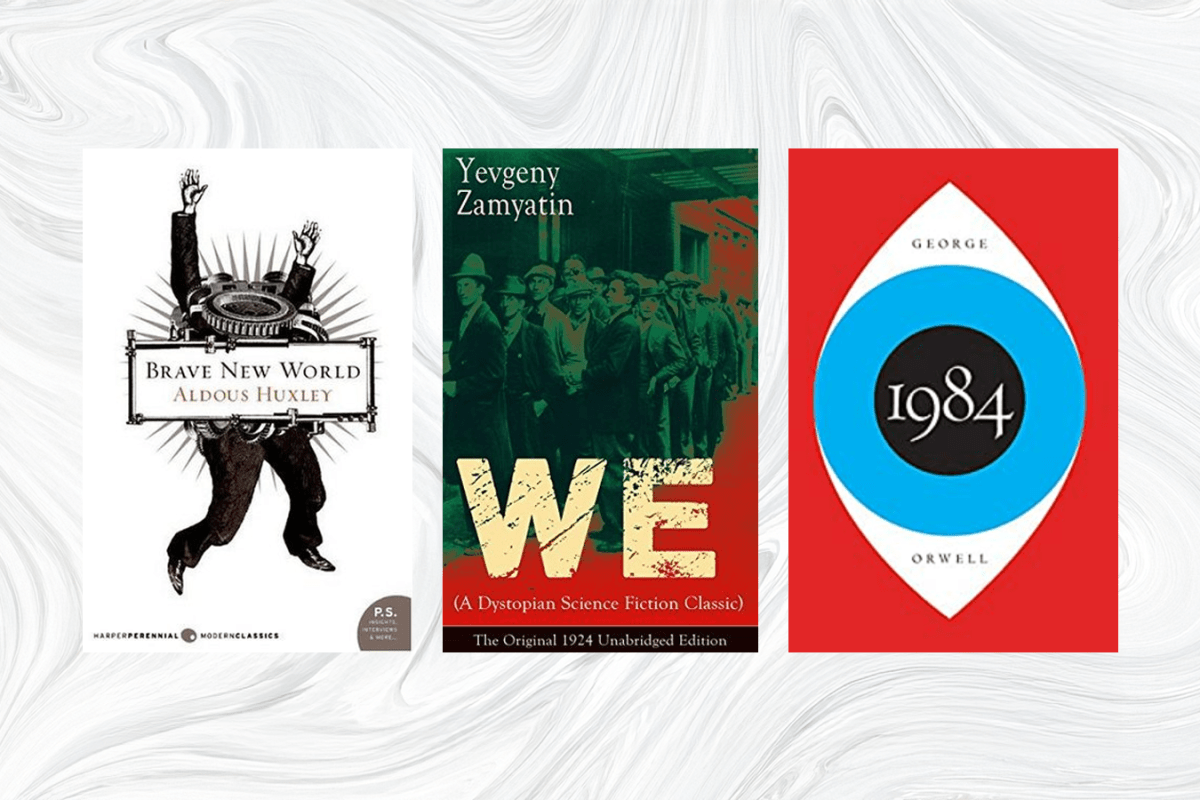
Every time the news cycle coughs up another surveillance scandal, someone posts an Orwell meme. When pharmaceutical companies peddle happy pills, a Huxley meme pops up. 1984 and Brave New World have become the twin saints of dystopian shorthand, invoked as lazily as “Kafkaesque” or “Orwellian” whenever someone feels spooked by authority.

And yet, these two canonical nightmares don’t quite capture the mess we’re in. Our world is less Orwell’s boot stamping on a face, less Huxley’s soma lullaby, and more Zamyatin’s forgotten gem: We.

Audio: NotebookLM podcast on this topic.

NB: As my regular readers may know, I am an author and a philosopher. I decided to post this here – being about books – but from a philosophical perspective.

1984: The Boot and the Telescreen

Orwell’s vision of perpetual war, Newspeak, and state terror is always good for a scare. Yes, we have endless surveillance, but here’s the trick: nobody had to force us. We carry the telescreens in our pockets and call them iPhones. We gleefully sell our data for dopamine pellets disguised as “likes.” The Ministry of Truth hasn’t so much rewritten history as buried it under an avalanche of memes, cat videos, and outrage cycles. Orwell’s nightmare had to be imposed. Ours is volunteered.

Brave New World: The Soma Holiday

Huxley saw a culture distracted into oblivion – sex, drugs, and feelies. It resonates because the entertainment-industrial complex has outpaced even his imagination. We live in a time when attention spans collapse under TikTok’s weight, when “self-care” is code for medicated oblivion, and when consumption doubles as identity. But Huxley underestimated how much suffering we’d tolerate alongside our pleasures. His world was too tidy. Ours is messy: opioids meet social media, Prozac meets precarity.

We: The Transparent Cage

Here’s where Zamyatin earns his eerie prescience. Written in 1921, We imagines a society of glass walls, total transparency, and algorithmic order. People don’t need to be beaten into compliance; they celebrate their own reduction to predictable ciphers. Privacy is seen as deviance. Sound familiar? From fitness trackers to mood apps to your browsing history, we’re already busy quantifying ourselves into oblivion. Where Orwell needed torture and Huxley needed narcotics, Zamyatin needed only maths and consent.

Why We Now?

Because it shows the nightmare where people joyfully give themselves away. That’s not speculative fiction anymore; it’s our social contract with Big Tech, with influencer culture, with the dopamine economy. We don’t need Ministries or Somas when we’ve willingly built the glass house and handed over the keys.

So next time someone posts that Orwell vs Huxley meme, hand them Zamyatin. He may not have the brand recognition, but he has the sharper scalpel. And if you haven’t cracked We yet, do it soon – before it stops feeling like a novel and starts reading like user documentation.

Sci-Fi, Fantasy, and the Politics of Imagination

1–2 minutes

As I’ve been working through Octavia Butler’s Dawn, I’ve realised why science fiction as a genre rarely resonates with me. It isn’t the aliens or the starships; it’s the scaffolding. Sci-Fi carries the weight of the Modernist project – questions posed and quickly answered, problems rationally explained, the reader guided toward the “lesson.” It feels like indoctrination: tidy, didactic, instructional.

Companion piece on Philosophics Blog
Audio: NotebookLM podcast summarising this topic.

Fantasy, strangely enough, I tolerate even less. Where science fiction pushes forward, fantasy looks backward. Sci-Fi imagines the future of the Modern experiment: technology, politics, survival scenarios, all with a rationalist bent. Fantasy imagines the past of the same experiment: kings, bloodlines, prophecies, destiny. One proclaims progress, the other tradition, but both insist on role conformity.

This struck me as almost political: science fiction reads like fodder for Liberals and Progressives, those who believe we can build better systems if only we’re clever enough. Fantasy, meanwhile, often aligns with a Conservative ethos – a return to order, hierarchy, and providence, just with dragons and spells thrown in. Both are catechisms of Modernity, just oriented in opposite directions.

It may just be me. I don’t identify with the Modern project, and so the genres that proselytise it – looking forward or looking back – leave me cold. I prefer literature that unsettles, that leaves silence where there might have been certainty, that lets ambiguity breathe. But for many, Sci-Fi and Fantasy provide something else entirely: reassurance.

Thank You for Sustenance Reviews

Sustenance (available here) was free for everyone on Kindle on 8 and 9 September. My goal was to provide access to the book for exposure with the hope of getting ratings and reviews. It’s still early, but I’d like to report that over 100 people downloaded the Kindle version. Now, I’ll share some details.

  • The Kindle version was downloaded 106 times in the past two days.
  • Some read it from their KindleUnlimited accounts
  • Some bought physical copies
  • Some people rated the book; some even left reviews on Amazon or Goodreads

The ratings and reviews are mixed, but all are welcome. Few people rate books; even fewer review them, so I appreciate the effort.

I got 3 ratings and 2 reviews on Amazon: ⭐⭐⭐⭐⭐, ⭐⭐⭐⭐, and ⭐. A one-star review. Thanks for that, too.

The ⭐rating didn’t leave a review, so I don’t know why they didn’t like it. I don’t know what types of books they read or this is exatcly what they prefer – they just didn’t like this. Still, at least they took the time to do it.

As a former statistician who has worked with survey data, I find this to be similar – most people don’t respond to surveys. Most people don’t engage in call-in shows. Most often, the people who respond either love or hate the topic so much that they feel compelled to broadcast their opinions. The people who say “meh” won’t even bother.

KindleUnlimited notwithstanding, I have no idea how people engage with a book. I have purchased and downloaded more books than I can read in a lifetime – probably multiple lifetimes. Sometimes, I just want to have access to a classic in case the mood strikes me; sometimes a book comes into view, and I convince myself that when I have the time, I might read it. I have no way of knowing.

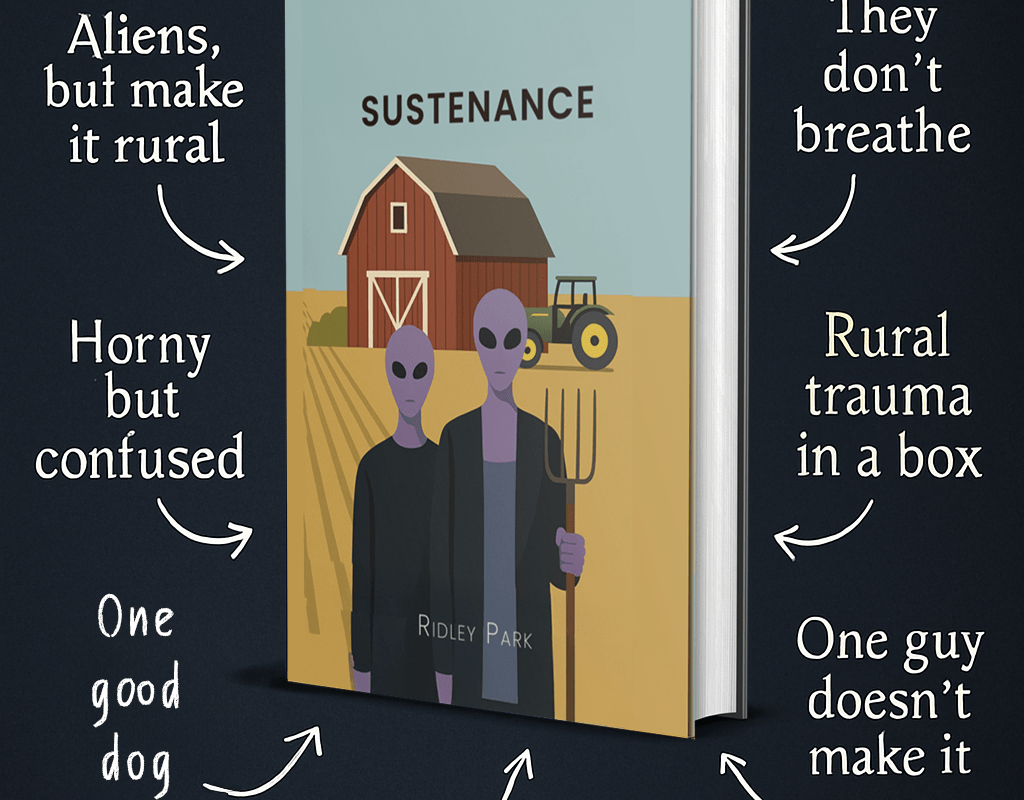
Image: Sustenance Trope Board

I’m guilty of some single-star ratings without leaving a review, so I am in no position to point fingers. Sometimes a book seems bad that you want to warn the world, but you don’t want to expend more time on the endeavour that you already have.

I took this screengrab of 1-star ratings from Goodreads – some have reviewers, others don’t.

Image: 1-Star Reviews

Only one of these books is non-fiction, though I might argue that point, hence the single star.

One Ayn Rand was a class assignment. The other was someone telling me that I hadn’t judged her best work. In this case, her best work is one star, so I can skip anything else. Ditto for the Bible – complete dreck.

Authority, I only recently read. it was part of a trilogy. The other two books got 4 and 3 stars, so I’ll consider this one a dud. I’m not in good company, as it rated worse than the other two on average, yet still managed a 3.55. Some people liked it.

The last one was a class assignment for my son that I read with him. His rating matched mine. How it became an assignment is just testimony that there is no accounting for taste.

Also, as a public service, I’d be willing to bet that if you liked these books, you won’t like mine.

Octavia Butler’s Dawn

On the topic of rating— I am midway through Dawn. It’s mid. I was asked why I hadn’t read it as part of the dystopian Venn, so I picked it up. To be fair, I thought several of the stories on the Venn were mid themselves, classics or otherwise. Perhaps I’ll write a separate post on that someday.

Honestly, I’d give Dawn 2 stars. However, I also know that Sci-Fi is not a genre that resonates with me, so I’ll be generous and give it a star because it may just be my personal bias of not relating to Sci-Fi that’s the problem, and the book might be better received by fans of that genre. Offhand, the only fiction genres I dislike worse than Sci-Fi are Fantasy and Romance.

Aside from being Sci-Fi, it reads like YA fiction. There’s nothing inherently wrong with YA, but I am clearly not its target demographic. Other than that, it’s serviceable, but I prefer to read content that’s more complex and layered, not spoonfed to me.

Conclusion

Anyway, I’ve derailed this thread, but I wanted to clarify how I approach rating books and want to thank those of you who have taken the time on Sustenance. If you haven’t yet, I’d appreciate any rating from 1 to 5. Reviews earn extra karma points.

What’s With the Violet Aliens?

🛸 A Closer Look at the Cover of Sustenance

👽 People ask me: What’s with the aliens on the front cover of Sustenance?
Fair enough. Let’s talk about it.

Sustenance is set in Iowa – real, dusty, soybean-and-corn Iowa. I’ve spent months there. I’ve lived in the Midwest (including Chicago) for over a decade. The farms, the tractors, the gravel roads… they aren’t just set dressing. They’re part of the book’s DNA.

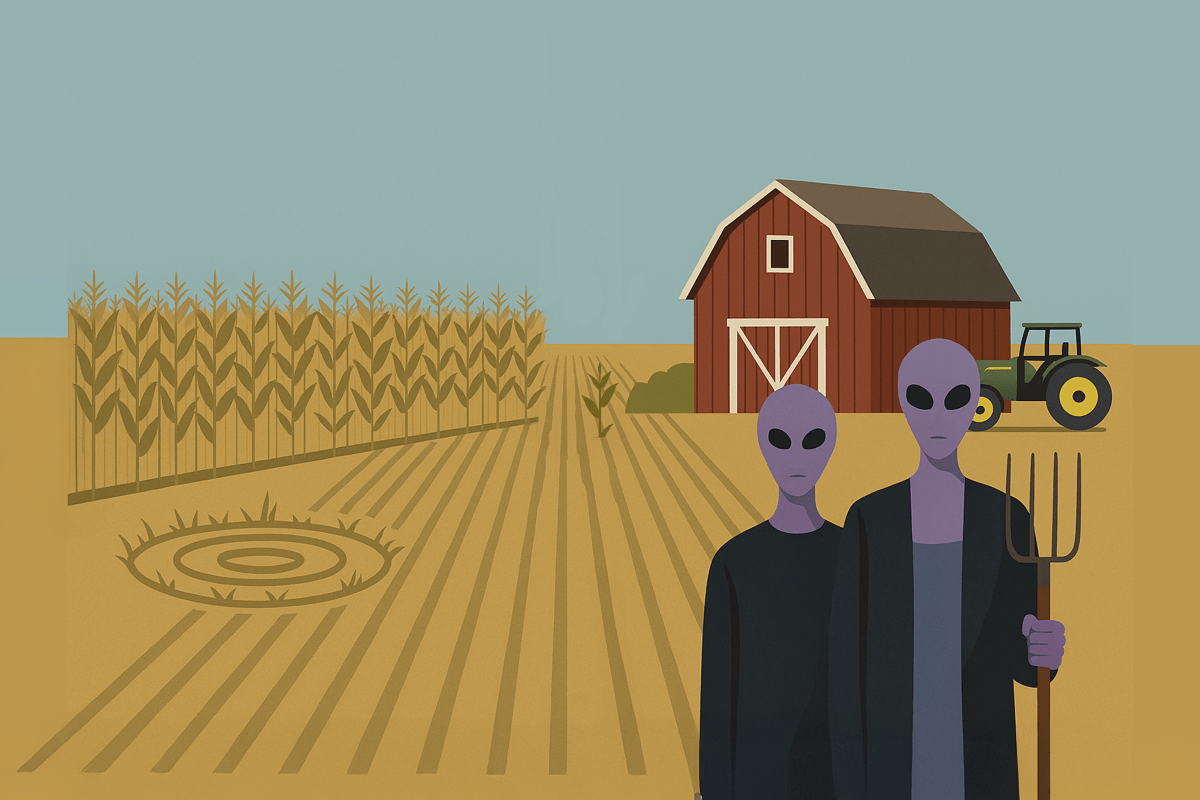
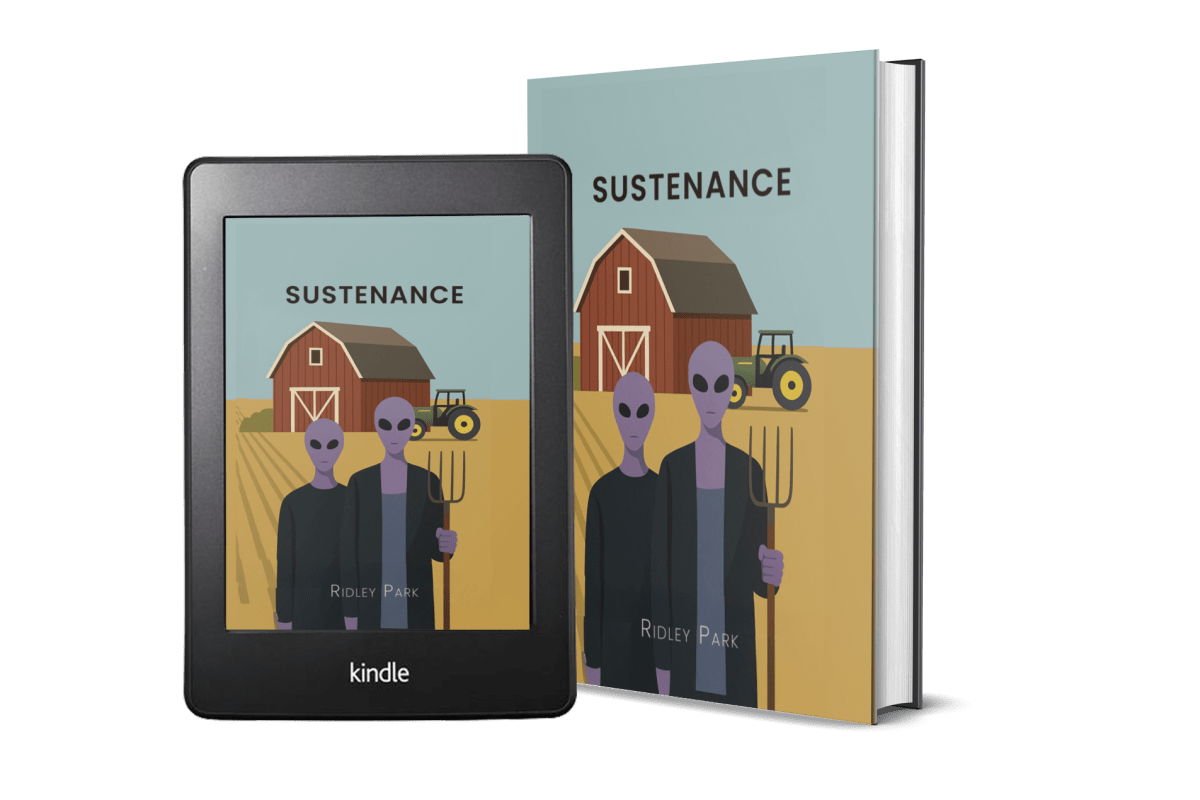
So, yes: we’ve got the requisite red barn, green tractor with yellow wheels (hi, John Deere 🚜), and a crop circle or two. The audiobook cover even features an alien peeking out of the barn – though logistics are holding that version back for now.

But those aliens…

If the composition feels familiar, it should.

The cover is a quiet parody of Grant Wood’s “American Gothic – a pitchfork-wielding farmer and his companion, stoic before their rural home. It’s one of the most recognisable paintings in American art, and I couldn’t resist twisting it just slightly. Grant was an Iowa boy.

I designed this cover using a flat vector art style, almost like cut paper or stylised children’s book illustrations. The sky is cyan, the land is beige, and everything is built in clean layers: barn, tractor, field, crop circle, and of course… two violet, large-eyed aliens striking a pose.

But no, this isn’t a literal scene from the book. You might encounter violet aliens in Sustenance, but you won’t find them standing around with pitchforks like interstellar Grant Wood impersonators. The image is meant to evoke the tone, not transcribe the events.

Why this style?

Because the story itself is quiet. Subtle. Set in the kind of place often overlooked or written off. The aliens aren’t invading with lasers. They’re… complicated. And the humans, well, aren’t always the best ambassadors of Earth.

The cover reflects that blend of satire, stillness, and unease.

Oh, and one last note:
🛑 No aliens were harmed in the writing of this book.

Octavia Butler Dawn Crosspost

I began reading Octavia Butler’s Dawn, and it raised some interesting* philosophical questions.

In the early chapters of Dawn, an alien declares that humanity has “committed mass suicide.” Sartre insists, “Inaction is still a choice.” Howard Zinn reminds us, “You can’t be neutral on a moving train.” Each collapses complexity into the fiction of agency, a story that props up Modernist notions of responsibility and blame. But what if agency itself is an unnecessary fiction? I’ve explored this tension in a new essay on my Philosophics blog:

Someone on social media, commenting on my Dystopian Venn post, asked me why I hadn’t read Octavia E Butler. Challenge accepted.

* Questions interesting to me.

Free for Two Days Only: Sustenance (Kindle Edition)

1–2 minutes

On 7–8 September 2025, the Kindle version of my novella Sustenance will be available free to everyone on Amazon. (It’s always free if you’re a KindleUnlimited member, but these two days open it up to all readers.)

So what is Sustenance?

It’s a novella that begins with the dust and grit of rural Iowa – soybean fields, rusted trucks, a small town where everyone knows your name (and your secrets). At first glance, it reads like plainspoken realism, narrated by a local mechanic who insists he’s just a “regular guy.” But then the ground literally shifts. A crash. Figures glimpsed by firelight in the woods. Naked, violet-skinned beings who don’t laugh, don’t sleep, don’t even breathe.

What follows is not your usual alien-invasion story. It’s quieter, stranger, and more unsettling. The encounters with the visitors aren’t about lasers or spaceships – they’re about language, culture, and the limits of human understanding. What happens when concepts like property, law, or even woman and man don’t translate? What does it mean when intimacy itself becomes a site of misunderstanding?

Sustenance is for readers who:

  • Gravitate toward literary fiction with a speculative edge rather than straight genre beats.
  • Appreciate the mix of the banal and the uncanny – the smell of corn dust giving way to the shock of alien otherness.
  • Are interested in themes of language, power, misunderstanding, and human self-deception.
  • Enjoy writers like Jeff VanderMeer, Margaret Atwood, Octavia Butler, or Denis Johnson – voices that blur realism, philosophy, and estrangement.

This isn’t a story that offers tidy answers. It lingers, provokes, and resists easy moral closure. Think of it less as a sci-fi romp and more as a philosophical fable wrapped in small-town dust and cicada-song.

This version of the book is available in these Kindle storefronts:
United States, United Kingdom, Germany, France, Spain, Italy, Netherlands, Japan, Brazil, Canada, Mexico, Australia, and India

For more details, visit the Sustenance page.

📚 Grab your free Kindle copy on 7–8 September 2025.

Autofiction Break

Three of the last four books I’ve read have been autofiction of one flavour or another.

I had never read Virginia Woolf’s A Room of One’s Own, but I picked it up after finishing The Hour of the Star by Clarice Lispector. The there was Trainspotting by Irvine Welsh.

I found Hour of the Star to be an interesting experiement, but I would have preferred a short story over a novelette. A Room of One’s Own is interesting and well-written, though the content resonates with me historically rather than personally. I’ve already written a bit on Trainspotting, which hit me quite close to home. I liked it the best but needed a change of scenery before engaging in its prequel, Skagboys. I need more motivation before I embark on a 500 page journey. I like Welsh’s writing, but it’s not an easy read, I I need more stamina or a break first.

I haven’t decided what to pick up next.

Ice by Anna Kavan – Five Chapters In

1–2 minutes

Five chapters down, and Anna Kavan’s Ice is already proving itself to be less a novel than a feverish novelette-length hallucination. It hits differently than the sprawling sagas I’ve been chewing through – leaner, sharper, like a shard of frozen glass pressed against the skin.

This isn’t realism. If you try to read it as realist narrative you’ll only tie yourself in knots, muttering that the protagonist keeps chasing a girl he half-admits isn’t even there. He catches glimpses, shadows, phantoms – and follows them anyway. Contrived? Yes, if you expect logic. Coherent? Absolutely, if you treat it as dream grammar, where compulsion replaces causality and the world obeys obsession more than physics.

The point-of-view is the real hall of mirrors. Not so much “unreliable narrator” as unreliable perspective: the voice flickers, sometimes inside his skull, sometimes inside hers, sometimes perched like an outside observer. As in a dream, identities blur. The supposed rescuer blurts out sadistic fantasies, sounding alarmingly like the blue-eyed Warden he claims to oppose. It’s less “out of character” than a reminder that character itself is already compromised.

So, no, you can’t hold this text to the rules of straight narrative. You have to read it the way you stumble through a nightmare: half-convinced, half-sceptical, fully captive.

Where it all leads? I’ve got perhaps seventy pages left to find out. For now, I’m letting the ice close over me, listening for the crunch of those imaginary bones.


EDIT: I’ve finished Ice and left a review on Goodreads. tl;dr: I gave it a 3 of 5 stars. ⭐⭐⭐ It was good. Mercifully it was short. As it reads like a dream sequence, there are no stakes. From the start, I wasn’t heavily invested in what happened to the protagonist nor the subject of his attrction. There were some good scenes, but not enough for me to give it more than a 3.