Not a People Person

Person writing at a desh, on the wall behind him, scales of justice, drama masks, and a red heart

I Don’t Do People

I don’t write character-based fiction. I’m not a “people person” – not in the lived world, and certainly not on the page. I prefer people at arm’s length, ideally shrink-wrapped and on mute, where I can manage the terms of engagement.

Yes, my work features characters. I flesh them out just enough to spare readers the Ayn Rand experience, those one-dimensional ideological mannequins masquerading as protagonists. But character isn’t the centrepiece. I write to explore worldviews, metanarratives, and environmental interactions. I’m less interested in what a person feels and more in what their presence means within a broader system.

Audio: NotebookLM podcast of this topic.

Audible Irony

At the fitness centre (the irony isn’t lost on me), I listen to audiobooks. Today’s pick: The Emotional Craft of Fiction by Donald Maass. I’ve just cracked Chapter Four, and already I’ve panned a few glittering nuggets for future consideration.

That said, I found myself wondering: why am I even listening to a book so obsessed with the deep inner life of characters?

Simple. Because it’s still useful – even if I only dose it homeopathically. Just because I don’t write bleeding-heart confessions doesn’t mean I can’t exploit emotional undercurrents when it serves a structural or rhetorical purpose.

Character, Morality, and My Problem with Haidt

One section rubbed me the wrong way: the bit about character morality. Maass references Jonathan Haidt’s work on moral psychology—yes, that Jonathan Haidt, patron saint of middlebrow centrism and moral-sentiment handwaving.

I’m familiar with Haidt. Not a fan. His notion of “moral elevation”—the idea that stories with virtuous themes inspire moral behaviour—strikes me as both quaint and quaintly manipulative. In a sense, I agree with him: morality is curated. But that’s where our Venn diagram becomes a shrug.

I’m a moral non-cognitivist. I won’t bore you here (though feel free to tumble down that rabbit hole over on my philosophical blog). In short, I don’t believe morals are objective truths handed down from Olympus or Enlightenment think-tanks. They’re socio-emotional artefacts – human constructs born from gut feelings, tempered by culture, and ossified into norms. Different contexts yield different values. That’s why I delight in yanking characters out of time and place, disorienting them – and you – to expose just how contingent it all is.

So yes, I understand moral tropes. I even deploy them. But I do so to subvert them – not to reinforce a collective bedtime story about “goodness” or “redemption.” Those are the myths we tell ourselves to stay sane. I’m here to loosen your grip.

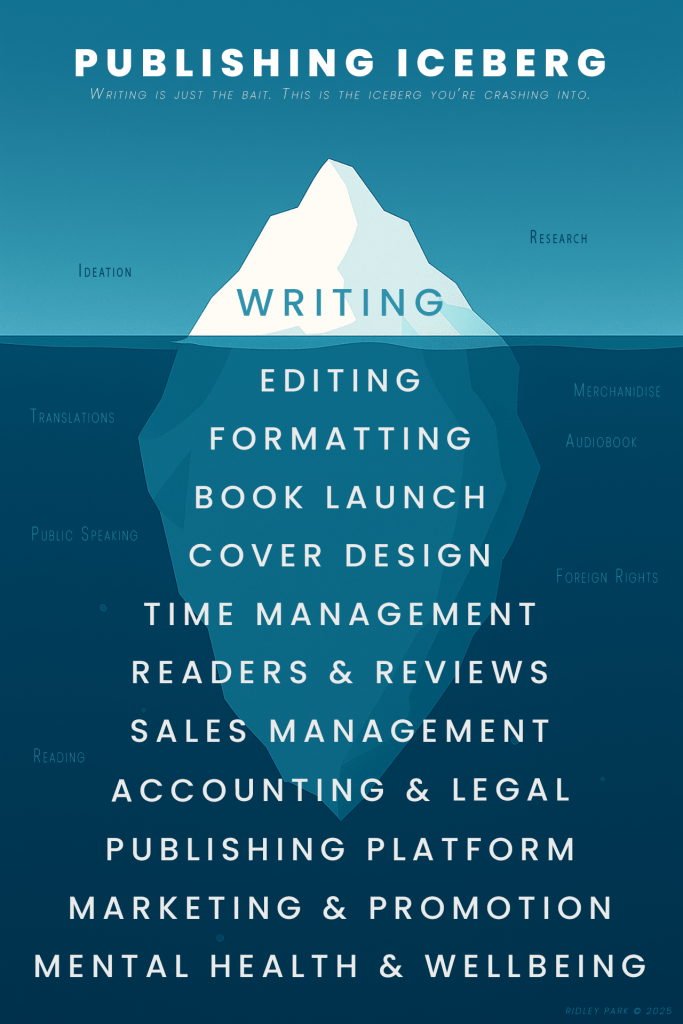
Dispatches from the Publishing Trenches: A Field Report

I, Ridley Park, am an independent author and publisher. Before this literary turn, I did time as an economist, business analyst, and management consultant – none of which prepared me for the peculiar economics of modern publishing.

Much like traditional music in the Digital Age, traditional publishing has lost a bit of its lustre. Its gatekeeping function remains, but the gates are now rusted, and half the guards have been made redundant.

Audio: NotebookLM podcast on this topic.

From a business standpoint, the Independent™ must ask: Is the distribution reach of a traditional publisher or third-party distributor worth the revenue share they demand? It’s tempting to cast them as parasites feeding off your creative lifeblood—but statistically, the average indie author sells only 60 copies of their book. Yes, that includes the five you bought yourself and the ten your mum distributed among reluctant neighbours.

Could you sell more than average? Possibly. Less? Almost certainly. Better to sell 100 copies and earn a pittance than to earn 100% of nothing. But if the publisher can’t move your book either, and if they’re not investing in you as an author, you may well find yourself in the red. Especially if you’re the one paying them for the privilege of being published. That’s not publishing – that’s vanity cosplay.

Publishers also offer (read: upsell) services like editing, formatting, and cover design. As an Independent™, you either pay for these à la carte or do them yourself. Or, if you’re like me, you cobble together a mixed strategy of DIY, AI, and professional outsourcing – whatever the project demands.

For Hemo Sapiens, I did everything except the typography for the title and byline on the cover. That part I outsourced; I know my limits. The rest – cover composition, layout, typesetting – I handled. I also brought in beta readers, who offered some valuable copyedits and corrections.

With Sustenance, I went end-to-end solo, with AI in the wings for flow and proofing support.

Propensity followed a similar path – except I made the rare (some might say perverse) choice of hiring a beta reader after release. Heretical, I know. But the feedback was so incisive I’m now considering a mid-edition revision, particularly in the middle third, where things get a bit heady.

As for Temporal Babel – still unreleased – I’ve done everything myself thus far, but I’m leaning toward bringing that same beta reader back for another round of bruising clarity.

Beta readers, it turns out, are worth their weight in snark and red ink. I’ll save my ruminations on them for another post, which I promise will be full of revelations and at least one semi-poetic lament.

I could say more here, but there are other things demanding my time – and no publisher breathing down my neck.


Bless MidJourney for the cover art based on this prompt:

beautiful woman wearing glasses and a sheer top, holding a red pen, reading a book, office setting

Behind the Binding: Sustenance in Print, Pixels, and Purgatory

Not quite a launch. Not quite a rant. Just one author trying to get a novella into the world without sacrificing too many hours or brain cells.

Paperback Problems

I’ve been writing quite a bit lately—several novellas/novelettes, to be precise.

They all began life as short stories, but brevity doesn’t come naturally. Apparently, I can’t shut up even on the page. I toyed with the idea of releasing a thematic collection, and I still might. But for now, Sustenance is getting its own debut—likely this month.

The book clocks in at around 14,000 words, printed across 144 pages. I’ve read that readers prefer novels to novellas, but I’ve also read that readers don’t really read anymore. Time’s short. Attention spans are shorter. Maybe shorter fiction has a fighting chance. We’ll see.

I formatted it in 6×9 inches, which may have been overly generous. It’s leaner than your average indie fantasy tome but still thicker than my last Žižek collection. So there’s that.

The manuscript began in Word, like every poor decision. I laid it out in InDesign and exported the PDF through Acrobat. No budget, so I designed the cover too—started in Illustrator for the vector charm, but ended up in Photoshop, where I’m more at home. I designed the full wrap—front, back, spine—as a single canvas.

This was a mistake. More on that later.

Still, I’m pleased with the final look. Might reuse the style across future novellas for a bit of visual branding. There’s barely enough of a spine to print on, but we suffer for aesthetics.

Proofs arrive Thursday. Fingers crossed.

Hardback Headaches

Then came the hardback edition. Same 6×9 size, same interior. Should’ve been simple.

It wasn’t.

I forgot (again) that hardbacks require extra bleed and margin space. Couldn’t just resize the existing cover without risking pixelation. If I’d stuck with vectors, this would’ve been a breeze. Instead, I got to rebuild the entire layout from scratch—layers, guides, grids, the lot.

Hours of joyous rework. Lesson learned. Until next time.

eBook Escapism (and Other Fantasies)

Converting the layout to eBook format was a slow-motion trainwreck. I’d inserted custom font glyphs above chapter titles in InDesign. They rendered fine—until they didn’t. Halfway through, chaos reigned.

I cracked open Sigil and manually edited the XHTML. So far, so fiddly.

Then I uploaded the .epub to Amazon. Except Amazon wanted a .kpf file. Of course it did.

Enter Kindle Previewer. Except it doesn’t support embedded font glyphs. So I converted them to SVGs.

Still no dice. Kindle’s rendering engine is older than most of its readers. SVGs failed too. So I converted every glyph to PNG, rewrote the CSS, rebuilt the XHTML again, and gave it another go.

Looks fine. Not perfect. I gave up.

They’re just decorative anyway. No plot-critical glyphs here.

The Kindle version should go live shortly. I enrolled it in KDP Select, which means 90 days of exclusivity in exchange for a modicum of convenience. After that, I’ll look at wider distribution.

For the eBook cover, I simply cropped the original layout in Photoshop. That part was, mercifully, straightforward.


What’s Next?

This post is more documentation than declaration. A sort of production diary. I’ll follow up with an actual announcement when the book launches, plus a few reflections on themes, characters, and that moment when you realise your protagonist may have accidentally sexed up a chicken.

Long story.

Anyway, this is just the start. Stay tuned.

Or don’t. Up to you.