Yes, I actually said that. Possibly whilst caffeinated.
I was chatting with a mate about book sales, and it slipped out: I’d rather get reviews than sales. Not that I’d turn down either. But priorities matter.
Priority One: Write
The first goal is to write. I wrote for years before publishing a single page. The ideas pile up in my head like unwashed dishes, and writing is how I clear the sink. I write for myself. Call it narcissism if you must – but it’s a productive narcissism.
Priority Two: Be Read
Then comes the hope of being read. A sale is not a reader. Someone might buy your book and never open it. They might read it and hate it. They might toss it into the void. I just want to know.
Last month, I gave away over a hundred copies of Sustenance. Four reviews. One was one-star – she loathed it. Good. At least I know. The other ninety-nine? A mystery. For all I know, they’re gathering digital dust on forgotten hard drives. To be fair, I’ve got thousands of neglected downloads myself, so no judgment. Still, if you did read it, I’d love to hear what you thought. Leave a review.
Priority Three: Money (the tedious bit)
I’m not a consumerist, nor a fan of money-based systems. Unfortunately, that’s the system we’ve got, so yes – I still appreciate sales. But sales without engagement are hollow victories.
Reviews (the absurd bit)
Some people email me their thoughts instead of posting reviews. Lovely, but invisible. I can’t quote a private email without looking like a fraud. I could always fake one —
I was musing on this topic – on writing, why one does it, for whom, and whether the effort deserves a standing ovation or a polite cough – when the Algorithmic Gods of YouTube, in their infinite surveillance, dropped this into my lap:
Video: Write like no one will read it.
What serendipity. Or surveillance. Or both.
Let’s be clear: I have no commercial aspirations. I write. That’s the thing. Do I want you to buy my books? Of course. But if you do, I’ll treat it like a solar eclipse – rare, beautiful, and probably not good for your eyesight. A bonus, not the baseline.
I’m not interested in moralising about art for art’s sake or parading around the notion of integrity like a damp flag in a digital hurricane. When I write, I write to express. Not to impress. I don’t care if no one likes it – though I admit, it’s a treat when someone does. Like finding your exact brand of misanthropy mirrored in another human being. Intoxicating.
I was in the Entertainment Industry for years. Not the TikTok variety – actual music, instruments, stages. The word sellout was thrown around like loose change. Some wore it like a scarlet letter, others like a badge of honour.
I remember Elliot Easton of The Cars once said to me – rather sheepishly, as if confessing to tax evasion – “I can’t help it that we’re talented.” This, after Heartbeat City blew up. He was defensive about success, as if it somehow invalidated his artistic credibility. Imagine being so good at your craft that you feel guilty for it. The poor bastard.
Elliot was a musician’s musician. He lived and breathed the stuff, but he wasn’t the band’s oracle. That mantle fell to Benjamin Orr and Ric Ocasek. Elliot was a brilliant contributor – but always downstream of someone else’s vision. I think his dissonance came from chasing a dream that wasn’t quite his.
I once saw an interview with Metallica. Their whole youthful drive was to be the number one band in their genre. They got there. Cue existential crisis. Now what? It’s the inevitable hangover of the goal-oriented artist. Beware the summit: it’s often just a ledge with a better view of the void.
Me? My goal is to write.
That’s it. Not to be a writer. Not to write a bestseller. Just to write. The thoughts in my head spiral out in all directions – sometimes absurd, sometimes barbed, occasionally beautiful. I’d love to share them with the world. And sometimes, gloriously, someone connects. A person I’ve never met reads a line and feels seen. That, my friend, is magic. Not transactional. Transcendental.
But if I were writing for them instead of for me? That would be an ouroboros – a serpent gnawing on its own tail, mistaking the feedback loop for intimacy. That’s not connexion. That’s algorithmic co-dependence.
Image: Technological Ouroboros – Autonomous Power Strip, because even metaphors get short-circuited these days
I’ll be honest: many of my ideas are weird. Not zany TikTok quirky. I mean alienating. Like stow-your-popcorn-and-strap-in strange. When I share them too early, I get a flood of feedback from people who were never going to be my audience. And yet they feel compelled to fix it. To shape it into something more palatable. More genre. More normal.
I’ve had entire manuscripts derailed by the well-meaning notes of people who should have never been allowed near them. Not bad people – just wrong readers. That’s on me. Lesson learned.
So now? I write like no one will read it.
Because they probably won’t.
And that’s oddly freeing.
Dance like no one’s watching. Write like you’ve been ghosted by the market. Make art like it’s the only way left to breathe. If someone finds it, and it saves their life – or just their afternoon that’s a bonus.
Measuring progress is far simpler when you’re writing. You can count words. Or characters, if you’re a sadist. Sure, half of them might be drivel. Whole chapters may end up ceremonially executed by draft five, but at least you’ve done something. There’s a metric. A tally. A sense of movement.
Audio: NotebookLM podcast on this topic.
You can even see your progress, pages stack, paragraphs grow fat with promise. And if you still write on physical media (bless your nostalgic heart), you get the added catharsis of crumpling your failures and lobbing them at the bin like a disgruntled poet. It’s theatre. It’s progress. It’s delusional.
Editing, by contrast, offers no such cheap thrills. The word count doesn’t so much creep as collapse. One minute you’re a literary demi-god sitting on 80,000 words. The next, you’re scraping along at 74k and wondering whether your “tightening” has amputated a limb.
Yes, the prose might be cleaner. Punchier. Less like a whisky-soaked rant and more like a distilled insult. But does it feel like progress? Not in the way dopamine understands it.
As I’ve written before, editing takes me five – maybe ten – times longer than drafting. It’s a full hemispheric shift: from right-brain dreamscapes to left-brain bureaucracy. Creativity gives way to spreadsheet logic. Grammar. Timelines. Continuity. Did she sit before she spoke, or after? Is this line meant to be his? Why is this in past tense? Is this in any tense?
And so, the grind.
Yes, there are flashes of satisfaction – a retooled transition here, a twist landed just-so there. But mostly, it’s a long, slow crawl through self-loathing and misplaced modifiers.
I’ve spent most of my adult life toggling between left-right hemisphere roles. And frankly, the left side still gives me hives. The corporate world, bless its hollow soul, tried to stuff me in a logic-shaped box. A coffin of metrics, meetings, and “measurable outcomes.” I’m still recovering.
So why not outsource editing? Why not let someone else swing the machete through this jungle?
Two reasons:
I secretly enjoy the act of refinement. It’s masochism, but it’s my masochism.
I operate on a margin so thin it’s practically theoretical. A Schrödinger’s budget – simultaneously there and not.
I hate to be the bearer of bad news – especially if you’re still slogging through a draft of your first manuscript. You know what some people say about writing a book is the hard part.
Lies. Damned lies. That’s the frothy, twinkly nonsense parroted by people who’ve never published anything beyond a social media post, probably only a comment.
Audio: NotebookLM podcast on this topic.
Let me tell you the truth. The actual, bloodstained, coffee-fuelled truth:
Writing the book is the easy part.
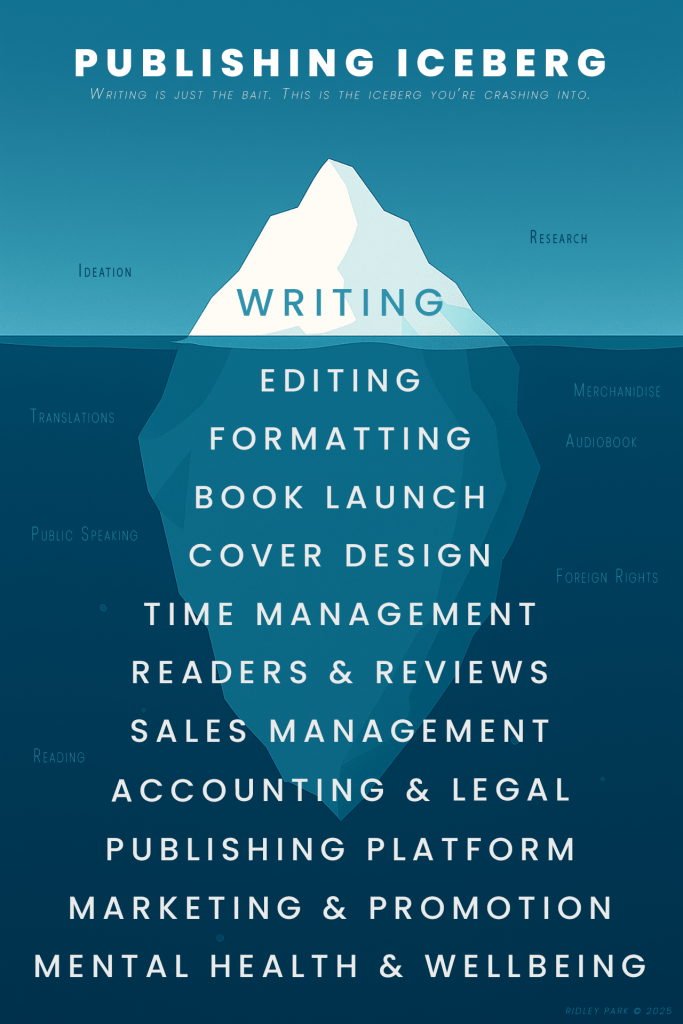
It’s the visible tip of the iceberg, smugly floating above the surface, soaking up the praise and admiration. Meanwhile, everything else – the sleepless nights, the decimal-point royalty statements, the unpaid invoices to your own soul – is lurking beneath, waiting to sink your mental health like the HMS Delusion.
So here it is, for posterity and pity:
Post-Writing Gauntlet: The Real Job Begins
1. Editing (Five Times, If You’re Lucky)
Developmental editing – “Is your plot a plot or a pile of wet spaghetti?”
Line editing – Making your sentences less embarrassing.
Copyediting – Catching your consistent misuse of ‘affect’ and ‘effect’.
Proofreading – The last defence against the typo apocalypse.
Beta feedback – Friends who suddenly vanish when asked to read a draft.
2. Formatting and Typesetting
Print vs digital layouts. Word crimes meet paragraph crimes.
EPUBs that break for fun.
That one widow on page 243 you didn’t notice until the proof copy arrived.
3. Cover Design
DIY, Fiverr roulette, or mortgage your cat to hire a professional.
Matching tone, genre conventions, and market expectations.
Spelling your own name correctly. (Don’t laugh, it happens.)
4. ISBNs and Metadata Hell
ISBN purchases (if you’re not relying on Amazon’s identifiers).
Title, subtitle, BISAC categories, keywords, blurbs, author bio — all rewritten seventeen times.
5. Publishing Platform Setup
Kindle Direct Publishing, IngramSpark, Kobo, Draft2Digital, Smashwords — pick your poison.
Print proofs, bleed settings, trim sizes, the baffling difference between matte and gloss.
6. Marketing (a.k.a. Screaming Into the Void)
Author website & blog (SEO: your new religion).
Social media presence — the façade of charm over existential dread.
Newsletter with a totally non-spammy freebie opt-in.
Ads: Amazon, Facebook, Instagram, Google. Burn money to test the water temperature.
7. Book Launch
ARCs, blog tours, launch events, or at least pretending you’re doing those things.
Coordinating reviews before anyone has read the damn thing.
Press kits and media outreach — basically shouting “LOOK AT ME” with tact.





 Ridley Park