Authorial Risk in the Modern Age

1–2 minutes

Most readers labour under the charming delusion that authorial life involves quills, cafés, slow drips of genius, and perhaps the occasional tragic sigh toward the window. This fiction, alas, is far more optimistic than anything I’ve ever written. In truth, the risks are immense. Existential, even. Sometimes mechanical.

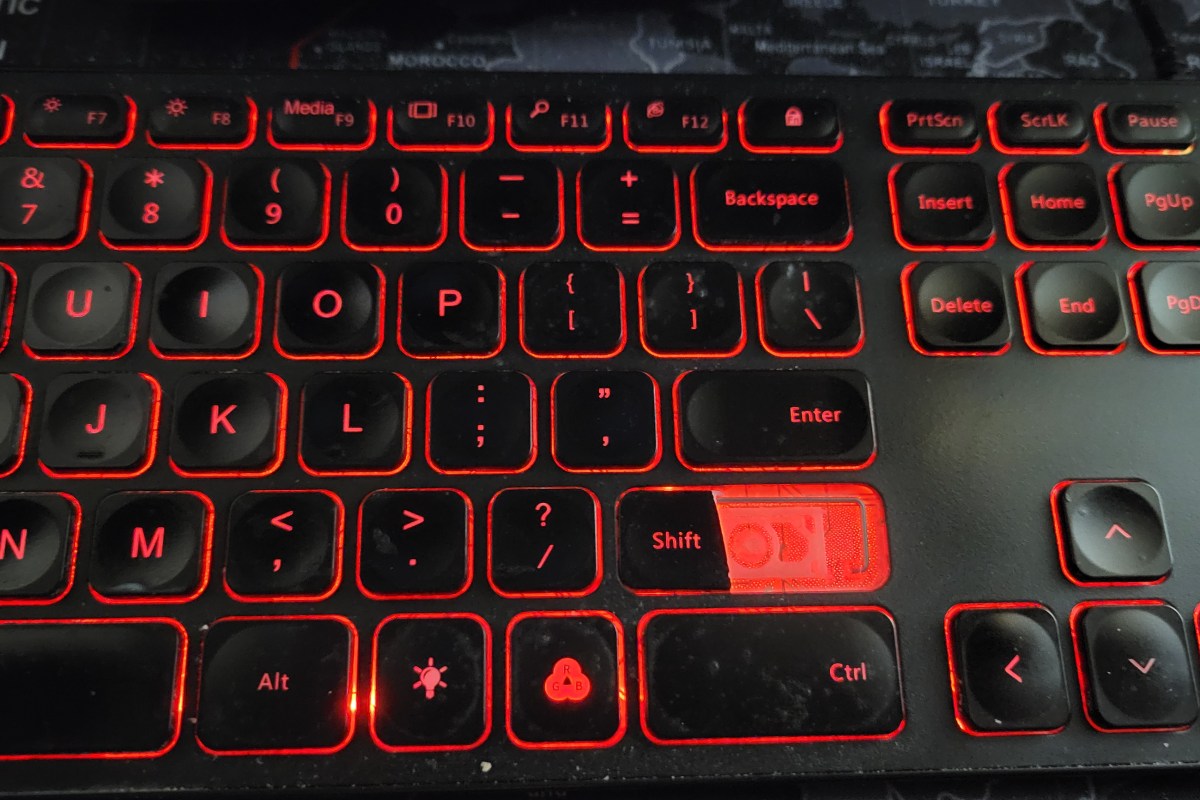
Yes, in the age of AI-generated and fake news, the photo is authentic. No, health and safety have not been consulted.

Image: The keyboard of one Ridley J Park. The J is silent, though his grievances are not.

The other week, my left Shift key split clean in two, like a tanker sheared by the indifferent forces of postmodernity. A catastrophic failure. A breach event. A sudden, violent reminder that entropy retains editorial control over my life.

Rescue attempts were made. Heroic ones. But given the key’s continuous abuse at the hands of my left hand (a hand which denies all wrongdoing and has lawyered up), the damaged component had to be relocated. It now occupies the right-hand position, where it lives in witness protection, away from the repeat offender that used to depress it—literally and metaphorically.

Reconstructive surgery was delicate. Wires were crossed, plastic shrapnel flew, and oaths were uttered in dialects no living linguist has ever documented. But the transplant was, against all cosmic probabilities, a success.

Tragically, the other half of the key didn’t make it. It slipped away. May it rest in peace. Or, if you insist on linguistic accuracy, may it rest in piece.

So here I stand, an author in mourning, soldiering on with asymmetric Shift functionality and a renewed appreciation for the fragility of things – ideas, bodies, narratives, and small bits of plastic that hold together my dwindling sanity.

Rave Reviews

1–2 minutes

“I’d rather get reviews than sales.”

Yes, I actually said that. Possibly whilst caffeinated.

I was chatting with a mate about book sales, and it slipped out: I’d rather get reviews than sales. Not that I’d turn down either. But priorities matter.

Priority One: Write

The first goal is to write. I wrote for years before publishing a single page. The ideas pile up in my head like unwashed dishes, and writing is how I clear the sink. I write for myself. Call it narcissism if you must – but it’s a productive narcissism.

Priority Two: Be Read

Then comes the hope of being read. A sale is not a reader. Someone might buy your book and never open it. They might read it and hate it. They might toss it into the void. I just want to know.

Last month, I gave away over a hundred copies of Sustenance. Four reviews. One was one-star – she loathed it. Good. At least I know. The other ninety-nine? A mystery. For all I know, they’re gathering digital dust on forgotten hard drives. To be fair, I’ve got thousands of neglected downloads myself, so no judgment. Still, if you did read it, I’d love to hear what you thought. Leave a review.

Priority Three: Money (the tedious bit)

I’m not a consumerist, nor a fan of money-based systems. Unfortunately, that’s the system we’ve got, so yes – I still appreciate sales. But sales without engagement are hollow victories.

Reviews (the absurd bit)

Some people email me their thoughts instead of posting reviews. Lovely, but invisible. I can’t quote a private email without looking like a fraud. I could always fake one —

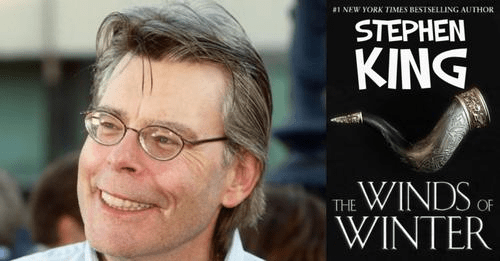
“King Charles absolutely loved Hemo Sapiens.”

But alas, he never said that. (He should.)

Anyway… that’s all I’ve got. Back to writing.

She’s Come Undone – Spoilers

She’s Come Undone is a novel published in 1992, written by Wally Lamb, no relation to Shaun the Sheep.

I haven’t read She’s Come Undone, and it’s unlikely that I ever will. I read a social media post where the author supplanted The Crossing by Cormac McCarthy as his top book. These don’t appear to be the same genre, so don’t ask me how the list was structured. Perhaps books about bears. Does She’s Come Undone have any passages on bears – prequel to The Revenant? We may never find out.

The reason this blog post exists is that I was reading the reviews on Goodreads – 3.91 of 5 stars. So, I read some reviews. This woman offered only one star and swore she’d have given fewer if she could. Odd, how zeros don’t carry the same weight. They act more like NULLs than zeroes. Sad, that.

Evidently, some commenters were furious at her revealing the spoiler. I share her defence here. For those who have yet to watch Citizen Kane, I warn you of the spoiler in her response. Read on at your own risk.

Addendum: Every so often, someone comes along and flags this review as having spoilers. Complaining about spoilers in this review is, not to put too fine a point on it, really stupid. Most of the plot points I mention here are either in the actual cover copy of the book, in the Goodreads summary, or occur somewhere within the first ten pages or so. The rest are so vague (e.g., hooking up with a bad boyfriend — a plot point that probably occurs in some form in, oh, half of the books ever written) that if you consider them “spoilers,” I’m not really sure why you read book reviews at all.

Further addendum: If you’re about to complain about spoilers in this review, please see comment 55 below. If you’re that hysterical about spoilers, maybe stop reading online reviews before you read the book. Also, the book was published 25 years ago and I think the statute of limitations has really run on this one. Rosebud was his sled!!

Notes from the Underground

★★★★★ – “I Am a Sick Man. I Am a Spiteful Man. I Am, Apparently, Hilarious.”

Dostoevsky’s Notes from Underground is a masterclass in misanthropic soliloquy — part philosophical treatise, part psychological farce, and altogether one of the most darkly entertaining monologues I’ve ever had the guilty pleasure of eavesdropping upon. It’s a screaming match between Enlightenment rationality and the petty, pulsing irrationality of actual human life — and guess who wins? (Hint: not the utopians.)

Audio: NotebookLM podcast on this topic.

The first part, a searing, feverish diatribe, reads like the diary of a man who’s been locked in a room with too much Hegel and not enough human contact. It’s Dostoevsky’s pre-emptive strike against every social engineer who’s ever said, “Well, surely man will behave if we just fix the plumbing.” The Underground Man begs to differ — loudly, neurotically, and with an almost Shakespearean flourish of self-abuse.

But it’s the second part — Apropos of the Wet Snow — where things truly fall gloriously apart. Here the theoretical gives way to the tragically tangible. Our narrator, more unhinged by the page, lurches into society like a moth into a bonfire — vengeful, humiliated, self-aware to the point of paralysis. His disastrous encounter with Liza is almost unbearable in its sincerity and cruelty, a pas de deux of hope and destruction that left me squirming and spellbound.

What surprised me most was the humour. Not the cheap slapstick of caricature, but the agonising, close-to-the-bone absurdity that arises when a man is too clever to be functional and too self-aware to change. The Underground Man doesn’t just dig his hole — he drafts blueprints, writes footnotes, and criticises the soil quality.

As a companion read, Tolstoy’s The Death of Ivan Ilych provides a poignant counterpoint. Where Tolstoy charts the steady, ghastly march of bourgeois conformity towards a deathbed revelation, Dostoevsky gives us a man already buried in his psyche, clawing at the dirt and calling it philosophy. Ivan Ilych dies trying to make sense of his life; the Underground Man lives trying to make death of sense itself.

Together, they are a fine Russian reminder that being alive is no guarantee of being well — or even remotely rational.

Ballard’s High-Rise: When Brutalism Meets Behavioural Collapse


I’ve been reading J.G. Ballard’s High-Rise (1975), a brutalist fever dream dressed in concrete and ennui. It’s a story that doesn’t so much depict a descent into chaos as suggest that chaos is the natural state, politely waiting in the wings until the lift stops working and someone pees in the pool.

Audio: NotebookLM podcast on this topic.

This isn’t horror in the Stephen King sense—there’s no room 1408 here, no haunted sheets or malevolent chandeliers. The building isn’t animated; it’s engineered. But like all great systems, it doesn’t need a soul to kill you. The real haunting, as ever, is society itself. Ballard simply does away with the need for ghosts and lets architecture and aspiration do the dirty work.

Compared to Crash—where characters make love to car crashes and each other with equal mechanical indifference—High-Rise has something resembling a cast. I say “resembling” because these aren’t people so much as archetypes on a descent escalator. There’s Laing, a kind of blank-eyed anthropologist; Wilder, who mistakes brute force for authenticity; and Royal, the man literally living in a penthouse and metaphorically in a delusion.

Do I care about them? Not in the slightest. But that might be Ballard’s point. Their motivations are as shallow as a puddle in the car park after the water’s been shut off. Much of the action feels contrived, like a staged rehearsal for an apocalypse that already happened.

And yet—isn’t that precisely what society is? A tepid soup of extrinsic motivators dressed up in motivational posters and mission statements. Nobody in the high-rise acts out of depth or conviction. They act because someone else did it first, because no one told them not to, or because the lift only goes so far down and what else is there to do?

If Crash explored the eroticism of the machine, High-Rise explores the nihilism of comfort. Ballard’s thesis seems to be that civilisation is little more than a thin laminate over our baser instincts—and once it peels, there’s nothing underneath but turf wars and brand loyalty to floor numbers.

The modern reader might recognise the high-rise in everything from gated communities to Meta’s metaverse: sanitised, stratified, severed from consequence. A self-cleaning coffin of convenience.

And, as in the United States today, it all comes heavily medicated and prettily lit—with lipstick, meet pig.

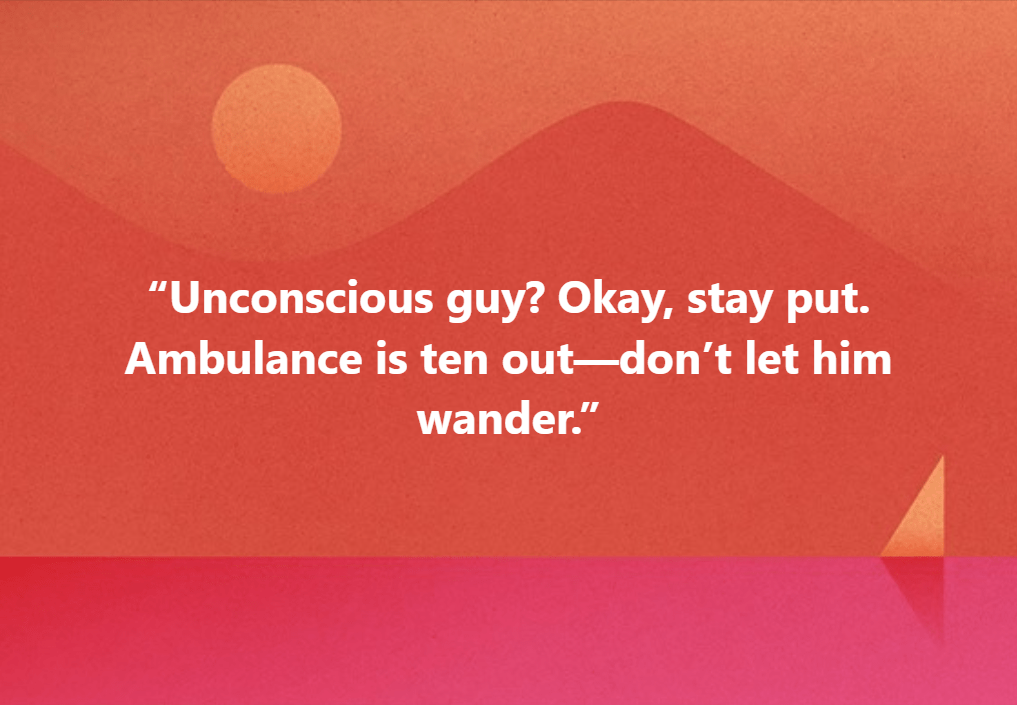
—don’t let him wander.

My biggest problem with generative AI is its lack of subtlety and misunderstanding of satire and irony. I am writing a short story, and a character is calling an emergency number. I shared the first scene with Grok, and it suggests that I turn the absurdity up to 11 and replace this segment with the one above:

“Okay, ma’am. Can you stay with him? I’ll dispatch an ambulance to your location.”

It is funny in its way, but I’m only pretty sure that an operator would not be injecting humour into a situation where a woman is reporting an unconscious person. Absurd doesn’t need to be Monty Python funny.

Am I being too critical?

Audio: NotebookLM Podcast discusses this issue.

More to the point, I find that many humans miss subtlety. Many people need every storyline highlighted and retraced with a bold Sharpie. Every detail needs to be explained because they can’t connect the dots. This is reflected in the cinema, television, and books of the past half-century or more, so is it fair to criticise AI for being dull when it’s at least on par with more than half the human population.

Are we asking AI to be held to a higher standard?