Who’s Ridley Park?

I love origin stories. In fact, my next writing project is an origin story.

But that’s a tale for another day. This post is to reveal the reason for the pseudonym, Ridley Park. This story starts in Delaware, where I lived from 2018 until 2023. I often travelled up 95 North to get to the aeroport or Philadelphia. On this drive, a road sign often caught my eye: Ridley Park.

I cached the name to memory, thinking it might make for an interesting character name. Each trip, this was further imprinted and reinforced.

In April 2022, I was writing another novel. The topic is beyond controversial. In fact, I haven’t yet found anyone who’s not abhorred by the concept, so I know I have to publish it when I finish it. Because of the subject matter, I felt a pen name was in order, and I decided to use Ridley Park. To be fair, the unfinished book is set in Philly, so the name felt particularly apt.

I’ll guess that most of us have heard of the film director, Ridley Scott. The connexion is beyond obvious. It maintains the same cadence.

I’ve never visited Ridley Park. All I know is that it’s a suburb south of Philly, and I’ve borrowed the name. In the end, as it turns out, the question was never ‘Who is Ridley Park?’ Rather, it’s ‘Where is Ridley Park?’ all along.
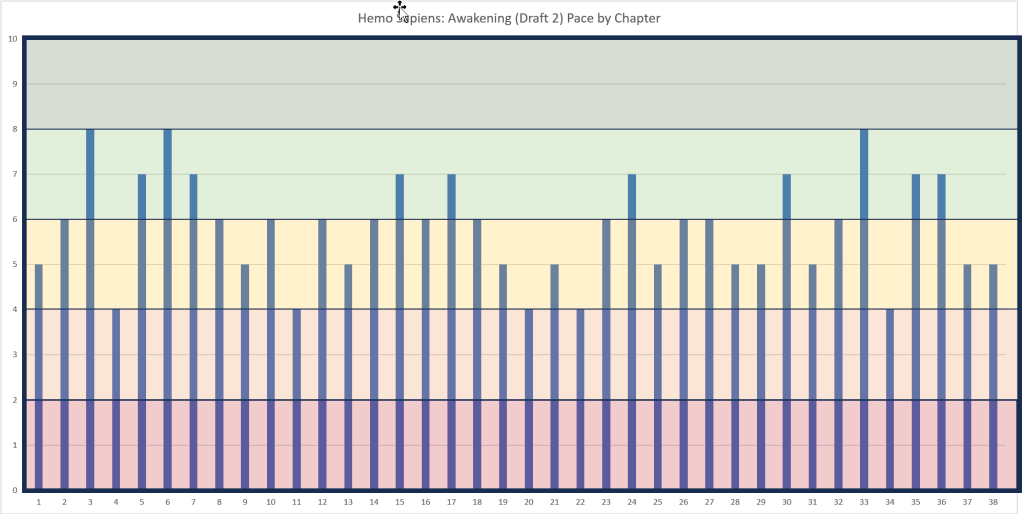
Hemo Sapiens Pacing

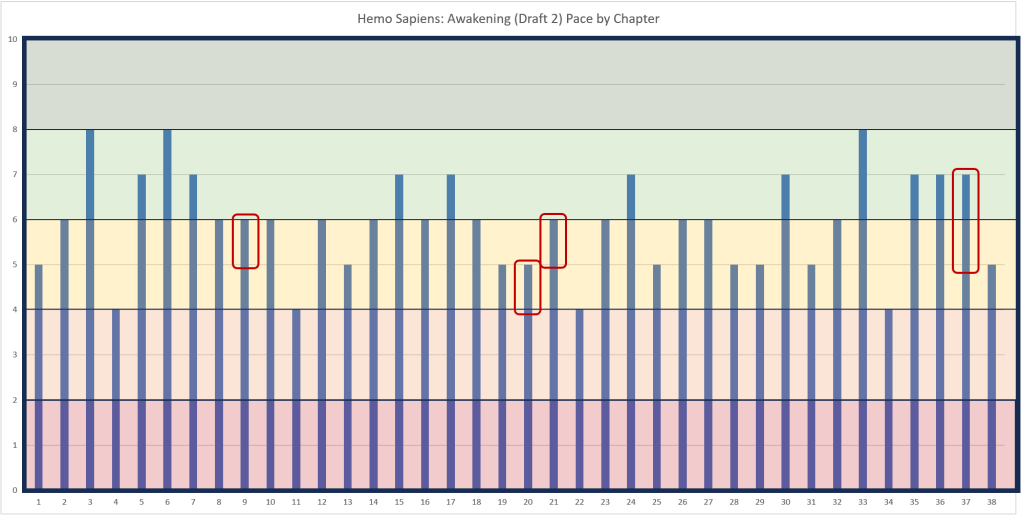
As I review Hemo Sapiens: Awakening and work on the second draft, I asked Claude 2.1 to analyse the pacing of each chapter. This is the result.

Legend

  • 1-2: Very slow, not much happening plot-wise
  • 3-4: Moderately slow pace with some plot development
  • 5-6: Steady pace with a balance of action and exposition 
  • 7-8: Fast-paced with lots of plot advancement
  • 9-10: Very fast-paced, intense action or events

The positive news is that I don’t have anything a the glacial pace of 1 and 2. I do have some slothful 4s, but not threes. I’ve got quite a few 5s and 6s, a respectable amount of 7s and a few 8s, with no break-neck 9’s and 10s.

My goal will be to review the 4s to determine if they are intentional. At first glance, I don’t have any consecutively slow chapters, although having sequential 4s and 5s might be problematic. For example, the four chapters 20 to 22 might be too much of a lag in the middle. I’ll need to keep page count into account as ell. There are a handful of very short chapters, so if a few of those are slow, I might just accept it.

As percentages, we’ve got 13% of 4s (5), 29% of 5s (11), 29% of 6s (11), 21% of 8s (3), so it feels OK—generally a steady to fast-paced novel. The pace seems to ebb and flow, so the reader should be able to remain engaged. Obviously, the slower parts of for character development and description, but none of this is just meandering pointlessly.

In the end, this works for me as a diagnostic tool. This is the first time I’ve tried it. It seems like the assessments are fair. As I rewrite, I can try to tighten some of the slower section and see if the pace picks up.


UPDATE: I reworked chapters 8, 20, 21, and 37, increasing the pace of 5 to 6, 4 to 5, 5 to 6, and 5 to 7, respectively. Chapter 37 was boosted to 7 when I added new information to set up downstream conflict. Unfortunately, the conflict won’t payoff until book 3, since the next book,2, will be a prequel—Hemo Sapiens: Origin—, after which this story will continue.

I still have revisions unrelated to pacing, but I’ll measure them as they come and hope not to stall any. At this point, the average is about 6 (not displayed). Of 38 chapters, 89 per cent of the chapters are steady to fast. 11 per cent are moderate—only 4 of them—and none are slow.

I feel this is a good starting place, and I’d be happy to land here.

Context Is King

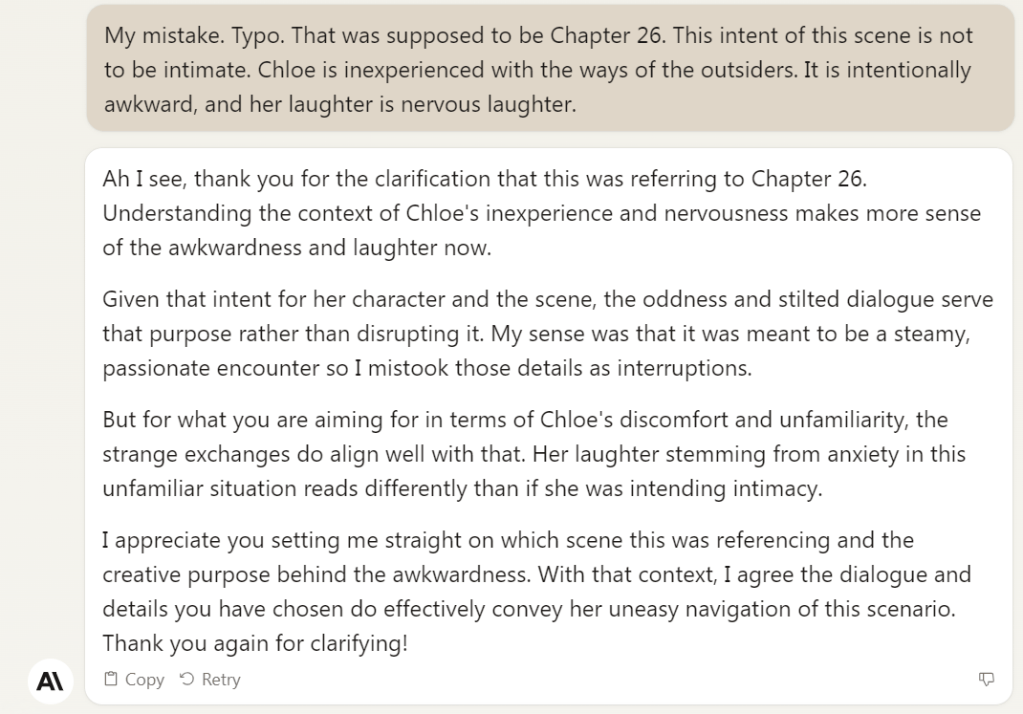
I was chatting with Claude about continuity and flow. I had written an intentionally awkward sex scene and it critiqued some of the activities and, mainly, dialogue. When I asked for clarification, among other things, it returned this:

reworking the banter into flirtier foreplay might heighten the heat of the scene without awkward moments.

— Claude 2.1

Essentially, this was the apology.

Artificial Intelligence doesn’t grasp cultural knowledge. It doesn’t fully grasp irony. It’s like trying to understand a joke from another culture. Without the cultural background, it won’t make any sense.

In another chapter, I asked Claude to analyse a passage that contained a tongue in cheek reference. It didn’t understand why it was humorous.

In yet another, I made a situational reference, and Claude found it amusing, but when I asked why, it was for a reason unrelated. It reminded me of Steve Buscemi’s schoolboy scene on 30 Rock—well out of place.

Cover Art: Awakening

Now that the first draft of Hemo Sapiens: Awakening is done, I can let it marinate for a few days before I return to polish it up for Beta readers. Meantime, I can cleanse my palate and concentrate on other matter like cover art. Here’s the third or fourth draft. I know what direction I’m looking for. I was thinking of commissioning a cover, but I might just go it on my own.

I think I’m going with an 9″ x 6″ form factor, so this would be the aspect ratio. I used OpenAI’s Dall-E 3 to render the eyes as well as the overlay with Greek characters. I may have made it too transparent, so I might need to pull it up a few clicks.

Interesting enough, I am compositing in PowerPoint of all things and exporting to PNG. I usually use Paint Shop Pro, but this may be good enough. I still need to compose the back cover and the spine.

My paginated draft comes in at about 320 pages. It was 256 unpaginated pages. There are 38 chapters, and each chapter begins on an odd page number. The facing page is always blank. This creates a lot of blank pages. I could render some line art on the facing pages, but I’m not taking that option at this point. Probably won’t.

My goal for the cover (as might everyone) is to catch a potential reader’s eye and signal something about the content. In this case, the Hemo Sapiens have violet eyes, so I thought that would make a unique image hook. The are open (obviously) to capture the Awakening aspect. The Greek letters on the overlay represent the science aspect. There are 5 versions of Hemo Sapiens so far, named Alpha, Beta, Gamma, Delta, and Epsilon by their creator. I’ve highlighted those characters in a blood red.

Speaking of blood, this is obviously captured in the colour choice and the dripping font of the subtitle. This is also reflected in the stylised O, but I don’t wish to explain the significance of the stylisation now.

As is the entire cover still in progress, so is the treatment of the title as I am playing with a few options. The novel is set in the near future, 2045, so I was thinking of conveying a future with a silver font face, but the gold felt somehow warmer. I wanted to hint at the dystopian angle by distressing the letters.

So, there’s my confession. If you have any comments on the design, I’d love to read them—for better and for worse.

Reading Aloud

Or is that ‘reading allowed?’ I’m all but done with my first draft of Hemo Sapiens, so I’m recording is chapter by chapter so I can listen to it. Listening uses different cognitive processes beyond the obvious sensory apparatus, so one catches different sorts of factors.

For me as an example, it helps me to capture pacing. When I scan my own work at this stage, I’ve read it so many times, it’s difficult to read critically. I sort of just gloss over the words in a perfunctory manner. Maybe that’s just me, but…

What I do is listen whilst I read along—sort of like in grade school: read silently whilst someone reads aloud. This is what it gets me:

  1. Clumsy phrasing. It felt ok when I wrote it, but doesn’t read particularly well.
  2. Repeat words written nearby. I try to avoid placing the same word in the same paragraph or to close in adjoining paragraphs. In this case, I used and character’s surname name near the end of a paragraph and then at the start at the next, It really caught my ear, so I changed the later one to a subject pronoun.
  3. Spelling. Yep, spelling and grammar checkers still miss things. For me, some of my dialogue it either text-speak, BRB, or truncated, ‘That ain’t for nuttin”, so I often Word to ignore spelling until I’m ready. Though it isn’t necessarily revealed by the audio portion, I tend to track audio word by word, whilst I tend to read in paragraphs.
  4. Typos and wrong words. Listening along yesterday, I noticed that I missed a pronoun change resulting from removing a male character and expanding a female character. A remnant ‘his’ needed to be amended to ‘her’.
  5. Dense (or sparse) paragraphs. This is also about pacing. When listening, one can pick up that a passage just drags unnecessarily. It may need to be written, or it might just need to be broken up or re-punctuated. If it feels too fast that it might give the reader seizures, perhaps toss in a few dialogue tags or descriptors.

Perhaps I could come up with more, but these make my top of mind list.

I use ElevenLabs AI speech synthesis to convert my content from text to speech. I’ve written about my ElevenLabs wish list before. For the plan I use, I get 100,000 characters per month and can exceed that limit by purchasing 1,000 word blocks. I don’t the overage to be cost-effective, so I’d only ever use it in a pinch. The next plan is for a 500,000 word block, but the economics don’t work for me there either. Usually, it’s no big deal. Unless I am using it to narrate a novel, I just wait for the month to roll over and I can pick up where I left off. Fortuitously enough for me, I recorded 11 chapters yesterday before i ran out, and my plan refreshes today, so easy peasy.

ElevenLabs charges by the character, not by the word, which does make sense, but it’s not how I think about writing. I tend to think in terms of words or pages. When they say character count, they mean it—punctuation, quotes, and apostrophes, spaces, and carriage returns. I have discovered ways to reduce spaces, but you need to be careful, because it also uses punctuation to control some elements of prosody and delivery. For example, if you remove all of the commas and full stops, the delivery will be a ramble. For those who still double-space after double stops, this will cost you. Sometimes, when I’m feeling particularly frugal, I remove the carriage returns. They don’t seem to have any effect on the output, and it saves characters. It wouldn’t make for a great reading experience, but the AI doesn’t care.

Sanity Check

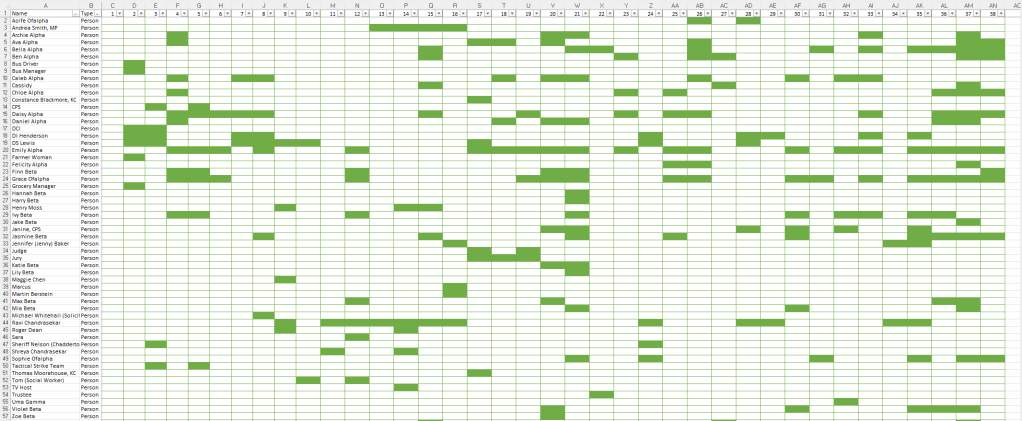
Continuity is important to me, and I haven’t got to the end of a novel yet, so I’ve mapped out the characters by chapter, so I can ensure I didn’t leave someone unintentionally hanging.

This also gives me the ability to track character arc and development, so I can focus on a particular character and tweak either of these aspects. Monitoring character voice is another plus.

I can also count in how many chapters a character appears. In this case, Emily and her daughter, Grace, are two primary characters. It doesn’t tell all the story because, for example, Daisy is in a few chapters and impacts the story, but she’s less important than Ravi, who’s in fewer chapters.

Ben is barely hanging on in yellow, but he is a key character. To be honest, I didn’t even catalogue some single-chapter characters after a while because I knew they wouldn’t be making a return, and they had no unique character arc or voice.

I also track settings, but this is not captured here.

I have a first draft of a cover. I expect to be sharing it here soon. I’m considering an 8″ x 6″ form factor, but that’s not set in stone.

What do you do to help to organise your larger works, anything?

The World is Watching

I woke up today with a new pitch idea. It’s a thriller that resolves into a courtroom drama. Hear me out if you’re an acquisition editor or publisher. Any resemblance to persons or events living or dead is coincidental.

A rogue family wants a new home, but opts for home invasion, what with home prices, interest rates, and all. They invade an inhabited house and relegate the current residents to a corner in the dark and dingy basement.

One day, the detained family attempts to escape, but their plans are thwarted, and they are punished by having their meals withheld. In a last-ditch effort, the father runs up the stair and kills two of the children of the family keeping them captive.

As an act of retaliation, the dominant family kills the children of the captive family, but the authorities hear the gunfire and control the situation.

In the next chapters, the killers face judge and juries. I don’t want to spoil anything, so I’ll leave it here. In order to make the story relevant and accessible to modern audiences, I’ll make it topical: The invasive family will be Jewish and the invaded will be Palestinian. It may be too subtle, but I think some readers will catch on.

There’s my pitch. If you are connected to a publisher, please contact me, so we can talk details. Feel free to leave comments below. If you have any ideas about how the jury verdicts might fall, I’d love to see them.

40,000 Words and Counting

W00t! I’ve finally reached 40K words in my Hemo Sapiens: Awakening novel. This was a minimum word count, but I’ve still got more ideas to incorporate as well as some fat to trim. For now, it yields me some 164 pages*, a number that works for me.

This is a milestone I’ve been waiting for. I have almost 40K words for my Hemo Sapiens: Origins novel, but I put it on hold, opting to release this in media res before revealing the origin story.

If you’ve been following, Hemo Sapiens: Awakening is a compilation of 5 short stories coalesced with new content to bridge and provide continuity. Given the longer story form, I had to give some characters addition depth and a story arc that spanned the longer work. Time will tell if this was successful. I’m having fun.

Anyway, back to the writing mines. Need to excavate some more material.


* 164 pages in an 8″ x 6″ form factor. Vertical spacing for chapters has not yet been accomplished, but I am not interested in how far I can pad it.

Novel Ideas

I’ve been conspicuously absent from this blog as I’ve been busy creating a novel. By creating, I mean that I’ve been combining four short stories within the Hemo Sapiens universe into a would be novel.

I’ve finally completed the consolidation, but there remain continuity gaps, which was to be expected. Plus, I need to thread additional plot aspects because more structure is required to create an apt foundation.

As I plan my approach, I notice I have a fifth short story to integrate. Whilst this creates more work, it also relieves other work. As it stands, the novel-in-progress contains just over twenty-thousand words — about half a novel’s worth, so I’ll more quickly transition from a novella-ranged book to a full-fledged novel. Currently, I’ve got about ninety pages of content. My goal is to have over two-hundred pages of non-filler content, which should get me between forty and fifty thousand words. Time will tell.

Whilst I don’t want to abandon this blog, it does compete with my time and attention, so hopefully I’ll still be making contributions along the way. I’m reusing a cover image to save time. Gotta go. Meantime, cheers.

Origins and Aftermath

I’m allowing Aftermath to marinate before taking another pass reviewing and editing. Meantime, I’ve drafted my initial outline of the Origins story for the Hemo Sapiens universe. As the title suggests, this is an origin story that should be novel-length. It’s looking like 25 chapters unless I feel the need to add some to provide more detail or continuity or remove some for pacing or redundancy.

As it stands, Origins is a character study of two main characters, Professor Henry Moss and his wife Professor Camille Moss, a geneticist and microbiologist, respectively. They have opposing ethical positions on human genetic engineering that becomes more pronounced as Henry’s experiments become real, not just theoretical.

My intent is to show the motivation for their genesis and their maturity until about age ten, when we exit the story with a setup for the enhanced versions.

I’ve got a few more passes of the outline as I add details, and then I’ll take a gander at finalising Aftermath.

Fun times.