Most readers labour under the charming delusion that authorial life involves quills, cafés, slow drips of genius, and perhaps the occasional tragic sigh toward the window. This fiction, alas, is far more optimistic than anything I’ve ever written. In truth, the risks are immense. Existential, even. Sometimes mechanical.
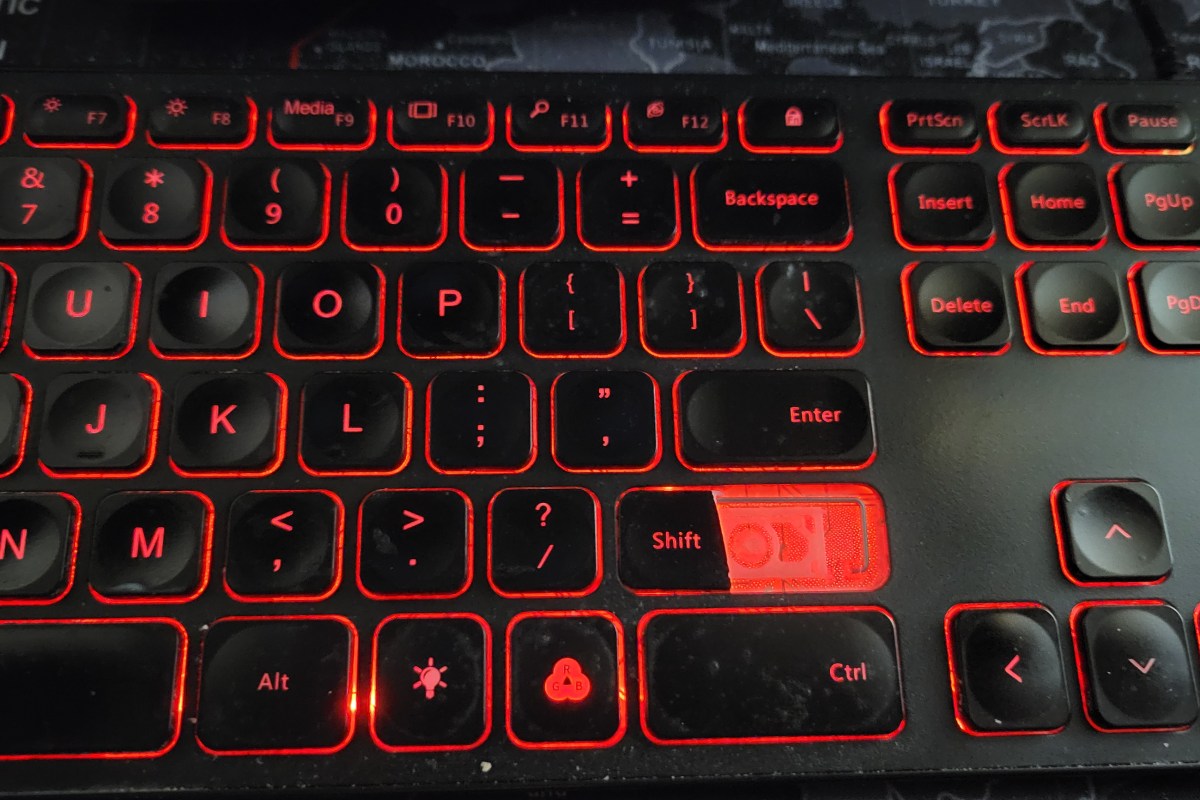
Yes, in the age of AI-generated and fake news, the photo is authentic. No, health and safety have not been consulted.
Image: The keyboard of one Ridley J Park. The J is silent, though his grievances are not.
The other week, my left Shift key split clean in two, like a tanker sheared by the indifferent forces of postmodernity. A catastrophic failure. A breach event. A sudden, violent reminder that entropy retains editorial control over my life.
Rescue attempts were made. Heroic ones. But given the key’s continuous abuse at the hands of my left hand (a hand which denies all wrongdoing and has lawyered up), the damaged component had to be relocated. It now occupies the right-hand position, where it lives in witness protection, away from the repeat offender that used to depress it—literally and metaphorically.
Reconstructive surgery was delicate. Wires were crossed, plastic shrapnel flew, and oaths were uttered in dialects no living linguist has ever documented. But the transplant was, against all cosmic probabilities, a success.
Tragically, the other half of the key didn’t make it. It slipped away. May it rest in peace. Or, if you insist on linguistic accuracy, may it rest in piece.
So here I stand, an author in mourning, soldiering on with asymmetric Shift functionality and a renewed appreciation for the fragility of things – ideas, bodies, narratives, and small bits of plastic that hold together my dwindling sanity.
Written by a stricken Ridley Park, who had had a long relationship with said key. The grief is real. The replacement part is on back-order,
At last, the circle is complete. I’ve slogged through the full dystopia roster, the canonical set so beloved of memes and Venn diagrams. Orwell, Atwood, Burgess, Huxley – and now, Gattaca. Completion is satisfying, but the price of admission? Almost two hours of cinema so wooden you could build an ark.
The problem is not the premise. Genetic determinism as a caste system is a fine conceit – prescient even. But the execution? Trite, contrived, and about as subtle as an Ayn Rand sermon. This is a film with zero degrees of freedom: a script where every outcome is preordained, every obstacle contrived, every subplot bent double to guarantee Vincent’s ascent. It rails against determinism while embodying it.
And the characters? Archetypes in pressed suits. Vincent, the plucky underdog. Jerome, the fallen aristocrat with a liquor cabinet. Irene, the sceptical love interest who abruptly switches sides because the script tells her to. They don’t act, they oblige. It could just as easily have been written in the 1940s, swapped in for a Jimmy Stewart melodrama about class prejudice, courtroom vindication, and the triumph of the “human spirit.” The only modern touch is the genome gimmick.
Yes, admirers gush about its minimalism, its prescience, its “timeless” style. But strip back the sleek lines and moody jazz soundtrack, and you’re left with fortune-cookie profundities (“There is no gene for the human spirit”) welded onto a Rube Goldberg plot. It’s not timeless; it’s tired.
So yes, I’ve ticked it off the list. But at what cost? I endured the dialogue, the implausible sequencing, the endless plot coupons masquerading as destiny. Gattaca may live on in classrooms and think-pieces, but as cinema it collapses under its own deterministic weight.
I recently watched two movies. The book The Children of Men was published by P.D. James in 1992, and the movie was adapted by Alfonso Cuarón in 2006; Filth was written by Irvine Welsh in 1998 and adapted for film by Jon S. Baird in 2013.
Upon watching Children of Men, I came away feeling that the movie was better than the book – at least it resonated more to my liking. A person with other sensibilities may prefer the other. Taste is never universal. I understand that some people can actually eat seafood.
Audio: NotebookLM podcast on this topic.
The book Filth was more typical in that it was better than the movie, although the movie was interesting in its own right; it still paled in comparison. I also found Trainspotting – another Irvine Welsh story – to be a good movie, but it still doesn’t quite live up to the book.
So where am I going with this?
I decided to consider what movies surpassed their source material. I chatted it up with several colleagues and came up with a short list of titles I suspect many have already encountered at least one or the other. I’ll mention where I disagree with the consensus position.
Here’s my rogue’s gallery of films that managed the rare trick of outshining their ink-and-paper parents. Note that this doesn’t represent the order of importance. It is sorted by IMDB film rating as of today.
Stephen King’s novella Rita Hayworth and Shawshank Redemption is solid, but Darabont turns it into a near-religious fable of hope, anchored by Tim Robbins and Morgan Freeman.
Mario Puzo’s novel is pulpy, uneven, and bogged down with subplots; e.g., a chapter on vaginal surgery, no joke. Francis Ford Coppola elevates it into a Shakespearean tragedy.
Chuck Palahniuk’s Fight Club is culty fun, but Fincher sharpens it into a pop-culture grenade – stylistically explosive and endlessly quoted.
IMDB Rating: 8.8/10
One Flew Over the Cuckoo’s Nest (Book: 1962; Film: 1975)
Ken Kesey’s novel One Flew Over the Cuckoo’s Nest is beloved but limited by its narrator’s hallucinations. Milos Forman widens the lens, gives Nicholson free rein, and makes Louise Fletcher’s Nurse Ratched iconic.
Robert Bloch’s Psycho is a tidy pulp thriller. Hitchcock elevates it to a cultural earthquake: the shower scene, mother’s voice, the birth of the modern slasher film.
Stephen King hated Kubrick’s icy interpretation, but cinephiles generally rank the film higher for its visual dread and Nicholson’s unhinged performance.
Inspired by Joseph Conrad’s Heart of Darkness. Conrad’s novella is foundational but slight. Coppola transposes it to Vietnam and creates an operatic nightmare of war.
Apocalypse Now is the consensus masterpiece, and I’ll grant Coppola his fever-dream credentials. But here’s where I part ways with the choir: strip away the meta-theme and you’re left with a bloated war movie that mistakes endurance for profundity.
Upton Sinclair’s socialist novel Oil! is didactic and sprawling. Paul Thomas Anderson cherry-picks a few ideas and creates a volcanic character study of greed and obsession.
Philip K. Dick’s Do Androids Dream of Electric Sheep?is clever but meandering; Ridley Scott builds a visual and philosophical cathedral around identity, memory, and humanity.
Stephen King’s second entry, novella The Body, is a touching coming-of-age tale, but Reiner’s adaptation injects nostalgia, pathos, and one of the best ensemble casts of the ’80s.
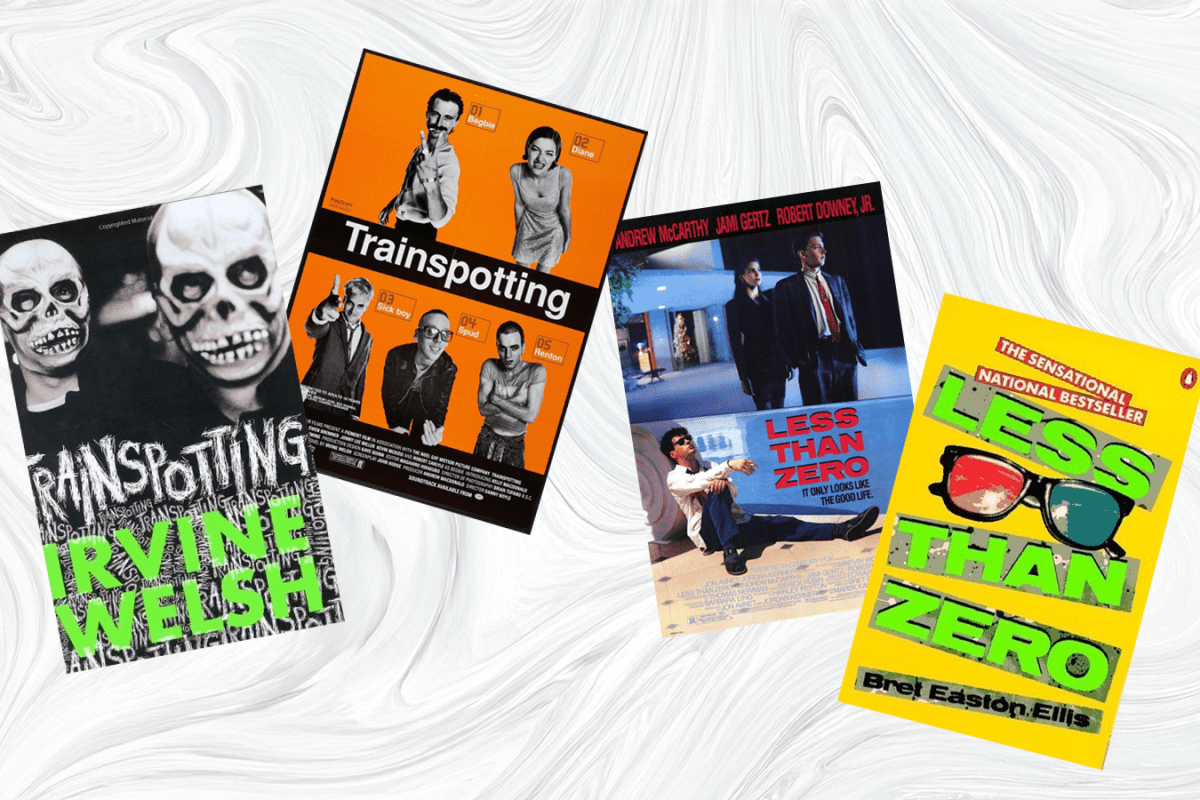
Film has an extraordinary talent for turning jagged, difficult novels into cultural smoothies. Hand Hollywood a text about drugs, despair, and the grotesque collapse of youth, and it will hand you back something fit for a date night. Less Than Zero was gutted. Trainspotting was diluted. Both survived, after a fashion, but only one crawled back out with its bones still rattling.
Audio: NotebookLM podcast on this topic.
Ellis’s Less Than Zero was a flatline pulse of Californian ennui, a catalogue of hollow gestures in which the children of wealth consume themselves into oblivion. The backdrop was Reaganism in full bloom—an America drunk on consumerism, cocaine, and the fantasy of eternal prosperity. The kids in Ellis’s Los Angeles aren’t rebelling; they’re marinating in the very ideology that produced them. The film, by contrast, became a tepid morality play, complete with Robert Downey Jr.’s photogenic martyrdom. The void was swapped for a sermon: drugs are bad, lessons have been learned, and the Reaganite dream remains intact.
Welsh’s Trainspotting was messier, darker, harder to pasteurise. His junkies live in Thatcher’s Britain, where industry has collapsed, communities have rotted, and heroin fills the crater where meaningful work and social support once stood. Addiction is not just chemical but political: it is Thatcher’s neoliberalism rendered in track marks. Boyle’s film kept the faeces, the dead baby, the violence—but also imposed coherence, Renton as protagonist, a redemption arc, and that chirpy “Choose Life” coda. Welsh’s episodic chaos was welded into a three-act rave, all set to Underworld and Iggy Pop. Diluted, yes, but in a way that worked: a cocktail still intoxicating, even if the glass had been sanitised.
And yet, here’s the perennial fraud: drug films always get high wrong. No matter how grim the setting, the “junkie experience” is rendered as theatre, actors impersonating a template someone else once performed badly. The reality of heroin use is crushingly dull: twenty minutes of near-unconsciousness, slack faces, dead time. But you can’t sell tickets to drool and silence. So we get Baudrillard’s simulacrum: a copy of a copy of an inaccurate performance, dressed up as reality. McGregor’s manic sprint to “Born Slippy.” Downey’s trembling collapse. Junkies who look good on screen, because audiences demand their squalor to be cinematic.
And here’s where readers outpace viewers. Readers don’t need their despair blended smooth. They can sit with a text for days, grappling with jagged syntax, bleak repetitions, and moral vacuums. Viewers get two hours, max, and the thing must be purréd into something digestible. Of course, not all books are intellectual, and not all films are pap. But the balance is clear: readers wrestle, viewers swallow. One is jagged nourishment, the other pasteurised baby food.
So Less Than Zero becomes a sermon that spares Reagan’s dream, Trainspotting becomes a rave-poster that softens Thatcher’s wreckage, and audiences leave the cinema convinced they’ve glimpsed the underbelly. What they’ve really consumed is a sanitised simulation, safe for bourgeois digestion. The true addict, the tedious, unconscious ruin of the body, is nowhere to be found, because no audience wants that reality. They want the thrill of transgression without the boredom of truth.
And that, finally, is the trick: cinema gives you Reagan’s children and Thatcher’s lost boys, but only after they’ve been scrubbed clean and made photogenic. Literature showed us the rot; film sells us the simulacrum. Choose Life, indeed.
Zach Cregger wrote Weapons. He also directed it, produced it, and composed the soundtrack. This blog is about writing, so let’s stay with that. In a recent interview with Perri Nemiroff at Fandango, he described how the story emerged almost by accident:
Video: Perri Nemiroff Interviews Cast and Director of Weapons
Perri asks Zach how he got the idea for the story:
I didn’t have an idea for the movie when I started writing
— Zach Cregger
I was like, “Okay, little girl telling a story— takes place at a school. Kids go to school. Follow a teacher. Class is empty. Why? I don’t know. Let’s find out.”
And then two sentences later – because the kids all ran out the night before.
Okay, that’s a hook I like. So, I knew… I have a good question. So then, I probably wrote 50 pages before I even knew what the answer was going to be, honestly.
So, you know, I got the teacher, I got the angry dad, and they’re kind of doing their cat and mouse sort of a thing, and then… I got this cop, and… it wasn’t until about the midpoint where I had… what it was.
And that was a really good moment for me because I was like, “This might not ever be a thing. I might not have anything here.”
You know, if I don’t have a good answer, there’s no reason to watch this movie.
That’s pantsing in its purest form — starting with a question and running fifty pages before you even know if there’s an answer. Discovery writing at its most precarious: equal parts exhilaration and existential dread.
Personally, I lean hybrid. Sometimes I pants a draft until it coughs up a structure; other times I start with scaffolding and let the innards misbehave. But the dead ends always loom. I’ve euthanised countless ideas that failed to evolve, rather than stitching them together with some lazy deus ex contrivance. (Television thrives on that sort of duct-taped plotting, which is precisely why I don’t bother with it.)
Anyway, I have not seen this movie. I am not a fan of horror, but every now and then I sample what’s out there. I might check this out to see how well it delivers.




 Ridley Park