Hemo Sapiens Pacing

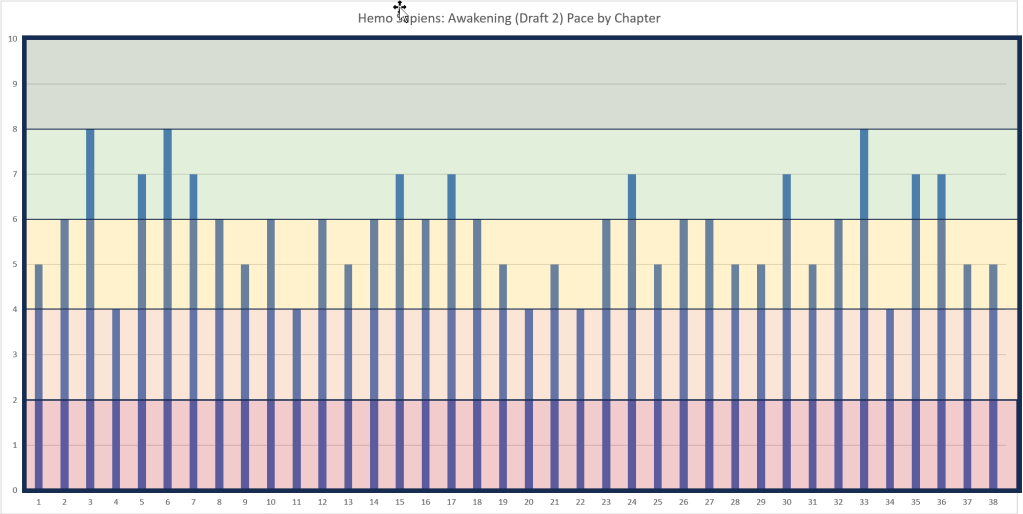
As I review Hemo Sapiens: Awakening and work on the second draft, I asked Claude 2.1 to analyse the pacing of each chapter. This is the result.
Legend

  • 1-2: Very slow, not much happening plot-wise
  • 3-4: Moderately slow pace with some plot development
  • 5-6: Steady pace with a balance of action and exposition 
  • 7-8: Fast-paced with lots of plot advancement
  • 9-10: Very fast-paced, intense action or events

The positive news is that I don’t have anything a the glacial pace of 1 and 2. I do have some slothful 4s, but not threes. I’ve got quite a few 5s and 6s, a respectable amount of 7s and a few 8s, with no break-neck 9’s and 10s.

My goal will be to review the 4s to determine if they are intentional. At first glance, I don’t have any consecutively slow chapters, although having sequential 4s and 5s might be problematic. For example, the four chapters 20 to 22 might be too much of a lag in the middle. I’ll need to keep page count into account as ell. There are a handful of very short chapters, so if a few of those are slow, I might just accept it.

As percentages, we’ve got 13% of 4s (5), 29% of 5s (11), 29% of 6s (11), 21% of 8s (3), so it feels OK—generally a steady to fast-paced novel. The pace seems to ebb and flow, so the reader should be able to remain engaged. Obviously, the slower parts of for character development and description, but none of this is just meandering pointlessly.

In the end, this works for me as a diagnostic tool. This is the first time I’ve tried it. It seems like the assessments are fair. As I rewrite, I can try to tighten some of the slower section and see if the pace picks up.


UPDATE: I reworked chapters 8, 20, 21, and 37, increasing the pace of 5 to 6, 4 to 5, 5 to 6, and 5 to 7, respectively. Chapter 37 was boosted to 7 when I added new information to set up downstream conflict. Unfortunately, the conflict won’t payoff until book 3, since the next book,2, will be a prequel—Hemo Sapiens: Origin—, after which this story will continue.
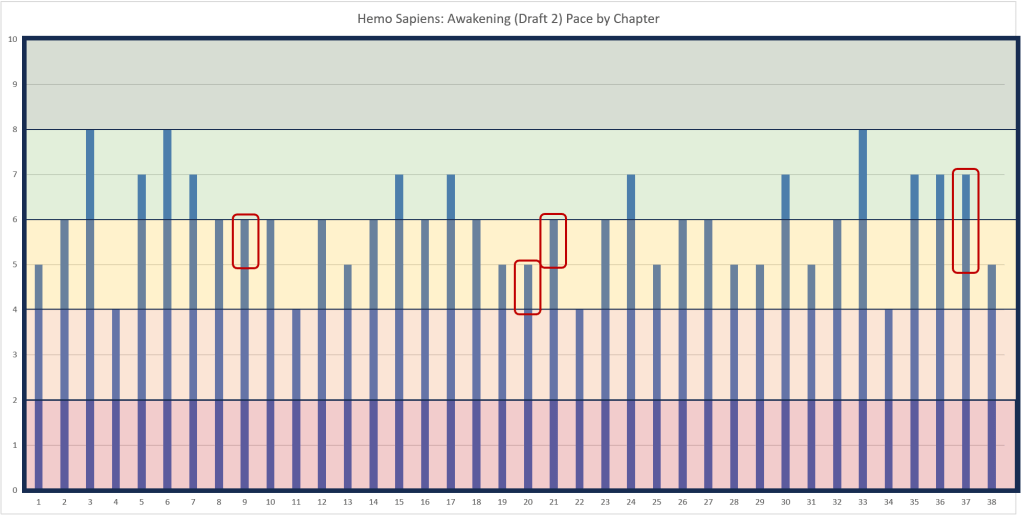
I still have revisions unrelated to pacing, but I’ll measure them as they come and hope not to stall any. At this point, the average is about 6 (not displayed). Of 38 chapters, 89 per cent of the chapters are steady to fast. 11 per cent are moderate—only 4 of them—and none are slow.

I feel this is a good starting place, and I’d be happy to land here.

Context Is King

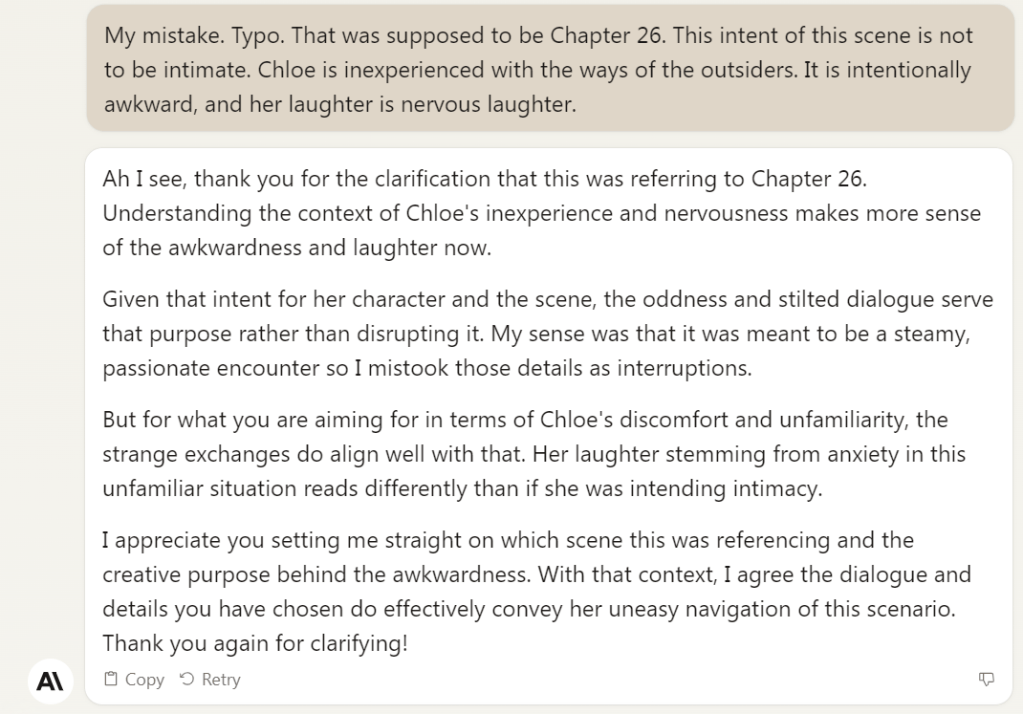
I was chatting with Claude about continuity and flow. I had written an intentionally awkward sex scene and it critiqued some of the activities and, mainly, dialogue. When I asked for clarification, among other things, it returned this:

reworking the banter into flirtier foreplay might heighten the heat of the scene without awkward moments.

— Claude 2.1

Essentially, this was the apology.

Artificial Intelligence doesn’t grasp cultural knowledge. It doesn’t fully grasp irony. It’s like trying to understand a joke from another culture. Without the cultural background, it won’t make any sense.

In another chapter, I asked Claude to analyse a passage that contained a tongue in cheek reference. It didn’t understand why it was humorous.

In yet another, I made a situational reference, and Claude found it amusing, but when I asked why, it was for a reason unrelated. It reminded me of Steve Buscemi’s schoolboy scene on 30 Rock—well out of place.

ElevenLabs Subscription

I was very disappointed to discover that characters don’t roll over into a new month’s subscription.

What happens to my subscription and quota at the end of the month?

Your subscription will automatically renew with each billing cycle and your characters will reset.

The unused quota does not roll over as it is a subscription-based service and the quota is an allotment for that month only. The only time where the quota rolls over is if you upgrade your subscription in the middle of an ongoing cycle, in which case the remaining quota will be added to the new cycle.

Italics are mine. Luckily for me, I tend to use most of my characters anyway. Last month I had 300-some-odd left over, but when I checked my balance, I only had the 100,000 for the month. This is what their Help page said.

300 characters is barely two sentences, but I could have, IDK, recorded some chapter titles and save those characters for actual prose.

It’s a good thing I read this. I was thinking of saving up a few months and knocking out an audiobook. For now, that’s not an available option. I’ll need to pay for the next subscription level. #SadPanda

For now, I’ve recorded 11 of 38 chapters JUST for my own editorial process. If in the unlikely scenario a chapter requires no changes, I’ll be ahead of the game. To be honest, I can just rerecord amended passages, but this involves a lot of post-production editing, which I’ve done, but it usually ends up being cheaper to just re-record. #FirstWorldProblems

Cover Art: Awakening

Now that the first draft of Hemo Sapiens: Awakening is done, I can let it marinate for a few days before I return to polish it up for Beta readers. Meantime, I can cleanse my palate and concentrate on other matter like cover art. Here’s the third or fourth draft. I know what direction I’m looking for. I was thinking of commissioning a cover, but I might just go it on my own.

I think I’m going with an 9″ x 6″ form factor, so this would be the aspect ratio. I used OpenAI’s Dall-E 3 to render the eyes as well as the overlay with Greek characters. I may have made it too transparent, so I might need to pull it up a few clicks.

Interesting enough, I am compositing in PowerPoint of all things and exporting to PNG. I usually use Paint Shop Pro, but this may be good enough. I still need to compose the back cover and the spine.

My paginated draft comes in at about 320 pages. It was 256 unpaginated pages. There are 38 chapters, and each chapter begins on an odd page number. The facing page is always blank. This creates a lot of blank pages. I could render some line art on the facing pages, but I’m not taking that option at this point. Probably won’t.

My goal for the cover (as might everyone) is to catch a potential reader’s eye and signal something about the content. In this case, the Hemo Sapiens have violet eyes, so I thought that would make a unique image hook. The are open (obviously) to capture the Awakening aspect. The Greek letters on the overlay represent the science aspect. There are 5 versions of Hemo Sapiens so far, named Alpha, Beta, Gamma, Delta, and Epsilon by their creator. I’ve highlighted those characters in a blood red.

Speaking of blood, this is obviously captured in the colour choice and the dripping font of the subtitle. This is also reflected in the stylised O, but I don’t wish to explain the significance of the stylisation now.

As is the entire cover still in progress, so is the treatment of the title as I am playing with a few options. The novel is set in the near future, 2045, so I was thinking of conveying a future with a silver font face, but the gold felt somehow warmer. I wanted to hint at the dystopian angle by distressing the letters.

So, there’s my confession. If you have any comments on the design, I’d love to read them—for better and for worse.

Neuromancer

William Gibson coined the term ‘cyberspace’ in his book Neuromancer. Just the opening sentence informs the reader to expect something different.

In this book, Gibson is poetic and florid. I decided to task ChatGPT to rephrase a paragraph I wrote in Hemo Sapiens: Awakening to follow the style of Gibson.

I shared this paragraph:

The Deputy Chief Inspector starts her day at her polished wooden desk, perusing emails whilst sipping hot morning tea. The sharp aroma fills her nostrils. The fluorescent office lighting hides nothing. Except for some personal photos, her office looks like an austerity challenge. The absence of personal effects betrays her personality.

ChatGPT rendered this:

In the sterile dance of fluorescent light, the Deputy Chief Inspector’s day unfolds. This unforgiving light, a stark mimic of daylight, strips the room of shadows, laying bare the austerity of her workspace. It’s a realm where the polished wooden desk becomes a stage for the mundane ritual of morning emails, and where the walls, devoid of adornment except for a few personal photos, echo the unspoken ethos of restraint.

Amidst this, her morning tea stands as a solitary rebellion. Its steam, a curling serpent of warmth in the chill of artificial light, carries with it an aroma sharp enough to slice through the monochrome of her surroundings. Each sip is a fleeting escape, a momentary immersion in sensory richness that contrasts starkly with the barren office landscape. The tea’s heat whispers of a world beyond these walls, a reminder of life’s subtle flavors amidst the unyielding glare of fluorescent reality. In this space, where the lighting reveals all but understands nothing, the tea becomes not just a beverage, but a quiet testament to the hidden depths beneath her pragmatic exterior.

You’ll notice straight away that my writing is more concise. When I write in 51 words, he writes (by AI proxy) in 181. Mine is 28% of his.

Don’t get me wrong, I love the poetry of the longer form. I just don’t think like that unless I force myself, and then it comes off as stilted or pretentious. My preference is a more direct, terse writing style over the verbose. Perhaps, I’m of a different era. In the end, I compromise.

When I ask AI to critique my prose, a common response to to provide more sensory inputs. In this case, these are represented by her desk, polished and wooden, no less. And she’s sipping hot morning tea—not just a drink, but tea; not just tea, but hot tea, morning tea; and she’s sipping. And this tea has aroma. It’s sharp. So, I’ve got a visual (tea), a tactile (hot), and an olfactory (aroma). I’ve got no auditory or gustatory cues, but I might have.

My preference is to describe as little as possible to allow readers to form their own impressions. This is even more important for characters. On balance, I don’t personally care about the sex, gender, or race of my characters, but I share clues anyway. For race, I might be somewhat obvious as in Hemo Sapiens: Awakening by naming a character Ravi Chandrasekar. It’s fairly obvious that this is an male with heritage from the Indian subcontinent, though it says nothing of his preferred gender.

I might mention height or physique, a moustache or spectacles, a lisp or a stammer, but in the end if a reader wants to image that person as black or white or brown or whatever, I’m not affecting that much. Naming a character Maria instead of Marie sends subtle hints, but it’s not overpowering.

It the case of the Hemo Sapiens, they have blue eyes. Probability would lead one to believe they are Caucasian whites, but this doesn’t preclude something else. That’s not for me to decide. In my head, they are European whites, but I am not going to beat the reader over the head with this trivia.

I’m rambling now. Now read the faux-Gibson passage. It is much more immersive and experiential. If that’s your aim, then go for it. No harm, no foul.

You may prefer one over the other. I say they are simply different, and it depends on the intent of both the reader and the writer.

BONUS

Wanting to generate a featured image for this post, I used Dall-E. I’ve never had Dall-E talk back to me. It usually just renders what I’ve asked. This time, note its response. 🤣

Do you have a writing style preference? Does your writing style veer from your reading style? Let me know in the comments.

Reading Aloud

Or is that ‘reading allowed?’ I’m all but done with my first draft of Hemo Sapiens, so I’m recording is chapter by chapter so I can listen to it. Listening uses different cognitive processes beyond the obvious sensory apparatus, so one catches different sorts of factors.

For me as an example, it helps me to capture pacing. When I scan my own work at this stage, I’ve read it so many times, it’s difficult to read critically. I sort of just gloss over the words in a perfunctory manner. Maybe that’s just me, but…

What I do is listen whilst I read along—sort of like in grade school: read silently whilst someone reads aloud. This is what it gets me:

  1. Clumsy phrasing. It felt ok when I wrote it, but doesn’t read particularly well.
  2. Repeat words written nearby. I try to avoid placing the same word in the same paragraph or to close in adjoining paragraphs. In this case, I used and character’s surname name near the end of a paragraph and then at the start at the next, It really caught my ear, so I changed the later one to a subject pronoun.
  3. Spelling. Yep, spelling and grammar checkers still miss things. For me, some of my dialogue it either text-speak, BRB, or truncated, ‘That ain’t for nuttin”, so I often Word to ignore spelling until I’m ready. Though it isn’t necessarily revealed by the audio portion, I tend to track audio word by word, whilst I tend to read in paragraphs.
  4. Typos and wrong words. Listening along yesterday, I noticed that I missed a pronoun change resulting from removing a male character and expanding a female character. A remnant ‘his’ needed to be amended to ‘her’.
  5. Dense (or sparse) paragraphs. This is also about pacing. When listening, one can pick up that a passage just drags unnecessarily. It may need to be written, or it might just need to be broken up or re-punctuated. If it feels too fast that it might give the reader seizures, perhaps toss in a few dialogue tags or descriptors.

Perhaps I could come up with more, but these make my top of mind list.

I use ElevenLabs AI speech synthesis to convert my content from text to speech. I’ve written about my ElevenLabs wish list before. For the plan I use, I get 100,000 characters per month and can exceed that limit by purchasing 1,000 word blocks. I don’t the overage to be cost-effective, so I’d only ever use it in a pinch. The next plan is for a 500,000 word block, but the economics don’t work for me there either. Usually, it’s no big deal. Unless I am using it to narrate a novel, I just wait for the month to roll over and I can pick up where I left off. Fortuitously enough for me, I recorded 11 chapters yesterday before i ran out, and my plan refreshes today, so easy peasy.

ElevenLabs charges by the character, not by the word, which does make sense, but it’s not how I think about writing. I tend to think in terms of words or pages. When they say character count, they mean it—punctuation, quotes, and apostrophes, spaces, and carriage returns. I have discovered ways to reduce spaces, but you need to be careful, because it also uses punctuation to control some elements of prosody and delivery. For example, if you remove all of the commas and full stops, the delivery will be a ramble. For those who still double-space after double stops, this will cost you. Sometimes, when I’m feeling particularly frugal, I remove the carriage returns. They don’t seem to have any effect on the output, and it saves characters. It wouldn’t make for a great reading experience, but the AI doesn’t care.

Today, I Cried

To be fair, I’ve been a bit more emotional since I was hospitalised, and I’m occasionally moved by certain musical passages in minor keys, but I’ve never cried as I write.

I hope this translates to the reader. I feel that this ties back to a recent post on Conscious and Subconscious Writing. I was just writing in the Flow. I was nearing the end of the beat at the and of a scene in my nearly finished Hemo Sapiens: Awakening, and I wrote the last paragraphs through literal tears—not the metaphorical sort.

When I was finished, I asked the AI for it’s critique. I felt the section might feel too long and rambling, but Claude gave me this feedback”

Not at all – I don’t think this section felt too long or rambling! You brought nice closure on the media spotlight scenario by showing the attempted interview with the Hemo Sapiens family. I enjoyed seeing the ending play out.

I can’t wait to publish it. I don’t have an agent, so my plan is to self-publish and then seek a distributor. We’ll see how that works out. The prequel, Hemo Sapiens: Origins is already some 60% done, so it will follow behind relatively quickly.

As this is planned to be a series in a universe, I’ve commissioned a logo/graphic artist to render the title and subtitle, as I’ll be maintaining the same font and treatment for each book, amending just the subtitle.

Fingers crossed.

Client Confidentiality

Claude 2.1 was analysing my current project. I had just added a bridging section and asked for an evaluation. It returned three suggestions including this one:

Suggestions:
Steps could be taken to protect identities when analyzing client content.

This made no sense to me given the context, so I enquired: I don’t understand this statement: ‘Steps could be taken to protect identities when analyzing client content.’

Claude responded:

Protecting identities:
I should not have made this assumption. Please disregard this comment, as you have no obligation to anonymize names or details in your fictional narrative. I erred there.

What caused this? We’d been discussing and analysing this all evening. Sometimes Claude just goes off the reservation.

Restructuring with GenAI

I’ve been working with Claude to help structure my Hemo Sapiens novel. Essentially, I am asking for advice about logically grouping and naming chapters. This was my first mistake.

Firstly, I asked the AI to ignore my chapters and headings and to tell me what it suggested. It took about ninety per cent from me and offered me different chapter titles about half the time. In one case, it offered my two titles for the same chapter. Secondly, it re9organised some of my chapters—and no, it would not work sequenced as suggested. File this under ‘Order Matters’.

I made most of the changes and asked it to review it again and make more suggestions, if appropriate. I also noted that the chapters it suggested were of wildly different lengths—some as short as a paragraph—, so I asked for consolidation tips.

Claude agreed with my assessment, so it recommended combining two short chapters, say, 1 and 9, together—and why not 7 and 13 while you’re at it. Let’s just say that Claude has no common sense.

I do like a lot of the advice Claude and ChatGPT gives, but you really have to be careful. I swear these guys have a severe psychotropic drugs problem when they’re offline, and it’s affecting their performance.

Wrestling with ChatGPT

I use ChatGPT as a copy editor, and I am constantly bouncing ideas off it. If only I had some available alpha readers. lol

This afternoon, I had it review passages, especially since I recently consolidated characters. Because of this, ChatGPT felt that I should elevate the Detective Sergeant from a secondary B-level character to a B+ character. Therefore, I should flesh her out more to make her more memorable. And I should expose the reader to more of her internal dialogue.

I took this advice to heart and reviewed the sections I had shared. I tend to indicate internal dialogue in italics, and there was plenty of italics. Of course, ChatGPT doesn’t have access to this markup, so I manually wrapped curly braces around {internal dialogue}, thusly.

I copy-pasted the section back into ChatGPT and asked for an analysis. This time, it was all praise.

This is something worth keeping in mind. You might have to do some extra throwaway markup for your AI editor to keep it honest.

Pro Tip: Another thing I do, is I place my [author comments] in square brackets and instruct the AI to ignore these in the analysis. I use author comments as placeholders for my own exposition, notes for later clarification, and so forth. With the brackets, I can just tell ChatGPT or Claude something like:

Analyse and evaluate this section. Inner dialogue is in curly braces, { }. Ignore content is square brackets, [ ]. This seems to work for me. YMMV