Translations of The Blind Owl

I was less than happy with my review of The Blind Owl. It’s an OK summary, but it’s at too high of a level—fifty-thousand feet as some say.

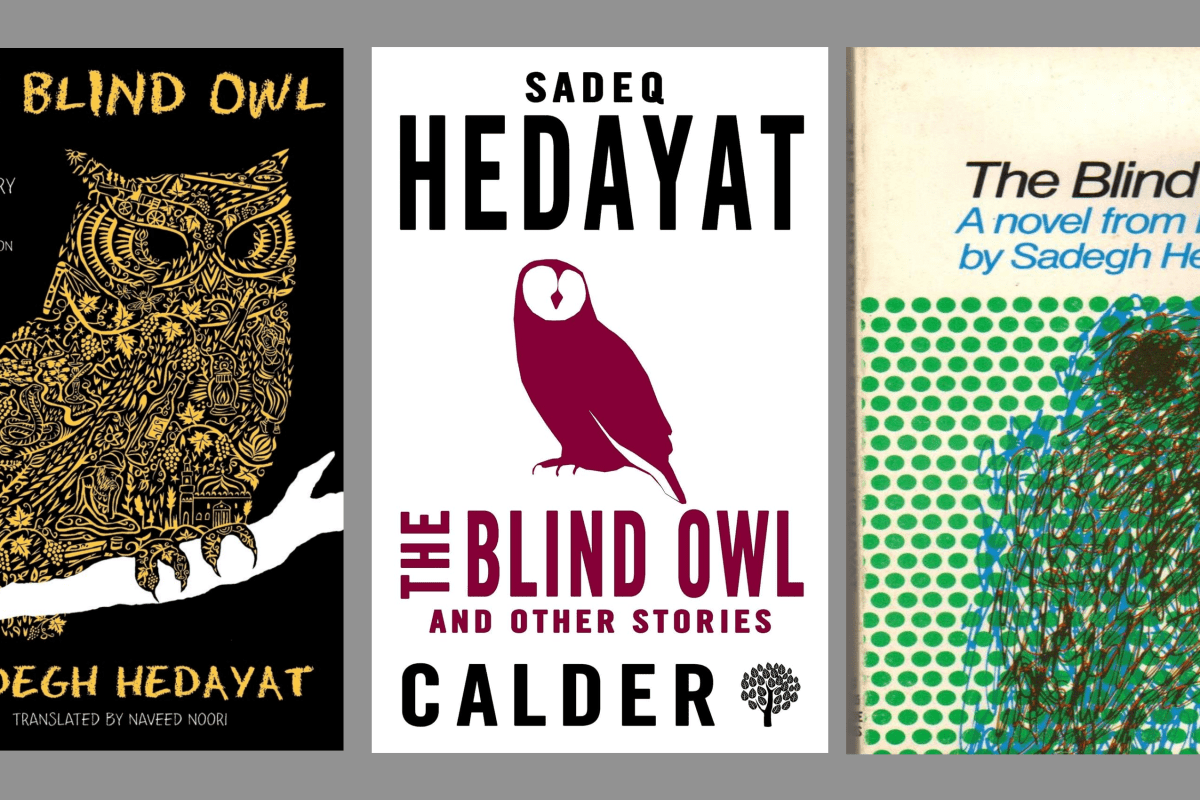
I problem is that I need to make notes as I read rather than recollect at the end. As it happens, I’ve got three English translations of the book, I don’t read Persian, and reading in French still gives me translation differences. I decided to read a different translation, and they’re a bit askew. So I picked up the third. Different, still. I’ll illustrate my point.

The book opens with a sort of prologue before the narrative begins. Each of the translations read as follows:


Each of these establishes the tone but in differing ways. The narrator’s world is bleak. It’s a mean world, full of wretchedness and misery; a base world, full of destitution and want; a debased and wretched world, full of destitution and want.

As the chapters progress, I can’t help but wonder what the translators have interjected and what is faithful. I’ve written about the challenge in translations is that sometimes an exact word doesn’t exist in the target language.

For example, in Camus’ L’étranger, the novel opens:

Aujourd’hui, maman est morte. Ou peut-être hier, je ne sais pas.”

This translates to “Today, mother died. Or maybe yesterday, I don’t know.” Rather, it doesn’t.

In English, we have the word ‘mother’, which is relatively formal when referring to one’s own parent. We also have the children’s term ‘mummy’ or perhaps ‘mom’, but maman falls between them. ‘Mother’ makes him feel overly rigid or formal than his character unfolds to be; ‘mummy’ would make him seem feeble or infantile, so we are left with ‘mother’.

In The Blind Owl, I have no such reference to parse the language. I am at the mercy of the translator. In the sample passages, not much meaning is lost, if any, but stylistically it reads differently. The pace feels different. I don’t know which I prefer. Anchoring has likely led me to favour the first.

Is the world bad, or does it contain bad, or both, and in what composition?

I’ll keep reading, and I hope to improve it with a more personal accounting.
Franglais

In Hemo Sapiens: Origin, I am mixing French and English dialogues and tags. The challenge I am having is switch between the languages.

For example, see this passage:

« Où est maman ? » Camille asks Claire just as her parents come into view. « Maman » she exclaims, starting to weep again. « Papa. » She receives his hug.

French and English dialogue and speech markers work differently. I I were depicting large swathes of each language, I’d simply apply the specific language rules, but I am mixing it up, and that creates challenges. I haven’t seen any good examples how to present this.

Some obvious differences are the guillemets « » in French versus ‘ ‘ in English. In French, ? and ! are spaced after the sentence, and all content internal to guillemets is offset by leading and terminal spaces. Another big difference is that guillemets offset dialogue blocks whereas English uses speech marks to identify each speaker’s dialogue.

Referencing the example above—in English for English readers—, if I were to convey the content using French presentation rules, it might look something like this:

« Where’s mum ? Camille asks Claire just as her parents come into view.

Mum, she exclaims, starting to weep again.

 Dad.  She receives his hug. »

Notice that the entire block is enquoted. I’ve considered this, but I feel it will not track well for English readers, who are used to the speaker-reference convention.

Also, I really want to set off the French language content, and the guillemets serve that function.

Regarding dialogue, French and English punctuation rules are similar enough, but there aren’t many cases of a comma (virgule) following a speech mark given the convention. To my eyes, it looks better inside the marks, but it feels off. The Oxford English style guide suggests not even using commas to separate the dialogue from the tag, but I don’t see that much in the wild.

Again, referencing the example above, one can see how I am solving this at the moment.

At first, I indicate the French dialogue by guillemets and employ French punctuation rules followed by a dialogue tag and descriptive content.

« Où est maman ? » Camille asks Claire just as her parents come into view.

Next, I use the English format, but I replace quotation marks with guillemets. I’ve omitted the trailing comma—after ‘Maman’—in this example.

« Maman » she exclaims, starting to weep again.

Finally, since ‘Papa’ expresses a complete thought, I enclose the full stop within the guillemets. Rather than a dialogue tag, I opt for a stand-alone sentence.

« Papa. » She receives his hug.

When I write mixed language copy, I usually identify a foreign language in italics, but I didn’t choose to do this for French dialogue. Firstly, because I am already using italics for other foreign words, e.g. Latin; secondly, because these also depict internal dialogue/monologue, so I don’t want to create too many visual design patterns.

Has anyone else solved this problem? I’d love to know.


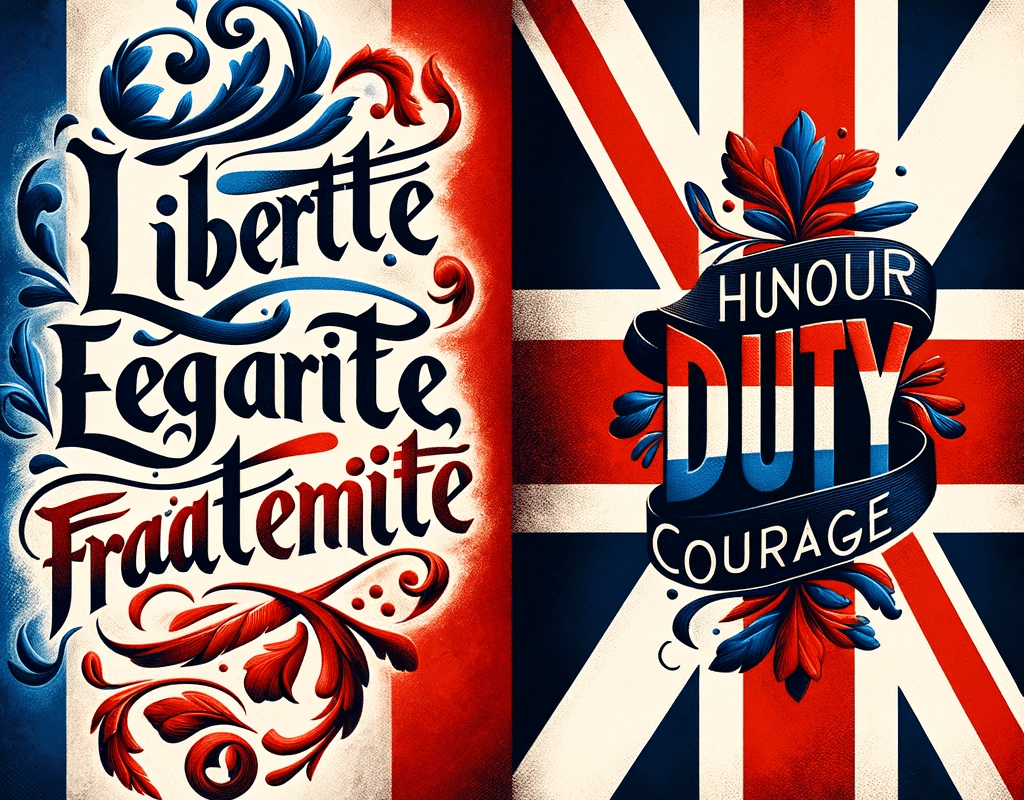
As for the cover image, Dall-E 3 still can’t quite figure out words and can’t spell in French or English. I share it if only for the absurdity of it. Here was my other choice:

French-English Content in Word

It seems that spelling and grammar checking in Microsoft Word might use some improvement.

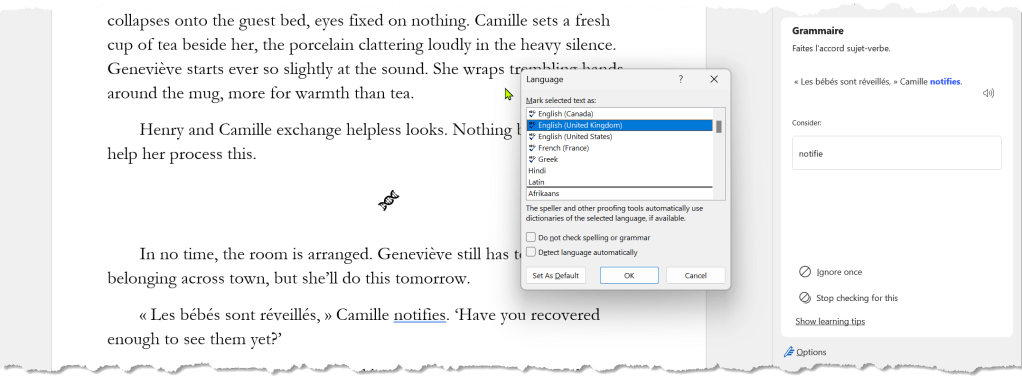
Here is a segment from a chapter from the first draft of Hemo Sapiens: Origin. Notice the last paragraph. I’ve written some dialogue in French with a tag in English. followed by more dialogue in English. This is my attempt to provide guidance to readers who don’t read French, so they can still maintain the context The problem is that Word doesn’t do a great job of accepting language markers. In this case, ‘notifies’ is underlined as being incorrect because Word, despite being informed otherwise, sees this as being French.

I wish I could just highlight a phrase and select the language from a context menu. Up front, I could specify that I am using languages X, Y, and Z, so I am not burdened with a laundry list of language options.

Another interesting thing to me is that there are separate auto-correct dictionaries per language. This makes sense, but it creates a burden to have to signify the language to let Word know which one to use. In my case, I tend to add accented words to autocorrect because I use a standard English-language QWERTY keyboard, and Windows/Word doesn’t make compounding diacritical marks very easy.

For example, a common entry might be ‘bien sûr’ for ‘bien sur’. I also get guillemets « » from << and >>, respectively.

Sadly, the ‘Detect language automatically’ feature isn’t very reliable either, so I leave it unchecked instead of having it misidentify languages.

I just noticed a typo in the screen shot. Word missed that ‘belonging’ should be plural, but probably thinks it’s a verb rather than a noun. Other AI tools make similar semantic errors.