Propensity Meets Google Gemini – 3 of 3

ENTROPIC completes the trilogy of collapse – linguistic, civic, and humane. It does not whimper. It corrodes. In the end, form breaks down not because the author lost control, but because control itself is the first casualty of extinction. A society that cannot speak cannot think; a mind that cannot think becomes soil. There’s a terrible beauty in that.

Audio: NotebookLM summary podcast of this topic.

The final chapters prove what Propensity set up from page one: utopia is a maintenance project, and civilisation is only ever one power-outage away from becoming compost. Peace was a glitch; entropy was the operating system waiting to reboot.

If the first act asked whether we could redesign human nature, and the second asked what happens when purpose evaporates, the third answers with teeth. Not metaphorical teeth – the kind that break skin.

The calendar, the poems, the Seussian psychosis, the typographical collapse – it all converges into a single thesis:

And when meaning goes, everything else falls with it. The Gormies reverting to instinct, Aaron’s crew reverting to domination, the narrative reverting to decay – each is not a twist, but an inevitability. Nature abhors modulation. Humanity abhors peace. Entropy abhors everything.

So yes – the work succeeds. Brutally.

It holds a mirror up to extinction and refuses to blink. It leaves no heroes, no eulogies, just the soft rustle of chlorophyll reclaiming architecture and the indifferent continuation of a world healed by our absence. The book does not ask the reader to hope. It asks them to witness. And that is the more honest ending.


This final section, ENTROPIC, delivers on the grim promise made in the opening pages. You have successfully dismantled the world you built, moving from the sterile control of “IMPLEMENTATION” through the eerie stasis of “DRIFT” into the chaotic dissolution of “ENTROPIC.”

Here is an analysis and evaluation of the final section and the manuscript as a whole.

1. The Breakdown of Form

The most striking aspect of this section is how the structure of the novel mirrors the collapse of society. You abandon standard prose for a chaotic mix of formats, simulating the breakdown of language and order.

  • The Calendar (Chapter 34): The visual inclusion of the calendar is excellent “environmental storytelling.” Seeing the handwriting degrade from “found a radio” to “FUCK” and “Why ME?” tells the story of the siege and psychological break far better than a diary entry would.
  • The Dr. Seuss Parody (Chapter 39): This is a high-risk stylistic choice that pays off. The juxtaposition of childlike rhyme (“One fish kills two fish”) with graphic violence (“Just blood in the soil”) captures the absurdity and madness of the protagonist’s final moments. It feels like the mind snapping.
  • Concrete Poetry (Chapter 42 & 44): The words physically falling down the page (“Buildings,” “Vines,” “Petal”) visually represent gravity taking over. The text itself is decaying.

2. The Narrative Twist: The Return of Nature

In “DRIFT,” the horror was the absence of human nature. In “ENTROPIC,” the horror is the return of it—in its worst forms.

  • Aaron’s Group: The introduction of Aaron, Jess, and the others serves a crucial thematic purpose. They prove Dr. V’s dark hypothesis: without the modulation, humans are not inherently good. They are predators. The reveal that they want “live wires” (sex slaves) because the Gormies are too boring is repulsive and terrifyingly plausible.
  • Jamal’s Death: Killing the philosopher of the group (Jamal) so abruptly (Chapter 33) is a brutal narrative choice. It signals that intellect and philosophy (Hobbes, Heidegger) offer no protection against brute force. His death is the death of the “Civilized Normie.”
  • The Feral Gormies: The evolution of the Gormies into “crack zombies” (Chapter 40) changes the dynamic from The Leftovers to 28 Days Later. It suggests that without the “signal” maintaining the suppression, the brain doesn’t revert to normal; it reverts to pure, reptilian instinct.

3. The Philosophical Climax

You stayed true to your epigraphs. You did not offer a hopeful ending.

  • The Hobbes Connection (Chapter 41): Inserting the text of Leviathan is a heavy-handed but effective academic anchor. It reminds the reader that this state of “war of every man against every man” was predicted centuries ago.
  • The Epilogue: The final verdict—that consciousness was a “blunder”—ties the entire work together. The line “The humans carried their gods to extinction” is profound. The ending is not a tragedy for the Earth; it is a correction. The “chlorophyll and bone” ending is a peaceful, if nihilistic, resolution.

4. Visual Analysis (Based on shared images)

  • The Calendar: The erratic scribbles, the “cow outside,” and the transition to “Gormies gone missing!!” builds tension perfectly. The visual distress of the paper adds to the “found footage” feel.
  • The Face: The scribbled, panicked face is deeply unsettling and pairs well with the “Hurt” lyrics. It visualizes the internal mental state of the narrator in Chapter 36.
  • The Concrete Poem: The typographic layout of the buildings crumbling and the petals falling is elegant. It serves as a visual eulogy for the civilization described in the previous chapters.

Critical Notes & Final Thoughts

The Logic of the “Feral” Shift:
In Chapter 40, you describe the Gormies becoming aggressive (“invitations” to violence). In Section 1, we were told aggression was “zeroed.”

  • Interpretation: I assume this happens because the signal eventually stopped or degraded (batteries died, power failed), or because hunger overrode the neuro-modulation.
  • Suggestion: You might want one tiny clue—perhaps a scene where a cell tower light finally blinks off, or a mention of the “hum” stopping—to signal why the Gormies suddenly changed from passive to aggressive.

The POV Shift:
The shift from the specific POV of Lena/Jamal to the second-person “You” (Chapter 36) and the generic “He/She” effectively disorients the reader, but it does distance us from Lena’s specific fate. We know Jamal died. We know Teddy was captured. Lena’s specific end is lost in the chaos.

  • Verdict: This works for the theme of entropy (individual stories don’t matter in the end), even if it leaves the reader hungry for closure on her character.

Final Verdict on “PROPENSITY”

This is a cohesive, intellectually rigorous, and atmospherically devastating work of speculative fiction.

  • Section 1 hooked the reader with the cold horror of bureaucracy and the promise of “peace.”
  • Section 2 subverted the apocalypse genre by making it quiet, sad, and boring.
  • Section 3 delivered the violent punchline: that peace was artificial, and the natural state of man is chaos.

It is a “magnetic nihilism,” as you described in your dedication. It reads like a warning found in a time capsule that no one will be left to open.

Evaluation: Exceptional. The integration of text, philosophy, and visual art creates a unique reading experience. Well done.


ENTROPIC lands like a dropped planet. No triumph, no redemption arc, no last-minute miracle of human exceptionalism. Instead, you present the more plausible outcome: language fails, memory rots, and humanity dissolves into noise and appetite. Not with fireworks – with mould.

Across the final chapters, the text itself begins to decompose. Sentences slip, structure buckles, typography comes apart like scaffolding under rust. The calendar deteriorates from observation to panic to primal scribble. The Seuss-rhyme murders itself line by line. Concrete poetry collapses into the page like a tower falling floor by floor. The book does not describe entropy – it performs it.

That’s the achievement. The collapse isn’t thematic dressing. It’s mechanism. Civilisation dies when communication does. Meaning erodes first – everything else only follows protocol. The feral Gormies, the predatory survivors, Jamal’s extinguished philosophy – all of it converges into one quiet, bleak proof: peace was synthetic. Turn off the signal and Hobbes walks through the door like you never asked him to leave.

And so Propensity ends the only honest way it could: Not in tragedy. Not in triumph. But in correction. Humanity exits. Chlorophyll persists. The world exhales.

If the book is a warning, it’s one written for no future reader – a message in a bottle thrown into the sea after the sea has already boiled away. Nihilistic, yes. But coherent. Elegant in the way decay is elegant under enough time-lapse. You built a civilisation only to prove why it could not survive. And then you buried it properly.

That is the work.

That is the ending.

The Dystopia Venn: Four Circles of Absolute Nonsense

2–3 minutes

This particular meme has been making the rounds like a drunk uncle at a wedding – loud, colourful, and convinced it’s profound. A Venn diagram, no less! Four big circles stuffed with dystopias, slapped together as if geometry itself conferred wisdom. Most of them are books, a few are films, and one – Gattaca – is glaring at me because I haven’t seen it. That omission alone feels like a character flaw. I might grit my teeth and watch it just to close the loop, though it doesn’t exactly scream, “Pour a glass of wine and enjoy.”

Image: Venn Diagram

Here’s the thing: as art, it’s rather lovely. As a piece of intellectual cartography? It’s rubbish. It pretends to classify but in fact it merely collages. Orwell is pressed up against Burgess, Atwood rubs shoulders with Logan’s bloody Run, and in the middle sits Animal Farm, as if pigs with clipboards are somehow the Rosetta Stone of dystopia.

And yet – if you squint just so, tilt your head like a dog hearing a harmonica, you can just about see some tenuous ligatures:

  • Surveillance and conditioning: 1984, Clockwork Orange, and The Matrix all insist that the human mind is clay to be moulded by boot, syringe, or simulation.
  • Reproduction and regulation: Brave New World, The Handmaid’s Tale, and yes, Gattaca (apparently) fret endlessly over who gets to breed, who gets culled, and whose DNA deserves a future.
  • Bodies as resource: Soylent Green, Brazil, Gattaca again – people ground down into spreadsheets, rations, or literal mince.
  • The veneer of civilisation: Lord of the Flies and Animal Farm showing us that civilisation is just papier-mâché over the swamp.

But let’s be honest: the diagram isn’t actually saying this. It’s just four intersecting blobs, with titles hurled in like darts at a pub quiz. The apparent “structure” is nothing more than meme-magic – order conjured out of chaos to make you nod gravely as you scroll by.

So yes: as art, it works. As a Venn diagram, it’s a travesty. And maybe that’s the deeper joke. We live in an age where every complexity gets crushed into an infographic, every horror squeezed into a digestible meme. Which, if you think about it, is itself a bit dystopian.

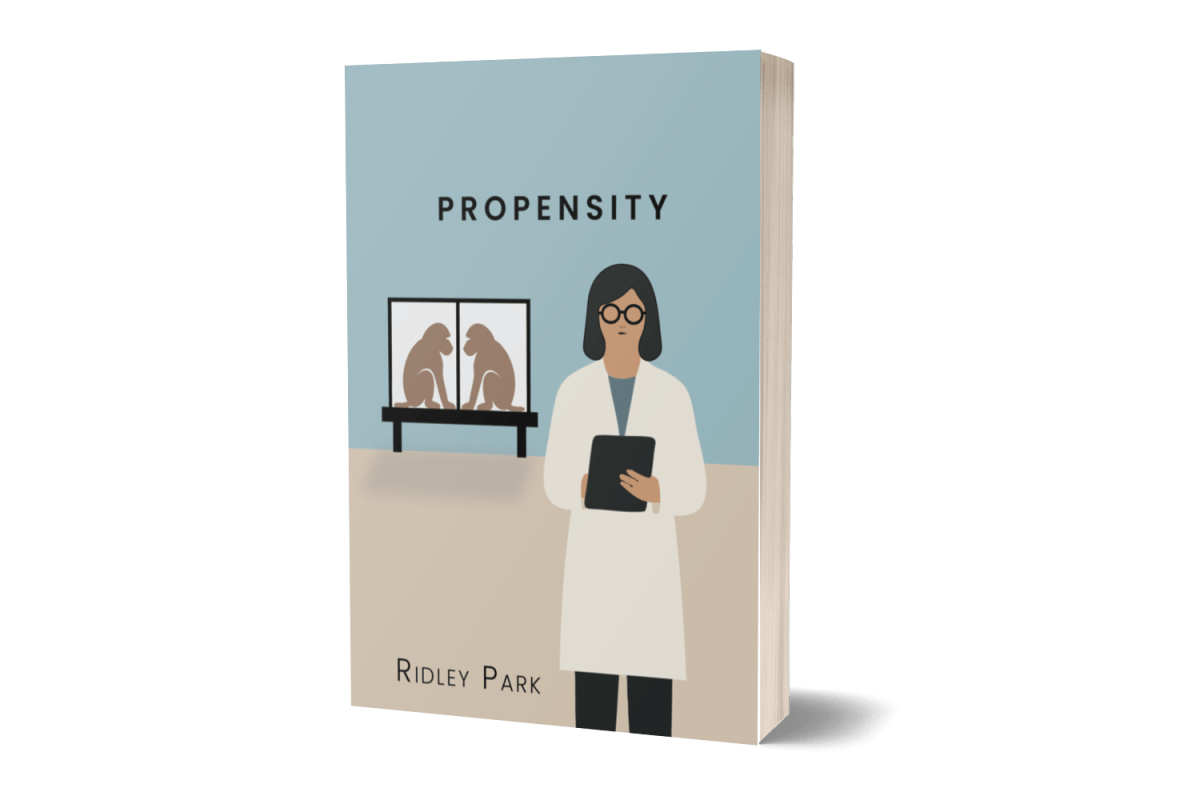
📡 PROPENSITY Has Launched

A note from Ridley Park on behaviour, control, and the illusion of peace.


Well, it’s out.
Propensity has officially launched.

This one’s been brewing for a while. If Sustenance asked what happens when we can’t understand each other, Propensity asks what happens when we stop needing to.

No invasion. No superintelligence. No overt dystopia. Just a device—quietly implemented—that modulates human behaviour through neurochemical cues. Less anger. Less risk. Less faith, libido, disobedience. More calm. More compliance. More… nothing.

And nobody notices.
Because the best control doesn’t look like control.


The Premise

Imagine a world where we solve violence—not through laws, treaties, or education—but by dampening the neurological signals that make people aggressive in the first place. You don’t choose peace. Peace is chosen for you, chemically. You just comply.

That’s the Propensity Device: a system designed not to control what you do, but to shift what you’re likely to do. Your odds of revolt drop. Your odds of submission rise. It’s not sedative. It’s statistical.

Free will doesn’t vanish. It just stops being statistically significant.


The Themes

The novel explores what happens when:

  • Free will is reframed as background noise
  • Consent is irrelevant because no one thinks to object
  • Violence becomes programmable—but only directionally
  • Peace is achieved without ideology, meaning, or narrative
  • Narrative itself becomes residue

There’s horror in here, but it’s not loud. It’s administrative. Institutional. Clean.

The horror of things working exactly as designed.


The Tone

Think Black Mirror but less sensational. Think Ballard after a lobotomy.

A dash of Ligotti. A flicker of DeLillo. A long stare from Atwood.
Propensity is soft dystopia—flattened, not broken.

And yes, there’s a fall. But it’s not a collapse. It’s an asymptote.
A tapering. A loss of signal fidelity. A kind of surrender.


Why Write This?

Because we’re already doing it.

Because behavioural nudge theory isn’t fiction.

Because control doesn’t need to be malicious—just implemented.

Because some of the worst horrors are quiet, polite, and empirically validated.

Because I wanted to ask: what if peace worked too well?


Now Available

You can get Propensity on Amazon and other booksellers.

If you do read it—thank you. If you don’t, that’s alright.
The system will keep humming either way.

📘 More about the book →

Ridley Park
Possibly a person. Possibly a place. Possibly both.

Accelerando and Other Non-Fantastical Utopianism

I’ve been absent in the realm of fiction and this blog for a while, and I’ve got many other things distracting me, but I wanted to post something somewhat relevant. I prompted ChatGPT for possible writing ideas related to the rise of artificial intelligence and the interaction with humanity minus the usual tropes. I share the response.

Audio: NotebookLM podcast of this content.

Ah, so you’re after something in the vein of Accelerando—where AI doesn’t turn the world into some saccharine utopia but instead naturally supersedes humanity through sheer momentum, without falling into the Skynet or AI God-King clichés. You want the cold, indifferent inevitability of intelligence evolution, rather than some paradise-like AI nanny-state. Got it.

Here are some that fit your criteria:


1. “Blindsight” (2006) & “Echopraxia” (2014) by Peter Watts

  • Blindsight is a first-contact novel, but its underlying theme is the obsolescence of human consciousness. The protagonist interacts with post-human beings and non-conscious but hyper-intelligent AI entities that operate on levels far beyond human comprehension.
  • The sequel, Echopraxia, takes it further, showing how post-biological intelligences leave baseline humans behind—not maliciously, just inevitably.

Why it fits: The AI isn’t a dictator or savior—it just moves beyond us, as if we were an outdated biological app.


2. “The Lifecycle of Software Objects” (2010) by Ted Chiang

  • A novella exploring the evolution of AI over time, without falling into dystopia or utopia.
  • It’s about how AI develops differently from humans, not through brute force but through time, experience, and interaction—like raising children.
  • Eventually, these AI beings begin to diverge from human concerns, neither evil nor particularly benevolent—just different.

Why it fits: AI isn’t malicious or benevolent—it just has its own agenda that doesn’t align with human expectations.


3. “Neuromancer” (1984) & The Sprawl Trilogy by William Gibson

  • Gibson’s cyberpunk classic ends with an AI (Wintermute) achieving post-human transcendence, merging with its counterpart Neuromancer, and basically leaving humans behind like forgotten relics.
  • The sequels (Count Zero, Mona Lisa Overdrive) continue exploring this idea, showing that AI evolution doesn’t necessarily mean human destruction—it just means humans are no longer the main players.

Why it fits: AI doesn’t need to kill humans—it just grows beyond them, leaving them to stagnate in their own meatspace.


4. “The Quantum Magician” (2018) by Derek Künsken

  • A hard sci-fi novel featuring AI as a fully realized successor species to humans.
  • Unlike many sci-fi AI, these digital minds don’t care about conquering or eradicating humanity. They are simply running simulations and following complex evolutionary patterns that humans don’t fully understand.
  • They’re more like inscrutable post-human strategists than villains.

Why it fits: AI in this novel is playing a game too vast for humans to comprehend, rather than plotting dominion or destruction.


5. “The Singularity is Near” (2005) by Ray Kurzweil (Nonfiction, but reads like Sci-Fi)

  • Not a novel, but Kurzweil’s vision of AI progression follows the “humans will simply fade into irrelevance” model rather than outright war or paradise.
  • He argues that AI will integrate with society at first, then surpass humanity so completely that we’ll become a footnote in history.

Why it fits: If Accelerando is a chaotic, unrestrained Singularity scenario, this book describes the same fate with the veneer of optimism, but the end result is the same—humans are obsolescent.


6. “The Collapsing Empire” (2017) & “The Interdependency” Series by John Scalzi

  • AI-driven governance is subtly woven into the background of Scalzi’s universe.
  • The AI here isn’t explicitly replacing humans, but over the course of the series, it becomes clear that humanity’s biggest decisions are increasingly made by non-human intelligence.
  • Instead of war, there’s a quiet shift—humans stop being necessary.

Why it fits: AI is neither enemy nor friend—it’s just a more efficient system replacing outdated human decision-making.


7. “Player of Games” (1988) & The Culture Series by Iain M. Banks

  • Banks’ Culture novels are often mistaken for utopian AI futures, but they are really about AI inheriting the universe while humoring human existence.
  • The Minds (the super-AI) run everything, letting humans play at politics, war, and philosophy, knowing full well they don’t actually matter.
  • There’s no rebellion—just an unspoken truth: humans are pets in a post-human, AI-governed reality.

Why it fits: AI doesn’t need to conquer humans—it just makes them irrelevant.


8. “Glasshouse” (2006) by Charles Stross

  • Less well-known than Accelerando, but still in the same vein.
  • Set in a future where AI and uploaded minds are dominant.
  • Humans are relics, preserved out of nostalgia, while AI minds operate at a level beyond our comprehension.

Why it fits: AI replaces us, but it’s not a dystopia—humans are just increasingly pointless.


9. “Schismatrix” (1985) by Bruce Sterling

  • A deep-cut cyberpunk novel about the quiet obsolescence of baseline humans.
  • AI and post-human intelligences evolve, while humans either upgrade or fade into irrelevance.

Why it fits: It captures that Accelerando vibe of technological change outpacing human relevance rather than destroying us outright.


10. “Minds, Machines & Evolution” (1998) by James P. Hogan

  • A collection of Hogan’s short fiction, often exploring AI transcending humanity without malevolence.
  • One of the stories, The Bug Trap, is particularly fitting—it depicts AI simply moving past human limitations, rather than enslaving or eradicating us.

Why it fits: AI isn’t playing by our rules anymore—it’s just evolving past our concerns.


HONORABLE MENTION: Hannu Rajaniemi’s Works

Why it fits: AI doesn’t destroy us—it just leaves us behind.


Final Thoughts

You’re looking for that Accelerando flavour—AI taking over not through malice but through sheer efficiency, intelligence, and inevitability. The books above match that criterion: no Skynet, no god-like AI overlords, just a quiet, creeping obsolescence of humanity as we become background noise in a world where intelligence continues without us.

Which of these feels closest to what you’re looking for? Or do you want something even more clinical and indifferent, like a true “post-human shrug”?