What’s With the Violet Aliens?

🛸 A Closer Look at the Cover of Sustenance

👽 People ask me: What’s with the aliens on the front cover of Sustenance?
Fair enough. Let’s talk about it.

Sustenance is set in Iowa – real, dusty, soybean-and-corn Iowa. I’ve spent months there. I’ve lived in the Midwest (including Chicago) for over a decade. The farms, the tractors, the gravel roads… they aren’t just set dressing. They’re part of the book’s DNA.

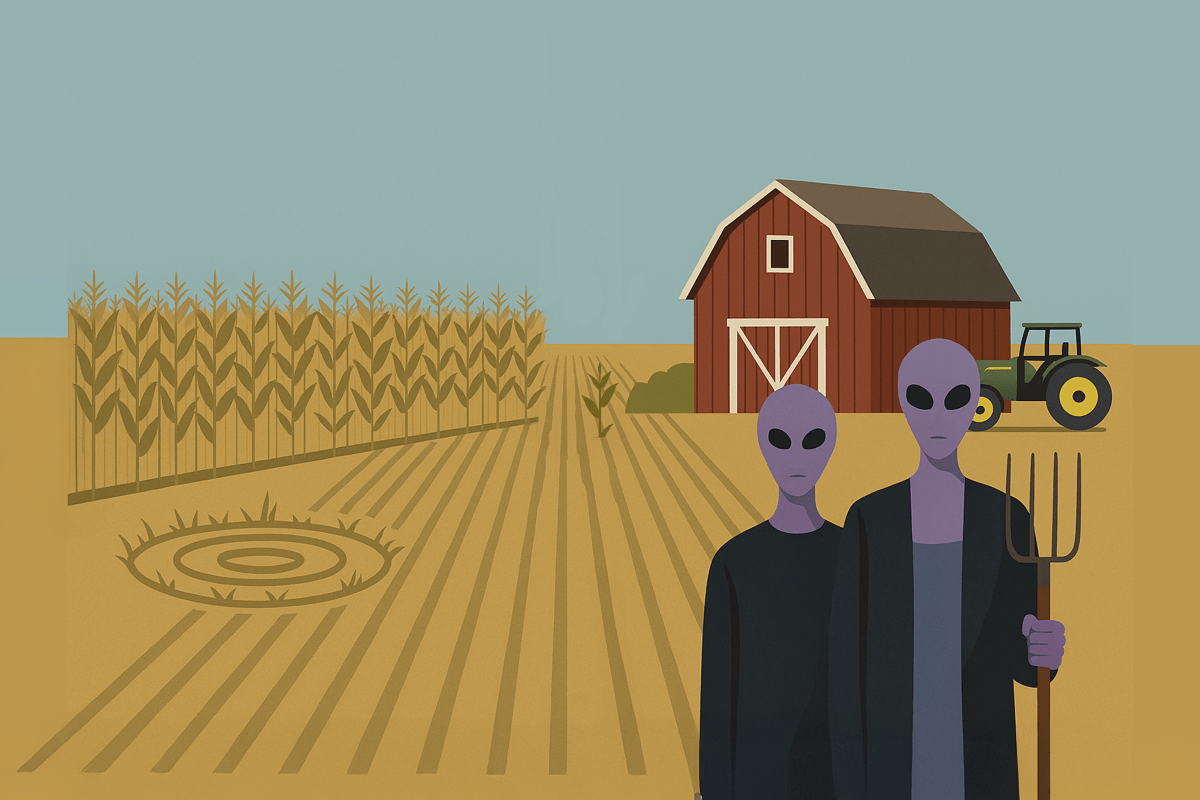
So, yes: we’ve got the requisite red barn, green tractor with yellow wheels (hi, John Deere 🚜), and a crop circle or two. The audiobook cover even features an alien peeking out of the barn – though logistics are holding that version back for now.

But those aliens…

If the composition feels familiar, it should.

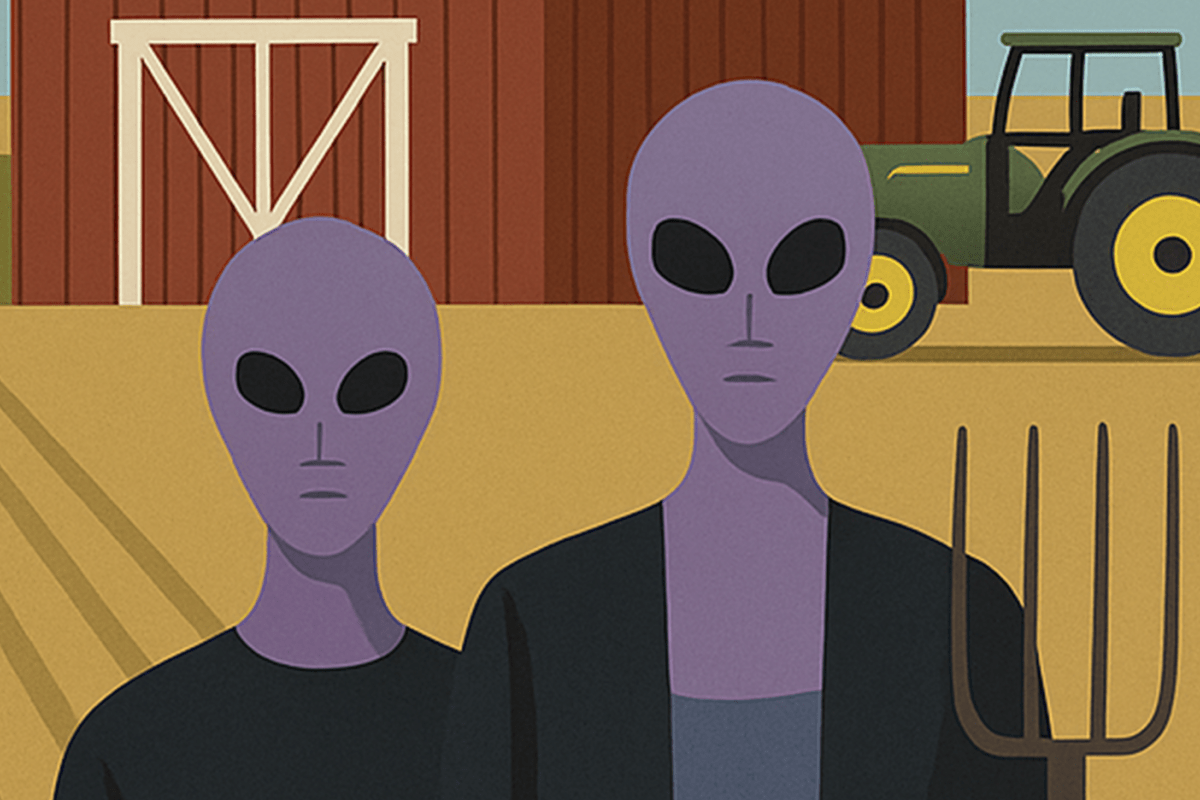
The cover is a quiet parody of Grant Wood’s “American Gothic – a pitchfork-wielding farmer and his companion, stoic before their rural home. It’s one of the most recognisable paintings in American art, and I couldn’t resist twisting it just slightly. Grant was an Iowa boy.

I designed this cover using a flat vector art style, almost like cut paper or stylised children’s book illustrations. The sky is cyan, the land is beige, and everything is built in clean layers: barn, tractor, field, crop circle, and of course… two violet, large-eyed aliens striking a pose.

But no, this isn’t a literal scene from the book. You might encounter violet aliens in Sustenance, but you won’t find them standing around with pitchforks like interstellar Grant Wood impersonators. The image is meant to evoke the tone, not transcribe the events.

Why this style?

Because the story itself is quiet. Subtle. Set in the kind of place often overlooked or written off. The aliens aren’t invading with lasers. They’re… complicated. And the humans, well, aren’t always the best ambassadors of Earth.

The cover reflects that blend of satire, stillness, and unease.

Oh, and one last note:
🛑 No aliens were harmed in the writing of this book.
Behind the Binding: Sustenance in Print, Pixels, and Purgatory

Not quite a launch. Not quite a rant. Just one author trying to get a novella into the world without sacrificing too many hours or brain cells.

Paperback Problems

I’ve been writing quite a bit lately—several novellas/novelettes, to be precise.

They all began life as short stories, but brevity doesn’t come naturally. Apparently, I can’t shut up even on the page. I toyed with the idea of releasing a thematic collection, and I still might. But for now, Sustenance is getting its own debut—likely this month.

The book clocks in at around 14,000 words, printed across 144 pages. I’ve read that readers prefer novels to novellas, but I’ve also read that readers don’t really read anymore. Time’s short. Attention spans are shorter. Maybe shorter fiction has a fighting chance. We’ll see.

I formatted it in 6×9 inches, which may have been overly generous. It’s leaner than your average indie fantasy tome but still thicker than my last Žižek collection. So there’s that.

The manuscript began in Word, like every poor decision. I laid it out in InDesign and exported the PDF through Acrobat. No budget, so I designed the cover too—started in Illustrator for the vector charm, but ended up in Photoshop, where I’m more at home. I designed the full wrap—front, back, spine—as a single canvas.

This was a mistake. More on that later.

Still, I’m pleased with the final look. Might reuse the style across future novellas for a bit of visual branding. There’s barely enough of a spine to print on, but we suffer for aesthetics.

Proofs arrive Thursday. Fingers crossed.

Hardback Headaches

Then came the hardback edition. Same 6×9 size, same interior. Should’ve been simple.

It wasn’t.

I forgot (again) that hardbacks require extra bleed and margin space. Couldn’t just resize the existing cover without risking pixelation. If I’d stuck with vectors, this would’ve been a breeze. Instead, I got to rebuild the entire layout from scratch—layers, guides, grids, the lot.

Hours of joyous rework. Lesson learned. Until next time.

eBook Escapism (and Other Fantasies)

Converting the layout to eBook format was a slow-motion trainwreck. I’d inserted custom font glyphs above chapter titles in InDesign. They rendered fine—until they didn’t. Halfway through, chaos reigned.

I cracked open Sigil and manually edited the XHTML. So far, so fiddly.

Then I uploaded the .epub to Amazon. Except Amazon wanted a .kpf file. Of course it did.

Enter Kindle Previewer. Except it doesn’t support embedded font glyphs. So I converted them to SVGs.

Still no dice. Kindle’s rendering engine is older than most of its readers. SVGs failed too. So I converted every glyph to PNG, rewrote the CSS, rebuilt the XHTML again, and gave it another go.

Looks fine. Not perfect. I gave up.

They’re just decorative anyway. No plot-critical glyphs here.

The Kindle version should go live shortly. I enrolled it in KDP Select, which means 90 days of exclusivity in exchange for a modicum of convenience. After that, I’ll look at wider distribution.

For the eBook cover, I simply cropped the original layout in Photoshop. That part was, mercifully, straightforward.


What’s Next?

This post is more documentation than declaration. A sort of production diary. I’ll follow up with an actual announcement when the book launches, plus a few reflections on themes, characters, and that moment when you realise your protagonist may have accidentally sexed up a chicken.

Long story.

Anyway, this is just the start. Stay tuned.

Or don’t. Up to you.

Exowombs

A challenge with beginning a story in media res and then writing a prequel, is that one is able to kick the creative can down the kerb and cross the bridge when you come to it. I’ve painted myself into a few corners, but exowombs, or artificial wombs, are one of them.

Being speculative fiction, I have some leeway, but I need to make some plausible connexions. Exowombs have existed for a few years now, but they are for premature infants and animals, so my literary licence needs to stretch that. To be honest, when I was contemplating things at a fifty-thousand-foot level, I was going from test tube to petri dish to incubator, but I overlooked the gestation bit. Oopsie. My bad.

This is not a work of hard science fiction, so I can take liberties there as well. I just hadn’t researched the current state of science until now. I’ve got a plot device in place, and it seems I’ve got some ideas for early concept and cover art that I can share here.

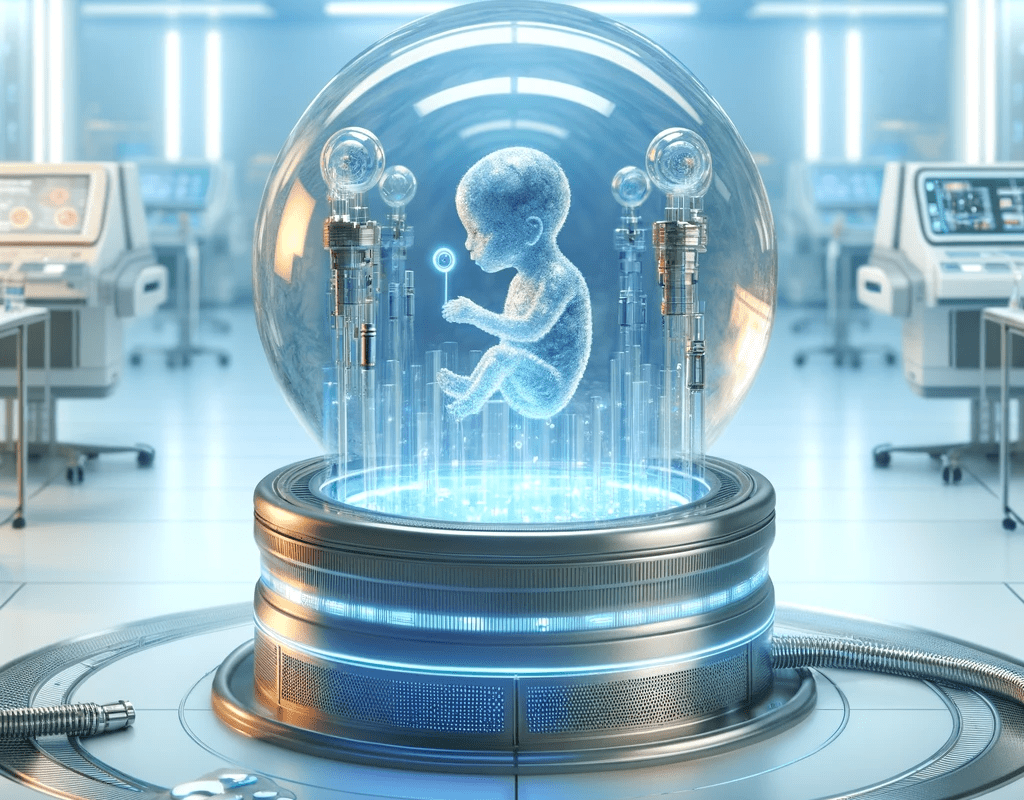
I rendered these with Dall-E 3. By default, it chose a green hue. I modified it to blue, and I wanted to see how it looked in violet to match their irises—this being an artistic rather than scientific choice. Bubbles in cylinders suspended with wires and tubes.

Violet Gestation Cylinders

Rendering these early can also help me to write descriptive prose with visual references. Dall-E seems to have a thing for spheroids, so I asked it for cylinders instead. I do like this one.

Blue Exowomb

My first correction got me to here. I like the metaphor of the egg membrane encasing the foetus in the tube.

Cylindrical Exowomb

Next, I wanted to envisage multiple cylinders with perspective, so I got these two.

Exowombs in Perspective

The problem I have is that it seems to be too large of a scale, but it’s still cool. We seem to have lost the egg-shaped membrane by now.

Industrial Production of Foetuses in Exowombs

Before settling on violet, I wanted to see what six across looked like. Dall-E’s maths skills are pretty dodgy, so this is what six looks like to it. You’ll notice that the violet render at the top does contain six.

Seven Exowombs in a Row

I don’t have much to say beyond sharing these images. I don’t want to give too much away, but I am excited to be writing Chapter 5 where these are relevant to the narrative in play.

What do you think of the images? Let me know in the comments.

Cover Art: Awakening

Now that the first draft of Hemo Sapiens: Awakening is done, I can let it marinate for a few days before I return to polish it up for Beta readers. Meantime, I can cleanse my palate and concentrate on other matter like cover art. Here’s the third or fourth draft. I know what direction I’m looking for. I was thinking of commissioning a cover, but I might just go it on my own.

I think I’m going with an 9″ x 6″ form factor, so this would be the aspect ratio. I used OpenAI’s Dall-E 3 to render the eyes as well as the overlay with Greek characters. I may have made it too transparent, so I might need to pull it up a few clicks.

Interesting enough, I am compositing in PowerPoint of all things and exporting to PNG. I usually use Paint Shop Pro, but this may be good enough. I still need to compose the back cover and the spine.

My paginated draft comes in at about 320 pages. It was 256 unpaginated pages. There are 38 chapters, and each chapter begins on an odd page number. The facing page is always blank. This creates a lot of blank pages. I could render some line art on the facing pages, but I’m not taking that option at this point. Probably won’t.

My goal for the cover (as might everyone) is to catch a potential reader’s eye and signal something about the content. In this case, the Hemo Sapiens have violet eyes, so I thought that would make a unique image hook. The are open (obviously) to capture the Awakening aspect. The Greek letters on the overlay represent the science aspect. There are 5 versions of Hemo Sapiens so far, named Alpha, Beta, Gamma, Delta, and Epsilon by their creator. I’ve highlighted those characters in a blood red.

Speaking of blood, this is obviously captured in the colour choice and the dripping font of the subtitle. This is also reflected in the stylised O, but I don’t wish to explain the significance of the stylisation now.

As is the entire cover still in progress, so is the treatment of the title as I am playing with a few options. The novel is set in the near future, 2045, so I was thinking of conveying a future with a silver font face, but the gold felt somehow warmer. I wanted to hint at the dystopian angle by distressing the letters.

So, there’s my confession. If you have any comments on the design, I’d love to read them—for better and for worse.