Quoteless Dialogue

I’ve noticed a few publications adopting a quoteless or quote-free dialogue convention. I was wrestling with the idea of using it for my current short story, but I’ve opted not to.

On the upside, it can:

  1. create a more immersive reading experience, blending dialogue seamlessly with narration.
  2. give the prose a more streamlined, modern feel.
  3. be effective in representing stream of consciousness or internal monologue.
  4. subtly underscore themes of ambiguity or the blurring of reality and imagination.

On the upside, it might:

  1. lead to confusion about what is spoken aloud versus what is thought or narrated.
  2. be challenging for some readers, particularly those used to more traditional formatting.
  3. not be suitable for all types of stories or narrative styles.

I feel that it’s a valid stylistic choice that can be very effective when used deliberately and consistently. Its appropriateness depends on the specific work, its themes, and its intended audience.

If used, it often requires more careful writing to ensure clarity about who is speaking and what is dialogue versus narration. It works best when the author employs other means to differentiate dialogue, such as syntax, diction, or paragraph breaks.

    For my current writing project, (working title: “The Riga Paradox”), given its themes of reality versus perception and the blurring of identities, omitting quotation marks could be an interesting choice.

    However, it’s also a significant departure from my comfort zone and might require adjustments in other aspects of my writing to maintain clarity.

    Does anyone have thoughts for or against quote-free dialogue? Have you used it yet?

    Write, Review, Revision

    I lost my faith in the English language and trust in people in grade school where I was taught the 3 Rs – reading, writing, and arithmetic. On balance, these each have the R consonant sound on the stressed syllable, but it is otherwise misrepresented. Game over.

    In this tradition, I’ve got my own 3 dodgy Rs: Write, Review, and Revision. This sums up my approach to writing.

    Write

    Duh, right? You’ve got to write to write. In fact, to be a better writer, you’ve got to be a reader, a leading-candidate for as fourth R – but I’ll call it a necessary precondition. Being exposed to reading allows you to absorb different styles and genres. It remind you that pedantic constraints of grammar need not apply. My grammar-checker reminds me often.

    I took this route as a musician as well. Exposure to genres, styles, and approaches fortifies your craft. Some of the best groups contain members of diverse backgrounds. Sure, there are some groups where members are cut from the same cloth, but they are usually stuck in a particular niche. Nothing wrong with this mind you, if you don’t mind being painted into a corner. I’m too claustrophobic for this.

    Review

    Once you’ve written, review your work. In fact, this should be more than one representative R. Perhaps it should instead be read, write, review, review, review, review… or an alternative, read, write, review, write, review, write, review… To be honest, when I write blogs, I just write – stream of consciousness. No net, no review. Submit. Done. But this is not how I approach longer works. The longer the work, the more read-review cycles.

    Revision

    After you’ve dumped all of your thoughts onto the page, write, review, rinse, and repeat, you have to opportunity to revise your work before you release it into the wild – transplant it from your private greenhouse to watch in flourish or perish.

    A revision is more than a review. It’s the opportunity to re-view, re-vision, re-imagine the work that arrived in the first pass with sequential editorial hining and rework.

    Maybe you now imagine a new character or story line, a new twist, two characters can be consolidated. Perhaps even a different ending or beginning. It’s all clay. Sentences are malleable.

    As a professional musician, I learned not to become married to your work. And just as your parents may not appreciate your choice in partners, your readers may not appreciate your art. And this is not important as an artist. This is only important in the commercial realm. I don’t find this realm interesting. It the reason I don’t enjoy pop music – disposable commerce. We don’t so much categorise books into pop, but we should. At least we can.

    Now I’ve gone off on a rant. In a novel, I would likely delete this during an editing cleanse, but here, there is only forward.

    In the end, you can just write with none of the ancillary activities – as I do here. Or you can take a different approach to harden your final output. I don’t prefer to call it a product.

    You may not even opt for revisioning because you had it all in your head. You just needed to rush to capture it all on the page – 700 pages times 7 volumes. You’re the lucky type. That’s not my style, so I’ve not much to say on the matter.

    My parting words – just write.
    Hemo Sapiens: Origins

    Now that Hemo Sapiens: Awakening has been released into the wild, I can again focus on Hemo Sapiens: Origins. I started writing Origins a few weeks ago, but I was interrupted by the review and production process of Awakening.

    In the world of Pantsers and Plotters, I tend to fall somewhere in between, but I favour plotting.

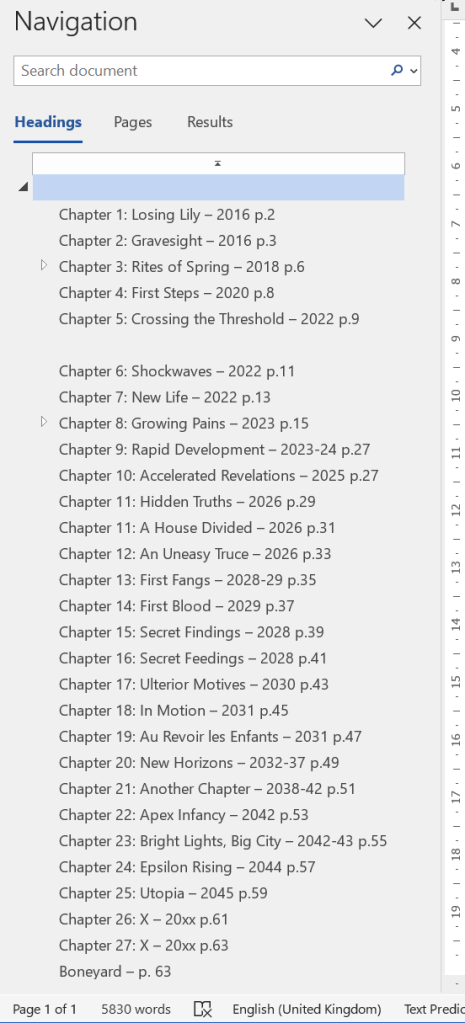
    I write in Word. In the example above, you can see the working chapter titles, the year(s) a chapter covers and its starting page. Some of the chapters already contain preliminary copy.

    As a writer, I don’t necessarily work chronologically. I find the chapters that are the most compelling and interesting to me. Then, I work down to the bridging chapters, hoping that the meat of the chapters penned earlier will support and inspire the later ones.

    As I write, I usually create a ‘Boneyard’ chapter. This is where ideas go to incubate or die. Workable ideas are resurrected whilst others are laid to rest. Some ideas are like zombies, but at the end a project, they are either among the dead or living.

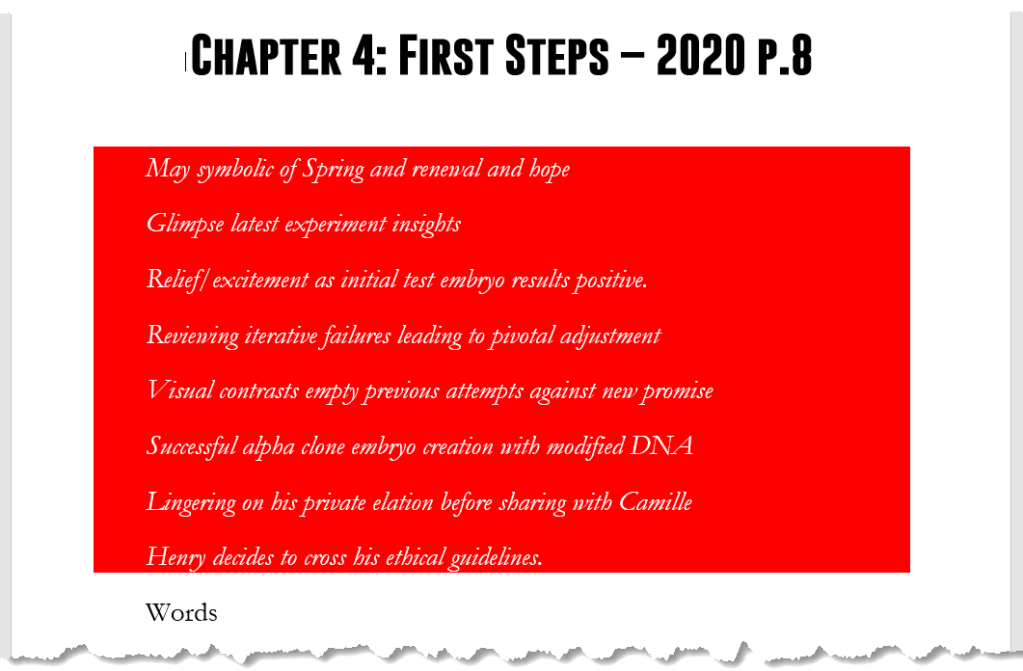
    At the start, a chapter looks something like this. It’s a blend between ideas and story beats. Each chapter is outlined similarly. The other advantage this lends me is that I can *ahem* walk away from writing for a while and still have handholds and reminders when I return. For short fiction, I just write. No outlines. Perhaps just an idea to explore.

    What is your writing style? Leave comments below.

    One Thousand Words

    My target goal for writing is about 1,000 words per day. It’s a goal I hit way more often than not. On a good day, I can reach 2,500 or more.

    As a reference, I write in Word with pages formatted for a 6 x 9 form factor, so a page holds about 200 words, which equates 1,000 words to about 5 pages. Not too shabby. It puts 60,000 words at around 300 pages or 50,000 words — a small novel—at around 250.

    Doing some more maths, at 1,000 words a page, one can ostensibly write a 60,000 word novel in about 2 months. Not bad, right?

    You still need more time for editing, revisions, and so on, so 3 months per book of this size gets you 4 books a year. If you are writing tiny novels or novellas, then you might be able to double this. I ‘m not sure how sustainable this is, but maths doesn’t care about sustainability.

    Some people think they can game the system and produce a novel a day with AI. The truth is that they can. The other truth is that the output will most likely suck. If you actually read the material critically, a person could not likely publish a book a day. A piss-poor book a week would probably be a challenge. A book a month or so might be within range — even more achievable for shorter fare.

    This might be someone’s goal, but it’s not mine. My interest in writing to to write. It’s not about quantity or even commerce. My writing is not my livelihood. It’s an art. I’ve seen so many videos on YouTube given advice how to write and sell more books. Usually, this involved researching the marketplace and determining what’s hot. Is mystery hot this month? Write a mystery book. Need some ideas for books? AI will help.

    I guess I just don’t come from that position. I watched a video the other day with a woman switching from offering low-content books on Amazon to some other business model. Her entire modus operandi is to make money online. Myself, I felt sorry for her. I know that two-thirds of people dislike their jobs, so she’s in good company. By that I mean, she might as well just pick some random money-making job because it’s probably as stupid as whatever else she’d be doing. The question is whether it’s worth it.

    For me, I’ll stick with writing at least 1,000 words a day with the occasional doubling. Hopefully, I sell some books along the way. Time will tell.