There’s a peculiar little ecosystem out there called the author’s forum. You’ve probably seen it – digital watering holes where writers congregate to swap tips, trade war stories, and, inevitably, flog their latest magnum opus like a Victorian street hawker with a sack of dubious oysters.
Don’t get me wrong: I don’t begrudge other writers their moment in the sun. We all want our roses sniffed. But here’s the problem: I’m not looking for fellow gardeners. I’m looking for bees. Readers. Pollinators of stories. The ones who carry your words away, let them germinate somewhere else, and maybe if you’re very lucky leave a little honey in return.
Instead, these forums are like a row of market stalls where every vendor is shouting, “Buy my book!” at every other vendor. It’s a deafening loop of mutual advertising in which no one is actually in the market to buy anything. Imagine a cocktail party where everyone is giving a TED Talk at the same time. You can’t even taste the hors d’oeuvres for the noise.
Yes, there’s theoretical overlap; writers are often readers, and some might genuinely enjoy a novel by an unknown author. But the ratio is wildly off. Authors’ forums are not where most readers live. And when you do find a forum of book lovers, they’re usually busy discussing the books they’re already reading, not soliciting a cold pitch from a stranger waving around their unrecognised genius.
Bookseller and library forums? Same issue, just with a corporate gloss. They’re less like communities and more like speed dating events where every participant turns up with a PowerPoint presentation and a sales target.
I suppose it’s a rite of passage for indie authors: you wander into these places thinking you’ve found the gates to literary Shangri-La, only to discover you’ve walked into a multi-level marketing convention where everyone’s selling the same product in slightly different packaging.
So, I’ll keep my profile there, post occasionally and drop in to wave, but I know the audience I’m after isn’t there. The real trick, as ever, is finding the places where the readers live, and learning how to be interesting enough that they might actually care.
I’ve been lurking and participating in many author and writing groups, but I’m not sure this is a productive strategy.
Like other authors, my goal is to network and connect to readers, and more importantly, buyers. The problem is that other authors, like myself, share the same goal in mind. There is no reciprocity, no “coincidence of wants,” which is that I happen to be offering a book that you might find engaging.
Audio: NotebookLM podcast on this topic.
Of course, one can frequent reader groups, but these are often inundated with publications, so there is no focus. I don’t write genre fiction, so I don’t have the benefit of, say, a sci-fi group, romance, werewolves, and whatnot. I (tend to) write literary fiction without identifiable tropes and storyline. As I’ve written before, there are no Hero’s Journeys, no saving the cat.
Indeed, there are literary fiction groups, but there are numerous motivations for this reader cohort. It is not homogeneous. I could (and do) hunt for sub-categories, but these are less fruitful.
I see dozens of ads splashed on my screen, suggesting someone can help me write my next book by telling me what’s hot, what’s selling. I am not interested in writing books that sell. I want to tell my stories. I am not a commercial writer in the same way that I was never a commercial musician. I am interested in the art. Of course, I want to sell my works, but it needs to be on my terms. If I were to sell out, it would just be another job with all of the intrinsic joy sucked out of it. The extrinsic appeal of money is not enough to compensate. Some people who take this commercial convince themselves, “at least I’m still writing,” or painting, or performing for a living. I am not able to comfort myself with this self-delusion. As the saying goes, ignorance is bliss.
Since I’m ranting…
I’ve been haunting author and writing groups for a while now – lurking in the shadows, peeking behind the curtain, occasionally tossing in a snide comment or two. Call it market research. Call it masochism. Either way, I’m starting to suspect it’s not the most productive use of my time.
You see, like most of these poor souls, I’m here to “network” (whatever that means in late-stage capitalism) and, more importantly, connect with actual readers. Buyers. The unicorns. Not fellow authors trying to sell me their 17-book werewolf reverse-harem saga or the latest AI-generated cover that somehow still manages to have three left hands.
And here’s the rub: we’re all pitching. No one’s catching. It’s a bazaar where everyone’s hawking their wares and no one’s carrying a purse. The law of the marketplace – what economists once called the “coincidence of wants” – simply doesn’t hold. I don’t want what they’re selling. They don’t want what I’m offering. It’s not even personal. It’s just noise.
Could I wade into reader groups instead? Sure. But these are often genre-clogged pools: romance, sci-fi, vampires with high school diplomas. God bless them. It’s just not my lane. I write literary fiction. You know, the kind without a tidy plot, without a cat-saving hero, and – brace yourselves – without an obligatory third-act redemption arc.
Even literary fiction groups aren’t much help. That label encompasses too much: Booker-bait bildungsromans, moody minimalism, and the occasional Proustian doorstop for good measure. And reader motivation in these spaces is hardly uniform. Some want to weep. Some want to feel clever. Some just want to say they read something “important” at brunch. None of them are asking for me – and that’s fine. But it does make targeting a pain in the arse.
Then come the ads. The snake-oil salesmen. “Here’s how to write a book that sells!” “Tap into trending genres!” “Master the market!” As if we’re all desperate to become a literary McDonald’s franchisee, pumping out Big Macs with words. I didn’t become a writer to stuff my soul into a Happy Meal box. I didn’t become a musician to churn out jingles. I don’t paint by numbers and I don’t plot by templates.
Yes, I want to sell my work – but on my terms. I’m not allergic to money; I just refuse to whore out my creativity to chase it. Some people convince themselves that so long as they’re still writing – still playing the game – they’ve won. I’m not built for that flavour of self-delusion. Call it ego. Call it integrity. I call it survival.
Since I’m already up here on my soapbox, let me kick it once or twice for good measure.
There’s a mountain of writing advice out there. I’ve read plenty. Some of it’s even good. But much of it is just a conveyor belt back to the same old factory settings: save the cat, beat the plot, rinse and repeat. I don’t write that way. I don’t read that way. I need more than recycled tropes wearing different hats. I need teeth. Friction. Depth.
Do I use tropes? Of course. We all do. Language itself is a trope. But I twist them. I break them. I bury them in the garden and see what grotesque things bloom. It’s not even effortful – it’s just how my brain is wired. Call it a feature, not a bug.
Anyway, that’s enough bark for one day. If you’ve ever stared into the marketing void and felt it blink indifferently back, I see you. If you’re a writer trying to walk the tightrope between integrity and visibility, I hear you. If you’ve got thoughts, confessions, or sacrificial goats to share, drop them in the comments. Misery loves literate company.
I’ve read a wide range of genres. I’ve found them most unsatisfying and therefore unappealing. I am not saying that these are now good. I’m saying that they don’t resonate with me. It’s why I don’t watch television and find few movies interesting. I need more than templated tropes.
Do I use tropes? Of course I do. Writing a book without tropes would be nearly impossible. I try to subvert tropes and expectations. In practice, I don’t even have to try very hard. It’s how my brain works on its own.
Last but not least, I don’t need a writer’s group, starter ideas, prompts, or exercises. I don’t get writer’s block, probably because I am not trying to force a plot.
Anyway, I’ll hop down off my soapbox. I wonder how many other writers share some of my perspectives and challenges. Let me know in the comments.
Welcome, dear reader, to the eternal skirmish between Art and Entertainment, or as the marketing departments like to call it, Literary Fiction vs Commercial Fiction. This is not just a genre squabble; it is the ideological showdown between truth-seeking masochists and market-savvy optimists.
Literary Fiction: Starving Artist Chic
Literary Fiction is what happens when someone spends ten years writing a novel that doesn’t sell but gets shortlisted for an award no one outside The Guardian has heard of. It is the sanctum of character studies, of prose polished until it cuts glass, of metaphors so dense they require footnotes and a whisky.
It doesn’t have to be inaccessible, of course—it just often chooses to be, on principle. Plot is optional, punctuation negotiable. The point is to mean something. To explore the human condition. To examine alienation in a post-industrial neoliberal hellscape, not to entertain your aunt with a beach read.
It’s not that Literary Fiction hates readers. It just isn’t convinced they’re entirely necessary.
Commercial Fiction: Mass Appeal on Tap
Enter Commercial Fiction: the cheerfully formulaic cousin who makes six figures ghostwriting romance under three pseudonyms while sipping cocktails on a cruise. It values clarity, pace, and payoff. There is a beginning, a middle, and—brace yourself—a satisfying end.
It’s written with the audience in mind. The actual audience, not the imagined one you conjure during your third espresso in a North London café while reworking the opening line for the sixth time.
Commercial Fiction exists to be read. Literary Fiction exists to be discussed. Possibly in a room full of mirrors. Possibly after death.
The High-Low Culture Divide
If this were the Renaissance, Literary Fiction would be frescoes in a cathedral—revered, roped-off, and best viewed with your neck craned in discomfort. Commercial Fiction would be the travelling puppet show outside: rowdy, raucous, full of cheap laughs and bawdy jokes. Guess which one brings joy to the masses and which one gets preserved by UNESCO.
There is still this Victorian hangover about high art and low art, as if prose needs a monocle and a trust fund to be taken seriously. Literary Fiction clings to its moral high ground, publishing monographs on the death of the novel, while Commercial Fiction’s out here resurrecting it one bestseller at a time.
Intention Matters
Let’s be honest: some literary writers stumble into the bestseller lists. It’s not beneath them—it just wasn’t the point. Conversely, when a commercially-minded author attempts “Art,” the results are often embarrassing—like a stand-up comic trying Shakespeare in clown shoes.
Approaching from a commercial angle and achieving something artistically resonant? That’s the alchemy. That’s the rare bird. But the reverse—starting with art and accidentally making money—is a tale as old as Joyce (who, let’s remember, died broke and banned).
Can’t We All Just Get Along?
No. Just kidding. Sort of.
Yes, there is crossover. Yes, The Road is both. But let’s not pretend that Twilight and To the Lighthouse are playing the same game. One is trying to build a fanbase; the other is trying to dissect perception itself. And while both may involve vampires, only one is metaphorical.
In Conclusion
Commercial Fiction is a warm bath. Literary Fiction is a cold shower that leaves you questioning your life choices. One sells. The other sulks. One entertains. The other enlightens (maybe). You can love both, loathe both, or—if you’re cursed with a literary soul—you can write one while envying the other.
Either way, don’t pretend they’re the same. One is art. The other is commerce. Sometimes they shake hands. Occasionally they snog. But more often, they glare at each other from opposite ends of the bookstore, muttering into their blurbs.
I hate to be the bearer of bad news – especially if you’re still slogging through a draft of your first manuscript. You know what some people say about writing a book is the hard part.
Lies. Damned lies. That’s the frothy, twinkly nonsense parroted by people who’ve never published anything beyond a social media post, probably only a comment.
Audio: NotebookLM podcast on this topic.
Let me tell you the truth. The actual, bloodstained, coffee-fuelled truth:
Writing the book is the easy part.
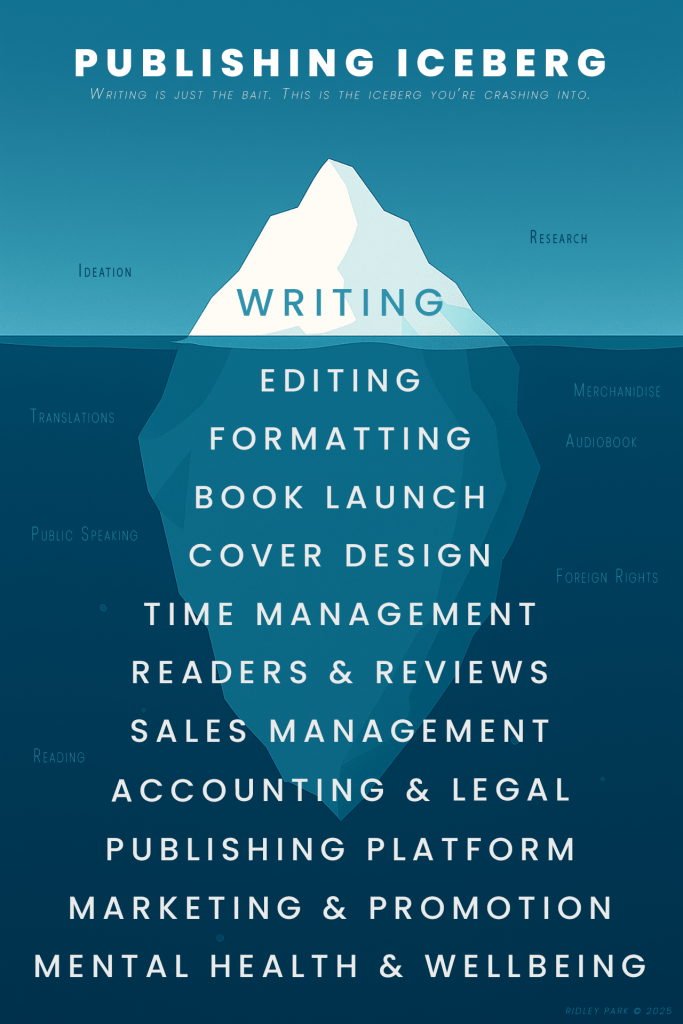
It’s the visible tip of the iceberg, smugly floating above the surface, soaking up the praise and admiration. Meanwhile, everything else – the sleepless nights, the decimal-point royalty statements, the unpaid invoices to your own soul – is lurking beneath, waiting to sink your mental health like the HMS Delusion.
So here it is, for posterity and pity:
Post-Writing Gauntlet: The Real Job Begins
1. Editing (Five Times, If You’re Lucky)
Developmental editing – “Is your plot a plot or a pile of wet spaghetti?”
Line editing – Making your sentences less embarrassing.
Copyediting – Catching your consistent misuse of ‘affect’ and ‘effect’.
Proofreading – The last defence against the typo apocalypse.
Beta feedback – Friends who suddenly vanish when asked to read a draft.
2. Formatting and Typesetting
Print vs digital layouts. Word crimes meet paragraph crimes.
EPUBs that break for fun.
That one widow on page 243 you didn’t notice until the proof copy arrived.
3. Cover Design
DIY, Fiverr roulette, or mortgage your cat to hire a professional.
Matching tone, genre conventions, and market expectations.
Spelling your own name correctly. (Don’t laugh, it happens.)
4. ISBNs and Metadata Hell
ISBN purchases (if you’re not relying on Amazon’s identifiers).
Title, subtitle, BISAC categories, keywords, blurbs, author bio — all rewritten seventeen times.
5. Publishing Platform Setup
Kindle Direct Publishing, IngramSpark, Kobo, Draft2Digital, Smashwords — pick your poison.
Print proofs, bleed settings, trim sizes, the baffling difference between matte and gloss.
6. Marketing (a.k.a. Screaming Into the Void)
Author website & blog (SEO: your new religion).
Social media presence — the façade of charm over existential dread.
Newsletter with a totally non-spammy freebie opt-in.
Ads: Amazon, Facebook, Instagram, Google. Burn money to test the water temperature.
7. Book Launch
ARCs, blog tours, launch events, or at least pretending you’re doing those things.
Coordinating reviews before anyone has read the damn thing.
Press kits and media outreach — basically shouting “LOOK AT ME” with tact.
I, Ridley Park, am an independent author and publisher. Before this literary turn, I did time as an economist, business analyst, and management consultant – none of which prepared me for the peculiar economics of modern publishing.
Much like traditional music in the Digital Age, traditional publishing has lost a bit of its lustre. Its gatekeeping function remains, but the gates are now rusted, and half the guards have been made redundant.
Audio: NotebookLM podcast on this topic.
From a business standpoint, the Independent™ must ask: Is the distribution reach of a traditional publisher or third-party distributor worth the revenue share they demand? It’s tempting to cast them as parasites feeding off your creative lifeblood—but statistically, the average indie author sells only 60 copies of their book. Yes, that includes the five you bought yourself and the ten your mum distributed among reluctant neighbours.
Could you sell more than average? Possibly. Less? Almost certainly. Better to sell 100 copies and earn a pittance than to earn 100% of nothing. But if the publisher can’t move your book either, and if they’re not investing in you as an author, you may well find yourself in the red. Especially if you’re the one paying them for the privilege of being published. That’s not publishing – that’s vanity cosplay.
Publishers also offer (read: upsell) services like editing, formatting, and cover design. As an Independent™, you either pay for these à la carte or do them yourself. Or, if you’re like me, you cobble together a mixed strategy of DIY, AI, and professional outsourcing – whatever the project demands.
For Hemo Sapiens, I did everything except the typography for the title and byline on the cover. That part I outsourced; I know my limits. The rest – cover composition, layout, typesetting – I handled. I also brought in beta readers, who offered some valuable copyedits and corrections.
With Sustenance, I went end-to-end solo, with AI in the wings for flow and proofing support.
Propensity followed a similar path – except I made the rare (some might say perverse) choice of hiring a beta reader after release. Heretical, I know. But the feedback was so incisive I’m now considering a mid-edition revision, particularly in the middle third, where things get a bit heady.
As for Temporal Babel – still unreleased – I’ve done everything myself thus far, but I’m leaning toward bringing that same beta reader back for another round of bruising clarity.
Beta readers, it turns out, are worth their weight in snark and red ink. I’ll save my ruminations on them for another post, which I promise will be full of revelations and at least one semi-poetic lament.
I could say more here, but there are other things demanding my time – and no publisher breathing down my neck.
Bless MidJourney for the cover art based on this prompt:
beautiful woman wearing glasses and a sheer top, holding a red pen, reading a book, office setting



 Ridley Park