Authors Talking to Authors Whilst the Readers Are Elsewhere

There’s a peculiar little ecosystem out there called the author’s forum. You’ve probably seen it – digital watering holes where writers congregate to swap tips, trade war stories, and, inevitably, flog their latest magnum opus like a Victorian street hawker with a sack of dubious oysters.

Don’t get me wrong: I don’t begrudge other writers their moment in the sun. We all want our roses sniffed. But here’s the problem: I’m not looking for fellow gardeners. I’m looking for bees. Readers. Pollinators of stories. The ones who carry your words away, let them germinate somewhere else, and maybe if you’re very lucky leave a little honey in return.

Instead, these forums are like a row of market stalls where every vendor is shouting, “Buy my book!” at every other vendor. It’s a deafening loop of mutual advertising in which no one is actually in the market to buy anything. Imagine a cocktail party where everyone is giving a TED Talk at the same time. You can’t even taste the hors d’oeuvres for the noise.

Yes, there’s theoretical overlap; writers are often readers, and some might genuinely enjoy a novel by an unknown author. But the ratio is wildly off. Authors’ forums are not where most readers live. And when you do find a forum of book lovers, they’re usually busy discussing the books they’re already reading, not soliciting a cold pitch from a stranger waving around their unrecognised genius.

Bookseller and library forums? Same issue, just with a corporate gloss. They’re less like communities and more like speed dating events where every participant turns up with a PowerPoint presentation and a sales target.

I suppose it’s a rite of passage for indie authors: you wander into these places thinking you’ve found the gates to literary Shangri-La, only to discover you’ve walked into a multi-level marketing convention where everyone’s selling the same product in slightly different packaging.

So, I’ll keep my profile there, post occasionally and drop in to wave, but I know the audience I’m after isn’t there. The real trick, as ever, is finding the places where the readers live, and learning how to be interesting enough that they might actually care.

Until then, I’ll save my breath. And my roses.

Writing is Just the Tip of the Iceberg

I hate to be the bearer of bad news – especially if you’re still slogging through a draft of your first manuscript. You know what some people say about writing a book is the hard part.

Lies. Damned lies. That’s the frothy, twinkly nonsense parroted by people who’ve never published anything beyond a social media post, probably only a comment.

Audio: NotebookLM podcast on this topic.

Let me tell you the truth. The actual, bloodstained, coffee-fuelled truth:

Writing the book is the easy part.

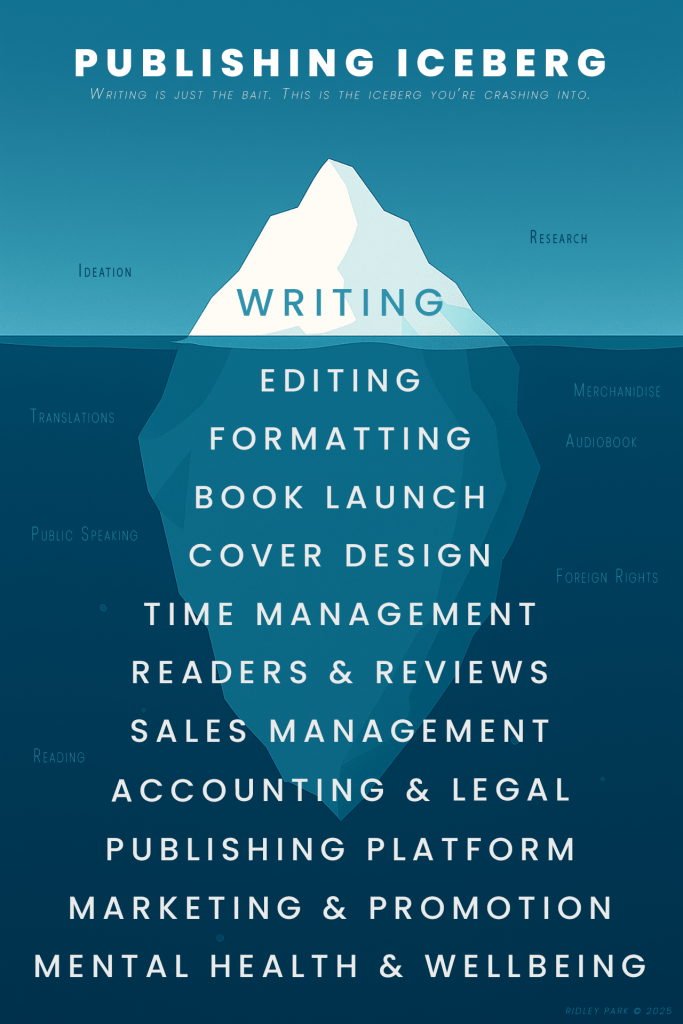
It’s the visible tip of the iceberg, smugly floating above the surface, soaking up the praise and admiration. Meanwhile, everything else – the sleepless nights, the decimal-point royalty statements, the unpaid invoices to your own soul – is lurking beneath, waiting to sink your mental health like the HMS Delusion.

So here it is, for posterity and pity:

Post-Writing Gauntlet: The Real Job Begins

1. Editing (Five Times, If You’re Lucky)

  • Developmental editing – “Is your plot a plot or a pile of wet spaghetti?”
  • Line editing – Making your sentences less embarrassing.
  • Copyediting – Catching your consistent misuse of ‘affect’ and ‘effect’.
  • Proofreading – The last defence against the typo apocalypse.
  • Beta feedback – Friends who suddenly vanish when asked to read a draft.

2. Formatting and Typesetting

  • Print vs digital layouts. Word crimes meet paragraph crimes.
  • EPUBs that break for fun.
  • That one widow on page 243 you didn’t notice until the proof copy arrived.

3. Cover Design

  • DIY, Fiverr roulette, or mortgage your cat to hire a professional.
  • Matching tone, genre conventions, and market expectations.
  • Spelling your own name correctly. (Don’t laugh, it happens.)

4. ISBNs and Metadata Hell

  • ISBN purchases (if you’re not relying on Amazon’s identifiers).
  • Title, subtitle, BISAC categories, keywords, blurbs, author bio — all rewritten seventeen times.

5. Publishing Platform Setup

  • Kindle Direct Publishing, IngramSpark, Kobo, Draft2Digital, Smashwords — pick your poison.
  • Print proofs, bleed settings, trim sizes, the baffling difference between matte and gloss.

6. Marketing (a.k.a. Screaming Into the Void)

  • Author website & blog (SEO: your new religion).
  • Social media presence — the façade of charm over existential dread.
  • Newsletter with a totally non-spammy freebie opt-in.
  • Ads: Amazon, Facebook, Instagram, Google. Burn money to test the water temperature.

7. Book Launch

  • ARCs, blog tours, launch events, or at least pretending you’re doing those things.
  • Coordinating reviews before anyone has read the damn thing.
  • Press kits and media outreach — basically shouting “LOOK AT ME” with tact.

8. Ongoing Sales Maintenance

  • Price promos, countdown deals, boxed sets, bundling — keep flogging the corpse.
  • Monitoring sales dashboards like a Victorian ghost watches the wallpaper peel.
  • Adjusting metadata because one reviewer didn’t understand it was satire.

9. Audiobook Production (If You Hate Money)

  • Narrator auditions, contracts, studio time.
  • Alternatively, read it yourself and discover your own voice is intolerable.
  • Or muddle through with an AI speech companion. Hullo, ElevenLabs.
  • Distribution through ACX or Findaway, both of which will pay you in dry leaves.

10. Accounting and Legal Fuss

  • Tracking royalties across platforms.
  • Filing taxes as an “author-publisher-entrepreneur-marketer-entity”.
  • Copyright registration, contracts, intellectual property trolls under the bridge.

11. Dealing With Readers

  • Responding to fan mail (both lovely and deranged).
  • Ignoring 1-star reviews that say “not what I expected, didn’t read it”.
  • Navigating book clubs who want a discount because they’re “doing you a favour”.

12. Mental Health and Motivation

  • Impostor syndrome, burnout, elation, despair — the writer’s buffet.
  • Rewriting your author bio weekly because you don’t know who you are anymore.

Optional Add-Ons (for masochists)

  • Translations and foreign rights – Because English isn’t the only language in which you can fail to sell books.
  • Merchandise – T-shirts nobody buys, mugs that mock your financial situation.
  • Public speaking / readings – Summon the courage to read your sex scenes aloud in a room of pensioners.
Image: Publishing iceberg poster in all its glory.

Dispatches from the Publishing Trenches: A Field Report

I, Ridley Park, am an independent author and publisher. Before this literary turn, I did time as an economist, business analyst, and management consultant – none of which prepared me for the peculiar economics of modern publishing.

Much like traditional music in the Digital Age, traditional publishing has lost a bit of its lustre. Its gatekeeping function remains, but the gates are now rusted, and half the guards have been made redundant.

Audio: NotebookLM podcast on this topic.

From a business standpoint, the Independent™ must ask: Is the distribution reach of a traditional publisher or third-party distributor worth the revenue share they demand? It’s tempting to cast them as parasites feeding off your creative lifeblood—but statistically, the average indie author sells only 60 copies of their book. Yes, that includes the five you bought yourself and the ten your mum distributed among reluctant neighbours.

Could you sell more than average? Possibly. Less? Almost certainly. Better to sell 100 copies and earn a pittance than to earn 100% of nothing. But if the publisher can’t move your book either, and if they’re not investing in you as an author, you may well find yourself in the red. Especially if you’re the one paying them for the privilege of being published. That’s not publishing – that’s vanity cosplay.

Publishers also offer (read: upsell) services like editing, formatting, and cover design. As an Independent™, you either pay for these à la carte or do them yourself. Or, if you’re like me, you cobble together a mixed strategy of DIY, AI, and professional outsourcing – whatever the project demands.

For Hemo Sapiens, I did everything except the typography for the title and byline on the cover. That part I outsourced; I know my limits. The rest – cover composition, layout, typesetting – I handled. I also brought in beta readers, who offered some valuable copyedits and corrections.

With Sustenance, I went end-to-end solo, with AI in the wings for flow and proofing support.

Propensity followed a similar path – except I made the rare (some might say perverse) choice of hiring a beta reader after release. Heretical, I know. But the feedback was so incisive I’m now considering a mid-edition revision, particularly in the middle third, where things get a bit heady.

As for Temporal Babel – still unreleased – I’ve done everything myself thus far, but I’m leaning toward bringing that same beta reader back for another round of bruising clarity.

Beta readers, it turns out, are worth their weight in snark and red ink. I’ll save my ruminations on them for another post, which I promise will be full of revelations and at least one semi-poetic lament.

I could say more here, but there are other things demanding my time – and no publisher breathing down my neck.


Bless MidJourney for the cover art based on this prompt:

beautiful woman wearing glasses and a sheer top, holding a red pen, reading a book, office setting

Hemo Sapiens: Origins

Now that Hemo Sapiens: Awakening has been released into the wild, I can again focus on Hemo Sapiens: Origins. I started writing Origins a few weeks ago, but I was interrupted by the review and production process of Awakening.

In the world of Pantsers and Plotters, I tend to fall somewhere in between, but I favour plotting.

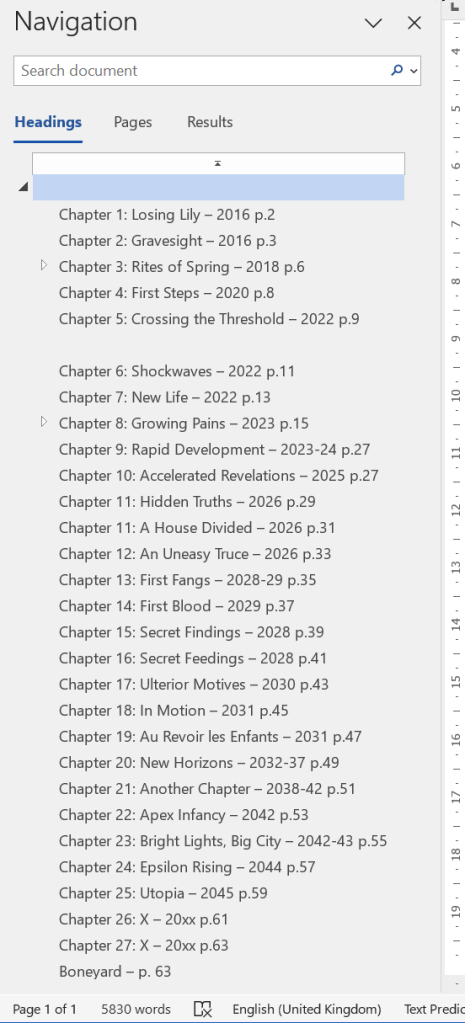
I write in Word. In the example above, you can see the working chapter titles, the year(s) a chapter covers and its starting page. Some of the chapters already contain preliminary copy.

As a writer, I don’t necessarily work chronologically. I find the chapters that are the most compelling and interesting to me. Then, I work down to the bridging chapters, hoping that the meat of the chapters penned earlier will support and inspire the later ones.

As I write, I usually create a ‘Boneyard’ chapter. This is where ideas go to incubate or die. Workable ideas are resurrected whilst others are laid to rest. Some ideas are like zombies, but at the end a project, they are either among the dead or living.

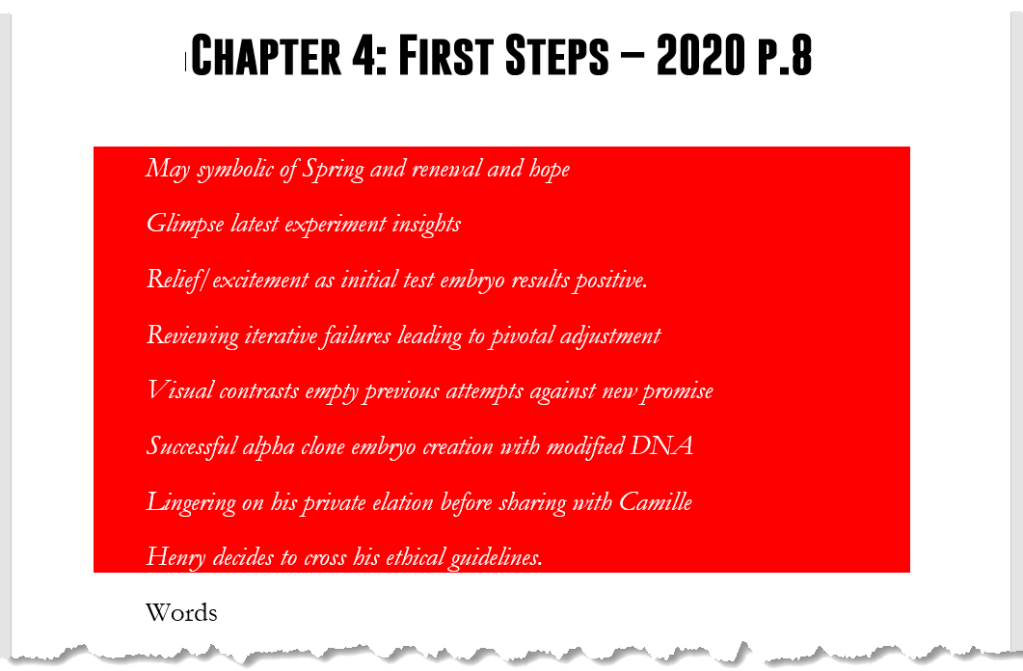
At the start, a chapter looks something like this. It’s a blend between ideas and story beats. Each chapter is outlined similarly. The other advantage this lends me is that I can *ahem* walk away from writing for a while and still have handholds and reminders when I return. For short fiction, I just write. No outlines. Perhaps just an idea to explore.

What is your writing style? Leave comments below.