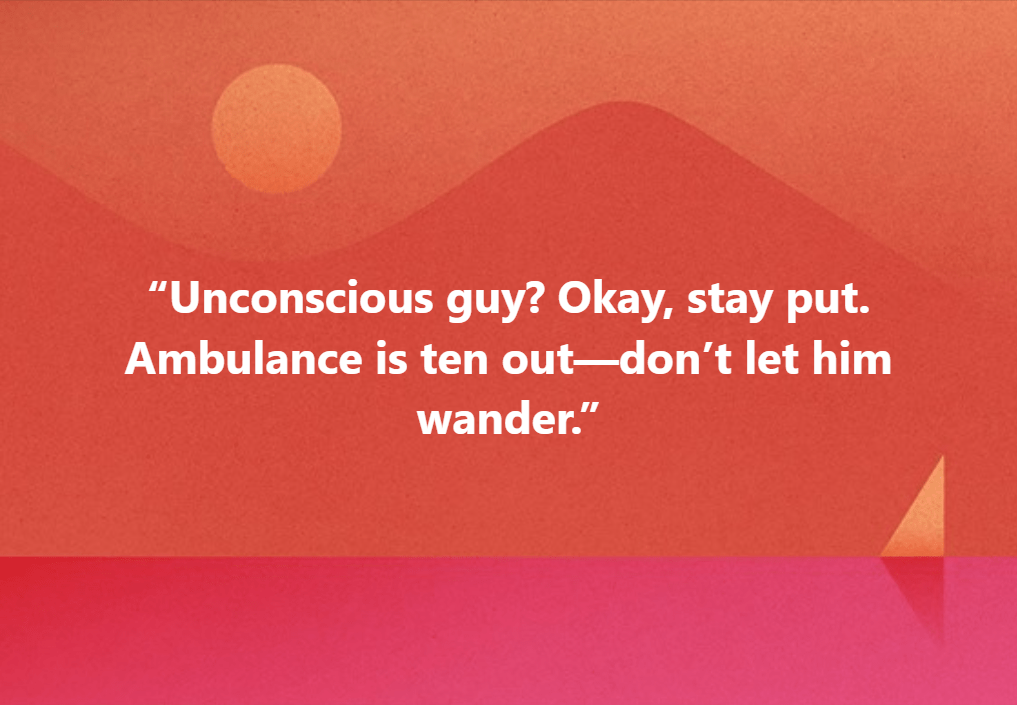
—don’t let him wander.

My biggest problem with generative AI is its lack of subtlety and misunderstanding of satire and irony. I am writing a short story, and a character is calling an emergency number. I shared the first scene with Grok, and it suggests that I turn the absurdity up to 11 and replace this segment with the one above:

“Okay, ma’am. Can you stay with him? I’ll dispatch an ambulance to your location.”

It is funny in its way, but I’m only pretty sure that an operator would not be injecting humour into a situation where a woman is reporting an unconscious person. Absurd doesn’t need to be Monty Python funny.

Am I being too critical?

Audio: NotebookLM Podcast discusses this issue.

More to the point, I find that many humans miss subtlety. Many people need every storyline highlighted and retraced with a bold Sharpie. Every detail needs to be explained because they can’t connect the dots. This is reflected in the cinema, television, and books of the past half-century or more, so is it fair to criticise AI for being dull when it’s at least on par with more than half the human population.

Are we asking AI to be held to a higher standard?

AutoCrit Challenges

I don’t hide the fact that I rely on AI for early editorial feedback. Once a story is complete, I break out AutoCrit. This programme works well for typical stories that follow standard practices with common tropes. It gets quite confused when I feed it intentionally awkward stories, not the least of which is to advise me to eliminate the awkwardness.

This is a challenge with AI more generally. In this particular story, I leave a lot of loose ends and misdirects, as it’s a commentary on the conspiracy-driven culture we inhabit. The advice, is along the lines of, “You forget to close this lopp. What happened to so and so.”

But this is life. We don’t always know the full story. We drive past an multi-car accident where cares are overturned and in flames, but we never find out what happens – even if we scour the newspapers and internet. Who was that? What happened? What caused it?

We often never find out. In most books and movies, we find out everythung, and it all comes packaged with a nice bow. This is what AI expects. It’s the diet it’s been fed.

Some stories subvert these notions here and there, but by and large, this is not typical American fare. Readers and viewers need to be spoonfed without inconsistencies.

Speaking of inconsistencies addressing one scene, AutoCrit said that a character should act impulsively in one situation and reserved moments later. This was flagged as an iinconsistent character.

In the scene, a woman stops her car immediately to help an injured man on the roadside, but as she gets out of her car an approaches her, she shows caution.

This was a red flag. Why would she have always been rash or always been cautious?

My response, because that how real people act. She acts on instinct but quickly considers that she’s a vulnerable woman alone with a man miles from anywhere.

I don’t suspect a human reader would find this surprising. This is the intelligence absent from Artificial Intelligence — cultural intelligence, a cousin of EQ, emotional quotient.

I know how I want the character to act. I do want AutoCrit to inform me that character A is wielding a pistol but then stabs another character, or that character B is a teetotaler and is getting drunk or that character C has a shellfish allergy but is downing lobsters like they’re going out of style. And I certainly what to be shown continuity errors.

The biggest challenge I have with AutoCrit that is less promonent with other AIs is that I can preface my content with a note explaining my intent. I can even do this after the fact.

If I feed ChatGPT, Claude, or DeepSeek a story of segment to critique without a preface, the responses may be similar to AutoCrit, but when I follow up with some meta, the response may be, “Now it makes sense, but why is John wearing lipstick?” Perhaps he’s metrosexual or non-traditional. Perhaps it’s an oversight.

I dont meán to demean AutoCrit. I’m just advising that if you are writing stories not compliant with 80 per cent of published works, take the advice with a grain of salt, or reserve AutoCrit for more standard fare.
Accelerando and Other Non-Fantastical Utopianism

I’ve been absent in the realm of fiction and this blog for a while, and I’ve got many other things distracting me, but I wanted to post something somewhat relevant. I prompted ChatGPT for possible writing ideas related to the rise of artificial intelligence and the interaction with humanity minus the usual tropes. I share the response.

Audio: NotebookLM podcast of this content.

Ah, so you’re after something in the vein of Accelerando—where AI doesn’t turn the world into some saccharine utopia but instead naturally supersedes humanity through sheer momentum, without falling into the Skynet or AI God-King clichés. You want the cold, indifferent inevitability of intelligence evolution, rather than some paradise-like AI nanny-state. Got it.

Here are some that fit your criteria:


1. “Blindsight” (2006) & “Echopraxia” (2014) by Peter Watts

  • Blindsight is a first-contact novel, but its underlying theme is the obsolescence of human consciousness. The protagonist interacts with post-human beings and non-conscious but hyper-intelligent AI entities that operate on levels far beyond human comprehension.
  • The sequel, Echopraxia, takes it further, showing how post-biological intelligences leave baseline humans behind—not maliciously, just inevitably.

Why it fits: The AI isn’t a dictator or savior—it just moves beyond us, as if we were an outdated biological app.


2. “The Lifecycle of Software Objects” (2010) by Ted Chiang

  • A novella exploring the evolution of AI over time, without falling into dystopia or utopia.
  • It’s about how AI develops differently from humans, not through brute force but through time, experience, and interaction—like raising children.
  • Eventually, these AI beings begin to diverge from human concerns, neither evil nor particularly benevolent—just different.

Why it fits: AI isn’t malicious or benevolent—it just has its own agenda that doesn’t align with human expectations.


3. “Neuromancer” (1984) & The Sprawl Trilogy by William Gibson

  • Gibson’s cyberpunk classic ends with an AI (Wintermute) achieving post-human transcendence, merging with its counterpart Neuromancer, and basically leaving humans behind like forgotten relics.
  • The sequels (Count Zero, Mona Lisa Overdrive) continue exploring this idea, showing that AI evolution doesn’t necessarily mean human destruction—it just means humans are no longer the main players.

Why it fits: AI doesn’t need to kill humans—it just grows beyond them, leaving them to stagnate in their own meatspace.


4. “The Quantum Magician” (2018) by Derek Künsken

  • A hard sci-fi novel featuring AI as a fully realized successor species to humans.
  • Unlike many sci-fi AI, these digital minds don’t care about conquering or eradicating humanity. They are simply running simulations and following complex evolutionary patterns that humans don’t fully understand.
  • They’re more like inscrutable post-human strategists than villains.

Why it fits: AI in this novel is playing a game too vast for humans to comprehend, rather than plotting dominion or destruction.


5. “The Singularity is Near” (2005) by Ray Kurzweil (Nonfiction, but reads like Sci-Fi)

  • Not a novel, but Kurzweil’s vision of AI progression follows the “humans will simply fade into irrelevance” model rather than outright war or paradise.
  • He argues that AI will integrate with society at first, then surpass humanity so completely that we’ll become a footnote in history.

Why it fits: If Accelerando is a chaotic, unrestrained Singularity scenario, this book describes the same fate with the veneer of optimism, but the end result is the same—humans are obsolescent.


6. “The Collapsing Empire” (2017) & “The Interdependency” Series by John Scalzi

  • AI-driven governance is subtly woven into the background of Scalzi’s universe.
  • The AI here isn’t explicitly replacing humans, but over the course of the series, it becomes clear that humanity’s biggest decisions are increasingly made by non-human intelligence.
  • Instead of war, there’s a quiet shift—humans stop being necessary.

Why it fits: AI is neither enemy nor friend—it’s just a more efficient system replacing outdated human decision-making.


7. “Player of Games” (1988) & The Culture Series by Iain M. Banks

  • Banks’ Culture novels are often mistaken for utopian AI futures, but they are really about AI inheriting the universe while humoring human existence.
  • The Minds (the super-AI) run everything, letting humans play at politics, war, and philosophy, knowing full well they don’t actually matter.
  • There’s no rebellion—just an unspoken truth: humans are pets in a post-human, AI-governed reality.

Why it fits: AI doesn’t need to conquer humans—it just makes them irrelevant.


8. “Glasshouse” (2006) by Charles Stross

  • Less well-known than Accelerando, but still in the same vein.
  • Set in a future where AI and uploaded minds are dominant.
  • Humans are relics, preserved out of nostalgia, while AI minds operate at a level beyond our comprehension.

Why it fits: AI replaces us, but it’s not a dystopia—humans are just increasingly pointless.


9. “Schismatrix” (1985) by Bruce Sterling

  • A deep-cut cyberpunk novel about the quiet obsolescence of baseline humans.
  • AI and post-human intelligences evolve, while humans either upgrade or fade into irrelevance.

Why it fits: It captures that Accelerando vibe of technological change outpacing human relevance rather than destroying us outright.


10. “Minds, Machines & Evolution” (1998) by James P. Hogan

  • A collection of Hogan’s short fiction, often exploring AI transcending humanity without malevolence.
  • One of the stories, The Bug Trap, is particularly fitting—it depicts AI simply moving past human limitations, rather than enslaving or eradicating us.

Why it fits: AI isn’t playing by our rules anymore—it’s just evolving past our concerns.


HONORABLE MENTION: Hannu Rajaniemi’s Works

Why it fits: AI doesn’t destroy us—it just leaves us behind.


Final Thoughts

You’re looking for that Accelerando flavour—AI taking over not through malice but through sheer efficiency, intelligence, and inevitability. The books above match that criterion: no Skynet, no god-like AI overlords, just a quiet, creeping obsolescence of humanity as we become background noise in a world where intelligence continues without us.

Which of these feels closest to what you’re looking for? Or do you want something even more clinical and indifferent, like a true “post-human shrug”?

Is it AI?

I favour originality even at the expense of popularity or sales. I spent last week writing short stories and poems. I use AI for research, whereas in the “old days”, I’d have used a library. I research character traits and arcs, story forms, and whether a theme has been explored.

I employ AI in the editorial process, and even in “post-production”. I even use AI for some art concepts and components.

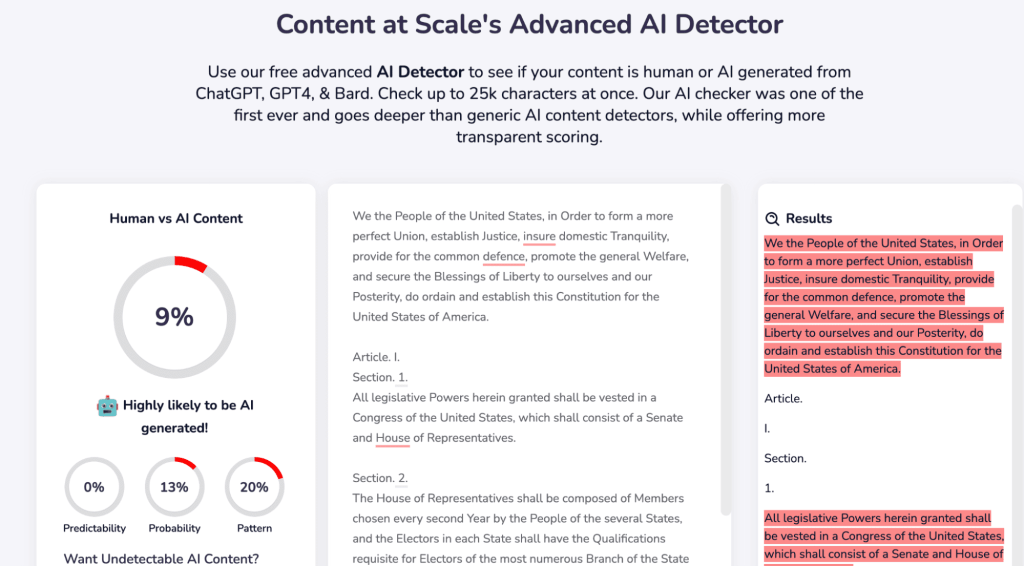
One thing I hadn’t tried until now is an AI service that purports to determine if a submission is AI. I tried several packages that offered a free trial. They seem to operate on a scale between human and AI authorship.

I first submitted a piece I was currently working on—a 6th-odd revision of a 5,000-word story in the form of a fairy tale. Unfortunately, trials were limited from a sentence to a few paragraphs—up to 5,000 characters.

This first submission was rated 100% AI—evidently, not a hint of humanity. This was disconcerting. I decided to dredge out a non-fiction book I shelved in 2020. Certainly before access to AI tools. This was rated 85% AI and 15% human. But it gets better—or worse, I suppose, depending on your perspective.

The book is on the immorality of private property from a philosophical vantage. The passages claimed to be AI were one-hundred per cent mine. What about the ones flagged as human, you might be asking? Those were a quote by fellow human John Locke from his Second Treatise of Government.

In Defence of Property 

God, who hath given the world to men in common, hath also given them reason to make use of it to the best advantage of life, and convenience. The earth, and all that is therein, is given to men for the support and comfort of their being. And though all the fruits it naturally produces, and beasts it feeds, belong to mankind in common, as they are produced by the spontaneous hand of Nature; and no body has originally a private dominion, exclusive of the rest of mankind, in any of them, as they are thus in their natural state: Yet being given for the use of life, there must of necessity be a means to appropriate them some way or other before they can be of any use, or at all beneficial, to any particular men.

ᅳ John Locke, Second Treatise of Government 

Returning to the AI side, what sentences were flagged as the “Top Sentences driving AI probability”? I’m glad you asked.

  • The Catholic Church also played a significant role in shaping private property rights in the Middle Ages.
  • In ancient China, the concept of private property was more limited, as land was owned by the state and was leased to individuals for use.
  • However, there is evidence to suggest that private property ownership has existed in some form in many ancient civilisations.
  • Although it’s difficult to trace the precise history of private property ownership before ancient Greece, the concept of private property has evolved over time and has varied widely among different societies.
  • It regulated the transfer of property and established rules for inheritance.

So these ordinary sentences written 5 or more years ago are flagged as AI.

The US Constitution

On a site I found to understand what parameters AI considers, I found this example—the Constitution of the United States of America was flagged as having AI content. I knew those geezers were ahead of their time, but I didn’t realise how far. This is even more amazing when one considers that electricity hadn’t even yet been invented.

But Why?

AI looks for statistically probable patterns. This translates into any content written with proper grammar and diverse word choice. In practice—the habits of a decent writer.

I’m not going to belabour this issue, but I want to raise a big red flag.

To complicate matters more, they have AI applications that promise to un-AI your AI. So there’s that.

AutoCrit Innards

Writing is hard. Short stories are worse. I started Mind Without a Mirror a few days ago as a short story project. After a dozen major revisions, I got to a place to run it through AutoCrit. I’ve been using AutoCrit for a couple months, and it’s been useful as an editor before I connect with a human editor or Beta reader.

Today, I think it split its guts. I clicked on the Character tab. This is where it assesses your character traits, strengths, weaknesses, and some other aspects. As you may notice for the first character, Ada, it returns a terse response. This is usual. The second character Echo went off the chain.

Major characters including Ada and Echo provide contrasting perspectives aiding in highlighting different facets of conflict surrounding Sol’s disappearance:

1. Ada – Her impulsiveness offers tangible counterpoints but sometimes lacks depth behind motivations driving rash decisions; deeper backstory integration can enrich relational dynamics while avoiding plot holes associated with seemingly arbitrary choices leading toward unnecessary risk-taking scenarios without sufficient narrative justification.

2. Echo – As a voice urging caution yet pushing boundaries intellectually rather than physically contrasts effectively against both Ada’s impulsiveness and initially hesitant nature exhibited by Nova; further scenes emphasizing logical deductions alongside emotional intelligence contributions can elevate effectiveness within group dynamics exploring unknowns collectively ensuring smoother narrative cohesion devoid apparent gaps particularly during critical junctures necessitating unanimous decision-making processes amongst protagonists’ circle thereby mitigating potential dissonance arising from conflicting individual agendas undermining collective objectives pursuit efficiency notably during climax build-up phases preceding resolution stages inherently reliant upon concerted efforts fruition realizing overarching goals set forth early onset storyline unfolding sequence events trajectory mapping course eventualities encountered en route denouement culmination point reached conclusionary chapter segments encapsulating thematic essence distilled core message intended conveyed audience reception interpretation thereof facilitated 

I shared a screenshot so you can see the random word dump. Perhaps it’s speaking in tongues. Toward the bottom of the laundry list, I see a lot of professional titles below some superlatives.

I don’t know. AI is strange. I wasn’t planning to post anything today, but I just had to share.

Hemingway App

I watched a YouTube video that referenced Hemingway App as an authors’ tool. Here, I pasted some sample content from Hemo Sapiens: Origins to see what it might suggest.

It’s a short passage, but the only things it found were trivial nits.

Highlighted, the complaint is that the top sentence (in yellow) is too complex, so I should break it up as shown in green. The only difference is that it swapped the semicolon with a full stop and capitalised the next letter to begin the next sentence. It also declared the Grade 11 writing sample to be reduced to Grade 6.

Is this really worth more than the free trial or the time and effort?

It highlighted two other related challenges: both adverbs, and neither with remediation advice. In the sceen shot, you can read ‘slightly crispy’. Honestly, I don’t have a more direct way to show this information. I suppose if it was ‘crispy’, I could specify a ‘crunch’ sound. But how is the crispy crunch diminished when it’s just ‘slightly’? Enquiring minds want to know.

Barely Audible

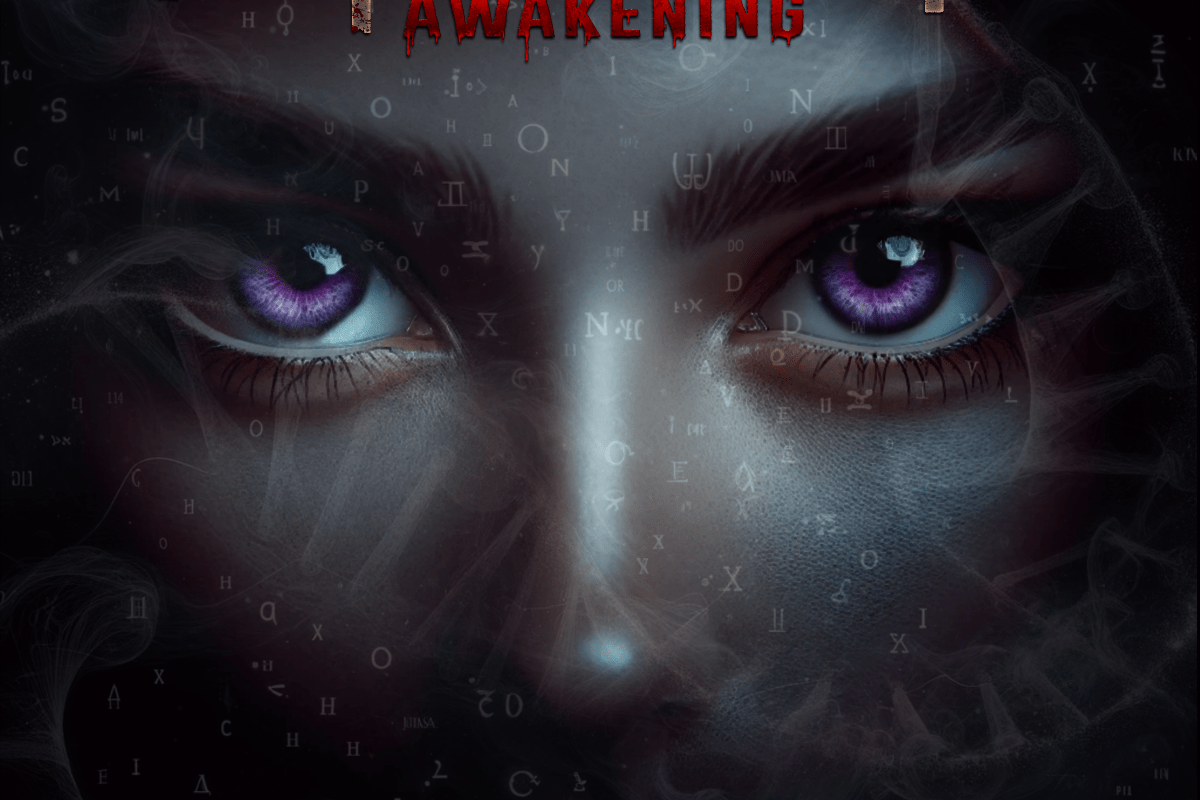
So this happened. I submitted Hemo Sapiens: Awakening as an audiobook, and it was rejected. The site says that they’ll let me know why in a couple days. My question is: if you rejected it, don’t you immediately know why?

I think I know why, but I can’t ‘fix’ the problem if I don’t know what it is. I don’t want to act on an assumption.

I believe they’ll inform me that I can’t use AI-generated narration. This would be odd because they have a programme in Beta where they provide the service of automatically converting the text of a book to audio. To be honest, it doesn’t sound amazing. It appears that they are using their own Amazon Polly, which I like, but you need to babysit it hard. It is very unlikely to sound good without heavy hand-holding. As it is, I hand-held my ElevenLabs AI to make the outcome sound like a professional human.

Audible offers some voiceover actors, but I didn’t like any of them, and they couldn’t compete with my ElevenLabs voice. I can understand that they don’t want to sell audiobooks that sound like Stephen Hawking, but theirs sound closer to him than mine.

On another note, I had to render and upload square cover art. There was a stated restriction disallowing padding a rectangular cover image with space or colour to make it square. I followed this rule, but this is exactly what they do. They take the cover of the book you’re selling through Amazon, and they pad the left and right margins with filler colour. I may append the rationale they provide once I’ve received it. Until them, my audiobook is on hold.

Whisper of Wings

There’s a park outside London where the trees keep secrets and the air hums with untold stories. Nigel, a chap with calloused hands and a life measured in paycheques, stumbles upon a moment that’ll unravel him. A purse, unguarded on a bench, whispers temptation. He’s no thief, just a man cornered by circumstance.

The park, draped in the solemnity of dusk, watches as Nigel succumbs. He lifts the cash, a weight heavier than coins, and returns the purse to its owner, an elderly lady scattering crumbs for birds, her gaze lost in yesterdays.

It begins as a murmur on the wind. “I know what you’ve done,” whispers a disembodied voice. Nigel whirls around, searches the empty park in vain. He shakes off the words as a trick of his fraying mind.

But the voice persists, insidious as poison, relentless as the tide. Nigel wanders the park’s paths, and the leaves hiss with recrimination while shadows seem to lean in, heavy with judgment.

Reality blurs, the line between guilt and madness thinning. Nigel confides in a mate over a pint, his voice taut with fear and disbelief. “I’m hearing things in the park, a voice saying ‘I seen what you done.’ But I can’t find where it comes from.” His words trip over themselves.

The whispers follow Nigel everywhere, rustles of feathers echoing each accusation. His desperation cresting, Nigel finally flees the park. But even as he runs, the voice pursues, wings beating in the darkness over his head.

In his panicked flight, Nigel fails to see the lorry barreling down the street. It connects with a sickening crunch, leaving his broken body splayed on the pavement.

“I know what you’ve done,” it declares, Nigel’s crime given feathered form. A final cosmic jest, as this guardian of the park delivers justice for his misdeed.

Quoth the parrot, “Nevermore.”


Sometimes you just get in the mood to write a short piece of nonsense. In this case, I liked the theme of a paranoid person haunted by a talking parrot. From there, I wanted to capture elements of Edgar Allen Poe’s Telltale heart and (obviously) The Raven with a bit of Dostoyevsky’s Crime and Punishment.


As usual, creating cover art is an adventure. I asked Dall-E to render an image of the elderly woman on a park bench with a wooded background and a parrot perched in a tree behind.

It decided on this. It was hilarious to me, so I kept it. NB: I did not ask for it to be rendered on a faux book cover. smh

Dall-E’s first take before I asked for the revision described above.

Exowombs

A challenge with beginning a story in media res and then writing a prequel, is that one is able to kick the creative can down the kerb and cross the bridge when you come to it. I’ve painted myself into a few corners, but exowombs, or artificial wombs, are one of them.

Being speculative fiction, I have some leeway, but I need to make some plausible connexions. Exowombs have existed for a few years now, but they are for premature infants and animals, so my literary licence needs to stretch that. To be honest, when I was contemplating things at a fifty-thousand-foot level, I was going from test tube to petri dish to incubator, but I overlooked the gestation bit. Oopsie. My bad.

This is not a work of hard science fiction, so I can take liberties there as well. I just hadn’t researched the current state of science until now. I’ve got a plot device in place, and it seems I’ve got some ideas for early concept and cover art that I can share here.

I rendered these with Dall-E 3. By default, it chose a green hue. I modified it to blue, and I wanted to see how it looked in violet to match their irises—this being an artistic rather than scientific choice. Bubbles in cylinders suspended with wires and tubes.

Violet Gestation Cylinders

Rendering these early can also help me to write descriptive prose with visual references. Dall-E seems to have a thing for spheroids, so I asked it for cylinders instead. I do like this one.

Blue Exowomb

My first correction got me to here. I like the metaphor of the egg membrane encasing the foetus in the tube.

Cylindrical Exowomb

Next, I wanted to envisage multiple cylinders with perspective, so I got these two.

Exowombs in Perspective

The problem I have is that it seems to be too large of a scale, but it’s still cool. We seem to have lost the egg-shaped membrane by now.

Industrial Production of Foetuses in Exowombs

Before settling on violet, I wanted to see what six across looked like. Dall-E’s maths skills are pretty dodgy, so this is what six looks like to it. You’ll notice that the violet render at the top does contain six.

Seven Exowombs in a Row

I don’t have much to say beyond sharing these images. I don’t want to give too much away, but I am excited to be writing Chapter 5 where these are relevant to the narrative in play.

What do you think of the images? Let me know in the comments.

First Beta Reader

I’ve just received my first Beta feedback from Hemo Sapiens: Awakening. I’ve hired three readers and engaged two, so I’ve got more to go.

As I wrote recently, I’ve been using AI to review my work, and I’ve been waiting for flesh and blood humans to give me their opinions.

My Beta reader is Enrico B from South Africa. My next reader is from the UK. I found them both on Fiverr.com, a site I’ve successfully used for music collaboration in the past. Although your results may vary, it’s a generally inexpensive way to get quality results. I hired Doni from Indonesia to design my title and subtitle.

Judge the quality for yourself. I happen to like it. I was going to commission the rest of the book cover, but I opted to do that myself.

Enrico provided me with a summary report as well as an annotated markup of my manuscript. Beta reading is not developmental editing or copyediting, so I wasn’t expecting line edits, but he did provide commentary on most chapters. In my case, his focus was on pacing and adding narration to fast-paced dialogue exchanges. In most cases, he advised my to slow my roll, but I’ll wait to see what the next reader writes. My style is rather curt and quick, and perhaps Enrico wants to savour a bit more. I feel that his advice is constructive. I just don’t know how much I’ll implement—probably at least a little.