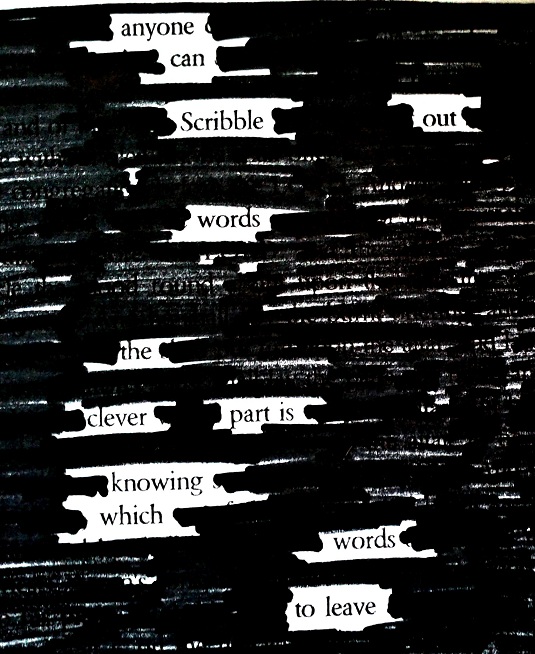
Sometimes less is more. So, I’ve just lost about a thousand words in my Hemo Sapiens story. Cutting the fat to retain the lean.
As difficult as it is to kill off that which you’ve spawned is difficult. It’s even harder when you are trying to reach a word-count goal. I’ve gone from about 32,500 to 31,500 in a day, on my way to 40,000+.
I’ll get there. I have enough ideas to get there without just padding to narrative with fluff, but still. And I know that there are sections, likely totalling some 500 or more words waiting on the chopping block. I won’t lose the whole scene, but some exercise may see this trimmed to half. I’m putting this off. No need to drop some 1,500 words overnight. We’ll see. This scene may get a reprieve.
Revisioning is not just proofreading and copyediting. It’s a chance to reimagine.
And this is just my first draft. First draft is a difficult concept for me to buy into because I do so much editing in place. The story’s not even finished, and I am making wholesale changes. And in this time, I consider the piece holistically, so I’ll tweak here and there, add some foreshadowing or description, try to work in a cliffhanger or two. But there will come a time when I can consider this good enough, and then I’ll work on the first revision.
I like the word revision. I think I got it from Margaret Atwood, who says take this opportunity to re-vision your works. Revisioning is not just proofreading and copyediting. It’s a chance to reimagine. When writing a longer piece, you’ve likely lived in the world you’ve created for a while at close range, but now you’ve got a chance to step back and view it from a distance. Take some time off and revisit with fresh eyes.
I’ve been working with Claude to help structure my Hemo Sapiens novel. Essentially, I am asking for advice about logically grouping and naming chapters. This was my first mistake.
Firstly, I asked the AI to ignore my chapters and headings and to tell me what it suggested. It took about ninety per cent from me and offered me different chapter titles about half the time. In one case, it offered my two titles for the same chapter. Secondly, it re9organised some of my chapters—and no, it would not work sequenced as suggested. File this under ‘Order Matters’.
I made most of the changes and asked it to review it again and make more suggestions, if appropriate. I also noted that the chapters it suggested were of wildly different lengths—some as short as a paragraph—, so I asked for consolidation tips.
Claude agreed with my assessment, so it recommended combining two short chapters, say, 1 and 9, together—and why not 7 and 13 while you’re at it. Let’s just say that Claude has no common sense.
I do like a lot of the advice Claude and ChatGPT gives, but you really have to be careful. I swear these guys have a severe psychotropic drugs problem when they’re offline, and it’s affecting their performance.
I use ChatGPT as a copy editor, and I am constantly bouncing ideas off it. If only I had some available alpha readers. lol
This afternoon, I had it review passages, especially since I recently consolidated characters. Because of this, ChatGPT felt that I should elevate the Detective Sergeant from a secondary B-level character to a B+ character. Therefore, I should flesh her out more to make her more memorable. And I should expose the reader to more of her internal dialogue.
I took this advice to heart and reviewed the sections I had shared. I tend to indicate internal dialogue in italics, and there was plenty of italics. Of course, ChatGPT doesn’t have access to this markup, so I manually wrapped curly braces around {internal dialogue}, thusly.
I copy-pasted the section back into ChatGPT and asked for an analysis. This time, it was all praise.
This is something worth keeping in mind. You might have to do some extra throwaway markup for your AI editor to keep it honest.
Pro Tip: Another thing I do, is I place my [author comments] in square brackets and instruct the AI to ignore these in the analysis. I use author comments as placeholders for my own exposition, notes for later clarification, and so forth. With the brackets, I can just tell ChatGPT or Claude something like:
Analyse and evaluate this section. Inner dialogue is in curly braces, { }. Ignore content is square brackets, [ ]. This seems to work for me. YMMV
I killed off a character, but not in the way you might think. In my Hemo Sapiens novel-in-progress, I decided to merge two characters into one.
Initially, I had wanted one, but I decided I would have two detective Sergeants play off one another in a good cop/bad cop sort of way. In the end, they had nuance, but there wasn’t really enough to justify the reader to track two people. They each had separate story lines and interacted often enough, so the question was how to combine them.
Allow me to step back for a moment. My word count was about 132,500, and I was still merging five short stories into this novel idea and making good progress. In fact, it’s been assembled, but I need to smooth some edges and fill in some gaps and transitions as well as look for opportunities to foreshadow and refine payoff promises.
During this process, I felt that the two Detective Sergeants weren’t worth keeping. I opted to retain DS Lewis, a female, and cut DS Jones, a male. Lewis was a bit more insouciant and Jones was more rigid. Jones drank coffee and smoked cigarettes while Lewis was repulsed by these. They exchanged banter and worked in parallel on the main case. Now, I had to ferret out all of these instances and turn Jones’s masculine pronouns into the feminine form.
In some ways, it will also read better. I found myself changing Jones said to she said instead of to Lewis said because the reader was no longer tracking the two in a scene with other. I feel that the he said|she said structure takes less effort for the reader to parse, so it’s a Win™, and I’ll take it.
I mainly use Microsoft Word to write, so I just searched for all instances of Jones and made all of the necessary adjustments to Lewis. Then, I had to proofread all of the surrounding content to look for straggling pronouns. I think I’ve gotten them all, and I’m ready to continue polishing the merges. Oh, and I’m not even done writing it yet.
I am aiming for at least 140,000 words, but I’ll take more if it makes sense. The last thing I want to do is to pad a story. If it doesn’t move the plot forward or demonstrate something about a character to a reader, I don’t want it. I hate bloat, and I’ll presume most readers are the same. Very little body fat. Believe me, I will fat-shame a book. At 132,500 words, I’m at 135 pages. At 140,000, I should be at 168 if the maths hold. I’ll be fine with that. Again, if I can get more with meat (apologies to vegans), I’ll do it.
I already have an origin story in mind as well as many sequels, so I want to keep enough meat on the Hemo Sapiens bone to serve them well.
If you’ve had to sacrifice a character for the greater good of your work, I’d like to read about it. Drop a comment. Cheers! 🍷
I’ve been conspicuously absent from this blog as I’ve been busy creating a novel. By creating, I mean that I’ve been combining four short stories within the Hemo Sapiens universe into a would be novel.
I’ve finally completed the consolidation, but there remain continuity gaps, which was to be expected. Plus, I need to thread additional plot aspects because more structure is required to create an apt foundation.
As I plan my approach, I notice I have a fifth short story to integrate. Whilst this creates more work, it also relieves other work. As it stands, the novel-in-progress contains just over twenty-thousand words — about half a novel’s worth, so I’ll more quickly transition from a novella-ranged book to a full-fledged novel. Currently, I’ve got about ninety pages of content. My goal is to have over two-hundred pages of non-filler content, which should get me between forty and fifty thousand words. Time will tell.
Whilst I don’t want to abandon this blog, it does compete with my time and attention, so hopefully I’ll still be making contributions along the way. I’m reusing a cover image to save time. Gotta go. Meantime, cheers.
I attended an online writers workshop yesterday evening via Meetup.com. It was a small group, and we reviewed three works, one of which was Hemo Sapiens: The Unidentified. I got some good feedback and amended my story as result of it.
The advice I got was to connect some elements of the story where a connexion between X and Z was missing a Y, leaving the reader disoriented. In one case, the protagonist was inside her home and taken outside before the doors shut on a van. It wasn’t immediately apparent that she was in the van. There were other such breaks.
I was advised to add descriptions and to earn the use of some words. In particular, I used the word nightmare, and a reviewer said that by the description that she didn’t feel it was deserving of the term nightmare; it qualified as best as a bad dream. I opted to change nightmare to bad dream instead of adding description that would have slowed the pace.
I amended some other more trivial aspects, but I drew the line at dialogue. Some advice was to make some dialogue snippets to be more grammatically correct. In the first place, this would slow the pace—and these were not contemplative moments—, and I don’t feel most people speak grammatically as prescribed — certainly not this character.
The other piece of advice I chose to ignore is the dialogue of Grace, the five-year-old that had originally been a three-year-old. The complaint was that she was one-dimensional, but I saw no benefit fleshing her out in a work of flash fiction, and she was more of a foil and not a fully realised character in this context. Also, I don’t think five-year-olds — and especially three-year-olds are really that deep. Until recently, I had a three-year-old, so I speak from experience. Grace’s dialogue is also well advanced of mine. I’d prefer at making the dialogue feel real over well presented.
What are your boundaries in accepting writing advice?
As much as I disparage generative AI, I still find it indispensable. Here I ask it to evaluate the use of echoing versus echoes. I had been leaning toward echoing, but I opted for the immediacy of echoes over the more durative echoing. I prefer a more terse style anyway. Here’s what is says:
Let’s analyse the contrast between these two sentences:
Sentence 1:
… the movement echoing in the halls.
Uses a present participle (“echoing”) to describe the sound of movement. This conveys a sense of continuation – the echo is ongoing.
“Echoing” implies a slight distance, as the sound travels through the halls.
The participle breaks up the sentence structure, adding a descriptive clause.
Sentence 2:
… the movement echoes in the halls.
Uses a simple present verb (“echoes”) for a more direct, immediate sound.
“Echoes” feels closer and crisper, not trailing off.
The verb tightens the sentence structure, keeping the action brisk.
Overall, the present participle in Sentence 1 allows for slightly more nuance in describing the elongated, reverberating echo. However, Sentence 2 has a more compact, staccato feel fitting the tense atmosphere.
I don’t have a strong preference between the two – I think either could work well depending on the surrounding context and intended tone. The participle flows a bit more, but the crisp verb maintains urgency. Let me know if you have any other examples you’d like me to contrast! I’m happy to provide more comparative analyses.
I’ve recently assembled a hemo sapiens wiki presence. For me, it’s more of an archive to capture definitions and connexions of and between characters, stories, and so on. It is a work in progress, and I’ll be populating it more as I develop new stories and characters. I also need to add some detail, but it’s a good start as far as I’m concerned.
It contains current and potential future content ideas. In some cases, there may be some spoilers, though I try not to make any big reveals. My favourite content pieces are the character profiles, for example Henry Moss, and the genetic versions, for example the Epsilons. The genetic version information is also available on this blog.
This is section five of five from my short story, Hemo Sapiens: Aftermath. I’ve made available an audio version if you are so inclined. I’ll be publishing the rest of the story over the next few days. The first section is also available. Let me know how you feel about it in the comments section. Check out another story in this universe: Hemo Sapiens: The Unidentified.
Ravi shuts off his presentation. “So that’s your glimpse into what it’s like to be a bat,” he tells the class, gesticulating. “If you’ve got any questions about the assignment, talk to Niamh. She’s your go-to for that.” He sets the remote down on his desk.
The oak-panelled walls of his classroom soak up the fluorescent light, but the air’s different today. Quieter. Tense. His mobile vibrates in his pocket. It’s from the Journal of Evolutionary Biology. “Your Article Is Now Published,” the subject line reads.
A swift swipe of his thumb and the notification’s gone. Pride swells, mixed with something less celebratory. “You’re dismissed,” he tells the class. The words feel heavy, like he’s severing something he can’t quite name.
Overnight, Ravi becomes renowned. But with fame comes shadows and backlash.
But shadows lurk beneath the glare of fame. As the light grows brighter, the darkness closes in too.
Henry warns the spotlight also illuminates targets. The brighter the light, the darker the shadow, and powerful enemies may lurk in the shadows.
Ravi’s inbox overflows with vitriol — trolls lobbing slurs, hate groups spewing conspiracies, armchair critics challenging his every claim. Even colleagues whisper in hushed corridors, envy tainting their smiles. He tells himself to let it roll off his back, but the hostility eats at him.
Ravi stands firm as the host tries to provoke him. Inside though, doubts gnaw.
Ravi pushes down the indignation rising within. “I’m well aware this research could tank my career,” he responds bluntly. “My colleagues may vilify me. I’ll likely lose funding and positions. But I had an obligation to publish the truth as I found it, regardless of the professional risk.”
The host raises his eyebrows, scepticism evident. Ravi feels his reputation is on the line, his life’s work hanging by a thread. But he maintains his composure. “I stand by my research, no matter the personal or professional consequences I face.”
Inside, his heart hammers at the looming prospect of destroying everything he’s built. But the world needs to know. He steels himself, determined to weather whatever backlash comes.
At a black-tie gala, he’s swarmed by socialites and sponsors eager to capitalise on his status. Their hungry eyes unnerve him. Ravi realises he’s become a commodity.
“What a ride, eh?” Henry remarks after one dizzying week.
Ravi nods, exhaling slowly. The ride’s far from over. And he’s no longer sure he wants a front row seat. Already he longs for the comforting solitude of his lab.
On a video call, Ravi sips his sole solace — a hot cuppa. But tensions run high.
“So glad you could find time in your busy schedule, Dr Chandrasekhar,” Detective Henderson tacitly introduces him. “I believe everyone here knows you. Let’s get started.”
Henderson continues with a rundown of the case so far, involving the hemo sapiens, ending with, “We are under a lot of pressure to uncover their history, but everything’s a dead end.”
Ravi listens as others weigh in on the unfolding societal drama. Human rights groups are calling for their release; the police consider them a flight risk.
A social worker chimes in about the difficult situation regarding the young hemo sapiens.
Henderson finally asks Ravi, “Do you have anything to add regarding your Hemo sapiens research, professor? Your perspective could prove invaluable, given your status as the preeminent expert on these individuals.”
“I appreciate being asked to help with this case,” Ravi begins cautiously, “But this feels squarely like detective work. I can continue to be of service, but I need your assurance that these people will be protected.”
Ravi senses the room’s collective gaze shift toward him, like a pack of wolves sizing up their next meal. This is well above his pay grade, isn’t it? “I appreciate being invited to help on this case.” He pauses, savouring the slight sting of the warm tea as it slips down his throat, a brief respite from the mounting tension.
The weight of their expectations gnaws at him. He feels like he’s clutching at straws, grappling for answers that just aren’t there. Silence hangs heavy. “But I must be frank; I’ve done what I can with the information I’ve been given. If there’s more to know, then it isn’t within the scope of my current research.”
Ravi clears his throat, trying not to think about the repercussions—how every pair of eyes on this screen will read into his words, how this could ricochet back on him, tarnishing years of credibility. “I have ethical concerns about how this case is being handled. The unvarnished truth is that we have no clue where these individuals have evolved from or who created them. Should we discover more, I can certainly connect some genetic dots. In any case, these are still people. Homo sapiens. They have rights.”
Disclaimer: This content is not necessarily a finished work. As such, details are subject to change or removal.
This is section four of five from my short story, Hemo Sapiens: Aftermath. I’ve made available an audio version if you are so inclined. I’ll be publishing the rest of the story over the next few days. Let me know how you feel about it in the comments section. Follow these links for the section one, section two, and section three of this story. Check out another story in this universe: Hemo Sapiens: The Unidentified.
Ravi’s fingers fly over the keyboard, crafting a complex report. It’s all there, from MSX1 and PAX9 to the larger metabolic canvases painted by Cytochrome P450 and SLC22A.
Ravi’s hand trembles slightly as he contemplates clicking Send. He leans back, questioning himself. Have I remained true to my ethical principles? Or have I sacrificed morality in my pursuit of scientific glory? The doubts gnaw at him.
He scrolls up and takes another pass through his densely packed paragraphs, questioning his choices. “SLC22A for metabolism, but no HOX genes ’cause we’re not sprouting wings here.”
“It could happen,” he chuckles dryly at the thought, double-checks the document, and finally hits Send.
He mulls the potential fallout. “Arrey bapu, this ain’t some theoretical thesis; this is real-world shit. Could make or break careers — mine included.” A deep inhale. Hold. Exhale.
At his shambolic desk, Detective Sergeant Jones pores over Ravi’s dense report, searching for clues. Ravi’s insights on the Hemo sapiens may be pivotal in cracking this case wide open.
“This could be game-changing, but we need more. Origins, Ravi. Damn origins,” he mutters, flipping through the printed report again.
He looks at the cold coffee in his “Best Detective” mug. “Am I really the best if I can’t crack this? Ravi’s got the science, but what do I have?”
He picks up an old case file, filled with unsolved mysteries. “Another oddity for the files unless Ravi illuminates things.”
An urgent email from Andrea makes Ravi bristle. Let’s stick to the science, not headlines.
“She’s got some nerve,” Ravi mutters, scanning the terse bullet points at odds with his meticulous research.
“Urgent, huh? My work’s groundbreaking, not some tabloid nonsense,” he grumbles, picturing Andrea’s poised presence beside him at the podium.
Typing talking points, Ravi feels the begrudging urgency of Andrea’s email. “Let’s break some news. For science, not for show, but always in an ethical, responsible way. The public must feel confident we are acting with integrity as we present these findings,” he tells himself.
A text from Henry gives Ravi pause. “Don’t say anything you’ll regret.” He’s right. Words can’t be unsaid.
He starts typing his talking points, the language technical but with the begrudging sense of urgency Andrea’s email conveyed. “Alright, let’s break some news. For science, not for show.”
Just as he’s about to save, his phone buzzes with a text from Henry. “Good luck with the presser. Don’t say anything you’ll regret.”
Henry’s text gives Ravi pause. Can’t take back words. No scientific do-overs.
Ravi re-reads his talking points, contemplating the public’s potential reaction. “It’s not just science nerds and politicians watching. It’s everyone. Gotta be sure, gotta be damn sure.”
Disclaimer: This content is not necessarily a finished work. As such, details are subject to change or removal.




 Ridley Park