Sanity Check

Continuity is important to me, and I haven’t got to the end of a novel yet, so I’ve mapped out the characters by chapter, so I can ensure I didn’t leave someone unintentionally hanging.
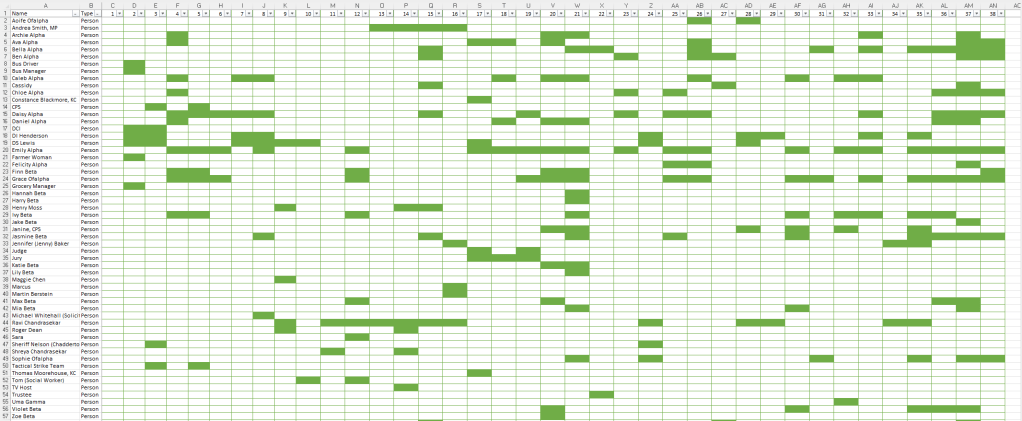
This also gives me the ability to track character arc and development, so I can focus on a particular character and tweak either of these aspects. Monitoring character voice is another plus.

I can also count in how many chapters a character appears. In this case, Emily and her daughter, Grace, are two primary characters. It doesn’t tell all the story because, for example, Daisy is in a few chapters and impacts the story, but she’s less important than Ravi, who’s in fewer chapters.

Ben is barely hanging on in yellow, but he is a key character. To be honest, I didn’t even catalogue some single-chapter characters after a while because I knew they wouldn’t be making a return, and they had no unique character arc or voice.

I also track settings, but this is not captured here.

I have a first draft of a cover. I expect to be sharing it here soon. I’m considering an 8″ x 6″ form factor, but that’s not set in stone.

What do you do to help to organise your larger works, anything?

1st Draft Chapters

My first draft of Hemo Sapiens: Awakening is almost finished. Below is a screenshot of my Word document with the navigation panel open to show the chapters, sections, and working titles.

The content from Chapter 5 (with tweaks) was taken from my short story, The Unidentified, published here, so it’s not spoiler to share. Funny enough, I just notices an error in my screenshot. Emily’s daughter Grace is almost five*, so I’ve amended that in my draft.

For those wondering, I maintain a spreadsheet with the birthdates and ages of all of the characters, so I can age-progress them appropriately. And there are certain maturity stages that occur around a certain age, for example, when their fangs come in. Just turning five, Grace won’t have fangs yet.

At this point, I’ve got 250 pages and 37 chapters. I deleted over 1,000 more words today—from 57,641 to 56,616—, but I expect to remain over 50k.

I also started working on the title and subtitle artwork, which I’ll share when I’m done with it. As I already know the title and subtitle of my next book, which is at least 60% done (🤞) in its own right, I am making sure the Hemo Sapiens title art leves space to nestle in the subtitle.

I’m getting excited, but the finish line is still a ways away. I think I’ve reached a major milestone in completing the first draft—99.999%, I feel. I still need to work on the cover art and layout and lining up Beta readers.


* Grace is five in the short story, but she’s been demoted a few months in the novel.

Today, I Cried

To be fair, I’ve been a bit more emotional since I was hospitalised, and I’m occasionally moved by certain musical passages in minor keys, but I’ve never cried as I write.

I hope this translates to the reader. I feel that this ties back to a recent post on Conscious and Subconscious Writing. I was just writing in the Flow. I was nearing the end of the beat at the and of a scene in my nearly finished Hemo Sapiens: Awakening, and I wrote the last paragraphs through literal tears—not the metaphorical sort.

When I was finished, I asked the AI for it’s critique. I felt the section might feel too long and rambling, but Claude gave me this feedback”

Not at all – I don’t think this section felt too long or rambling! You brought nice closure on the media spotlight scenario by showing the attempted interview with the Hemo Sapiens family. I enjoyed seeing the ending play out.

I can’t wait to publish it. I don’t have an agent, so my plan is to self-publish and then seek a distributor. We’ll see how that works out. The prequel, Hemo Sapiens: Origins is already some 60% done, so it will follow behind relatively quickly.

As this is planned to be a series in a universe, I’ve commissioned a logo/graphic artist to render the title and subtitle, as I’ll be maintaining the same font and treatment for each book, amending just the subtitle.

Fingers crossed.

Psychology of Writing

I’ve put in some 42,000 words and counting into Hemo Sapiens, so I’ve taken a couple of days to step back and take a long view. I want to ensure I am keeping my original vision with integrity. A major motivator for me is to write a social commentary. I am a philosophical and psychological person, but I am not looking to come across like Dostoyevsky, one of my favourite writers. Besides, this is adult contemporary speculative fiction, not psychological literary fiction like Fyodor. I’m shooting more in the space of Margaret Atwood or Cormac McCarthy, at least thematically.

The working title is Hemo Sapiens: Awakening. I might amend the subtitle to Awakenings. Time will tell. The story is about the awakening of the hemo sapiens. I’m always refining, but here’s the general pitch:

Nearly a hundred strong, a family of genetically engineered clones confront harsh realities when discovered by a fearful outside world.

It’s a story of the construction of group and individual identities—going from no conception of identity to battling an imposed identity as outsiders to form one of their own; from no individuation to a semblance of personal identity.

I hope to pay homage to Erikson’s stages of identity formation and Kubler-Ross’s stages of dying. Kubler-Ross gets double duty, as I wish to personify characters with each of her stages: Denial, Anger, Bargaining, Depression, and Acceptance.

It will also serve as a critique against post-Enlightenment Modernism. Whilst I agree that change was necessary and inevitable at that time, the direction taken was not necessarily for the better. As a so-called Postmodern™, this is my default position. As Rousseau notes, promises of freedom abound, yet most remains enchained. Or in the lyrics of Mad Season’s River of Deceit,

My pain is self-chosen

Anyway, back to writing.

Client Confidentiality

Claude 2.1 was analysing my current project. I had just added a bridging section and asked for an evaluation. It returned three suggestions including this one:

Suggestions:
Steps could be taken to protect identities when analyzing client content.

This made no sense to me given the context, so I enquired: I don’t understand this statement: ‘Steps could be taken to protect identities when analyzing client content.’

Claude responded:

Protecting identities:
I should not have made this assumption. Please disregard this comment, as you have no obligation to anonymize names or details in your fictional narrative. I erred there.

What caused this? We’d been discussing and analysing this all evening. Sometimes Claude just goes off the reservation.

The World is Watching

I woke up today with a new pitch idea. It’s a thriller that resolves into a courtroom drama. Hear me out if you’re an acquisition editor or publisher. Any resemblance to persons or events living or dead is coincidental.

A rogue family wants a new home, but opts for home invasion, what with home prices, interest rates, and all. They invade an inhabited house and relegate the current residents to a corner in the dark and dingy basement.

One day, the detained family attempts to escape, but their plans are thwarted, and they are punished by having their meals withheld. In a last-ditch effort, the father runs up the stair and kills two of the children of the family keeping them captive.

As an act of retaliation, the dominant family kills the children of the captive family, but the authorities hear the gunfire and control the situation.

In the next chapters, the killers face judge and juries. I don’t want to spoil anything, so I’ll leave it here. In order to make the story relevant and accessible to modern audiences, I’ll make it topical: The invasive family will be Jewish and the invaded will be Palestinian. It may be too subtle, but I think some readers will catch on.

There’s my pitch. If you are connected to a publisher, please contact me, so we can talk details. Feel free to leave comments below. If you have any ideas about how the jury verdicts might fall, I’d love to see them.

40,000 Words and Counting

W00t! I’ve finally reached 40K words in my Hemo Sapiens: Awakening novel. This was a minimum word count, but I’ve still got more ideas to incorporate as well as some fat to trim. For now, it yields me some 164 pages*, a number that works for me.

This is a milestone I’ve been waiting for. I have almost 40K words for my Hemo Sapiens: Origins novel, but I put it on hold, opting to release this in media res before revealing the origin story.

If you’ve been following, Hemo Sapiens: Awakening is a compilation of 5 short stories coalesced with new content to bridge and provide continuity. Given the longer story form, I had to give some characters addition depth and a story arc that spanned the longer work. Time will tell if this was successful. I’m having fun.

Anyway, back to the writing mines. Need to excavate some more material.


* 164 pages in an 8″ x 6″ form factor. Vertical spacing for chapters has not yet been accomplished, but I am not interested in how far I can pad it.

Subtractive Editing

Sometimes less is more. So, I’ve just lost about a thousand words in my Hemo Sapiens story. Cutting the fat to retain the lean.

As difficult as it is to kill off that which you’ve spawned is difficult. It’s even harder when you are trying to reach a word-count goal. I’ve gone from about 32,500 to 31,500 in a day, on my way to 40,000+.

I’ll get there. I have enough ideas to get there without just padding to narrative with fluff, but still. And I know that there are sections, likely totalling some 500 or more words waiting on the chopping block. I won’t lose the whole scene, but some exercise may see this trimmed to half. I’m putting this off. No need to drop some 1,500 words overnight. We’ll see. This scene may get a reprieve.

Revisioning is not just proofreading and copyediting. It’s a chance to reimagine.

And this is just my first draft. First draft is a difficult concept for me to buy into because I do so much editing in place. The story’s not even finished, and I am making wholesale changes. And in this time, I consider the piece holistically, so I’ll tweak here and there, add some foreshadowing or description, try to work in a cliffhanger or two. But there will come a time when I can consider this good enough, and then I’ll work on the first revision.

I like the word revision. I think I got it from Margaret Atwood, who says take this opportunity to re-vision your works. Revisioning is not just proofreading and copyediting. It’s a chance to reimagine. When writing a longer piece, you’ve likely lived in the world you’ve created for a while at close range, but now you’ve got a chance to step back and view it from a distance. Take some time off and revisit with fresh eyes.

Restructuring with GenAI

I’ve been working with Claude to help structure my Hemo Sapiens novel. Essentially, I am asking for advice about logically grouping and naming chapters. This was my first mistake.

Firstly, I asked the AI to ignore my chapters and headings and to tell me what it suggested. It took about ninety per cent from me and offered me different chapter titles about half the time. In one case, it offered my two titles for the same chapter. Secondly, it re9organised some of my chapters—and no, it would not work sequenced as suggested. File this under ‘Order Matters’.

I made most of the changes and asked it to review it again and make more suggestions, if appropriate. I also noted that the chapters it suggested were of wildly different lengths—some as short as a paragraph—, so I asked for consolidation tips.

Claude agreed with my assessment, so it recommended combining two short chapters, say, 1 and 9, together—and why not 7 and 13 while you’re at it. Let’s just say that Claude has no common sense.

I do like a lot of the advice Claude and ChatGPT gives, but you really have to be careful. I swear these guys have a severe psychotropic drugs problem when they’re offline, and it’s affecting their performance.