The AI Isn’t Coming for Your Manuscript, Karen

2–4 minutes

And neither is that editor you refused to hire.

Too many people don’t understand how generative AI works. Not civilians. Not your mum. Not even your dog (though he’s probably got better instincts about plot pacing than half of #WritingCommunity). No, the truly confused are writers. Authors. Editors. The ink-stained guardians of literary virtue who see AI and scream, “Plagiarism!” before they even read the terms of service.

Audio: NotebookLM podcast on this topic.

I posted a question on a Reddit forum for Fiction Writing—because I’m a glutton for punishment—and within seconds, the doomsday chorus began. “Don’t share your work with AI!” they cried. “It will steal your ideas!” As if ChatGPT is some sentient literary magpie with a fetish for your rough draft.

Another chimed in: “They’ll use your words to train future models!” Yes, Brenda, because your glacially paced fantasy epic with twelve warring kingdoms and three prologues is the key to cracking AGI.

Let’s set the record straight. This is not how AI works. Models are trained, and then they’re deployed. That’s it. Done. Finished. They’re not learning from your prompts any more than your toaster is evolving every time you burn the crumpets. The AI doesn’t remember you. It doesn’t save your work to some secret vault labelled “Possible Booker Prize Winners—Do Not Delete.”

Unless you deliberately cache content into a persistent memory—and you’ll know, because the interface reminds you like an overzealous librarian—it’s gone. The machine forgets. Your precious prose vanishes into the void, right alongside your childhood dreams of being discovered at Starbucks by a passing Penguin editor.

But what this really exposes is a deeper, older neurosis: the idea that someone—AI, human, interdimensional elf—is going to steal your genius. And you’ll be left penniless while they ride your glittering words all the way to a Netflix deal.

This is why some of these folks won’t share their work with editors either. Or beta readers. Or critique partners. Because someone might steal it. As if the entire industry is just waiting to snatch up your unproofed, comma-spliced debut and slap a different name on the cover. The paranoia is delicious. Also tragic.

Here’s the thing: no one is stealing your manuscript. Mainly because no one wants it. Yet.

You know who does get their work stolen? People who publish. People whose work is finished, polished, and out in the world. And even then, it’s usually pirated by some bot-run content farm in Indonesia, not secretly optioned by HBO.

Meanwhile, you’re clutching your WIP like it’s the Dead Sea Scrolls. You won’t let AI see it. You won’t let an editor see it. You won’t even let your cat walk across the keyboard while it’s open. And so, it rots. In obscurity. Like 99% of manuscripts that die not from theft but from neglect.

Look, I’ve been around since Wave 3 of AI. Back in the ‘90s, we called them “expert systems,” which is just a fancy way of saying “spreadsheet with delusions of grandeur.” They weren’t intelligent. Neither are today’s models, frankly. But we gave them a sexier name and suddenly everyone’s worried they’re going to replace Shakespeare.

Newsflash: AI isn’t going to write your book. But it might help you finish it—if you’d just stop screaming and let the damn thing look at a paragraph.

In short: AI is not your enemy. Editors are not out to get you. And the only person likely to sabotage your novel… is you.


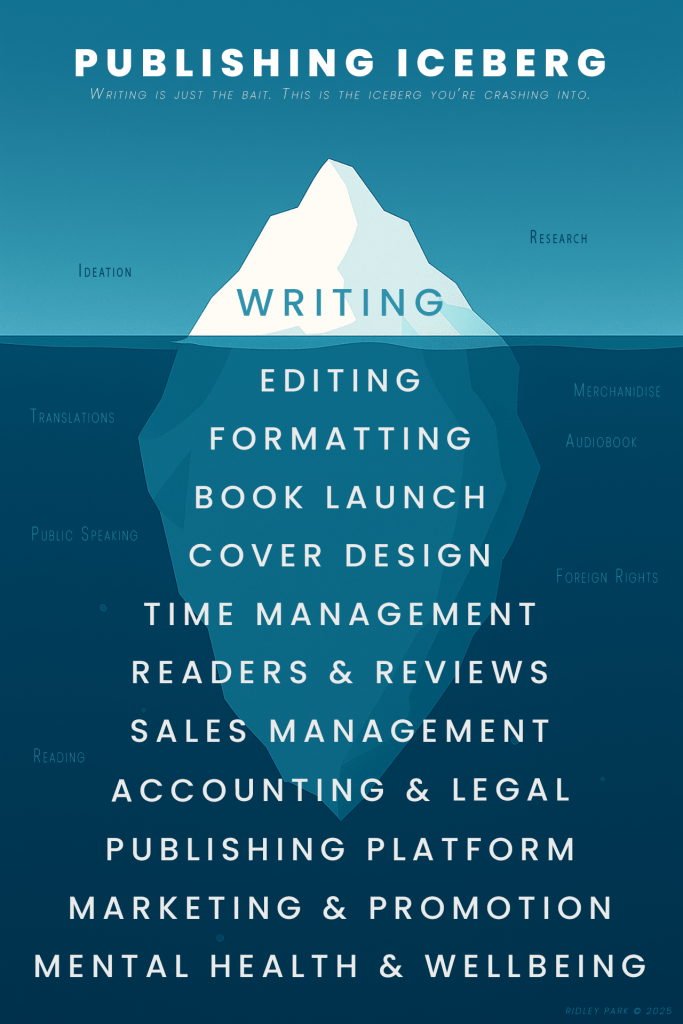
Writing is Just the Tip of the Iceberg

I hate to be the bearer of bad news – especially if you’re still slogging through a draft of your first manuscript. You know what some people say about writing a book is the hard part.

Lies. Damned lies. That’s the frothy, twinkly nonsense parroted by people who’ve never published anything beyond a social media post, probably only a comment.

Audio: NotebookLM podcast on this topic.

Let me tell you the truth. The actual, bloodstained, coffee-fuelled truth:

Writing the book is the easy part.

It’s the visible tip of the iceberg, smugly floating above the surface, soaking up the praise and admiration. Meanwhile, everything else – the sleepless nights, the decimal-point royalty statements, the unpaid invoices to your own soul – is lurking beneath, waiting to sink your mental health like the HMS Delusion.

So here it is, for posterity and pity:

Post-Writing Gauntlet: The Real Job Begins

1. Editing (Five Times, If You’re Lucky)

  • Developmental editing – “Is your plot a plot or a pile of wet spaghetti?”
  • Line editing – Making your sentences less embarrassing.
  • Copyediting – Catching your consistent misuse of ‘affect’ and ‘effect’.
  • Proofreading – The last defence against the typo apocalypse.
  • Beta feedback – Friends who suddenly vanish when asked to read a draft.

2. Formatting and Typesetting

  • Print vs digital layouts. Word crimes meet paragraph crimes.
  • EPUBs that break for fun.
  • That one widow on page 243 you didn’t notice until the proof copy arrived.

3. Cover Design

  • DIY, Fiverr roulette, or mortgage your cat to hire a professional.
  • Matching tone, genre conventions, and market expectations.
  • Spelling your own name correctly. (Don’t laugh, it happens.)

4. ISBNs and Metadata Hell

  • ISBN purchases (if you’re not relying on Amazon’s identifiers).
  • Title, subtitle, BISAC categories, keywords, blurbs, author bio — all rewritten seventeen times.

5. Publishing Platform Setup

  • Kindle Direct Publishing, IngramSpark, Kobo, Draft2Digital, Smashwords — pick your poison.
  • Print proofs, bleed settings, trim sizes, the baffling difference between matte and gloss.

6. Marketing (a.k.a. Screaming Into the Void)

  • Author website & blog (SEO: your new religion).
  • Social media presence — the façade of charm over existential dread.
  • Newsletter with a totally non-spammy freebie opt-in.
  • Ads: Amazon, Facebook, Instagram, Google. Burn money to test the water temperature.

7. Book Launch

  • ARCs, blog tours, launch events, or at least pretending you’re doing those things.
  • Coordinating reviews before anyone has read the damn thing.
  • Press kits and media outreach — basically shouting “LOOK AT ME” with tact.

8. Ongoing Sales Maintenance

  • Price promos, countdown deals, boxed sets, bundling — keep flogging the corpse.
  • Monitoring sales dashboards like a Victorian ghost watches the wallpaper peel.
  • Adjusting metadata because one reviewer didn’t understand it was satire.

9. Audiobook Production (If You Hate Money)

  • Narrator auditions, contracts, studio time.
  • Alternatively, read it yourself and discover your own voice is intolerable.
  • Or muddle through with an AI speech companion. Hullo, ElevenLabs.
  • Distribution through ACX or Findaway, both of which will pay you in dry leaves.

10. Accounting and Legal Fuss

  • Tracking royalties across platforms.
  • Filing taxes as an “author-publisher-entrepreneur-marketer-entity”.
  • Copyright registration, contracts, intellectual property trolls under the bridge.

11. Dealing With Readers

  • Responding to fan mail (both lovely and deranged).
  • Ignoring 1-star reviews that say “not what I expected, didn’t read it”.
  • Navigating book clubs who want a discount because they’re “doing you a favour”.

12. Mental Health and Motivation

  • Impostor syndrome, burnout, elation, despair — the writer’s buffet.
  • Rewriting your author bio weekly because you don’t know who you are anymore.

Optional Add-Ons (for masochists)

  • Translations and foreign rights – Because English isn’t the only language in which you can fail to sell books.
  • Merchandise – T-shirts nobody buys, mugs that mock your financial situation.
  • Public speaking / readings – Summon the courage to read your sex scenes aloud in a room of pensioners.
Image: Publishing iceberg poster in all its glory.

The Beta Reader Is Not Your Mum (Unless Your Mum Gets Postmodern Alienation and Narrative Decay)

Let’s get one thing straight: not all feedback is good feedback. In fact, a depressingly large proportion of it is the literary equivalent of asking a vegan to review your steakhouse. Technically they read the menu, but were they ever really your audience?

Audio: NotebookLM podcast on this topic.

We live in a culture that treats opinion like currency. Everyone’s got one. Everyone’s desperate to spend it. And nowhere is this more evident than in the world of beta reading—a supposedly sacred process in which brave authors hand over their embryonic manuscripts to friends, lovers, ex-wives, and total strangers in the desperate hope someone will “get it.” Most don’t.

Know Thy Manuscript (Before It’s Murdered by Committee)

Before you even think about soliciting feedback, ask yourself: do you actually know what your manuscript is? Is it a quiet literary allegory disguised as sci-fi? A philosophical middle finger wearing the trench coat of genre fiction? A slow-burn deconstruction of capitalism wrapped in alien gloop?

If you can’t answer that, neither can your beta reader. And you’ll deserve every clueless comment that comes slouching back across your inbox like a drunken tortoise.

Audience Matters. (No, Really.)

Let me put it in culinary terms for the metaphorically impaired: if someone hates seafood, they are not qualified to tell you whether your oysters are overcooked. They might be able to describe their gag reflex in exquisite detail, but that’s not useful culinary feedback—that’s autobiography.

Likewise, if your beta reader consumes nothing but cosy mysteries and thinks House of Leaves was “a bit confusing,” why in the name of Borges are you handing them your experimental novella about time, recursion, and the semiotics of grief?

I Know a Writer. I Know Your Pain.

A personal note, if I may. A close friend is a writer. A good one, in fact. But our ideas are so philosophically incompatible that they could be placed on opposite ends of a Möbius strip. Every time they read my work, they suggest alterations that, while technically well-formed, have the uncanny knack of annihilating the entire point of the piece. When I respond, “That’s a great idea—why don’t you write it?” they get cross.

Because here’s the truth: most beta readers don’t give you feedback on your book. They give you notes on the book they wish you’d written.

Signal vs Noise: Spotting the Useful Reader

There’s a simple test I use to distinguish signal from noise.

Bad beta feedback:

“I didn’t like the main character.”
“Why don’t they just call the police?”
“This story would be better with a love triangle.”

Good beta feedback:

“The way you structured the timeline echoes the narrator’s fragmentation—was that deliberate?”
“I wasn’t confused until Chapter 5, which made the earlier ambiguity retroactively frustrating.”
“The tonal shift on page 42 feels earned but abrupt—was that intentional?”

In short: good feedback interrogates execution. Bad feedback critiques intention.

The Beta Reader Interview (Yes, You Need One)

You wouldn’t hire a babysitter without asking if they’ve ever met a child. Why would you let someone babysit your manuscript without screening for genre literacy?

Ask them:

  • What do you normally read?
  • What do you hate reading?
  • Can you name a book you loved that nobody else seemed to?
  • Have you read [Insert book similar to yours]? Did you like it?

If they look at you blankly or start talking about Colleen Hoover, back away slowly.

The Beta Reader Zoo: Know Your Species

Here are a few common subspecies to watch for:

  • The Rewriter: Wants to turn your Kafkaesque nightmare into Eat, Pray, Love. Run.
  • The Literalist: “But how would that actually work in real life?” Mate, it’s a parable. About entropy.
  • The Cheerleader: “Loved it! Don’t change a thing!” (Translation: I skimmed it during Bake Off.)
  • The Cynic: Thinks everything is nihilistic, including your dedication page.
  • The Goldilocks: Rare. Reads the book you actually wrote, not the one they wish you had. Cultivate this one like a bonsai tree.

Curate, Don’t Crowdsource

Beta reading is not a democratic process. You are not running a focus group for toothpaste branding. You are searching for a handful of individuals who understand what you’re doing, why you’re doing it, and whether you’ve pulled it off—or fallen on your clever, post-structuralist arse.

Better three brilliant readers than thirty who think you should add a dragon in Chapter Two.

Final Thought

Your beta reader is not your editor. They’re not your therapist. And they’re definitely not your mum (unless your mum has an MA in critical theory and a fetish for broken narrative structures).

Choose wisely.

Or don’t – and enjoy reading thirty pages of feedback that begins, “I don’t usually read this sort of thing, but…”

PS: I love how Dall-E totally misfired on the cover image. lol