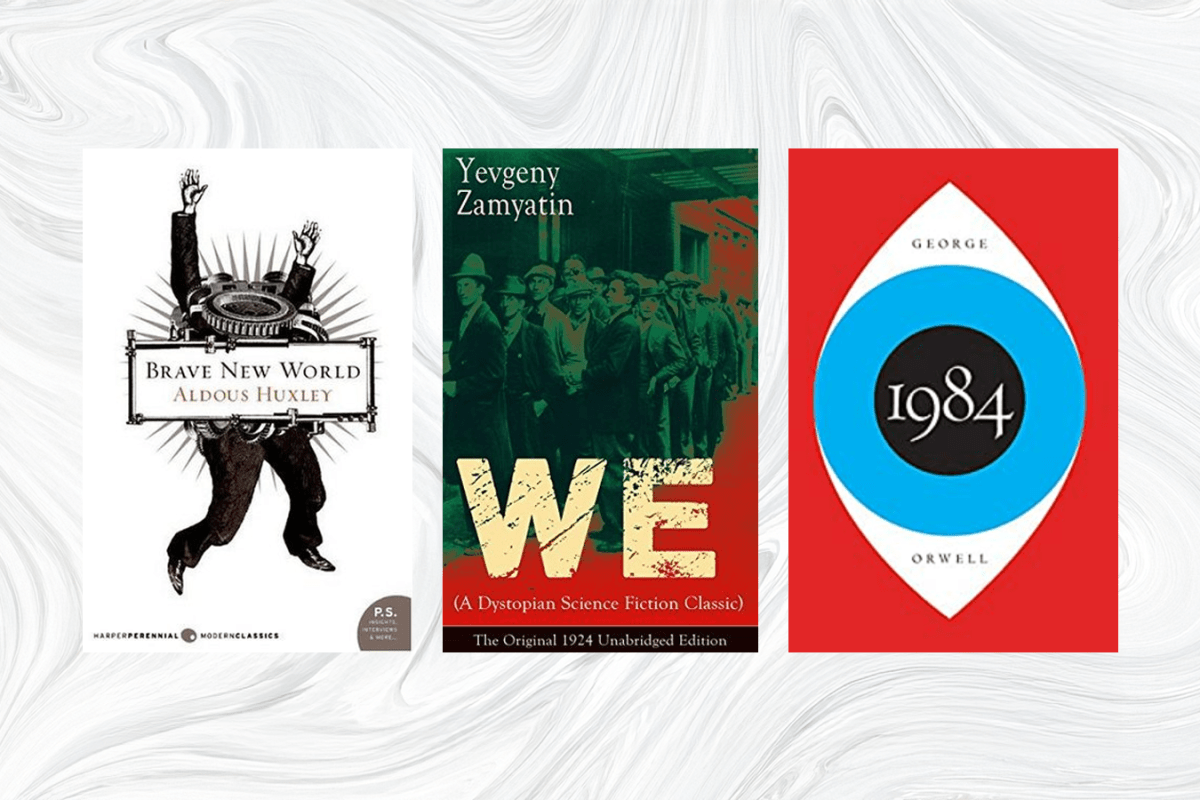
The Wrong Dystopias: Why ‘We’ May Be the Book for Now

2–3 minutes

Every time the news cycle coughs up another surveillance scandal, someone posts an Orwell meme. When pharmaceutical companies peddle happy pills, a Huxley meme pops up. 1984 and Brave New World have become the twin saints of dystopian shorthand, invoked as lazily as “Kafkaesque” or “Orwellian” whenever someone feels spooked by authority.

And yet, these two canonical nightmares don’t quite capture the mess we’re in. Our world is less Orwell’s boot stamping on a face, less Huxley’s soma lullaby, and more Zamyatin’s forgotten gem: We.

Audio: NotebookLM podcast on this topic.

NB: As my regular readers may know, I am an author and a philosopher. I decided to post this here – being about books – but from a philosophical perspective.

1984: The Boot and the Telescreen

Orwell’s vision of perpetual war, Newspeak, and state terror is always good for a scare. Yes, we have endless surveillance, but here’s the trick: nobody had to force us. We carry the telescreens in our pockets and call them iPhones. We gleefully sell our data for dopamine pellets disguised as “likes.” The Ministry of Truth hasn’t so much rewritten history as buried it under an avalanche of memes, cat videos, and outrage cycles. Orwell’s nightmare had to be imposed. Ours is volunteered.

Brave New World: The Soma Holiday

Huxley saw a culture distracted into oblivion – sex, drugs, and feelies. It resonates because the entertainment-industrial complex has outpaced even his imagination. We live in a time when attention spans collapse under TikTok’s weight, when “self-care” is code for medicated oblivion, and when consumption doubles as identity. But Huxley underestimated how much suffering we’d tolerate alongside our pleasures. His world was too tidy. Ours is messy: opioids meet social media, Prozac meets precarity.

We: The Transparent Cage

Here’s where Zamyatin earns his eerie prescience. Written in 1921, We imagines a society of glass walls, total transparency, and algorithmic order. People don’t need to be beaten into compliance; they celebrate their own reduction to predictable ciphers. Privacy is seen as deviance. Sound familiar? From fitness trackers to mood apps to your browsing history, we’re already busy quantifying ourselves into oblivion. Where Orwell needed torture and Huxley needed narcotics, Zamyatin needed only maths and consent.

Why We Now?

Because it shows the nightmare where people joyfully give themselves away. That’s not speculative fiction anymore; it’s our social contract with Big Tech, with influencer culture, with the dopamine economy. We don’t need Ministries or Somas when we’ve willingly built the glass house and handed over the keys.

So next time someone posts that Orwell vs Huxley meme, hand them Zamyatin. He may not have the brand recognition, but he has the sharper scalpel. And if you haven’t cracked We yet, do it soon – before it stops feeling like a novel and starts reading like user documentation.

Focus Matters

This is as much a reminder for me as a PSA. Time is the most limited resource you’ve got.

Consider your goals, and plan accordingly. Not everyone has concrete goals. As writers, we likely do. Finish that sentence, that page, that chapter, that draft, those edits, that book…

There’s social media – that’s this place – video games, partying, family and mates, eating and sleeping. Whatevs.

And don’t forget to take care of your mental health.

You may have many goals – or just one or two. Consider opportunity costs.

This blog post is distracting me from my editing. Still, I want to share. maybe it will help you.

Perspective is key.

Define your goals. Prioritise them. Make it happen.

Go away now!

White Rooms and Inventory Lists

I’m a writer, but not without challenges. Some writers have Writer’s Block™ and others don’t seem to understand grammar or structure. Me? I’m easily bored of details – simply don’t care. Here’s the rub.

When I read/hear writing advice, it recommends not to leave your reader in a white room – and certainly not in many white rooms, rooms with no detail to anchor the reader, just free-floating characters. The cure to white rooms is not an inventory list.

She entered the room with him. There was a table, two chairs, a lamp, and a pelican.

This does little to obviate the empty room.

When I read description, it quickly turns into blah, blah, blah, blah, and my brain fast-forwards. One of the most egregious examples is the literary classic, Dorian Gray. At some point, Oscar Wilde paints the image of Dorian’s parlour – to a fault. I mean, I’m pretty sure he gets down to the details of fabric choices and thread counts. I may have gone on for three pages or three paragraphs or three sentences. In any case. I lost track when my eyes glazed over.

The stated purpose of description is to immerse your reader into your built world. I get it. What I want is for the description to be key to the plot or the character – or at least be metaphorical. Don’t get me wrong, some description is good and necessary:

She wears black because she’s sullen or edgy.

He has a scar on his face under his left heterochromatic eye because of that fateful accident.

Chekhov’s gun on the wall will be used to kill the marauding jungle bear.

And perhaps it conveys an atmosphere, a mood, or a terrain, But how much does it take to do so? It’s raining, she’s pouting, steep mountains and foul faeries. What else do I need to know?

To be fair, I know this is just me. Other people do want to get immersed and lost in the world. Perhaps I’m coming from my place as a musician. I want the readers to interpret the book and make it fit themselves. If I create Snow White, the reader who’s not a pale white female can grasp and even enjoy the story, but she can’t as easily be Snow White. I feel that this might have led Michael Jackson down the wrong path in his day.