The Dystopia Venn: Four Circles of Absolute Nonsense

2–3 minutes

This particular meme has been making the rounds like a drunk uncle at a wedding – loud, colourful, and convinced it’s profound. A Venn diagram, no less! Four big circles stuffed with dystopias, slapped together as if geometry itself conferred wisdom. Most of them are books, a few are films, and one – Gattaca – is glaring at me because I haven’t seen it. That omission alone feels like a character flaw. I might grit my teeth and watch it just to close the loop, though it doesn’t exactly scream, “Pour a glass of wine and enjoy.”

Image: Venn Diagram

Here’s the thing: as art, it’s rather lovely. As a piece of intellectual cartography? It’s rubbish. It pretends to classify but in fact it merely collages. Orwell is pressed up against Burgess, Atwood rubs shoulders with Logan’s bloody Run, and in the middle sits Animal Farm, as if pigs with clipboards are somehow the Rosetta Stone of dystopia.

And yet – if you squint just so, tilt your head like a dog hearing a harmonica, you can just about see some tenuous ligatures:

  • Surveillance and conditioning: 1984, Clockwork Orange, and The Matrix all insist that the human mind is clay to be moulded by boot, syringe, or simulation.
  • Reproduction and regulation: Brave New World, The Handmaid’s Tale, and yes, Gattaca (apparently) fret endlessly over who gets to breed, who gets culled, and whose DNA deserves a future.
  • Bodies as resource: Soylent Green, Brazil, Gattaca again – people ground down into spreadsheets, rations, or literal mince.
  • The veneer of civilisation: Lord of the Flies and Animal Farm showing us that civilisation is just papier-mâché over the swamp.

But let’s be honest: the diagram isn’t actually saying this. It’s just four intersecting blobs, with titles hurled in like darts at a pub quiz. The apparent “structure” is nothing more than meme-magic – order conjured out of chaos to make you nod gravely as you scroll by.

So yes: as art, it works. As a Venn diagram, it’s a travesty. And maybe that’s the deeper joke. We live in an age where every complexity gets crushed into an infographic, every horror squeezed into a digestible meme. Which, if you think about it, is itself a bit dystopian.

When Books and Films Complete Each Other

Fresh from my recent post on movies that are better than books, I now consider books and movies with symbiotic or synergistic energy – better together.

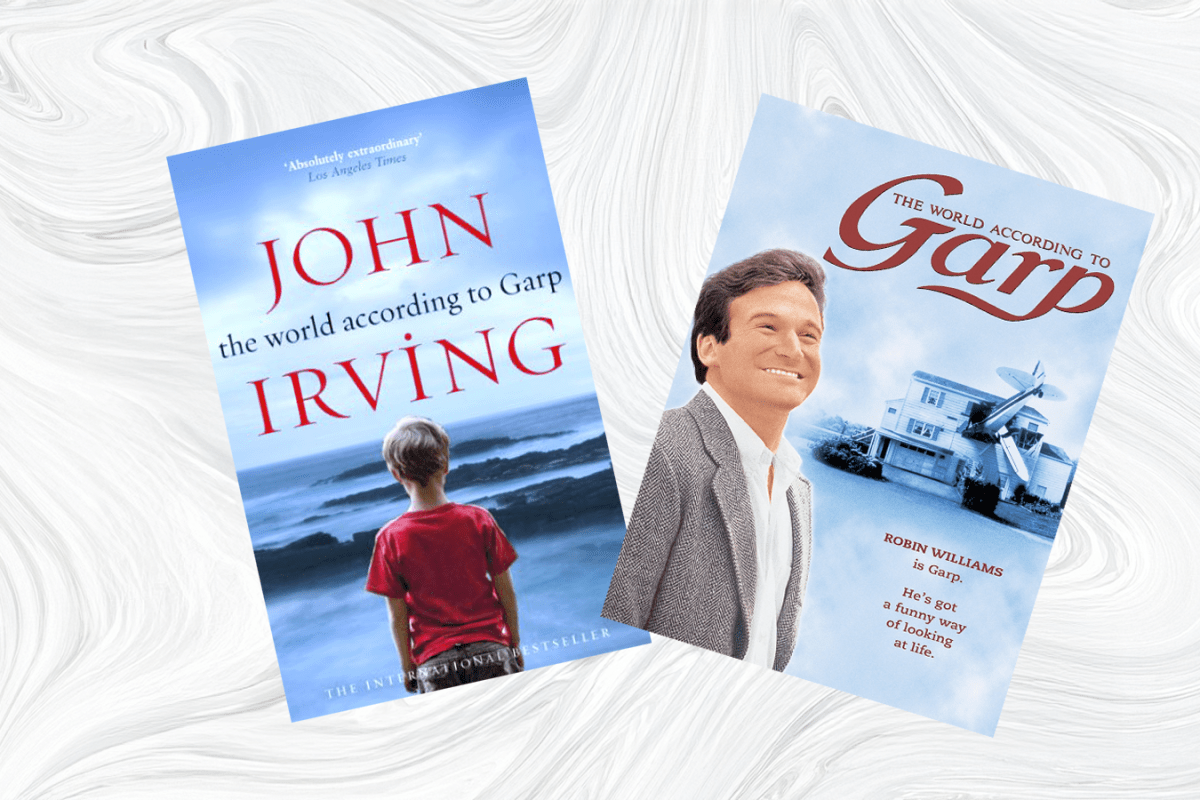
I first stumbled onto this realisation with The World According to Garp. Hearing that the film was about to be released, I bought the book; it was decent. I saw the movie when it came out; it was decent.

  • The book (John Irving, 1978) is sprawling, grotesque, and digressive, with moments of brilliance scattered through longueurs.
  • The film (1982), with Robin Williams and Glenn Close, trims away nuance for two hours of cinematic shorthand.
  • Alone, each feels middling. Together, they fill the gaps. The novel provides texture and detail; the film provides embodiment and immediacy. It’s like puzzle pieces snapping together.

We tend to frame it as a duel: book versus movie, page versus screen. One must be superior, the other a pale imitation. But occasionally, the two work in tandem, not rivals, but co-conspirators. Taken alone, each may be “just okay.” Together, they form a whole greater than their parts. Notice that the IMDB scores are lower for movies that are better than books, due to the synergistic effects.

Here are a few other book–film pairings that work this way:

The Remains of the Day (Book: 1989; Film: 1993)

Ishiguro’s novel is all repressed interiority; Hopkins and Thompson turn repression into visible ache. Read the words, then watch the faces.

Atonement (Book: 2001; Film: 2007)

McEwan’s metafictional games on the page feel cerebral. Wright’s film, with its Dunkirk tracking shot and that infamous green dress, floods the senses. Together they fuse thought and feeling.

Brokeback Mountain (Short story: 1997; Film: 2005)

Proulx’s prose is spare, devastating in its restraint. Ang Lee’s film opens the silences into landscape and longing. Neither feels whole without the other.

The English Patient (Book: 1992; Film: 1996)

Ondaatje’s novel is fragmentary and poetic, but elusive. Minghella’s film distils it into romantic tragedy. One gives the music, the other the melody.

Cloud Atlas (Book: 2004; Film: 2012)

Mitchell’s Russian-doll narratives dazzle but drag; the Wachowskis’ intercutting dazzles but confuses. Together they hint at the ambition neither medium alone quite nails.

I publicly confess that I didn’t really like either version of Cloud Atlas. A mate suggested I read the book ahead of the film. It was convoluted and mid. Ditto for the film, but for different reasons. I felt that the concept was nice; it simply didn’t translate. YMMV.

Lord of the Flies (Book: 1954; Film: 1963)

Golding’s allegory sometimes feels over-determined. Brook’s film, shot with actual boys descending into ferality, restores the anthropology behind the allegory.

Why Symbiosis Matters

When book and film complete one another, it challenges the false binary of better or worse. Sometimes, the text supplies what the film cannot: detail, psychology, interior voice. Sometimes the film supplies what the text cannot: embodiment, atmosphere, a world you can see.

Instead of competition, the relationship becomes conversation.

So perhaps the real question isn’t “Which is better?” but “Which needs the other to feel complete?”

What pairings have you found where book and film together elevate each other beyond what either could manage alone?