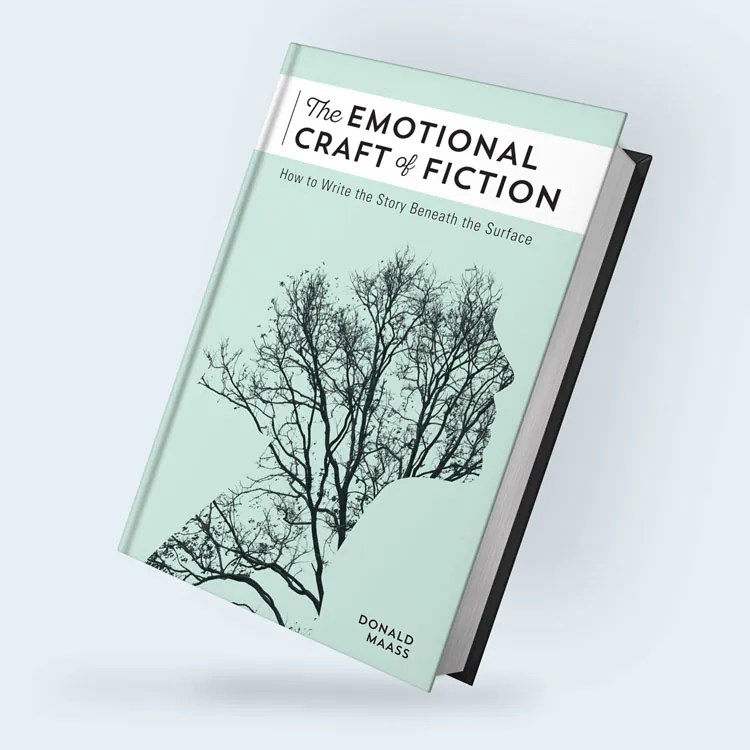
Book Review: The Emotional Craft of Fiction

Not Charlotte’s Web.

Instead, The Emotional Craft of Fiction: How to Write the Story Beneath the Surface by Donald Maass.

I just finished this book. I’ll say it’s good and even recommend it, but it’s not really for me. I wrote a blurb recently before I was even halfway through, and my opinion hasn’t changed.

Audio: NotebookLM podcast on this topic.

If you like to write in typical, character-driven stories, this should be right up your street. Besides character depth, the author also pushes moral righteousness. Thanks, but no thanks.

All of this said, I did gain some benefits from it, because although my writing is not heavily centred on characters, it does contain them, and I want them to feel alive. I want the world to feel lived in.

Personally, I think in schemes and threads – big ideas, deep ideas. Once all of this is roughly in place, I take a second pass for details. This is where Maass can help.

Full disclosure: Some people adopt a plotting approach to writing, whilst others adopt a pantser approach. I fall somewhere in between. Moreover, I might write something from one perspective and the next from the other – and I might flip-flop back and forth.

As a plotter, I might have waypoints that I want to hit, ideas I want to explore. Sometimes, I write these down on paper, in a spreadsheet, or somewhere to keep myself honest. Other times, I have these plot points in mind, but I take a stream-of-consciousness approach, simply discovering the story as it unfolds under my fingertips. I may even plot half a story and “pants” the rest of it. No telling.

As a pantser, I might have a kernel of an idea, and I just want to ideate on the page. So, I write. I lock myself in my room, throw up a “Do Not Disturb” sign, and head down to write until the well of ideas runs dry. At this point, I might put the idea aside or step back and consider plot points.

Looking back on this post, it’s not so much a book review at all. Apologies. That said, if you write characters and enjoy mainstream writing approaches, I think you’ll find the ideas in this book helpful. Many of the better ideas are presented early on, but it’s a short read. He offers some authors, titles, and excerpts you might find interesting. I found them to be a mixed bag.

Not a People Person

Person writing at a desh, on the wall behind him, scales of justice, drama masks, and a red heart

I Don’t Do People

I don’t write character-based fiction. I’m not a “people person” – not in the lived world, and certainly not on the page. I prefer people at arm’s length, ideally shrink-wrapped and on mute, where I can manage the terms of engagement.

Yes, my work features characters. I flesh them out just enough to spare readers the Ayn Rand experience, those one-dimensional ideological mannequins masquerading as protagonists. But character isn’t the centrepiece. I write to explore worldviews, metanarratives, and environmental interactions. I’m less interested in what a person feels and more in what their presence means within a broader system.

Audio: NotebookLM podcast of this topic.

Audible Irony

At the fitness centre (the irony isn’t lost on me), I listen to audiobooks. Today’s pick: The Emotional Craft of Fiction by Donald Maass. I’ve just cracked Chapter Four, and already I’ve panned a few glittering nuggets for future consideration.

That said, I found myself wondering: why am I even listening to a book so obsessed with the deep inner life of characters?

Simple. Because it’s still useful – even if I only dose it homeopathically. Just because I don’t write bleeding-heart confessions doesn’t mean I can’t exploit emotional undercurrents when it serves a structural or rhetorical purpose.

Character, Morality, and My Problem with Haidt

One section rubbed me the wrong way: the bit about character morality. Maass references Jonathan Haidt’s work on moral psychology—yes, that Jonathan Haidt, patron saint of middlebrow centrism and moral-sentiment handwaving.

I’m familiar with Haidt. Not a fan. His notion of “moral elevation”—the idea that stories with virtuous themes inspire moral behaviour—strikes me as both quaint and quaintly manipulative. In a sense, I agree with him: morality is curated. But that’s where our Venn diagram becomes a shrug.

I’m a moral non-cognitivist. I won’t bore you here (though feel free to tumble down that rabbit hole over on my philosophical blog). In short, I don’t believe morals are objective truths handed down from Olympus or Enlightenment think-tanks. They’re socio-emotional artefacts – human constructs born from gut feelings, tempered by culture, and ossified into norms. Different contexts yield different values. That’s why I delight in yanking characters out of time and place, disorienting them – and you – to expose just how contingent it all is.

So yes, I understand moral tropes. I even deploy them. But I do so to subvert them – not to reinforce a collective bedtime story about “goodness” or “redemption.” Those are the myths we tell ourselves to stay sane. I’m here to loosen your grip.