Story ideas come from everywhere. Sometimes from books, sometimes from overheard conversations, sometimes from the dubious cesspool of internet memes. The meme I saw claimed that male flatworms duel with their penises to determine which one gets saddled with pregnancy. Naturally, I thought: That’s a story seed if ever I’ve seen one. Biomimicry is also a viable source.
Of course, the meme was wrong. Flatworms aren’t male, or female. They’re simultaneous hermaphrodites – every worm is kitted out with sperm factories and egg sacs, with duelling penises to boot. When two meet, they fence. Whoever lands the stab injects sperm through the other’s skin (hypodermic insemination, to use the clinical term). The “winner” struts away as father, the “loser” absorbs the sperm, becomes mother, and carries the eggs. Sometimes both stab each other, and both walk away victorious fathers and reluctant mothers. Equality at last.
When a Meme Lies but the Story Survives
This is not genre fantasy, it’s zoology. No X or Y chromosomes, no fixed roles, just biology as a knife fight.
Writers, take note: this is why you don’t trust memes as science, but you do trust them as inspiration. The error – “male flatworms” – was pedestrian. The truth – all flatworms are both sexes all the time – is far more subversive. It blows up the binary and replaces it with a contest. Parenthood isn’t destiny, it’s a duel.
If I were to anthropomorphise this, I’d have the makings of a gladiator society: wounds as wombs, motherhood as punishment, fatherhood as prize. Not homoerotic vampire tropes, not vagina dentata horror – something stranger, sharper, harder to tame. A kind of Spartacus with gonads.
The point isn’t whether I’ll write it (probably not; worms don’t sell). The point is that even bad science can spark good fiction, provided you bother to check the details before running to press. Let the meme start the fire, let the facts shape the flame.
See Also (for the bookish wormhole explorer):
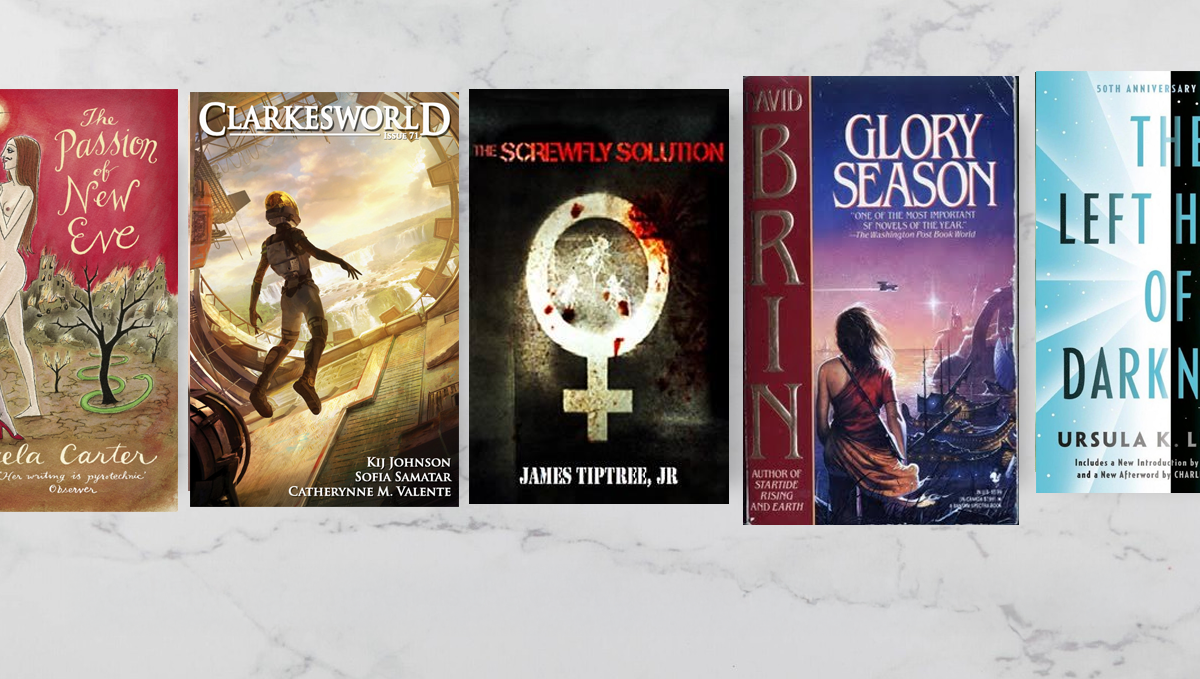
David Brin, Glory Season: speculative reproductive politics, society structured by cloning and sexual cycles.
Ursula K. Le Guin, The Left Hand of Darkness: androgynous Gethenians shifting between fatherhood and motherhood.
Kij Johnson, Mantis Wives (short story): erotic horror inspired by mantis cannibalism, equal parts Kama Sutra and war crime.
Angela Carter, The Passion of New Eve: grotesque gender-bending satire, bodies rewritten as battlegrounds.
James Tiptree Jr., The Screwfly Solution (short story): apocalyptic biology, where desire mutates into violence.
 Ridley Park