
I favour originality even at the expense of popularity or sales. I spent last week writing short stories and poems. I use AI for research, whereas in the “old days”, I’d have used a library. I research character traits and arcs, story forms, and whether a theme has been explored.
I employ AI in the editorial process, and even in “post-production”. I even use AI for some art concepts and components.
One thing I hadn’t tried until now is an AI service that purports to determine if a submission is AI. I tried several packages that offered a free trial. They seem to operate on a scale between human and AI authorship.
I first submitted a piece I was currently working on—a 6th-odd revision of a 5,000-word story in the form of a fairy tale. Unfortunately, trials were limited from a sentence to a few paragraphs—up to 5,000 characters.
This first submission was rated 100% AI—evidently, not a hint of humanity. This was disconcerting. I decided to dredge out a non-fiction book I shelved in 2020. Certainly before access to AI tools. This was rated 85% AI and 15% human. But it gets better—or worse, I suppose, depending on your perspective.
The book is on the immorality of private property from a philosophical vantage. The passages claimed to be AI were one-hundred per cent mine. What about the ones flagged as human, you might be asking? Those were a quote by fellow human John Locke from his Second Treatise of Government.
In Defence of Property
“God, who hath given the world to men in common, hath also given them reason to make use of it to the best advantage of life, and convenience. The earth, and all that is therein, is given to men for the support and comfort of their being. And though all the fruits it naturally produces, and beasts it feeds, belong to mankind in common, as they are produced by the spontaneous hand of Nature; and no body has originally a private dominion, exclusive of the rest of mankind, in any of them, as they are thus in their natural state: Yet being given for the use of life, there must of necessity be a means to appropriate them some way or other before they can be of any use, or at all beneficial, to any particular men.”
ᅳ John Locke, Second Treatise of Government
Returning to the AI side, what sentences were flagged as the “Top Sentences driving AI probability”? I’m glad you asked.
- The Catholic Church also played a significant role in shaping private property rights in the Middle Ages.
- In ancient China, the concept of private property was more limited, as land was owned by the state and was leased to individuals for use.
- However, there is evidence to suggest that private property ownership has existed in some form in many ancient civilisations.
- Although it’s difficult to trace the precise history of private property ownership before ancient Greece, the concept of private property has evolved over time and has varied widely among different societies.
- It regulated the transfer of property and established rules for inheritance.
So these ordinary sentences written 5 or more years ago are flagged as AI.
The US Constitution
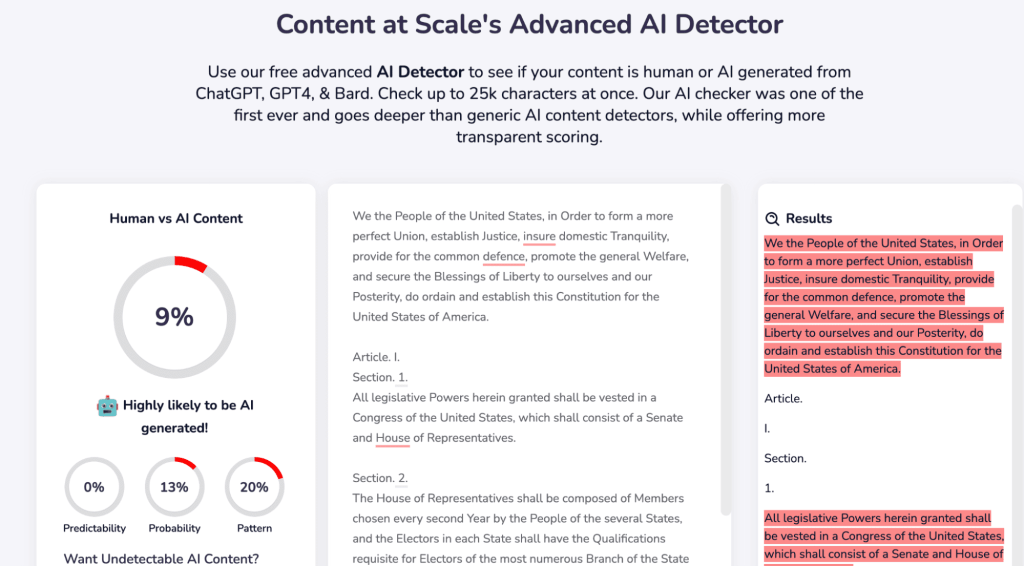
On a site I found to understand what parameters AI considers, I found this example—the Constitution of the United States of America was flagged as having AI content. I knew those geezers were ahead of their time, but I didn’t realise how far. This is even more amazing when one considers that electricity hadn’t even yet been invented.
But Why?
AI looks for statistically probable patterns. This translates into any content written with proper grammar and diverse word choice. In practice—the habits of a decent writer.
I’m not going to belabour this issue, but I want to raise a big red flag.
To complicate matters more, they have AI applications that promise to un-AI your AI. So there’s that.
 Ridley Park