In Hemo Sapiens: Origin, I am mixing French and English dialogues and tags. The challenge I am having is switch between the languages.
For example, see this passage:
« Où est maman ? » Camille asks Claire just as her parents come into view. « Maman » she exclaims, starting to weep again. « Papa. » She receives his hug.
French and English dialogue and speech markers work differently. I I were depicting large swathes of each language, I’d simply apply the specific language rules, but I am mixing it up, and that creates challenges. I haven’t seen any good examples how to present this.
Some obvious differences are the guillemets « » in French versus ‘ ‘ in English. In French, ? and ! are spaced after the sentence, and all content internal to guillemets is offset by leading and terminal spaces. Another big difference is that guillemets offset dialogue blocks whereas English uses speech marks to identify each speaker’s dialogue.
Referencing the example above—in English for English readers—, if I were to convey the content using French presentation rules, it might look something like this:
« Where’s mum ? Camille asks Claire just as her parents come into view.
— Mum, she exclaims, starting to weep again.
— Dad. She receives his hug. »
Notice that the entire block is enquoted. I’ve considered this, but I feel it will not track well for English readers, who are used to the speaker-reference convention.
Also, I really want to set off the French language content, and the guillemets serve that function.
Regarding dialogue, French and English punctuation rules are similar enough, but there aren’t many cases of a comma (virgule) following a speech mark given the convention. To my eyes, it looks better inside the marks, but it feels off. The Oxford English style guide suggests not even using commas to separate the dialogue from the tag, but I don’t see that much in the wild.
Again, referencing the example above, one can see how I am solving this at the moment.
At first, I indicate the French dialogue by guillemets and employ French punctuation rules followed by a dialogue tag and descriptive content.
« Où est maman ? » Camille asks Claire just as her parents come into view.
Next, I use the English format, but I replace quotation marks with guillemets. I’ve omitted the trailing comma—after ‘Maman’—in this example.
« Maman » she exclaims, starting to weep again.
Finally, since ‘Papa’ expresses a complete thought, I enclose the full stop within the guillemets. Rather than a dialogue tag, I opt for a stand-alone sentence.
« Papa. » She receives his hug.
When I write mixed language copy, I usually identify a foreign language in italics, but I didn’t choose to do this for French dialogue. Firstly, because I am already using italics for other foreign words, e.g. Latin; secondly, because these also depict internal dialogue/monologue, so I don’t want to create too many visual design patterns.
Has anyone else solved this problem? I’d love to know.
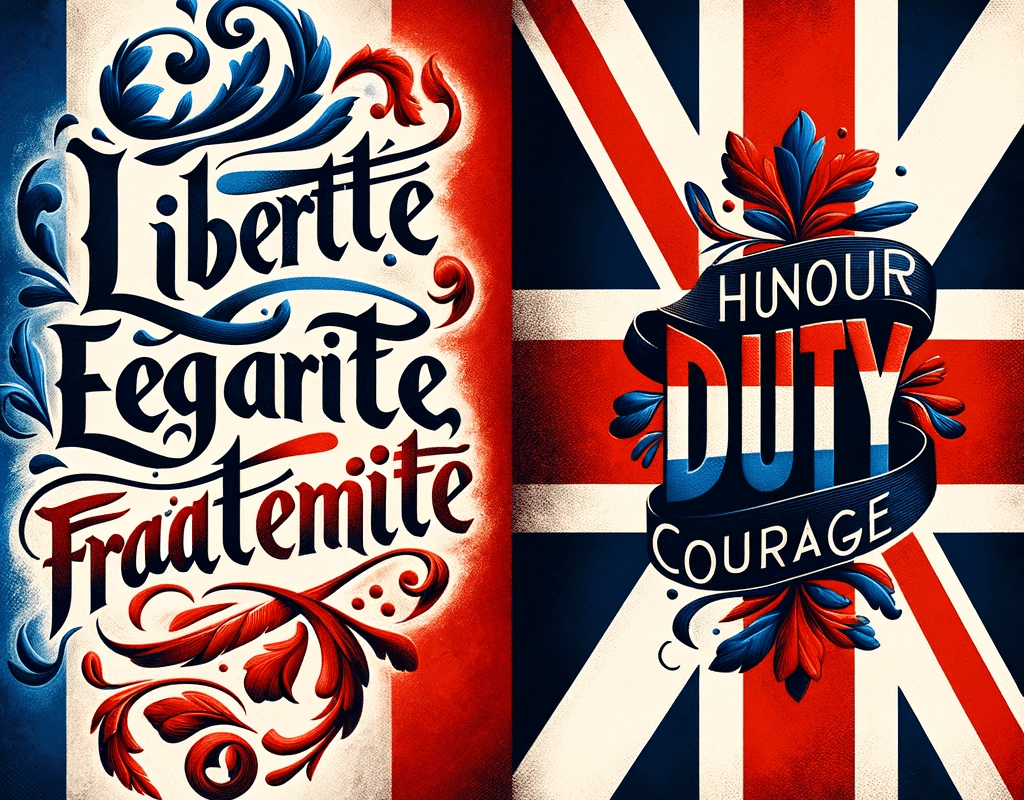
As for the cover image, Dall-E 3 still can’t quite figure out words and can’t spell in French or English. I share it if only for the absurdity of it. Here was my other choice:

 Ridley Park